5 Best Portable Mini-Projectors (original) (raw)
We found the best options for impromptu movie or gaming nights indoors or out.

By ,a senior writer at the Strategist covering appliances and men's style. He was formerly a deputy editor at Wirecutter.
Photo: Marcus McDonald
- Best overall
- Best less expensive
- Best even less expensive (no battery)
- Best for outdoors
- Best for replacing a TV
Using a good portable projector can feel like magic. With built-in speakers, self-focusing technology, and built-in streaming apps, the best of these battery-powered devices can create a large vibrant screen out of any flat light-colored surface at the push of a button.
While pocketable projectors from unfamiliar brands are easy to find on popular online marketplaces, these cheap options are rarely bright enough to be used anywhere but the darkest of rooms — sufficient for kids streaming YouTube videos past bedtime but disappointing for most other scenarios. While established projector manufacturers (such as Epson, LG, and BenQ) have good options worth considering, the best values come from newer brands specializing in portable projection, such as XGIMI and Nebula (a sub-brand of Anker). Whether you’re looking to replace your TV, host a rooftop movie series, or are just looking for a quick way to create a screen on the go, I’ve researched and tested the best options around to find picks to suit your specific needs.
Updated on July 17, 2025
I rewrote this guide with new testing and all-new picks. The XGIMI Halo+ GTV is our new best overall pick, and we have a less expensive favorite as well as recommendations for outdoor use and replacing a TV.
New! You can now save this product for later.
New! You can now save this product for later.
New! You can now save this product for later.
Clockwise from left: XGIMI Halo+ (New), XGIMI MoGo 4, Nebula Mars 3.Photo: Michael Zhao
More brightness means better visibility in a wider variety of lighting conditions, and the closest apples-to-apples comparison between various models from different brands is lumens, measured according to ANSI or ISO standards — two slightly different methodologies that yield roughly comparable results. A decent home-theater projector mounted to a ceiling or wall bracket will have no fewer than 2,000 lumens, but even the brightest portable projectors max out around 1,000 lumens. This is bright enough to provide a usable image in the presence of ambient-light sources, such as a table lamp or the afternoon sun filtering through drawn curtains or shades. Projectors in the 400 to 600 lumen range will look fine with a lamp on in the next room over but will struggle against a lamp in the same room. Projectors with fewer than 400 lumens look good only in a completely darkened environment. Even though the vast majority of portable projectors falls under this latter category, I do not recommend them because you will inevitably be disappointed.
Most projectors come with software that allows you to download and use streaming apps without needing to plug in an additional streaming device (like a Roku Stick or Google TV dongle). The best ones use Google TV, which supports all the major services and is easy to set up using any kind of smartphone. However, most rely on Android TV. This looks and feels a lot like Google TV but does not support the Netflix app and has a more onerous setup process if you don’t have an Android phone.
Portable projectors without built-in streaming are increasingly hard to find, but this is for the better. While it’s possible to plug in your own streaming dongle — such as a Roku Stick or Google Chromecast — this uses additional power and needlessly adds to the complexity of the setup considering the plethora of all-in-one options.
Depending on your needs, you may need a projector just small enough to fit in a carry-on to accompany you on work trips, or you may need something smaller to toss in your bag for a weekend camping trip. Some projectors pack a decent image into a tiny package — a few can fit in the palm of your hand — but you’ll trade brightness, battery life, and screen size for that portability. If you’re willing to lug around a projector with a slightly larger footprint, you’ll get a better and brighter image, and it will last longer on a single charge when you’re away from an outlet.
Most portable projectors have a built-in battery that lasts at least two hours on eco mode (reduced brightness). Those that offer more are better for camping, tailgating, and other off-grid uses.
Some newer models utilize a USB-C power supply, allowing them to be powered by most laptop chargers and some USB battery packs. Most still use an AC adapter.
Most mini-projectors can automatically adjust focus and keystone, which virtually adjusts the projected screen to appear more rectangular even if it looks oblong at first. Some are better than others, however. A good auto-keystone will find a square image within a few seconds, while a less good one may take a bit longer and require some fine-tuning after the fact.
While all mini-projectors have tripod mounts — some even come with tripods — a built-in stand is more convenient, especially if it rotates and tilts. Being able to find a square projection angle will always yield better results than virtually correcting the keystone (this uses up resolution that would otherwise be part of the projected image).
As of now, 1080p projectors still offer the best combination of performance and resolution, especially with portable projectors. 4K portable projectors exist, but they sacrifice contrast and color accuracy to cram all those pixels into a portable package and they cost more than better-performing 1080p projectors. Beware of projectors under $1,000 advertising “4K support” because all this means is that it can read a 4K signal even if it can’t project at 4K. There are also some lower-resolution 720p options on the more affordable end, but at this resolution, text and imagery appear noticeably blurry if you project an image much larger than 50 inches across. It’s also basically useless for spreadsheets, if you’re ever using it for meetings.
If you plan on moving the projector around with any frequency, anything larger than a tissue box or weighing more than four pounds will be prohibitively clunky. But some larger projectors come with features (such as extended battery life or water resistance) that make up for their heft.
Want to be emailed about sales and other updates to your saved products? Success! You'll get an email when something you've saved goes on sale.
Yes
New! You can now save this product for later.
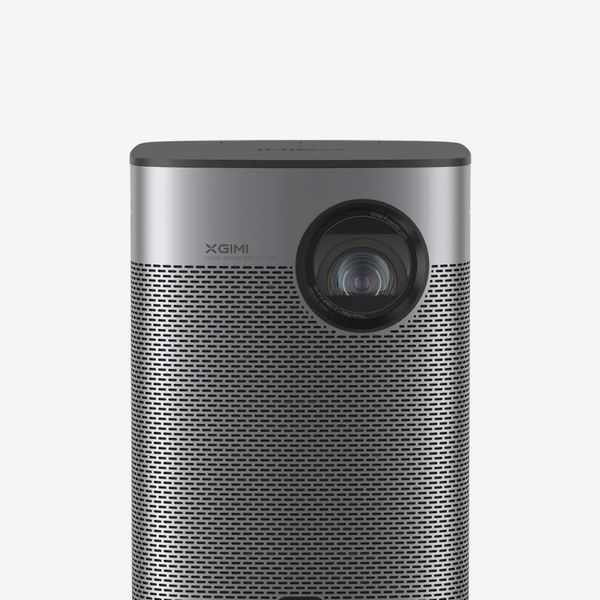
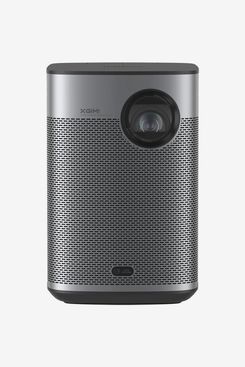
Brightness: 700 ISO lumens | Streaming OS: Google TV | Battery life: 2.5 hours | Power source: AC adapter | Auto adjustments: Keystone, focus | Built-in stand: Nonadjustable | Resolution: 1080p | Size: 5.71” L x 6.75” W x 4.47” H, 3.5 pounds
After testing all the best options, I chose the XGIMI Halo+ as my top pick for portable projector because it combines class-leading excellent image quality with decent portability yet looks elegant enough to live permanently on a coffee table. At 3.5 pounds and about the size of a tissue cube, it’s easy to bring almost anywhere you need a screen. Colors appear accurate and cinematic without requiring any adjustments out of the box, and its 700 ISO lumens of brightness are sufficient to make it usable indoors during daylight hours with the curtains drawn or outside in the evening. Two and a half hours of rechargeable battery life and decent built-in speakers let you use it almost anywhere. And because it runs Google TV, it supports all major streaming platforms — including Netflix — and will receive regular firmware updates. (If you don’t use Netflix and don’t mind a slightly quirkier setup process, the older version is available with Android TV for about $100 less.)
The few downsides of the Halo+ reveal themselves only in head-to-head comparisons with top competitors. Its built-in Harman Kardon speakers sound a touch thinner than those of others I tested, but you can pair it with any Bluetooth speaker or soundbar of your choosing. While it does have a built-in stand that folds into the bottom, it’s either fully out or not out at all (though you can add an adjustable one if you want), and its lack of USB-C charging feels like a missed opportunity considering similar XGIMI models offer this feature. Finally, while its fan is pretty quiet overall, it was the loudest among the models I tested. It was still the most well-rounded portable projector I tried, however, because it’s both powerful and portable enough to meet expectations under all the typical circumstances you would plan on using it in.
Want to be emailed about sales and other updates to your saved products? Success! You'll get an email when something you've saved goes on sale.
Yes
New! You can now save this product for later.
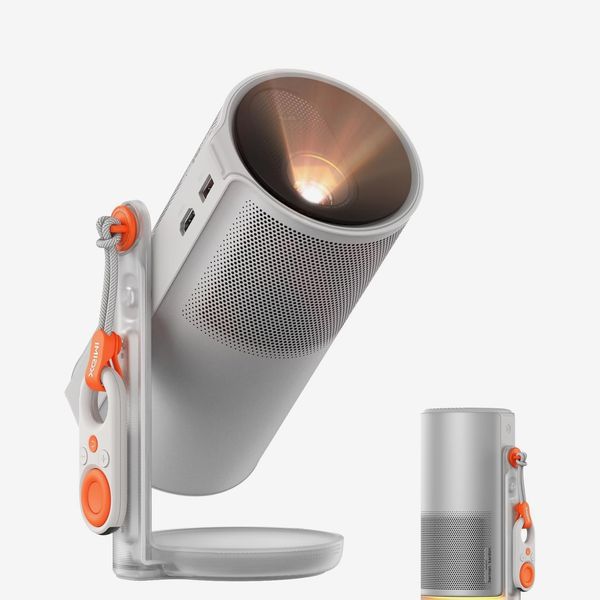
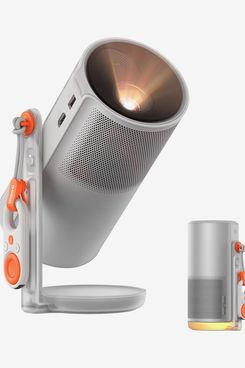
Brightness: 450 ISO lumens | Streaming OS: Google TV | Battery life: 2.5 hours | Power source: USB-C (65W) | Auto adjustments: Keystone, focus | Built-in stand: Rotating, tilting | Resolution: 1080p | Size: 3.8” L x 3.8” W x 8.2” H, 2.9 pounds
At just under three pounds and measuring about the size of a tin of Pirouette cookies, the XGIMI MoGo 4 is the most portable projector I tested. There are smaller ones out there, but none that offers the MoGo’s versatile performance and design. It arrives as a cylinder that cleverly unfolds to reveal a bright projector on a swiveling stand, which can be rotated to project in any direction including directly up at the ceiling. Auto keystone and focus adjustments happen quicker and more accurately than on any of the other projectors I tried. And it satisfies all my other basic criteria: 450 lumens of brightness, Google TV interface, decent built-in speakers, and 2.5 hours of battery life, which a battery pack can extend via its USB-C charging port. (In addition to the built-in stand, you can add a charging tripod for $129 that doubles its battery life.) I am especially impressed by its nearly silent fan. I also like that it comes with a handy mini-remote (in addition to a normal one) that’s tied to the stand, so you can leave the normal remote at home when you bring it on the go.
Due to its lower brightness, the MoGo 4’s image quality is noticeably (albeit slightly) inferior to that of its more expensive competitors. While it’s fine at night, 450 lumens is only marginally useful during the afternoon. Even in a darkened bedroom, colors appear a touch duller than I would like and shadows are gray when they should be black. It made me want to squint, but squinting didn’t help. While its slower processor has no problem streaming movies or shows, it can lead to stuttering while streaming live sports (as happened to me while streaming the French Open on Max and Wimbledon on ESPN). That said, it still performs better than anything cheaper. And if you prioritize portability over absolute performance, these trade-offs might be worth making.
Want to be emailed about sales and other updates to your saved products? Success! You'll get an email when something you've saved goes on sale.
Yes
New! You can now save this product for later.
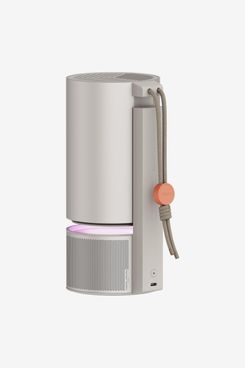
Brightness: 450 ISO lumens | Streaming OS: Google TV | Battery life: n/a | Power source: USB-C 65W | Auto adjustments: Keystone, focus | Built-in stand: Rotating, tilting | Resolution: 1080p | Size: 3.74” L x 3.74” W x 8.06” H, 2.4 pounds
If you like the MoGo 4’s form factor and performance but don’t need a built-in battery, the MoGo 3 Pro is almost the same product but without the extra remote and built-in battery — though you can use it with your own USB-C battery if it supports 65W output charging. The MoGo 3 also has slightly less powerful speakers and lacks the MoGo 4’s “creative filters” (which I don’t put any weight into anyway), but it is typically $100 cheaper and will continue to be sold alongside the MoGo 4 Pro.
Want to be emailed about sales and other updates to your saved products? Success! You'll get an email when something you've saved goes on sale.
Yes
New! You can now save this product for later.
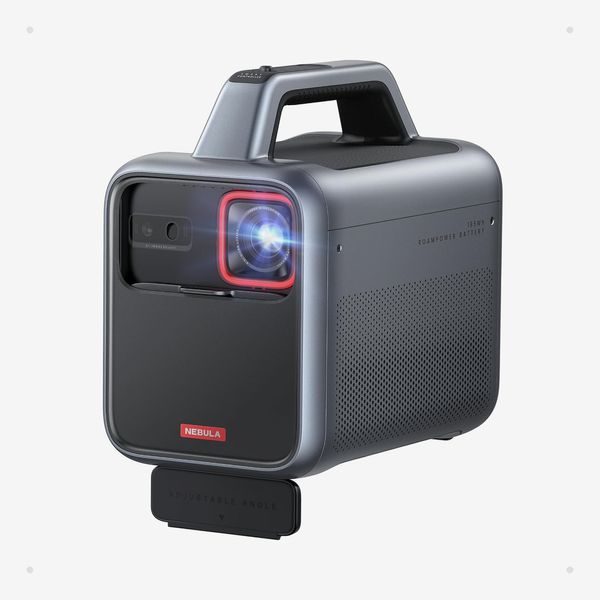
Brightness: 1,000 ANSI lumens | Streaming OS: Android TV 11 | Battery life: Five hours | Power source: AC adapter | Auto adjustments: Keystone, focus | Built-in stand: Tilting | Resolution: 1080p | Size: 6.29” L x 10.23” W x 9.84” H, 9.9 pounds
The Nebula Mars 3 is about the size of an Igloo Playmate handheld cooler, and at nearly ten pounds, it weighs as much as a full one — so it’s not the most portable projector. But its five-hour battery life, 1,000 ANSI lumens of brightness, and IP3X water-resistance rating make it the best option for outdoors or off-grid viewing. Its larger size also leaves room for powerful 45W stereo speakers, which sounded closer to a small soundbar than a portable speaker (that’s a good thing). Its built-in kickstand doesn’t rotate, but it still helped adjust the angle of projection, which is nice because automatic keystone and focusing were a bit slow and less consistent than with the XGIMI projectors.
Technically speaking, the Mars 3 has the best image quality of all the projectors I tested. When projecting indoors, still images appear bright and dynamic with accurate colors, even in the middle of the afternoon. However, movie footage renders with an off-putting smoothness I couldn’t disable in the settings. As a result, Pride and Prejudice (2005) ended up looking more like a soap opera than a meticulously produced period drama shot entirely on film. This projector also, frankly, looks a bit ridiculously huge resting on a coffee table. Overall, though, it’s an excellent choice for tailgating or car camping where weather, lighting, and sound are all highly variable.
Want to be emailed about sales and other updates to your saved products? Success! You'll get an email when something you've saved goes on sale.
Yes
New! You can now save this product for later.
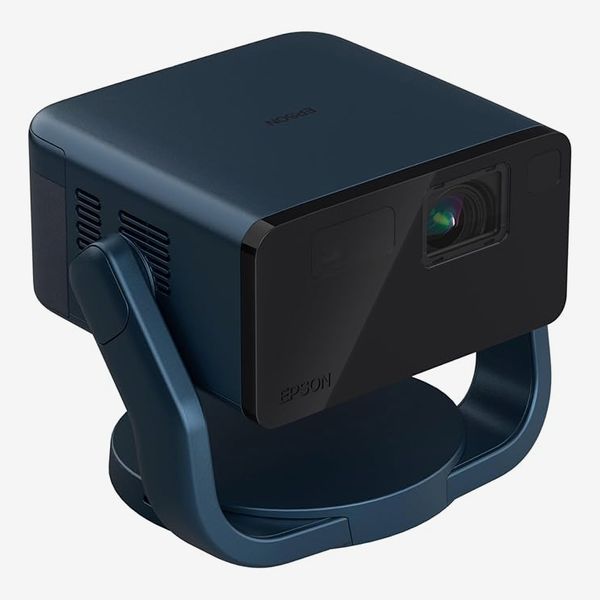
Brightness: 1,000 ISO lumens | Streaming OS: Google TV | Battery life: n/a | Power source: AC adapter | Auto adjustments: Keystone, focus | Built-in stand: Rotating, tilting | Resolution: 1080p | Size: 9.3” L x 7.5” W x 7.5” H, 6.6 pounds
The Epson EpiqVision Mini EF22 prioritizes image quality over portability by jettisoning the battery in favor of better brightness, contrast, and color accuracy. Epson is known for its 3LCD-based home-theater projectors, which — generally speaking — offer better contrast and brightness compared with the DLP chips used in most projectors in this price range (including our other picks here). The EF22 puts this technology into a compact, auto-adjusting, 6.6-pound package with built-in speakers, Google TV streaming, and a swiveling stand. It can create a large TV-like image almost anywhere with a power outlet. Its lack of battery is disappointing, though, and it’s about the size of a small countertop appliance, so if you want a projector that can move around more easily, I would recommend a XGIMI. That said, if you’re planning on keeping it mostly in one spot, I think the Epson’s superior image quality is worth sacrificing some portability. From 2016 to 2021, I used a portable projector mounted on a mini-tripod atop my coffee table in the place of a TV, and the only time I ever used it off battery power was when my friend borrowed it for a rooftop movie screening. Even then, we could have easily just used an extension cord.
The Strategist is designed to surface the most useful, expert recommendations for things to buy across the vast e-commerce landscape. Some of our latest conquests include the best women’s jeans, rolling luggage, pillows for side sleepers, ultra-flattering pants, and bath towels. We update links when possible, but note that deals can expire and all prices are subject to change.
Every editorial product is independently selected. If you buy something through our links, New York may earn an affiliate commission.
The 5 Very Best Portable Mini-Projectors Your product is saved! You’ll receive emails when your saved products go on sale. Manage preferences.