10 Best Skillets 2026 (original) (raw)
The 10 Very Best Skillets
For all your sautéing, searing, frying, and baking needs.

By ,a senior kitchen and dining writer at the Strategist. Previously, she was an editor at Bon Appétit and has worked in food media for nine years.
Photo: Marcus McDonald
- Best overall
- Best stainless steel
- Best nonstick
- Best carbon-steel
- Best enameled cast-iron
- Best copper
- Best wok
It should be said up top: Skillets is a broad category. There are several types — cast iron, enameled cast iron, carbon steel, stainless steel, copper, and nonstick, most of which I use on a weekly (if not daily) basis to cook well and efficiently. And then within each type, there are a lot of options. When it comes to such an essential tool, is it always worth it to splurge? What’s the deal with hybrid pieces that claim to combine the performance of multiple materials in one?How many skillets do you really need in total? There’s no one answer to any of these questions because the cookware you own should ultimately be a reflection of how you personally operate in the kitchen — something I’ve tried to help you think through here, with the recommendations of many pros and years of testing in my own kitchen.
If you’re simply looking to fill a hole in your collection and know what you want, you can jump to any section by clicking the quick links below. But if you’re starting from scratch or doing a full-on refresh, it’s worth a full read through to make sure you end up with a well-rounded, hard-working assortment. Meantime, if you’re looking for other types of cookware, I’ve written a guide to full cookware sets, too. And if you’re in the market for induction-compatible cookware, here’s a roundup of some of the best pots and pans (you’ll notice a lot of overlap with this list, as well).
Updated on January 27, 2026
I made sure all of my picks are still available and all prices are up to date. I also got rid of nonstick pans with PTFE coatings and added a couple of new favorite skillets to replace them: Made In’s ceramic nonstick fry pan and Misen’s carbon-steel nonstick.
This is so obvious it feels a little silly to say, but the most important factor in determining what skillets you need is the material. Pretty much all of the experts I spoke with agree that a mix of cast iron, nonstick, and stainless steel or copper (which are fairly interchangeable) are all you need to make first-rate food, so those are the types you will find on this list. (The one exception is carbon steel, what you might call a cousin to cast iron).
Some of these pans are meant to last a lifetime, others aren’t. But regardless, upkeep is important. For this, I’ve noted when maintenance is just a simple run through the dishwasher or hand wash, versus when there’s more to do. I’ll also note: Some makers of nonstick skillets say theirs are dishwasher safe, but in my experience, handwashing extends the life of the surface, so that’s what I’ve said for all of my nonstick picks.
Want to be emailed about sales and other updates to your saved products? Success! You'll get an email when something you've saved goes on sale.
Yes
New! You can now save this product for later.
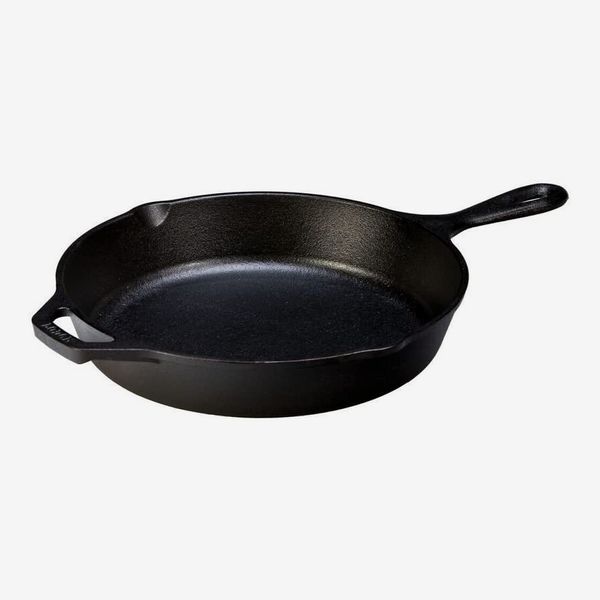
Material: Cast iron | Maintenance: Hand wash and keep well-seasoned
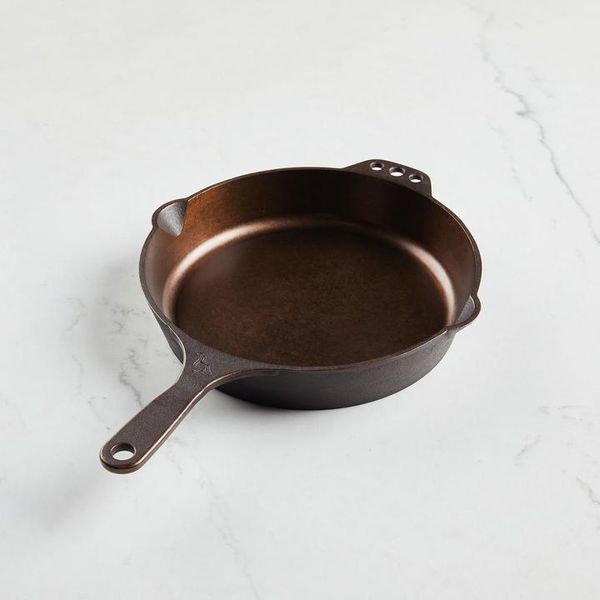
Choosing a “best overall” skillet is easier than you might expect given the vastly different categories I laid out above. I landed on this one because if I had to only cook with this style of pan for the rest of my life, I’d be pretty okay — and you would, too. And in my opinion, Lodge, which I’ve been using for as long as I’ve had a kitchen, hits all the markers you want in a perfect skillet. It’s durable (like, last-you-forever and then pass-it-down durable) and affordable. Indeed, there are some even more gorgeous and slicker-out-of-the-box models on the market that are quite a bit more expensive, which I wrote about in detail here. But if you don’t want to splurge on this particular piece, you won’t be at a true disadvantage. To me, Lodge’s well-roundedness — price point included — is what makes it a true best overall pick.
As a material, cast iron can pretty much do it all (the one exception is cooking acidic foods, for which you need stainless steel, nonstick, or enameled cast iron that has a more protective coating). But it can get really hot and retain that heat, go from the stove to the oven, and hold a nonstick surface if seasoned properly (Lodge cookware comes pre-seasoned, which is a great bonus, but it might require some upkeep over the years). You can sear, sauté, braise, fry, and bake in it. It’s solidly made and certainly has some weight to it — all cast iron does, and that’s part of the point — but I never have trouble maneuvering mine around.
It’s the most common cast iron you’ll see regular home cooks using, too: Ten Strategist staffers own one, including senior writer Liza Corsillo, who says it’s the very best thing she bought in the entirety of the last decade. Professional chefs are just as devoted. “This pan will last you forever,” says Daniel Cutler, co-owner and chef of Ronan in Los Angeles. “It always comes in handy and never disappoints,” adds New Orleans–based chef and restaurateur Alon Shaya. For something so useful, the price is already seriously low, but Lani Halliday, founder and owner of Brutus Bakeshop, notes that you can often find them even cheaper at thrift shops, yard sales, and antique stores. “All you have to do is clean them up,” she says. Here’s my guide on how to do just that.
Want to be emailed about sales and other updates to your saved products? Success! You'll get an email when something you've saved goes on sale.
Yes
New! You can now save this product for later.
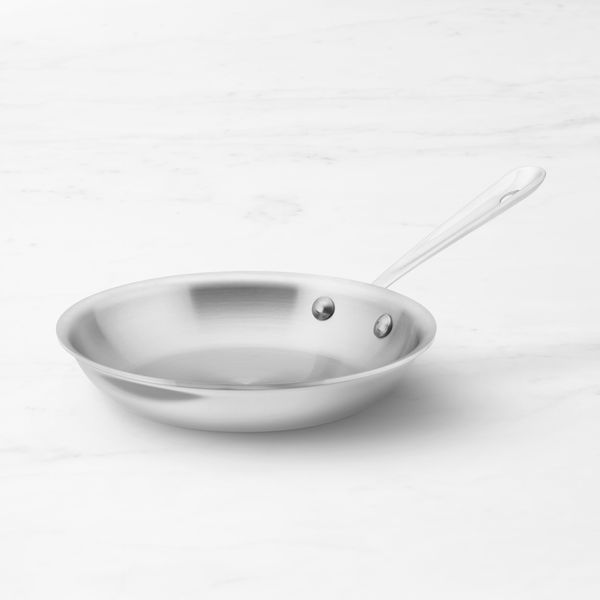
Material: Stainless steel | Maintenance: Hand wash recommended but dishwasher-safe
Stainless steel is another extremely versatile material; it just takes a bit more practice and finesse to get the hang of using it. When it comes to stainless steel,All-Clad is the tried-and-true forever favorite. I often refer to it as the “industry standard” because it’s the brand most commonly found in professional restaurant kitchens, which means it’s incredibly well-built. It certainly stands up to regular use in my kitchen, where I pull it out many nights a week to make dinner. This pan heats supremely evenly all the way around, creating uniform browning on whatever is inside, be it crispy chicken thighs or caramelized onions. The handle is long and sturdy, very securely fashioned to the outside wall. And it cleans up beautifully. Though hand washing is recommended (and a scrub with a sponge usually does it), I’ve also stuck mine in the dishwasher a fair amount and it hasn’t suffered for it.
Food writer, editor, and cookbook author Matt Rodbardeven says the handle is so “iconic” that if you flip through “most cookbooks of the last 20 years, you’ll spot it.”Robert Guimond, chef and owner of Public Display of Affection in Brooklyn, swears by his, which comes with a matching lid for splatter control, to steam ingredients, or help them cook faster. “It’s durable and it’s beautiful,” he says.
Crispy potatoes in the All-Clad.Photo: Emma Wartzman
Want to be emailed about sales and other updates to your saved products? Success! You'll get an email when something you've saved goes on sale.
Yes
New! You can now save this product for later.
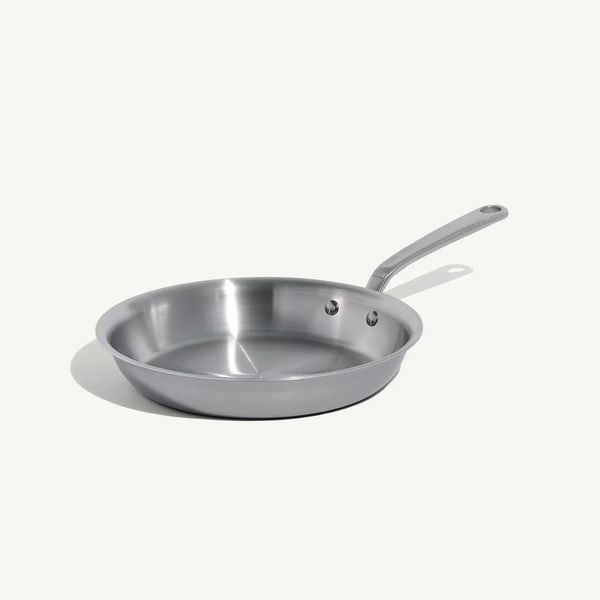
Material: Stainless steel | Maintenance: Hand wash recommended but dishwasher-safe
Made In’s stainless-steel skillet is slightly less expensive than All-Clad’s — and, I think, just as good. (Anecdotally, over the last several years I’ve spotted it being used in restaurants across the country, too, which means it’s comparable in durability.) In my own experience, it’s a beautiful pan: The curve of the inside allows me to easily maneuver and flip ingredients and I can pour sauces out cleanly thanks to the rolled lip. There’s even one feature that gives it a slight edge in my book: I like the handle better because I find the more elevated angle and rounded shape more comfortable to hold and pick up.
Toasted seeds and spices in the Made In stainless steel skillet.Photo: Emma Wartzman
Want to be emailed about sales and other updates to your saved products? Success! You'll get an email when something you've saved goes on sale.
Yes
New! You can now save this product for later.
Material: Stainless steel | Maintenance: Hand wash recommended but dishwasher safe
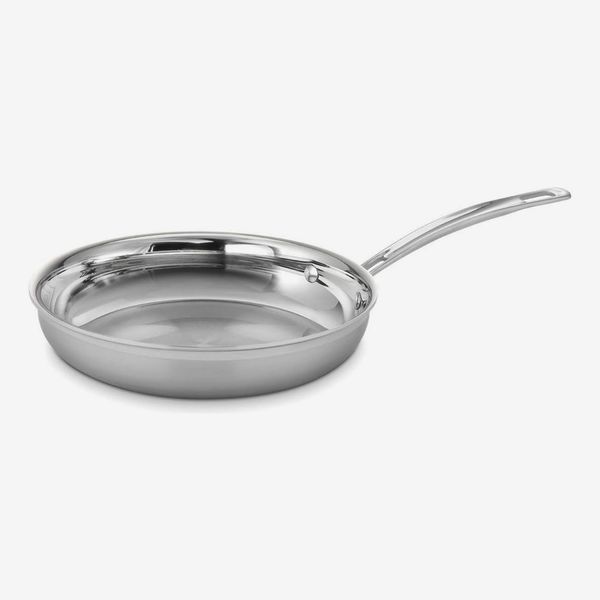
Cuisinart’s MultiClad skillet is a relatively recent addition to my kitchen — but one I’m genuinely so happy to have discovered. It was originally recommended to me by Strategist senior editor Winnie Yang, who has owned the small saucepot from the same line since 2017 and says it’s still in perfect shape. The skillet has the same makeup of the All-Clad and Made In above, stainless-steel sandwiched around an aluminum core, but for a fraction of the price. In my experience, it performs nearly as well.
Compared to both the All-Clad and Made-In skillets, the sides of the Cuisinart are slightly taller, with a less-elegant slope upwards and outwards, and not as flared of a lip. But these are subtle differences. Plus, it’s so significantly less expensive, I’d enthusiastically recommend it to anyone who didn’t want to splurge on those higher-end stainless-steel pans, as nice as they are.
Want to be emailed about sales and other updates to your saved products? Success! You'll get an email when something you've saved goes on sale.
Yes
New! You can now save this product for later.
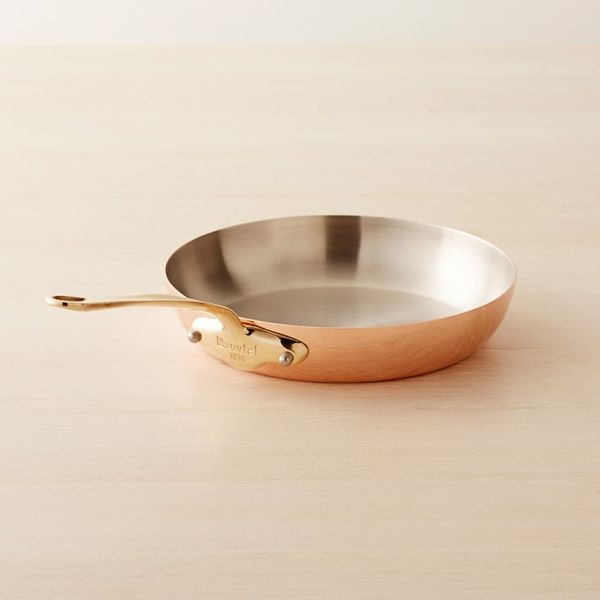
Material: Copper | Maintenance: Hand wash and dry as soon as possible after use
There’s a reason you’ll pay a premium for a copper skillet: You have precise control over it. “Copper conducts heat, retains heat, and then cools down in an incredibly exacting way,” Cutler explains. “Stainless steel is decent at that, too, but just not quite as good. And cast iron holds temperature for a really long time, but is hard to turn back down.” Mauviel, which has been making copper cookware in France for more than 150 years, is the go-to brand — the one used in professional kitchens. “We got ours as a gift,” Cutler admits, “but if I had unlimited money, I would only use these.” The one downside is upkeep. If you want to keep them sparkling clean, you’ll need Bar Keepers Friend. And even if you don’t mind the natural patina of age (Cutler doesn’t shine his set), you need to “wash it with hot soapy water and an abrasive sponge” as soon as you’re done cooking, so that food doesn’t stick.
Want to be emailed about sales and other updates to your saved products? Success! You'll get an email when something you've saved goes on sale.
Yes
New! You can now save this product for later.
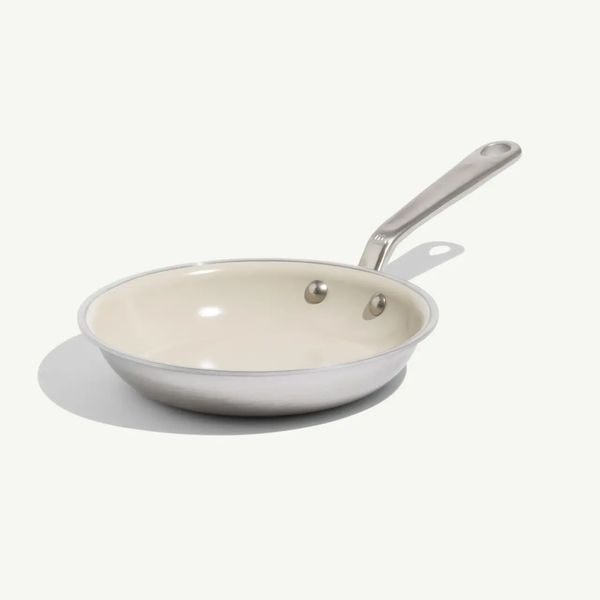
Material: Ceramic nonstick | Maintenance: Handwash only
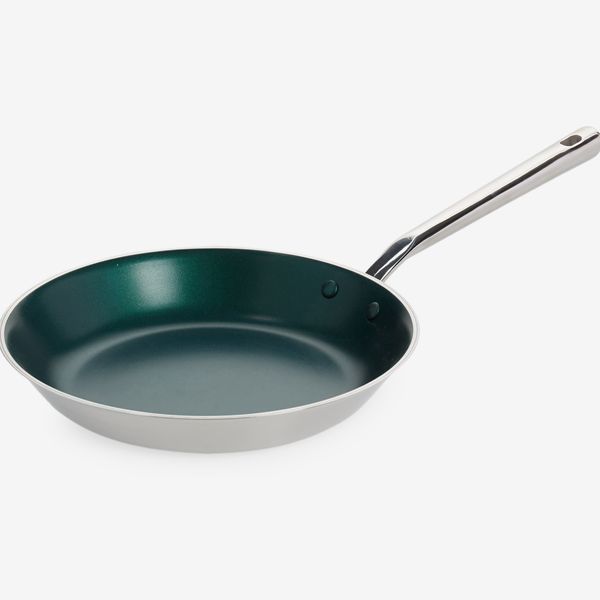
While nonstick pans with conventional coatings do work well, concerns about microplastics are becoming more and more top of mind. Replacing yours with a ceramic model, if you care to, is an easy swap to make. In my experience, ceramic coatings don’t last quite as long across the board (and if you look around the internet, I think you’ll find that many other people have come to the same conclusion) — but I’ve spent a ton of time testing different models and found several I think are totally good, especially if you’re discerning about what you cook on them.
This one from Made In is my personal favorite, thanks to the design details: the overall look is nicer than most; the shape and length of the handle make it comfortable to grip, tilt, and pick up; and the rolled lip helps food slip out easily.
Want to be emailed about sales and other updates to your saved products? Success! You'll get an email when something you've saved goes on sale.
Yes
New! You can now save this product for later.
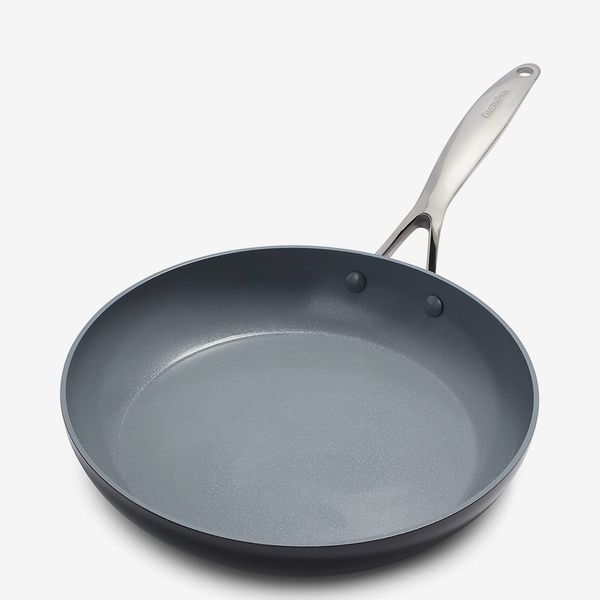
Material: Nonstick | Maintenance: Hand wash recommended
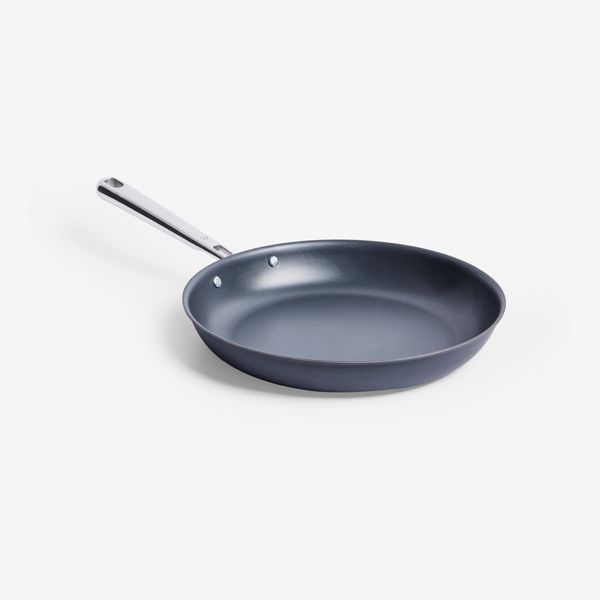
For a less expensive option, I think GreenPan is solid. The brand has a fewdifferent series of ceramic nonstick pans with slightly varying properties but out of the ones I’ve tested,the Valencia Pro line is my favorite. Recipe developer and food writer Caroline Lange has been using hers daily for severalyears (she even recipe tested three different cookbooks on them) — and they’re showing “very minimal wear,” she says. “They clean easily; if there’s ever any oil cooked on (like if I fry an egg really hot), scrubbing with a bit of baking soda takes it right off. And I also like that they’re really oven-safe, up to 600 degrees. My oven doesn’t even go to 600 degrees!” To that point, cookbook author Vallery Lomas even told me she’s even made a galette (which obviously goes in the oven) in her GreenPan.
Want to be emailed about sales and other updates to your saved products? Success! You'll get an email when something you've saved goes on sale.
Yes
New! You can now save this product for later.
Material: Carbon steel | Maintenance: Handwash only
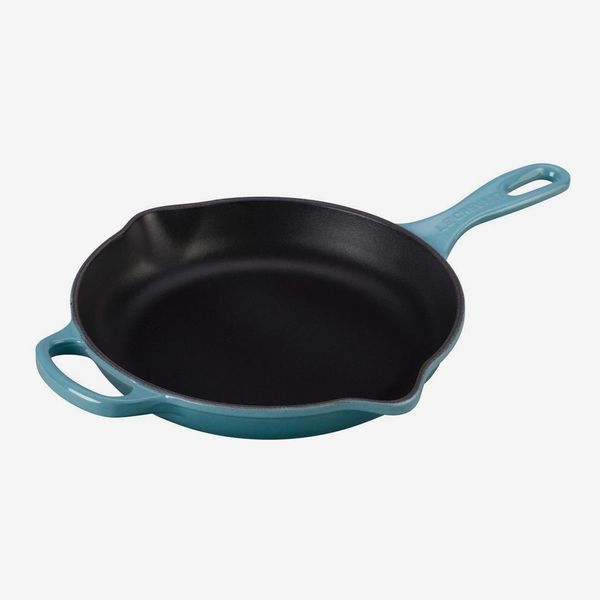
This Misen pan was a bit of a revelation to me. Like many stainless-steel skillets, it has an aluminum core for even heating. But what sets it apart is an outer layer of carbon steel that has been “superheated” in a nitrogen-rich environment to create an “extra-hard, extra-smooth, and extra-durable” surface, as the brand describes it. The pan delivers on this promise, and it behaves impressively similarly to a nonstick surface. Still, it’s lighter than standard carbon-steel pans. It releases food easily without needing to be seasoned (fat in the pan will help maintain this attribute over time), and it doesn’t require the care and maintenance of carbon steel or cast iron. I’ve used it to make crispy-skinned fish, simmer tomato sauce (yes, it can handle acid), toast nuts, fry chicken cutlets and falafel, sear burgers, and more. (The only thing I wouldn’t use it for is scrambled eggs. It works, but isn’t quite as gentle as a nonstick skillet.) “There are no bits of char permanently stuck to it after months of use,” says senior writer Michael Zhao, who has also been testing the pan.
Tomato pasta and chicken cutlets made in the Misen. Emma Wartzman.
Tomato pasta and chicken cutlets made in the Misen. Emma Wartzman.
Want to be emailed about sales and other updates to your saved products? Success! You'll get an email when something you've saved goes on sale.
Yes
New! You can now save this product for later.
Material: Enameled cast iron | Maintenance: Dishwasher safe
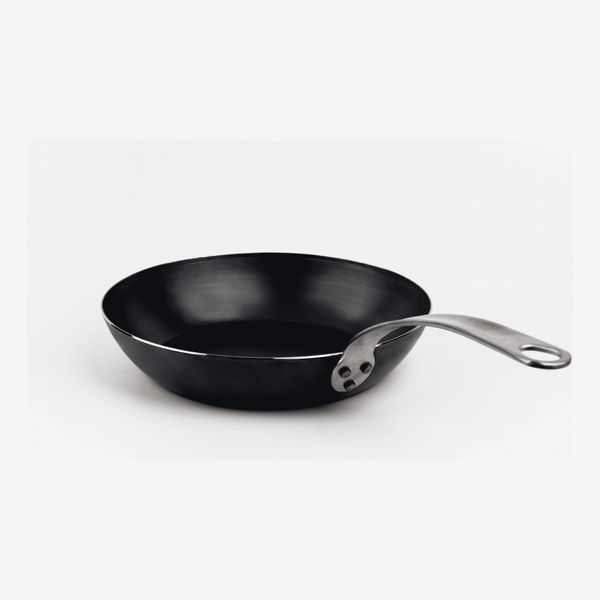
The primary difference between cast iron and enameled cast iron is a thin coating that makes the surface very smooth and fairly nonstick without having to season it. The downside is that the layer can be subject to scratching or chipping, and once that happens, it can’t be reseasoned to live on in perpetuity. But this shouldn’t happen if you take care of your pan, and I’ve found that in my manymonths of using this one, it still looks brand new. Think about it: Just like a Dutch oven (the vast majority of which are made from the same material), it’s meant to be durable, even if it can’t handle quite the same amount of wear and tear as a standard Lodge cast-iron skillet (and shouldn’t go over the grill either). The other difference is the look: Le Creuset’s enameled cast-iron skillets, which come in a variety of colors, look nice going straight from stove or oven to table (whereas Lodge’s cast-iron pans feel industrial, not something you would necessarily want to present food in). In mine, I make shakshuka and fried eggs for breakfast, toast sandwiches for lunch, sauté beans for dinner, and on and on. And when I’m done, a quick wash with water and dish soap cleans it right up.
Want to be emailed about sales and other updates to your saved products? Success! You'll get an email when something you've saved goes on sale.
Yes
New! You can now save this product for later.
Material: Carbon-steel | Maintenance: Hand wash and keep well seasoned
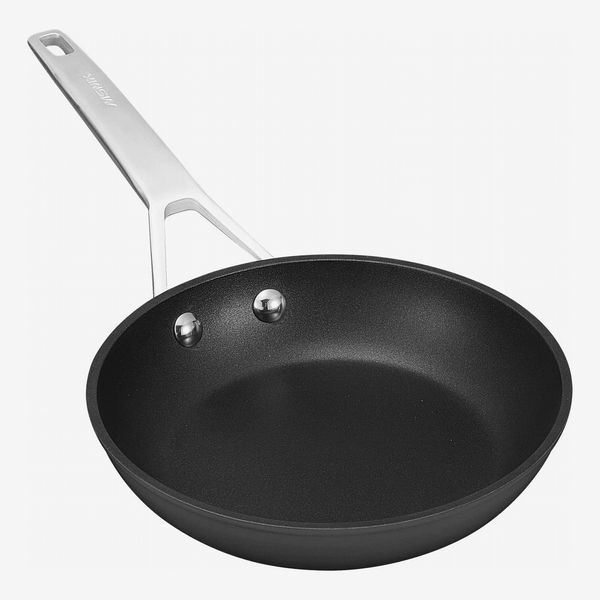
Woks are a particular type of skillet (if you can call them that at all). Because their primary purpose is for stir-frying, they are built in V shape with extremely high sides to accommodate tossing lots of ingredients and have two handles to make maneuvering around a high flame easy. Still, they can be used for many of the same tasks as standard skillets, like braising, sautéing, and steaming (and even for things standard skillets can’t, like boiling stew or popping popcorn). In my roundup of the best woks, this Made In frying pan was recommended by Lucas Sin, chef at Junzi Kitchen and Nice Day. It’s almost like a hybrid of the more traditional woks on that list and the brand’s carbon-steel pan above: It’s quite compact with slightly lower sides, though Sin says it “comfortably cooks for two;” has only one handle; and features a bottom on the wider side, which Sin prefers “for as much surface contact as possible.” Eric Sze, chef at 886 and Wenwen, is also a fan. He says the shape is especially helpful with the reduced BTU of home stoves and notes that when he does need to maneuver the pan around, the handle is “slightly curved” and “comfortable to hold,” whether close to his body for tossing or further out when it gets hot.
In previous versions of this story, I recommended the original Our Place Always Pan as the best nonstick skillet with high sides. In spring of 2023, the brand retired that version and released the Always Pan 2.0. The main difference between the products is a new and (according to the brand) improved nonstick coating that will last for longer and has the ability to go in the oven.
I appreciate these changes and still think the overall build of the pan is good. The high sides offer protection from splatter. The tight-fitting lid is handy; depending on how you place it, it has the option of fully closing or leaving a small opening for steam to escape. The pour spout is smart, making it a pan that can handle saucy dishes.
However, after testing out the updated version for nine months, there was one issue I couldn’t get over: It has a different handle design with a hole that runs through the length. Because of this, it spurts out steam and liquid and is burning hot to the touch. I decided to omit the skillet because, given this problem, I simply don’t think it’s worth the steep price point.
New! You can now save this product for later.
New! You can now save this product for later.
New! You can now save this product for later.
• Liza Corsillo, Strategist senior writer
• Daniel Cutler, co-owner and chef of Ronan
• Robert Guimond, chef and owner of Public Display of Affection
• Lani Halliday, founder and owner of Brutus Bakeshop
• Caroline Lange, recipe developer and food writer
• Vallery Lomas, cookbook author
• Matt Rodbard, food writer, editor, and cookbook author
• Lucas Sin, chef at Junzi Kitchen and Nice Day
• Alon Shaya, restaurateur and chef
• Eric Sze, chef at 886 and Wenwen
• Winnie Yang, Strategist senior editor
• Michael Zhao, Strategist contributor
The Strategist is designed to surface the most useful, expert recommendations for things to buy across the vast e-commerce landscape. Some of our latest conquests include the best dining room décor items, coffee-makers, knife sets, Japanese coffee brewer, charcoal water filter, and drinking glasses for water and more. We update links when possible, but note that deals can expire and all prices are subject to change.
Every editorial product is independently selected. If you buy something through our links, New York may earn an affiliate commission.
The 10 Very Best Skillets Your product is saved! You’ll receive emails when your saved products go on sale. Manage preferences.