How to Host a Party (original) (raw)
Last updated: March 22, 2026
Most parties start the same way: people walk in, grab a drink, and stand near whoever they already know. Nobody’s rude. Nobody’s having a bad time. But nobody’s really connecting either. A simple fix I’ve used at hundreds of parties is the icebreaker name tag: a regular name tag with one easy question on it that gives guests something to talk about the moment they walk in the door.
In this article, you’ll learn:
- Why icebreaker name tags work so well
- How to choose the right question for your name tag
- 9 specific name tag ideas you can use at your next party
- Good and bad examples of icebreaker questions
- Photos and real feedback from parties where I’ve used them
Why you should trust this article: My name is Nick Gray and I've helped over 175 people learn how to host cocktail parties and networking events. I've personally written thousands of name tags and run icebreakers at hundreds of parties. New York Magazine once called me a host of "culturally significant" parties. I'm also the author of The 2-Hour Cocktail Party.- Example in New York City
- Why Icebreaker Name Tags Work
- How to Choose a Good Icebreaker Question for Name Tags
- Video: Icebreakers on Name Tags
- 9 Icebreaker Name Tag Ideas
- Good vs. Bad Examples
- Photos: Icebreaker Name Tags in Action
- Feedback from a Real Event
- Name Tag Setup Tips
- Name Tag Options by Event Type
- Frequently Asked Questions
- Conclusion
Example in New York City
A Young Patrons program hosted an event for the Central Park Conservancy in New York City where they used name tags in a clever way.
They asked everyone to write their favorite Netflix show on their name tag.
That one small addition turned a standard mixer into a room full of easy conversations. Instead of “So what do you do?” people walked up to strangers and said, “Oh, The West Wing! Have you seen Succession?”
Here is what that looked like:
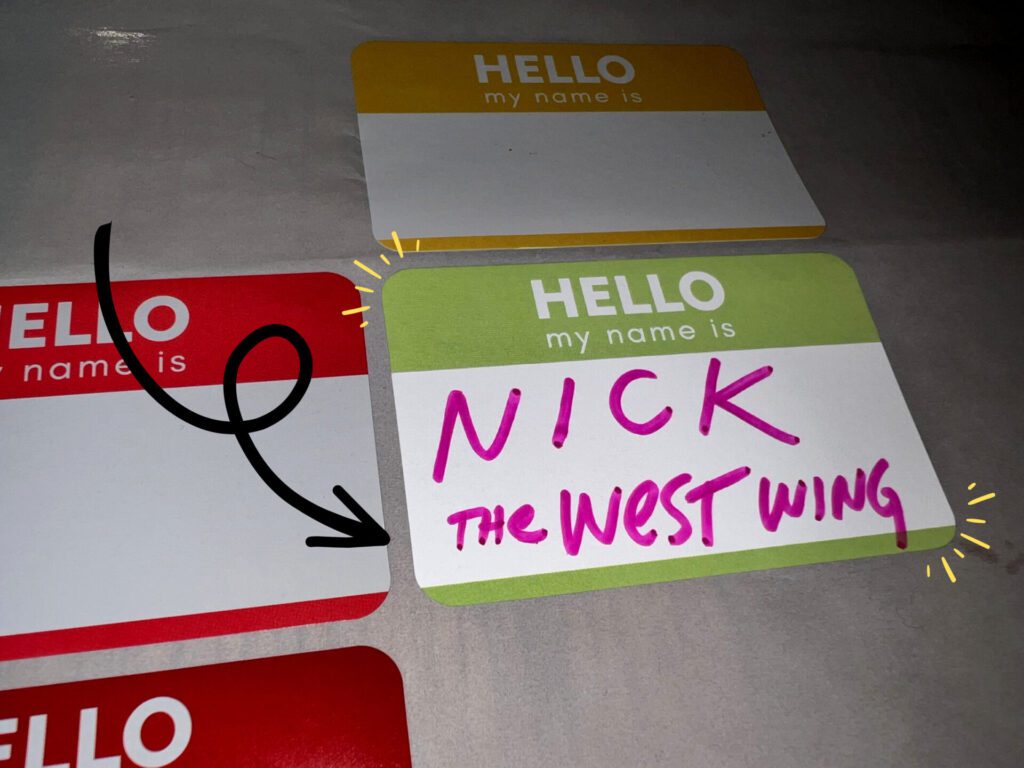
Simulated name tag because I didn’t take a close-up photo of my name tag that night (LOL!)
Why Icebreaker Name Tags Work
If you’ve read my guide to icebreakers, you know I think about icebreaker questions in three levels: green, yellow, and red. Green-level questions are low-vulnerability: easy to answer, fun, and appropriate for a room full of people who don’t know each other yet. Yellow-level questions require a bit more comfort and come later in the party. Red-level questions require real trust and have no place at a casual gathering.
Name tag icebreakers are always green. They have to be. Guests are filling out the tag the moment they arrive, before anyone’s had a drink or a real conversation. The prompt needs to be so easy and low-stakes that answering it takes five seconds and feels like fun rather than homework.
When you get the question right, the name tag does the work for you:
- It gives shy guests a conversation opener. Instead of waiting for someone to approach them, they can walk up to another person, point at their tag, and say “I saw your answer. I love that show too.”
- It kills the “So what do you do?” reflex. Work is fine to talk about, but it’s not a great opener. A name tag with a fun question gets people into a more relaxed, personal mode from the start.
- It makes guests feel like you planned with them in mind. A blank name tag says you needed to know who was who. A name tag with a prompt says you wanted people to connect.
- It works at any size event. I’ve used them at 12-person dinner parties and 80-person company mixers. The format scales.
How to Choose a Good Icebreaker Question for Name Tags
Not every icebreaker question works on a name tag. A question that’s great when I’m standing in front of 20 people and asking everyone to go around the room can be terrible when someone’s trying to write their answer in two seconds at the door.
Three rules I follow:
(1) Make it easy to answer fast
The guest is walking in, handing over their coat, saying hi, and grabbing a name tag all at once. They shouldn’t have to stop and think hard about their answer. If the question requires real reflection, save it for the spoken icebreaker round. For name tags, keep it to something anyone can answer in under five seconds: a favorite show, a breakfast food, a recent book. I always use “What is one of your favorite things to eat for breakfast?” as my first spoken icebreaker, and it works on name tags for the same reason: everyone eats breakfast, and there’s no wrong answer.
(2) Keep the answer short
Name tags are small. The answer needs to fit in a couple of words: a show title, a food item, a city. Anything requiring a full sentence won’t work. The guest next to you needs to be able to glance at your tag while you’re mid-conversation and immediately know what to ask about.
(3) Keep it fun and low-stakes
This is a party, not a job interview. The question should make people smile when they read it, not feel pressure to come up with the “right” answer. Anything that could embarrass someone, reveal something personal, or feel like a test is off the table. You want the room to feel light from the first moment guests arrive.
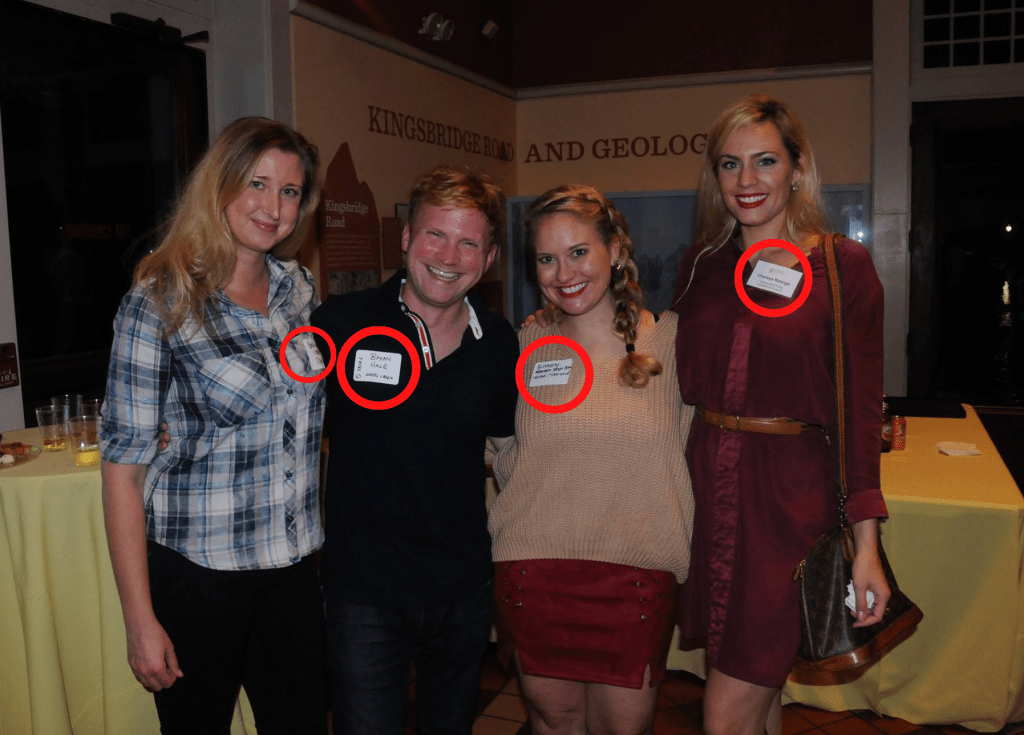
My friends Emily, Bryan, Brittany, and Chelsea all look great with their name tags on!
Video: Icebreakers on Name Tags
See how I’m doing it in this video filmed March 2023 at one of my events.
9 Icebreaker Name Tag Ideas
All of these are green-level prompts: easy, fun, and safe for any crowd. Each one has been used at real parties and produces good conversations. I’ve noted why each one works and any situations where it fits especially well.
- Favorite TV show. This is the one I recommend most often, and it’s what the Central Park Conservancy event used. Nearly everyone has a show they love right now, and shared tastes in TV are an instant bond. Two people who both wrote “Succession” will talk for the rest of the night. Works at any party type.
- Favorite thing to eat for breakfast. I’ve used this at dozens of parties as both a name tag prompt and a spoken icebreaker. It’s my go-to for a reason: no wrong answers, zero stakes, and it reliably sparks stories. Someone who writes “dim sum” gets a different conversation than someone who writes “cereal straight from the box.”
- Best book you’ve read recently. A great one for groups that skew intellectual or bookish: tech events, creative communities, author readings. The key word is “recently” rather than “best ever,” which makes the question easier. People can write the title without having to justify the choice.
- A city you’d love to visit. Works especially well at international or travel-oriented gatherings. It’s easy, universally relatable, and the answers often reveal something interesting about a person’s priorities: adventure, food, family history.
- Your hidden talent. This one gets interesting fast. People write things like “speed-solving crosswords” or “making really good pasta” or “remembering song lyrics from the 90s.” It’s fun to read at a glance, and it invites follow-up questions that feel genuine. Works best once the crowd has had a chance to arrive and settle in.
- How you know the host. I’ve seen this used at birthday parties and reunion-style gatherings where the guest list pulls from different parts of someone’s life. It answers the question everyone is secretly wondering (“Wait, how do you all know each other?”) and makes it easy to find common ground: “Oh, you two went to college together? I met her at work.”
- Favorite pizza topping. Lightweight and fun. Nobody feels put on the spot. The answers are short, readable at a glance, and they almost always generate at least one passionate debate. Good for casual house parties, especially if you’re actually serving pizza.
- A cause or nonprofit you care about. This one fits networking events and professional mixers well. It’s still green-level (nobody has to share anything too personal), but it moves the conversation somewhere more meaningful than small talk. People who care about similar things often become fast friends.
- Your spirit animal or mascot. Playful and a little silly, which is exactly right for some crowds. People write things like “golden retriever,” “honey badger,” or “definitely a sloth,” and the tags become conversation pieces just by being funny to read. Good for birthday parties, team offsites, or any event where you want the mood to be light from the start.
Pro tip: You don’t have to rotate these. If you host regularly, it’s fine to use the same question every time. Your repeat guests understand why you’re doing it, and new guests get a great experience. I’ve used the breakfast question more times than I can count. Consistency is fine.
Good vs. Bad Examples
The difference between a good name tag question and a bad one comes down to whether it passes the three rules above. Here’s how that plays out:
Good examples
- What’s one of your favorite TV shows?
- What’s one of your favorite things to eat for breakfast?
- What is a good book you’ve read recently?
- What is a cause or nonprofit you care about?
Bad examples
- What is the best single piece of advice for a new college graduate? Too hard. Takes real thought. Nobody wants to write a mini-essay on their name tag while someone is trying to take their coat.
- What are the top 3 things you’re most excited about? Too long. The answer won’t fit on a name tag, and asking for a list defeats the purpose of a quick prompt.
- What’s one of the worst first dates you went on? Too personal for a room full of strangers. Even if the story is funny, this is asking guests to share something potentially embarrassing the second they walk in the door. That’s a red-level question dressed up as a fun one.
Photos: Icebreaker Name Tags in Action
At this party, people wrote down their favorite Netflix shows on their name tags.
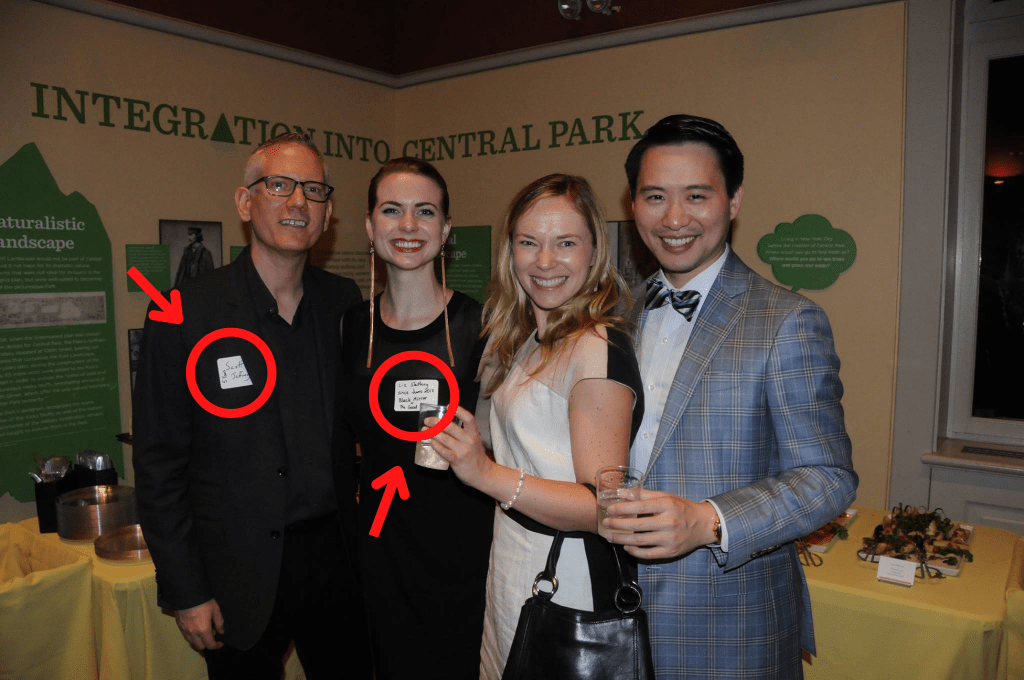
Liz and Scott also wrote their favorite shows on their name tags!
Like my friend Claire, who wrote down “The Good Place” on her name tag:
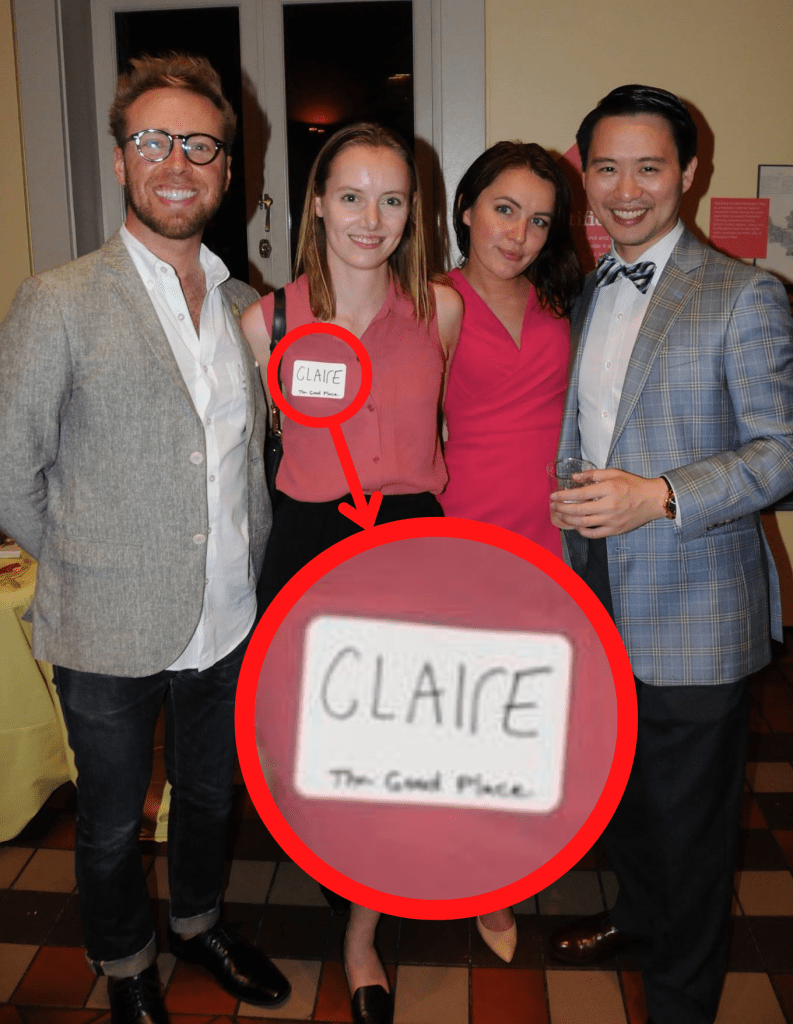
My friend Claire wrote The Good Place on her name tag as one of her favorite shows then.
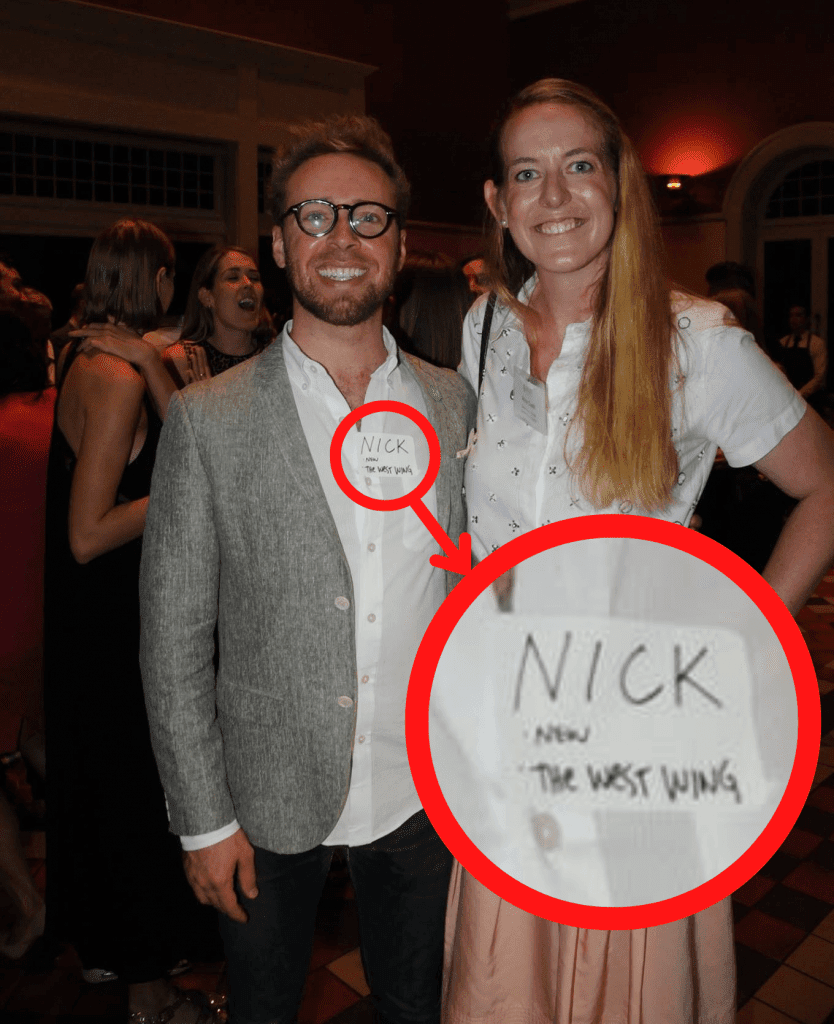
I wrote The West Wing on my name tag, one of my favorite old TV shows.
Feedback from a Real Event
My friend Ciaran took my advice to use icebreakers on name tags at one of his company mixers.
I encouraged him to keep it simple and just use the “What’s one of your favorite TV shows?” prompt.
Here’s what he told me about how it went:
“Thanks again Nick, for your advice and counsel here. We just finished our event, and it was a ROUSING success. People loved the name tags and the inclusion of an incredibly simple prompt (favorite TV show) really helped people have something quick and simple to connect on.” –Ciaran Rogers, Head of Growth, Insurate
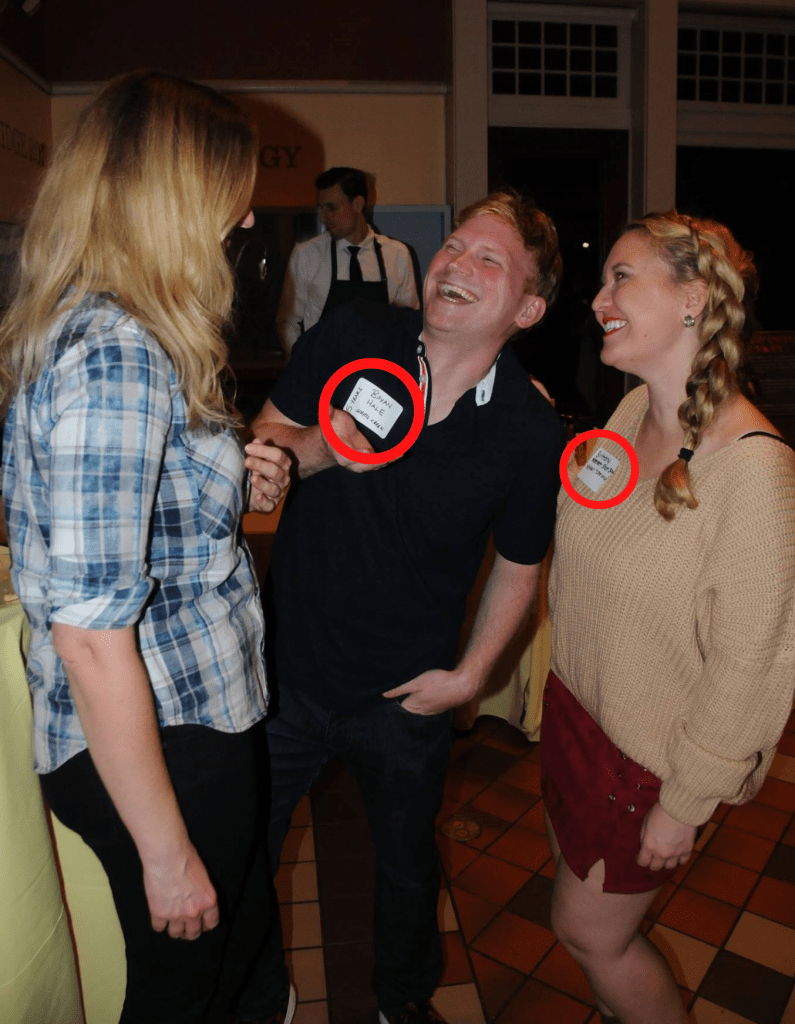
Bryan wrote Schitt’s Creek on his name tag, which is a show he loves. He also wrote five years to show how long he’s been in the organization.
Name Tag Setup Tips
The question you pick matters, but so does how you set up the name tag station. Here’s what I’ve found works:
- Put the name tag station right at the entrance. Guests should pick up their tag before they do anything else. If it’s in the back of the room or near the bar, people skip it. Position it right where they walk in.
- Print the question on the tag or on a sign at the station. Don’t make guests guess what they’re supposed to write. Put the prompt right in front of them: “Name + Favorite TV Show.”
- Have good markers available. Thin markers make writing harder to read from a distance. Use thick Sharpies or paint markers so answers are visible at a glance.
- Make tags large enough. For best readability, aim for 3 to 4 inches wide and 2 to 2.5 inches tall. That gives enough room for a name in large letters plus a short answer below it.
- Prepare 10 to 15 percent more than your guest count. Plus-ones happen, RSVPs are unreliable, and tags get messed up. Have extras ready.
- Wear yours first. If you’re the host and your tag is filled out before the first guest arrives, it signals that this is expected and normal. Lead by example.
Pro tip: Adhesive name tags placed on the right side of the chest work best. When you extend your hand for a handshake, your right side naturally rotates toward the other person, putting your tag right in their line of sight.
Name Tag Options by Event Type
The format of the name tag itself can match the vibe of your event.
- Adhesive labels. Cheap, easy, works for almost everything. A sheet of Avery labels and a pack of Sharpies is all you need for a casual party. Print the prompt on the label in advance if you want a cleaner look.
- Printed cardstock with badge holders. Better for professional events, corporate mixers, or anything where you want the setup to look intentional. You can design them in Canva, print on cardstock, and slip them into badge holders. Looks polished without much effort.
- Custom printed tags. If you host the same event repeatedly, a small order of custom-printed tags from Sticker Mule or Zazzle is worth it. You can include your logo, event name, or a pre-printed prompt. The per-tag cost drops fast on larger orders.
- Creative formats for themed parties. Button pins, lanyards, mini chalkboards, or wristbands all work if they match your theme. For casual parties, I’ve seen hosts use colored sticker dots (where the color indicates how someone knows the host), which is a clever way to help guests self-sort for conversation.
Frequently Asked Questions
What if guests refuse to wear a name tag?
Make it opt-in rather than mandatory, and frame it as fun rather than required. A well-set-up name tag station with good markers and an interesting prompt gets most people on board without any arm-twisting. If you’re wearing yours when guests arrive and it has a good answer on it, people will want to participate. The holdouts are usually won over once they see others engaging with it.
Can I use the same prompt every time I host?
Yes. I’ve used the breakfast question and the favorite TV show prompt more times than I can count. Repeat guests understand why you’re doing it and appreciate the consistency. New guests get a great experience. You don’t need to come up with something new every party. Pick one that works and stick with it.
Should I use icebreaker name tags instead of a spoken icebreaker round?
They serve different purposes, so I use both. The name tag gets conversation started the moment guests walk in and keeps working all night as people mingle. The spoken icebreaker round, which I do at roughly the 30-minute mark, brings the whole group together and gives everyone a chance to hear each other’s names and answers. Name tags are passive; the spoken round is active. Together, they’re a powerful combination. See my full icebreaker guide for how I structure the spoken round.
What’s the difference between a green, yellow, and red icebreaker question?
It’s a framework I use to match the question to the trust level in the room. Green-level questions are low-vulnerability and appropriate for any crowd at any point in the evening. These are what you always put on name tags. Yellow-level questions require a bit more comfort and work best after people have been mingling for 30 to 40 minutes. Red-level questions require real trust and should never appear at a casual party. The full breakdown is in my icebreakers article.
Conclusion
Icebreaker name tags are one of the easiest upgrades you can make to any party. They cost almost nothing, take five minutes to set up, and they work all night without any effort from you. The key is picking a question that’s genuinely easy to answer, short enough to fit on a tag, and light enough that nobody feels put on the spot when they walk in.
Key takeaways:
- Always use green-level questions on name tags: easy, fun, low-stakes
- The prompt needs to be answerable in under five seconds and fit in a few words
- Favorite TV show and favorite breakfast are the two most reliable options
- Position the name tag station at the entrance so every guest fills one out on arrival
- Wear your own tag first. It sets the tone.
- Name tags and spoken icebreakers complement each other; use both
If you want to pair this with a full spoken icebreaker round, read my complete guide to icebreakers and the green/yellow/red framework.
If you’re planning to use this at an upcoming event, send me an email and tell me what you’re hosting. I’m happy to answer any questions.
For more on how to run a great party from start to finish, grab my book The 2-Hour Cocktail Party.