Political Wire (original) (raw)
Voters went to the polls in four states on Tuesday — Maine, South Carolina, Nevada and North Dakota.
Leave your reaction the comments as the results come in.
“The U.S. launched strikes on Iran Tuesday in retaliation for the downing of a U.S. Apache helicopter near the Strait of Hormuz, according to U.S. Central Command. Targets included Iranian air defenses and radars near the waterway,” the Wall Street Journal reports.
“The strikes, which the military said were carried out in self-defense, were directed by President Trump.”
“The country’s most powerful pro-Israel group, the American Israel Public Affairs Committee, is jumping into the intense Democratic primary race for Senate in Michigan,” the New York Times reports.
“The group’s main super PAC, the United Democracy Project, on Tuesday released its first round of ads backing Representative Haley Stevens, a moderate lawmaker who is in a three-way fight before the August primary.”
“Alaska U.S. Senate candidate Dan Sullivan acknowledges that sharing a name and party affiliation with the incumbent Republican gives him ‘an instant megaphone’ in the crowded primary race. But Sullivan said his campaign isn’t a sham or something Democrats put him up to doing,” the AP reports.
“He said friends for years have jokingly referred to him as senator and asked if he has ever thought about running. He said he’s been considering it for more than a decade.”
“Two senior Republican senators on Tuesday agreed Congress is unlikely to pass a third reconciliation bill, cautioning against relying on the possibility for defense funding,” NewsNation reports.
Bloomberg: “Some key Republicans in Congress are throwing cold water on prospects for passing a third party-line budget bill, even as House GOP leaders insist they can move another mammoth legislative package this summer.”
Politico: “A key U.S. spy law remains on track to expire at the end of the week after Speaker Mike Johnson met Tuesday with President Donald Trump about the future of a key section of the Foreign Intelligence Surveillance Act.”
“Trump indicated in the private White House meeting that he’s not inclined to appease Democrats and pave the way for a FISA extension by nominating a permanent director of national intelligence to succeed Bill Pulte, the acting director he installed last week, according to three people briefed on the conversation who were granted anonymity to describe it.”
Wall Street Journal: “The celebratory air that Trump brought to the party has dissipated ever since his cultural cachet hit its zenith around his second inauguration. Country music superstar Carrie Underwood sang at the ceremony after rapper Snoop Dogg performed at a ball days before it. Podcasters and influencers, who propelled him into office, cheered him unabashedly while professional athletes celebrated big plays with ‘the Trump shuffle.'”
“Now Trump’s influence in entertainment circles shows signs of waning.”
Wall Street Journal: “Social Security is expected to deplete the fund that helps pay out retirement benefits by late 2032, the program’s trustees said Tuesday.”
“That is earlier than their projection last year of 2033, partly because the fund expects to collect less revenue after President Trump’s new tax law. Passed last summer, the law gave senior citizens an extra deduction that reduced taxes on benefits for many Social Security recipients.”
Kim Jong Un feted Chinese President Xi Jinping with two days of lavish celebrations in Pyongyang, calling ties with China a “top priority” in a clear message that Beijing, not Moscow, remains North Korea’s most important partner, Bloomberg reports.
CNBC: “A monthslong stalemate over immigration enforcement could come to an end on Tuesday, as the U.S. House is poised to vote on a $70 billion funding package despite Democrats’ vows to fight back.”
“It’s a major test for House Speaker Mike Johnson as he tries to cement one of President Donald Trump’s top domestic priorities.”
President Trump on Tuesday blamed Iran for shooting down a U.S. helicopter gunship over the Strait of Hormuz, adding in a social media post that “the United States must, of necessity, respond to this attack,” the New York Times reports.
“South Carolina voted enthusiastically for Donald Trump in 2024. But his endorsement in the state’s race for governor this year has so far not proved decisive,” the New York Times reports.
“The candidates went to extraordinary lengths to earn Mr. Trump’s endorsement, many of them repeatedly posting photos of themselves with the president as if his nod had been secured.”
“Ultimately Mr. Trump put his weight behind Lt. Gov. Pamela Evette in Tuesday’s crowded Republican primary. But in interviews, voters appeared to be more concerned about who could steer the state — the fastest-growing in the country — through its growing pains and infrastructure woes. And many drew a distinction between state and federal leadership.”
“One of Jeffrey Epstein’s longtime assistants told members of the House Oversight Committee on Tuesday morning that she did not know about the late convicted sex offender’s crimes, describing him as a master manipulator who had every reason to keep them a secret from her,“ CNN reports.
“As a way to try to demonstrate her ignorance about Epstein’s wrongdoing, Lesley Groff, Epstein’s former executive assistant, said she believed the massage appointments she made for Epstein with young women and girls were with massage therapists.”
“House Ways and Means Chair Jason Smith says he won’t get behind the GOP’s next budget reconciliation bill if tax provisions aren’t included,” Politico reports.
“A number of House Republicans — including those in leadership — are voicing concerns that including tax provisions would allow Democrats in the Senate to force floor votes on politically fraught health care amendments, putting vulnerable Republican senators in a difficult spot just before the midterms.”
“Company disclosures show the Trump family was entitled to roughly $500 million from a 2025 crypto transaction between World Liberty Financial and the publicly traded company then called Alt5 Sigma,” CNBC reports.
“Alt5 Sigma’s stock has fallen more than 90% since just before the deal was announced.”
Senate Majority Leader John Thune said Tuesday that President Donald Trump is “weighing seriously” naming a permanent nominee to be director of national intelligence and that he hopes Trump makes an announcement soon, Politico reports.
“For weeks, the parameters of a preliminary agreement to end the war between the United States and Iran have been clear to its negotiators. The hang-up? How to devise a deal so each side can claim a win,” the New York Times reports.
“Washington and Tehran — both neither fully victorious nor completely defeated in the war — badly want a deal. But they also need something they can present as favorable to the hawks and hard-liners back home.”
“Added to this fundamental dispute are the peculiarities of the two countries’ leaders. One of them is in hiding and slow to sign off on any proposal; the other is so unpredictable, his own envoys struggle to negotiate on his behalf.”
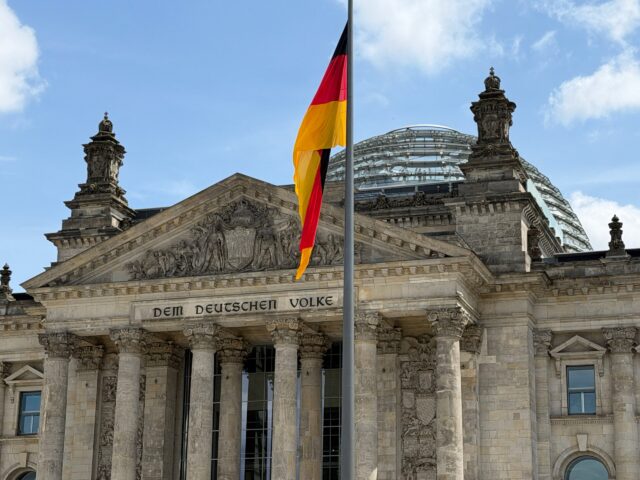
For such a young country — younger than the United States in its modern form — Germany has left an enormous imprint on the world.
It started two world wars. It committed atrocities so vast they still defy comprehension. And for 40 years, it sat at the center of the Cold War, divided between two hostile systems and two different visions of the future.
That history is everywhere in Berlin.
It’s in the Reichstag, where we climbed into the glass dome that now sits above the German parliament — a deliberate symbol of transparency after a century of catastrophe.
It’s in the remaining slabs of the Berlin Wall, still standing as a reminder of how quickly a country can be split in two.
It’s in the Jewish Museum, where the architecture itself seems designed to unsettle you.
And it’s most powerfully felt at the Memorial to the Murdered Jews of Europe, a vast field of concrete slabs that becomes more haunting the longer you walk through it.
Berlin is not a city that lets you look away.
And now Germany is once again confronting its past.
With Russia’s war in Ukraine and growing doubts about whether the United States can still be counted on as a reliable ally, Germany is rearming itself. Quietly, reluctantly, but unmistakably.
Most Germans do not know when another war in Europe might come. But many now seem to believe it will come.
That was the most striking part of the visit: how much of Germany’s past suddenly felt relevant again.
And not just because of Europe.
But because so much of what we saw — the nationalism, the propaganda, the cult of power, the dehumanization of enemies, the steady erosion of democratic norms — echoed the increasingly fascist strains in our own politics back home.
Berlin is a fascinating city — but it’s also a warning.