ReCiPe (original) (raw)
Published
29 August, 2016
When calculating the environmental impact of a product, service, or organization with a Life Cycle Assessment (LCA), you use a so-called Life Cycle Impact Assessment method (LCIA method). An LCIA method can transform the long list of input flows and emissions – your Life Cycle Inventory (LCI) results – into potential environmental effects. One of the most widely used LCIA methods is ReCiPe. This article provides further details about this commonly used method that is available in SimaPro.
Midpoint and endpoint impact categories
The primary objective of the ReCiPe method is to translate emissions and resource extractions into a limited number of environmental impact scores. These scores express the severity of the environmental impact within a specific impact category. In ReCiPe two levels of impact categories are defined:
- 18 midpoint impact categories
- 3 endpoint impact categories
Midpoint impact categories are single environmental issues such as global warming or water use. Through damage pathways, these environmental issues have an effect on human health, ecosystems and resource availability (see figure below). These are the endpoint impact categories. Endpoint categories are often easier to interpret, but it is important to note that this introduces higher uncertainty. You should consider this trade-off between easier interpretation and uncertainty when deciding which level to use for your study. The level you select should align with the objectives of your LCA study.
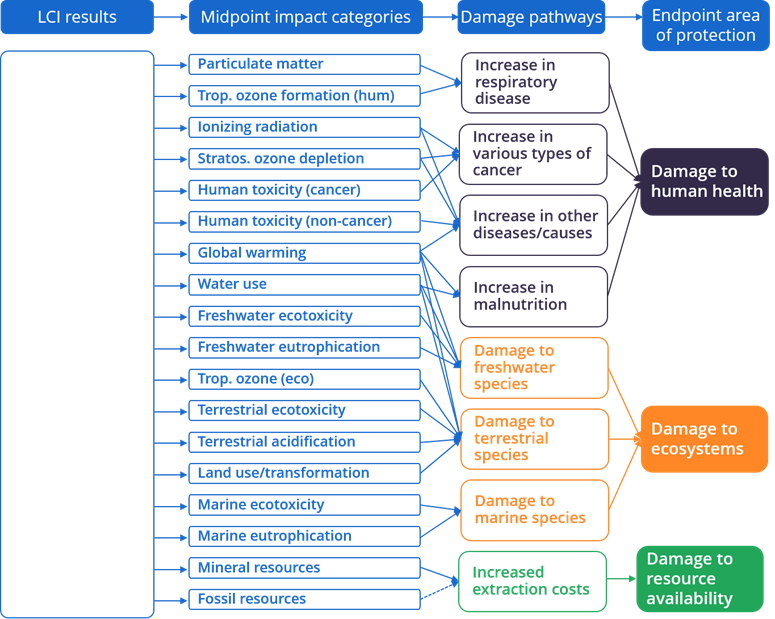
Framework of the ReCiPe method: Relationship between LCI results, midpoint impact category and endpoint impact categories
Three cultural perspectives
Besides selecting a level of impact categories that suits your objective, it is also important to choose a cultural perspective that aligns with the goals of your LCA study. The cultural perspective represents the way of dealing with unavoidable subjective choices. The ReCiPe method includes factors for three different cultural perspectives: individualist (I), hierarchist (H), and egalitarian (E). Among these three cultural perspectives, the hierarchist (H) perspective is the most commonly used because it is rooted in scientific consensus. You might also consider analyzing the other two perspectives to evaluate how sensitive the results are to your choice, as part of a sensitivity analysis.
| Time perspective | Manageability | Required level of evidence | |
|---|---|---|---|
| Individualist (I) | Short time | Technology can avoid many problems | Only proven effects |
| Hierarchist (H) | Balance between short and long term | Proper policy can avoid many problems | Inclusion based on consensus |
| Egalitarian (E) | Very long term | Problems can lead to catastrophe | All possible effects |
More information on the perspectives and weighting approach in ReCiPe is available on the SimaPro Help Center.
Selecting an impact assessment method for your LCA
Besides ReCiPe, there are a lot of other impact assessment methods. You should base the selection of your impact assessment method on the goal and scope of your study. The table below lists properties of three often used methods: ReCiPe, Environmental Footprint (EF), and GLAM (Guidance for LCA indicators and Methods). This might help you decide which one fits your goal and scope.
| ReCiPe | Environmental Footprint (EF) | GLAM (Guidance for LCA indicators and Methods) | |
|---|---|---|---|
| Scope | Global | European | Global |
| Level of maturity | Established and widely used | Official method for EU PEF/OEF studies | Recently launched, based on scientific consensus |
| Number of impact categories | Broad (18 midpoint, 3 endpoint categories) | Broad (16 midpoint categories) | Broad (23 midpoint, 3 endpoint categories) |
| Midpoint vs. endpoint | Both midpoint and endpoint indicators | Only midpoint indicators | Both midpoint and endpoint indicators |
| Normalization and weighting available | Yes, weighting factors for different perspectives | Yes | Yes, probably multiple versions |
| Geographical specificity | Global average | Europe-specific characterization factors | Global relevance and regional differentiation |
| Regulatory use | Not mandated by policy | Mandated for EU PEF/OEF applications | Intended for global harmonization (UNEP support) |
| Recommended use | General purpose LCA, global studies | PEF/OEF-compliant studies in European context | Global studies aiming for future harmonization |
| Update frequency | Periodic updates (latest: ReCiPe 2016) | Maintained by JRC for EF compliance | Evolving; updates as guidance matures |
| Available in SimaPro | Yes | Yes | Not yet implemented |
ReCiPe was initially developed in 2008 through cooperation between RIVM, Radboud University Nijmegen, Leiden University, and PRé Sustainability. It was later updated in 2016. The ReCiPe 2016 version was created in collaboration between the Dutch National Institute for Public Health and the Environment (RIVM), Radboud University Nijmegen, Norwegian University of Science and Technology, and PRé.
For more information on ReCiPe, please visit the RIVM website.