What is DevOps? (original) (raw)
DevOps defined
DevOps is a software development methodology that supports the efficient, continuous delivery of innovative, high-performing applications and services.
By integrating the processes, tools, and practices used by software development (Dev) and IT operations (Ops) teams, it builds speed and agility into every phase of the development lifecycle so that organizations can compete more effectively.
How DevOps works
Prior to the 2000s, IT teams worked primarily in silos—developers wrote software code and then handed it off to operations experts for deployment. This method often resulted in miscommunications, errors, and delayed, unsustainable release cycles.
DevOps concepts and practices took root in the 2000s, gradually replacing this siloed, linear approach with a more cohesive, flexible model. Early DevOps efforts combined development and operations teams into a single DevOps team. Today, this team also often includes quality assurance engineers, security professionals, and other stakeholders.
DevSecOps—short for development, security, and operations—integrates security into every part of the development lifecycle. Using automated security tools, developers identify and address security vulnerabilities as they code instead of waiting for security teams to address these vulnerabilities after deployment. For GitHub, good DevOps is synonymous with DevSecOps.
DevOps is based on three foundational principles:
- Cross-team collaboration: DevOps fosters a culture that values teamwork and open communication. Aided by integrated processes and tools, development and IT operations teams have visibility into and can discuss each other’s priorities and concerns, helping them respond quickly to changes and issues. Also, the DevOps team is guided by shared goals, with everyone taking greater accountability for lifecycle phases outside their area of expertise.
- Automation: DevOps automation streamlines repetitive tasks such as testing, deployment, and monitoring. Using robust workflow automation tools, the DevOps team can work with greater accuracy and efficiency, enabling them to focus on more strategic activities. Similarly, DevSecOps automates security-focused processes, helping teams efficiently protect software against vulnerabilities.
- Continuous integration and continuous delivery (CI/CD): DevOps thrives on CI/CD practices. Continuous integration involves regularly merging code changes into a shared repository where they’re automatically tested. Continuous delivery automatically prepares code changes for release to production, allowing for frequent and reliable software updates.
Benefits of DevOps
DevOps is designed to deliver significant advantages, including these top benefits:
- Enhanced collaboration: DevOps makes software development faster, friendlier, and more collaborative. With the ability to efficiently communicate throughout the development lifecycle, DevOps teams can more easily align their activities and solve problems.
- Increased efficiency: DevOps reduces manual tasks and streamlines workflows through automation, boosting productivity and improving developer experiences. In addition, CI/CD practices result in more reliable, consistent, and frequent release cycles.
- Improved quality and security: Continuous code integration and testing minimizes defects, increasing software stability and reliability. Also, DevOps teams use CI/CD and other tools to build security practices into development, allowing potential issues to be identified and addressed before deployment.
- Faster time to market: Automated workflows and frequent cross-team communications increase productivity, helping reduce the time from product inception to launch. DevOps teams can respond with greater agility to market demands and rapidly deliver customer updates that include new, innovative features.
The DevOps lifecycle
Often represented by an infinity loop, the DevOps lifecycle is continuous and iterative in nature. Even though it has no true beginning or end, the lifecycle can be characterized by the following eight phases, each supported by its own workflow and tools:
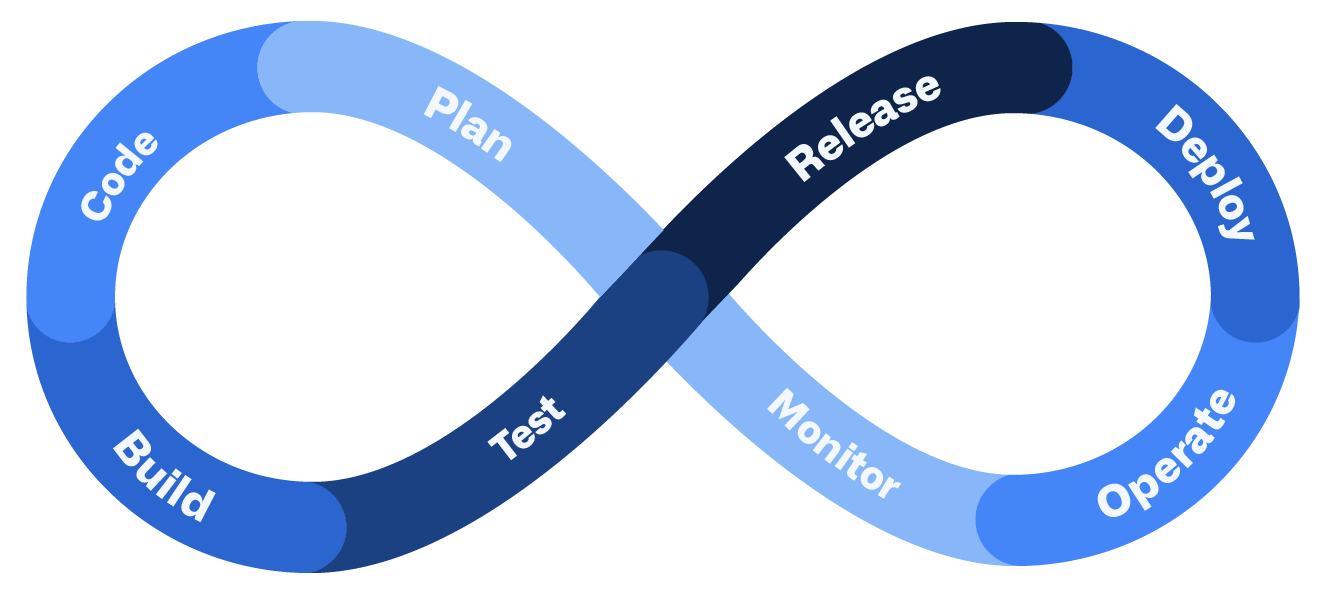
- Plan: Define project goals, software requirements, and timelines. Careful planning establishes a solid foundation for the coding process.
- Code: Develop the software to meet the defined requirements. This phase involves writing and reviewing code.
- Build: Integrate the code into the existing code base. Automated build and version control tools help ensure that the updated software is ready for testing.
- Test: Perform automated and manual testing to identify and fix defects. Continuous testing practices help ensure the software meets quality standards.
- Release: Prepare the software for deployment. This phase involves packaging the software so it’s ready for production, assigning it a unique version number for tracking, and performing final quality assurance checks.
- Deploy: Push the software to a live environment where it’s accessible to customers and other users. Automated continuous delivery tools help facilitate smooth, reliable releases.
- Operate: Manage the software in production. Operations teams fine-tune configuration and runtime needs so the software runs efficiently.
- Monitor: Continuously monitor the software and infrastructure to gather performance, usage, and other data. Automated monitoring tools track and record the insights, which are used to troubleshoot problems and drive planning for the next iteration.
The role of AI in DevOps
DevOps is undergoing a significant shift made possible by advancements in AI technologies, including machine learning (ML) and generative AI. Empowered with AI-powered tools, DevOps teams can add some automation at every phase of the DevOps lifecycle.
Here are just a few examples of AI in DevOps:
- Developers teams use AI-assisted code suggestions to write code more efficiently and with greater accuracy.
- Developers speed software delivery by using AI to automatically run tests on new code.
- Operations teams use AI to monitor software in real time and receive alerts when specific conditions are met, helping prevent downtime.
- Security analysts ask AI to summarize software and system vulnerabilities and provide suggestions on how to address them.
Five challenges of adopting DevOps
Modernizing the entire software development lifecycle so it efficiently supports DevOps practices requires a good deal of expertise and effort. Here are five common challenges associated with making the transition:
- Updating an outdated infrastructure: Older systems often lack the flexibility and compatibility required for continuous integration and delivery. These environments weren’t built for automation or rapid iteration, making it difficult to introduce DevOps practices without extensive system reengineering or parallel operations.
- Developing infrastructure as code (IaC) skills: Automated, code-driven infrastructure management, or IaC, can drastically improve development speed and consistency. However, it comes with a steep learning curve. Teams must be trained not only in coding infrastructure but also in version control, test automation, and secure deployment practices. Mistakes in IaC can have wide-reaching consequences if not carefully managed.
- Managing microservices: DevOps combines IaC with microservices, which use a cloud-native architecture to build each application from smaller, independent services. Managing dozens or hundreds of services demands a mature pipeline, robust monitoring, and seamless communication—areas where many organizations struggle during early stages of DevOps adoption.
- Learning to prioritize people over tools: While tools are essential to DevOps success, relying too heavily on them can lead to tool sprawl and inefficiencies. It can also detract from the fundamental principles of team collaboration, transparency, and accountability. A strong DevOps culture, supported by a clear organizational structure and aligned processes, are top priorities.
- Incorporating security practices: Strong security practices, including ongoing security monitoring and security testing, must be balanced with DevOps efficiency. Careful planning, close cross-team collaboration, and robust tools are key to maintaining security without sacrificing delivery speed.
To efficiently adopt a DevOps model, your organization should gradually modify its processes and pragmatically address any technology constraints. You’ll need to steadily build an effective DevOps pipeline—the combination of automation, tools, and practices supporting every phase of the DevOps lifecycle. Also, be sure to invest in upskilling teams and promote cultural change.
Best practices for adopting DevOps
Organizations across industries—including in retail, finance, and media—have successfully implemented DevOps by embracing the following best practices:
- Continuous integration: Frequently merge code into a shared repository, where automated builds and tests can catch issues early.
- _Success story:_A multinational e-commerce company uses CI to run automated tests every time they commit code, helping ensure a high-quality codebase despite hundreds of daily changes.
- Continuous delivery: Automatically push changes through the DevOps pipeline to staging or production, resulting in faster, smoother delivery.
- Success story: A software company uses CD to test new application functionality with subsets of users before broadly rolling it out, reducing the risk of large-scale failures.
- Automation: Streamline testing, security scans, deployment, and monitoring through automation, increasing efficiency and reducing errors.
- Success story: A large bank holding company automates its entire build-test-deploy pipeline, including security checks. This dramatically reduces the time needed to approve code changes from weeks to hours, all while improving compliance.
- Situational awareness: Observe and understand what is happening in the DevOps pipeline—and accurately predict what will happen—to identify issues in real time and proactively resolve them.
- Success story: A healthcare organization uses central logging and real-time alert systems to track user behavior and error rates during a new application feature rollout. If necessary, they can quickly roll it back.
- Infrastructure as code: Use repeatable code to automatically provision and configure infrastructure whether on premises or in the cloud, helping teams work faster at scale.
- Success story: A hospitality company uses IaC to spin up identical environments for development, testing, and production. This makes the deployment process smoother and more consistent across its DevOps teams.
- Microservices: Adopt a microservice architecture to support the efficient development, deployment, and scaling of innovative, cloud-based services.
- Success story: DevOps teams at a ride-sharing company work independently on driver-matching, trip-tracking, and other microservices, allowing each team to evolve its service without affecting other service cycles.
- Monitoring: Continuously monitor software and infrastructure throughout the development lifecycle to detect issues and gather performance data.
- Success story: Whenever a large retail chain launches a new online service, it monitors IT metrics _(_e.g., server uptime) and business metrics (e.g., click-through rates) to help assess the service’s technical performance and strategic impact.
In addition to adhering to best practices for implementing DevOps, consider these tips on what to avoid:
- Don’t dive into automation without fixing broken processes first—you’ll just automate chaos.
- Don’t neglect collaboration—DevOps is about people working together.
- Don’t force a one-size-fits-all toolset across teams—what works for one team might not work for another.
- Don’t skimp on project and process documentation—it’s critical to team efficiency and collaboration.
Instead, do set clear goals, proceed thoughtfully, and stay open to learning new things.
Every organization builds out its own set of DevOps tools, known as its DevOps toolchain, designed to enhance the efficiency, reliability, and security of the entire development lifecycle. Here are four primary categories of DevOps tools that successful DevOps organizations use:
- CI/CD tools automate the integration and deployment of code changes, reducing manual intervention while speeding the release cycle.
- Workflow automation tools streamline infrastructure provisioning, configuration management, and application deployment, using predefined scripts and configurations to improve consistency and accuracy.
- Version and source control tools manage changes to code over time, ensuring that all modifications are tracked and can be easily reverted if necessary.
- Security tools continuously monitor and test code for vulnerabilities, manage credentials (known as secrets), and enforce compliance with security standards.
Conclusion
DevOps is a software development methodology focused on continuous improvement and innovation. By embracing DevOps practices and tools, your organization can improve its operational efficiency while building more secure, high-quality software at scale.
GitHub offers a range of DevOps products, to help your organization build a complete DevOps toolchain, including:
- Git, an open-source version control system that supports parallel development, seamless collaboration, and accurate tracking of changes across teams.
- GitHub, a unified DevOps platform that boosts developer productivity, innovation, and satisfaction with AI-powered tools. Start a free trial.
- GitHub Actions, a comprehensive CI/CD platform that allows developers to automate, customize, and execute workflows while in their repositories.
- GitHub Copilot, an AI coding assistant that helps developers write code faster and with less effort.
- GitHub Advanced Security, a set of powerful security tools integrated into GitHub that automates security practices through every phase of the lifecycle, including scanning code as it’s created and suggesting fixes.