AI Mode has landed in Australia: here’s what we know so far (original) (raw)
Google’s AI Mode officially launched in Australia last week, bringing conversational search and generative summaries to local users.
And while we’re still waiting on the Australian data, the early US studies are already showing how it reshapes user behaviour – and what that means for visibility, clicks, and brand perception.
This isn’t just another interface change. It’s the start of search becoming a decision engine. As users spend more time inside AI summaries, Google’s influence over brand perception grows. The shift from search “find me a link” to research “help me decide” means discoverability and brand narrative are now unfolding in the same space.
Two early studies, one from Kevin Indig and Eric Van Buskirk, and another from iPullRank, point to the same conclusion: AI Mode is changing where people make decisions and how they evaluate brands.
What Kevin Indig and Eric Van Buskirk’s usability study found
AI Mode holds attention. Around three-quarters of users never left the AI pane, and 88% of first interactions were with the generated text.
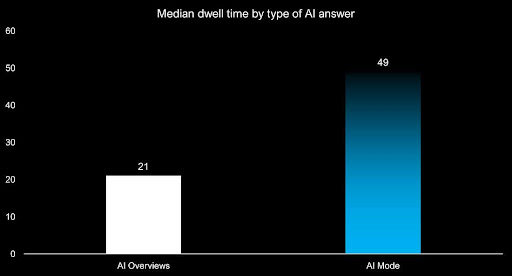
Clicks are rare. The median number of external clicks per task was zero. Seventy-seven percent of sessions ended without a site visit, and when users did click, it was usually to buy.
People skim but still decide. More than half of participants scanned the summary, formed an impression, and moved on.
AI Mode matches site type to intent. It surfaces brands, marketplaces, review sites, or publishers based on what the user wants to achieve, not just on keyword relevance.
Visibility, not traffic, is the new currency. Brand judgments are being made directly inside AI Mode, where exposure and framing now shape perception.
Even Google’s own leadership has hinted at this shift. On the Lex Fridman Podcast, Sundar Pichai called AI Mode “a proving ground for what the core search experience will look like.”
To put it simply, this isn’t an experiment. It’s a preview of what search will soon become.
Those few clicks that remain are largely transactional – users who’ve already decided. Awareness, evaluation, and preference are now happening inside AI Mode. For eCommerce and D2C brands, optimisation must move upstream: from conversion pages to citation-worthy content and trust signals that influence decisions earlier.
What iPullRank’s publishing study adds
The iPullRank study, focused on news and publishing behaviour, reinforced Indig’s findings – but added one key insight: trust and familiarity still matter.
- Users rarely started research in AI Mode without prompting; many defaulted to familiar news sites or social feeds.
- Scepticism was high for time-sensitive topics, with doubts about whether summaries were current or accurate.
- Even when they used AI Mode, they spent around a minute in the pane, scanning and then returning to known sources for confirmation.
- Dwell times mirrored Indig’s findings (50–70 seconds), showing that once inside, users stay long enough to form opinions.
The takeaway? AI Mode captures attention, influences perception, and reduces clicks – but trust still comes from recognisable, credible brands.
What this means for Australian brands
As AI Mode rolls out locally, visibility will depend on how well your brand is understood, cited, and trusted inside generative results.
The traditional funnel, rank, click, convert, is being replaced by recognise, summarise, and decide.
We’re seeing a growing divide between search and research:
- Search is where users go to transact or navigate.
- Research – where they explore, compare, and form opinions – is now unfolding inside AI Mode and other generative tools.
That means your brand must win twice: once inside the summary where opinions form, and again in search when users are ready to act.
How Google frames AI Mode and what that means for brands
Google describes AI Mode as the next leap in Search. A shift from information to intelligence.
In its official announcement for Australian marketers, Google highlights how Gemini-powered reasoning now lets users ask more complex questions, discover confidently, and act faster. Early results show query lengths doubling, satisfaction rising, and higher-quality clicks when users do visit a site.
It’s an optimistic, opportunity-led view but it’s not wrong.
Richer queries mean better intent signals. But they also mean the decision-making moment happens earlier, inside the summary, where trust, clarity, and brand familiarity shape outcomes long before a click.
For Australian marketers, the takeaway is balance.
Yes, AI Mode opens new ways to be discovered — through text, image, or even gesture. But it also redefines what discovery looks like. Success now depends less on keyword volume and more on whether Google’s systems can understand, describe, and trust your brand when it matters most.
What we’re telling clients
- Audit your brand presence inside AI summaries.
How is your brand described? Which competitors appear beside you? - Prioritise entity clarity.
Google’s systems need a clear, consistent understanding of who you are to describe you accurately. - Earn credible mentions.
PR, reviews, and citations from trusted domains build confidence, for both users and AI models. - Match your site type to intent.
If Google recognises you as a brand, review site, or marketplace, lean into that. Create content that fits the role you’re likely to play. Some may need to partner with complementary site types, like review or publisher domains, to stay visible across multiple intents. - Reframe your metrics.
Start measuring presence, sentiment, and citation frequency inside AI results, not just traffic or rankings.
Our early analysis
AI Mode isn’t a minor update. It’s a behavioural shift in how users discover and decide.
The Indig/Van Buskirk study shows that decisions are being made inside the pane. The iPullRank study reminds us that trust still anchors those decisions.
The distinction between search and research is now the defining line for marketers: visibility in search drives transactions; visibility in research drives preference.
Australian brands have a short window to act. Those that move early – clarifying entities, building credibility, and aligning content to intent – will not only appear in AI summaries but also earn belief inside them.
In this new search era, trust becomes the differentiator: the quality that determines not just whether your brand is seen, but whether it’s chosen.