Maritime crackdown expands from Hormuz to the Med (original) (raw)
Indian Coast Guard
US forces disabled a VLCC in the Gulf of Oman yesterday after the vessel attempted to breach Washington’s naval blockade of Iran, while the European Union simultaneously escalated pressure on both Tehran and Russia’s shadow fleet.
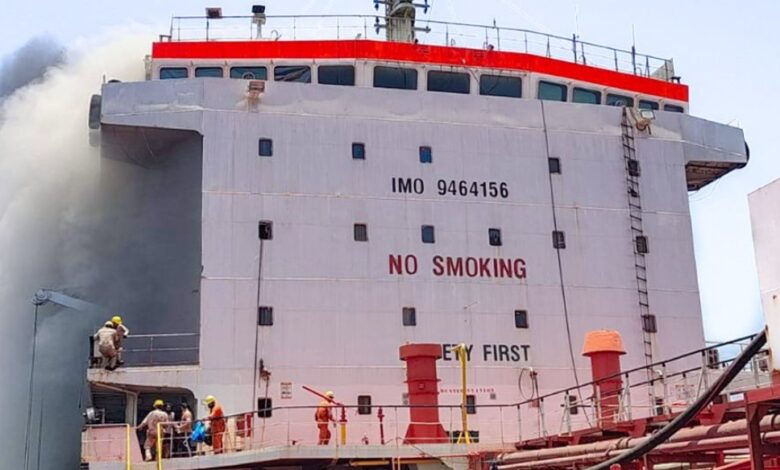
US Central Command (CENTCOM) disabled the Palau-flagged Marivex (pictured) on June 8 after the unladen vessel transited international waters toward an Iranian port in violation of the blockade imposed on April 13. An F/A-18 Super Hornet from the USS Abraham Lincoln fired a precision munition into the ship’s engineering and steering spaces after the crew failed to comply with directions from US forces. Twenty-four Indian seafarers were aboard at the time of the strike. All were subsequently rescued safely, the Indian Seafarers’ Union confirmed.
The Marivex strike is the seventh vessel disabled by CENTCOM since the blockade began. US forces have redirected 134 ships that complied with instructions and allowed 42 vessels carrying humanitarian aid to pass through since operations commenced nearly two months ago.
The strike came on the same day that the European Union announced fresh sanctions against Iran over threats to freedom of maritime navigation. EU foreign policy chief Kaja Kallas confirmed the measures but offered few immediate details. “The bloc has imposed sanctions on Iranian individuals and entities for threatening the freedom of maritime traffic,” she told reporters.
Kallas made the announcement in Cyprus ahead of a meeting of EU defence ministers, where a second major maritime enforcement decision was also confirmed. The EU has expanded the mandate of its EUNAVFORMED IRINI naval operation to authorise the inspection of vessels linked to Russia’s shadow fleet operating in the Mediterranean.
The IRINI operation was originally launched in 2020 to monitor compliance with the UN arms embargo on Libya, but its remit has now been significantly broadened. Kallas said the operation has changed its rules of engagement and inspections have already begun. “Our IRINI operation has changed its rules of engagement, and we are now also beginning to inspect ships,” she said. “This involves developing a common approach to how different countries deal with these vessels, as they pose a real danger. And, of course, the goal is to prevent Russia from financing the war.”
Starting out with the Informa Group in 2000 in Hong Kong, Sam Chambers became editor of Maritime Asia magazine as well as East Asia Editor for the world’s oldest newspaper, Lloyd’s List. In 2005 he pursued a freelance career and wrote for a variety of titles including taking on the role of Asia Editor at Seatrade magazine and China correspondent for Supply Chain Asia. His work has also appeared in The Economist, The New York Times, The Sunday Times and The International Herald Tribune.
Read Next
June 10, 2026
PXGEO signs Equinor deal for autonomous subsea inspection trials
June 10, 2026
Lloyd’s Register names Matthias Altendorf as next chair
June 10, 2026
New Brazilian biofouling rules come with fines of up to $9m
June 10, 2026
Aker BP teams up with Viridien to advance Norwegian exploration
June 10, 2026