The Neil Gehrels Swift Observatory (original) (raw)
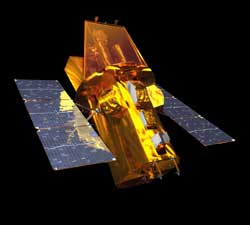 Gamma-ray bursts (GRBs) are the most powerful explosions the Universe has seen since the Big Bang. They occur approximately once per day and are brief, but intense, flashes of gamma radiation. They come from all different directions of the sky and last from a few milliseconds to a few hundred seconds. So far scientists do not know what causes them. Do they signal the birth of a black hole in a massive stellar explosion? Are they the product of the collision of two neutron stars? Or is it some other exotic phenomenon that causes these bursts?
With Swift, a NASA mission with international participation, scientists have a tool dedicated to answering these questions and solving the gamma-ray burst mystery. Its three instruments give scientists the ability to scrutinize gamma-ray bursts like never before. Within seconds of detecting a burst, Swift relays its location to ground stations, allowing both ground-based and space-based telescopes around the world the opportunity to observe the burst's afterglow. Swift is part of NASA's medium explorer (MIDEX) program and was launched into a low-Earth orbit on a Delta 7320 rocket on November 20, 2004. The Principal Investigator is Dr. Brad Cenko (NASA-GSFC).
NASA's Swift Studies Gas-Churning Monster Black Holes

Scientists using observations from NASA's Neil Gehrels Swift Observatory have discovered, for the first time, the signal from a pair of monster black holes disrupting a cloud of gas in the center of a galaxy.
» NASA Release
» En Espanol
» Multimedia
Swift Operations Status
Swift has suspended science observations to prioritize orbital lifetime in support of the reboost mission.
Latest Swift GRBs
- GRB 260204A
- GRB 260127A
- GRB 260122B
» SWIFTGRB Gamma-Ray Burst Catalog
» Data Table of Swift Bursts
» GCN Circulars Archive
Latest Swift News
June 10, 2026
Rocket Integration Complete for Katalyst-NASA Swift Boost
Engineers completed installation of Katalyst Space's LINK robotic servicing spacecraft into a Northrop Grumman Pegasus XL rocket on Tuesday, June 9, at NASA's Wallops Flight Facility in Virginia. Launch is anticipated later this month.
+ Read More
June 5, 2026
Robotic Spacecraft for Swift Boost Mission Arrives at NASA Wallops
The LINK robotic servicing spacecraft, built by Katalyst Space and designed to capture and boost NASA's Neil Gehrels Swift Observatory arrived at the agency's Wallops Flight Facility in Virginia on Friday, June 5.
+ Read More
May 26, 2025
NASA Predicts Swift Spacecraft's Location for Boost Mission
NASA analysts and engineers have been closely tracking the agency's sinking Neil Gehrel's Swift Observatory as part of a fast-paced plan to raise it to a higher orbit.
+ Read More