Gamification in the Workplace: Why and How to Use It | TA (original) (raw)
Key takeaways
- Gamification in the workplace is the use of game techniques in a non-game context.
- Many companies use gamification techniques in sales competitions, learning management strategies, and employee wellness programs.
- When implemented well, gamification software and strategies can increase employee productivity and motivation, attract younger workers, and foster healthy competition.
TechnologyAdvice is able to offer our services for free because some vendors may pay us for web traffic or other sales opportunities. Our mission is to help technology buyers make better purchasing decisions, so we provide you with information for all vendors — even those that don’t pay us.
Featured partners
Gamification in the workplace is the use of game mechanics, like points, badges, and challenges to improve employee engagement, motivation, and performance. Companies use it in sales, onboarding, training, and wellness because it increases participation, improves knowledge retention, and supports a more motivated, feedback-driven culture.
Gamification is particularly effective for remote and hybrid companies because it creates shared experiences and friendly competition, even when employees are spread across different locations. With the right tools, it can strengthen learning outcomes, boost productivity, and help teams stay connected day-to-day.
Some gamification techniques you can use in your workplace include:
- Creating a leaderboard to encourage healthy competition
- Awarding digital badges for hitting milestones
- Sending weekly or monthly “report cards” or check-ins that summarize employees’ standings
- Transforming training courses into quests or challenges
- Offering a lottery or sweepstakes prize for completing certain objectives
- Providing points or credits that can be redeemed for tangible rewards
How does gamification show up in the workplace?
While gamification is no longer a new thing to anyone in the business world, it’s still difficult to manage it effectively without technology. Fortunately, there are many tools that you can implement to leverage gamification to support your sales team, training curriculum, or wellness program.
Sales competitions
Salespeople are already driven by metrics, and the idea of a performance-based contest is appealing since competition forms the foundation of sales.
Companies often use gamification in sales to:
- Achieve higher outbound activity
- Increase pipeline volume with real-time visibility
- Improve team morale and cross-team recognition
- Speed up ramp time for new SDRs
Salespeople compete against their company’s bottom line and must bring in enough revenue to justify their position or secure a bonus. They must also compete against rejection, which is significantly more common than closing a deal.
That’s why gamification is a logical partner for sales competitions: applying game elements using software like Ambition encourages selling behavior and motivates the team to close more deals. Sales teams can set up leaderboards for various goals to balance collaboration and individual progress.
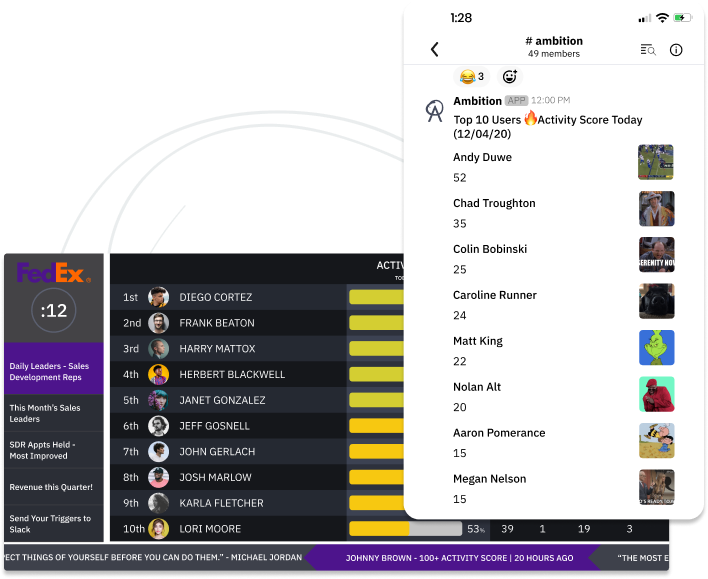
Ambition integrates with communication tools like Slack to make friendly competition a bigger part of day-to-day interactions. Source: Ambition
What to watch out for when gamifying sales
Sales competitions can fall flat if they lean too heavily on winner-take-all rankings, measure only closed deals instead of daily activities, or rely on the same rewards every cycle. Keep the goals balanced and incentives fresh to help the program stay motivating.
Learning management paths
Onboarding and training programs are necessary parts of doing business. However, many traditional training courses are tedious, and few employees are motivated to complete them in a timely manner. Even if they do finish the course on time, few employees retain all the important information.
Gamified learning programs are often structured around quest- or challenge-based courses. For example, Centrical lets you choose from different game narrative options like a car race or a game of hide-and-seek.
Gamification in workplace learning often lead to:
- Higher training completion rates
- Better knowledge retention due to spaced reinforcement
- Increased on-time compliance certification
- Greater sense of progress for new hires during onboarding
Whether you need to train a new hire about the company’s processes, conduct annual compliance certifications, or teach a whole department how to use a new software platform, this gamified structure helps improve knowledge retention and on-time completion rates.
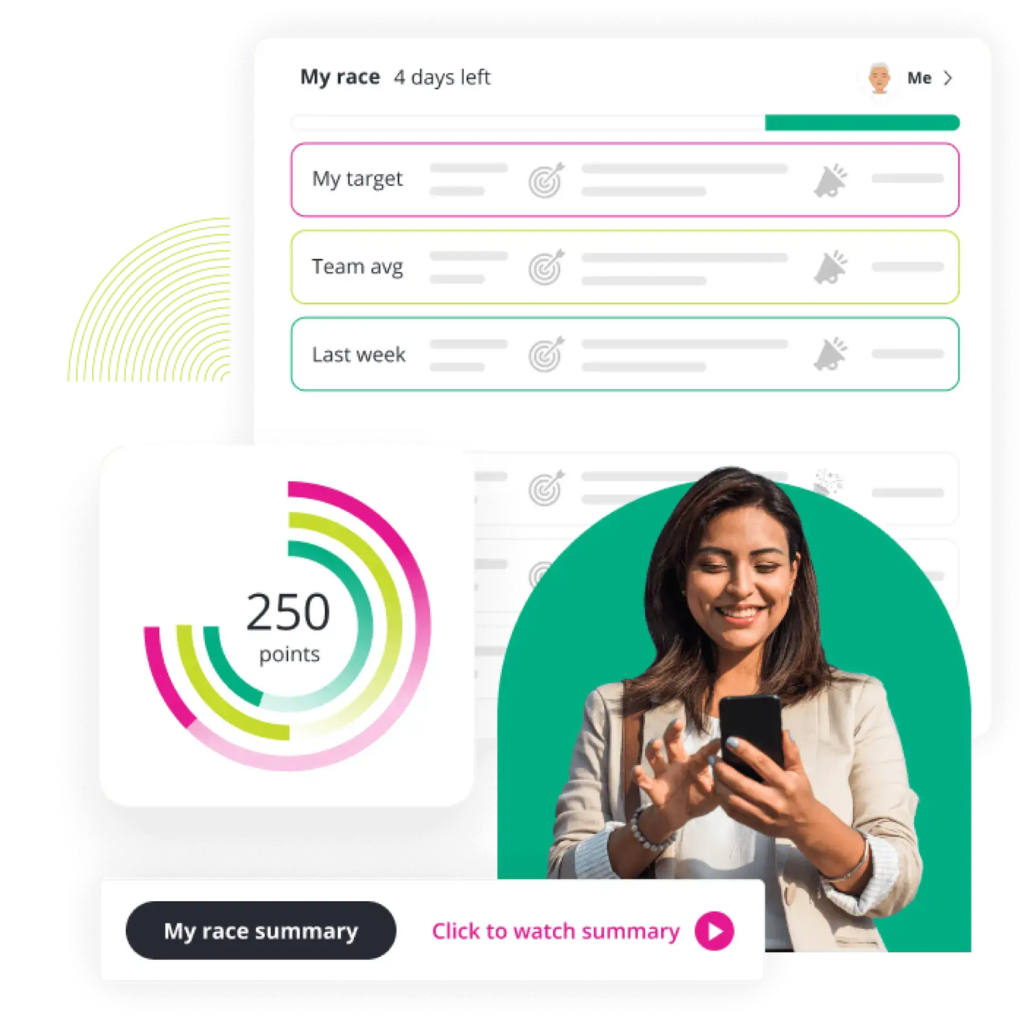
You can tailor Centrical’s gamified learning paths to be most effective for different teams or training programs. Source: Centrical
Pitfalls to avoid when gamifying learning
Long or overly complex learning paths can drag down completion rates, and passive content makes it harder for employees to retain information. Repeating the same challenge format can also cause engagement to drop. Mixing formats and keeping lessons focused, however, helps training stay effective.
Health and wellness programs
Effective wellness programs give employees the knowledge and tools they need to improve their lives at work and at home, often leading to higher productivity and lower health insurance costs for both employees and employers.
However, wellness programs are often underutilized because employees either lack awareness or don’t have a clear incentive to participate. Using gamification for these programs can bring:
- Higher participation in step challenges and mindfulness programs
- Better long-term engagement due to ongoing point systems
- Reduced absenteeism and improved morale
- Potential lower healthcare costs for organizations over time
Gamification applies the same principles of friendly competition and milestone accomplishments to motivate employees wherever they are in their wellness journeys.
Depending on the structure of your wellness program, this could take many different forms like step count leaderboards or mindfulness challenges that change from week to week. Many of these programs require self-reporting, but some platforms like Wellable allow employees to sync data from wearable devices such as Fitbits or Apple Watches.
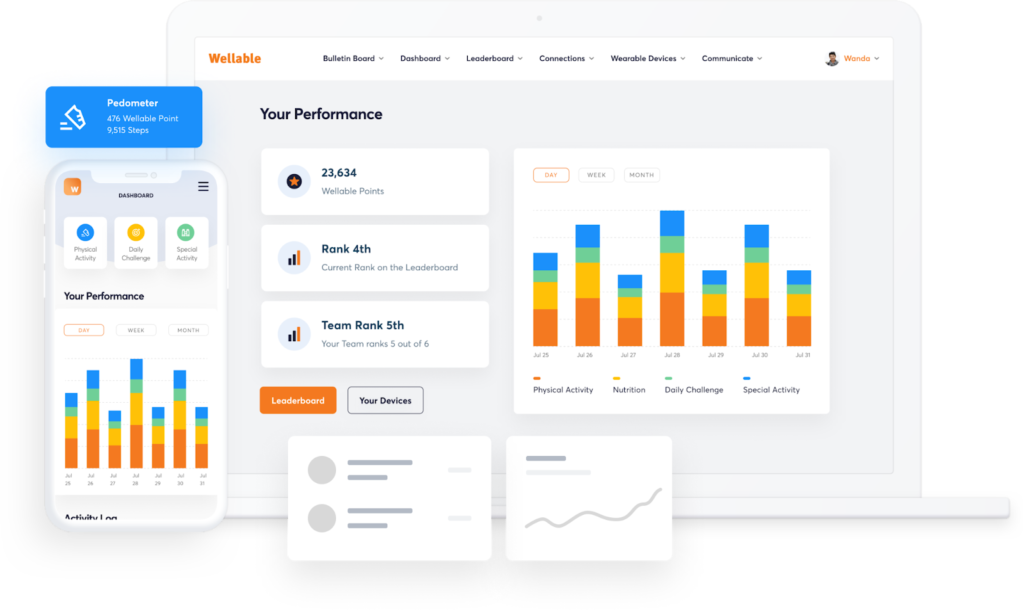
Wellable integrates with the devices your employees already use to track their health metrics and earn points that can be redeemed for rewards.
Where gamifying wellness programs might hit a snag
Wellness programs can lose momentum when participation feels like extra work or when challenges stay the same week after week. Engagement also drops quickly if tracking relies too heavily on manual reporting. Keeping activities varied and making tracking effortless (e.g., synced devices or simple check-ins) helps employees stay involved for a long time.
How to implement gamification in the workplace
1. Determine what to gamify
If your company is new to gamification, then we recommend choosing one area to start with implementation. The examples we listed above—sales competitions, help desks, onboarding, learning management, and health and wellness—are a great place to start.
Pick one to focus your gamification efforts on, and then you can expand into other areas later once you get a feel for what techniques work at your company.
2. Identify gamification goals
Then, decide what big-picture goals you want to reach in that area. Some possibilities include faster completion rates for help desk tickets, increased training participation rates, or higher win rates for sales opportunities.
Identifying the specific goals that you hope to achieve will help you select the most effective gamification techniques.
3. Pick a gamification technique
The specific gamification techniques you implement should be closely tied to your overall goals.
For instance, a leaderboard is an effective tactic to encourage some friendly competition amongst the sales team, but it’s not the best choice if you want to encourage the whole company to complete a training course about new software implementation.
Being selective about which gamification techniques you use will increase your chances of achieving your goals.
4. Select rewards or incentives
Many companies use prizes, gift cards, and other rewards as incentives in their gamification programs. Since employees aren’t motivated to keep winning the same prizes over and over again, some companies rotate reward types quarterly or yearly to keep them fresh. I
f you don’t have a good sense of what rewards your employees will find most motivating, use employee engagement software to survey them about what rewards would be most effective.
5. Configure analytics reports
No gamification program is perfect out of the gate, which is why you should set your key performance indicators (KPIs) before launch.
Many gamified software platforms provide reports and dashboards to track employee activity, success rates, and other metrics so you can see what’s working and what isn’t. Leverage these analytics to make improvements to your gamification program and increase results over time.
6. Gather employee feedback
In addition to tracking quantitative KPIs, gathering qualitative employee feedback will help you measure the effectiveness of the gamification program.
Your employees will likely have recommendations on how the program can be improved, so listen to what they have to say and take their suggestions into account.
Benefits of gamification
Gamification captures employees’ attention through elements like points, progress bars, and challenges. It makes routine tasks feel more interactive, which increases day-to-day motivation and overall participation.
Millennial and Gen Z employees—who grew up with mobile and digital games—tend to respond well to game mechanics. Gamified tools feel intuitive to them, making participation more natural and consistent.
By surfacing real-time progress, gamification creates more frequent feedback loops. Employees can see where they stand, understand what’s improving, and identify where to adjust, fostering a culture of accountability and continuous improvement.
Depending on the design, gamification can encourage friendly competition (through leaderboards) or reinforce teamwork (through shared challenges). This flexibility helps companies tailor the experience to their culture
In learning and onboarding, gamification turns long modules into smaller, more digestible milestones. This structure helps employees complete courses more quickly and retain information more effectively.
When engagement, training outcomes, and performance all improve, the cumulative effect is higher productivity across teams. Although gamification tools require an upfront investment, many companies see the programs pay for themselves through increased output and improved results.
Gamification FAQs
Sales, onboarding, customer support, and learning and development see the strongest impact because these functions rely heavily on activity-based metrics and repeatable processes that gamification enhances.
The most effective rewards are those that employees actually prefer, such as gift cards, PTO hours, spot bonuses, wellness perks, or team experiences. If you can provide them the option to pick, even better. Programs perform best when reward options are refreshed regularly.
It can, but usually only when poorly designed. Overly competitive structures, unclear scoring rules, or repetitive rewards can reduce motivation. Balanced goals, transparent scoring, and varied incentives help prevent this.
Not necessarily. While platforms like Ambition, Centrical, and Wellable offer robust features, companies can start small with simple point systems, progress trackers, or weekly challenges run through their existing tools.