Customer Success Enablement: The Essential Guide (original) (raw)
What exactly is customer success enablement in SaaS?
Customer success enablement is the strategic process of equipping CS teams with the necessary skills, knowledge, tools, and resources to execute customer success functions effectively.
This goes beyond simply providing software or basic training. Enablement focuses on creating a culture of continuous learning and improvement where customer success managers have the confidence and support to excel in their roles. This encompasses a wide range of initiatives, from onboarding programs and knowledge bases to advanced training on customer psychology and communication techniques.
What’s your biggest challenge with customer success enablement in SaaS?
How do you currently measure the effectiveness of your CS team?
What is your primary goal for improving your customer success enablement this year?
Your team is ready for the next level of customer success.
Empower your team with the right tools to drive adoption, reduce churn, and prove their value. See how Userpilot can transform your customer success enablement in SaaS.
Why invest in customer success enablement initiatives?
Not sure if customer success enablement is worth the effort? Here are a few of the benefits you’ll enjoy with the right implementation:
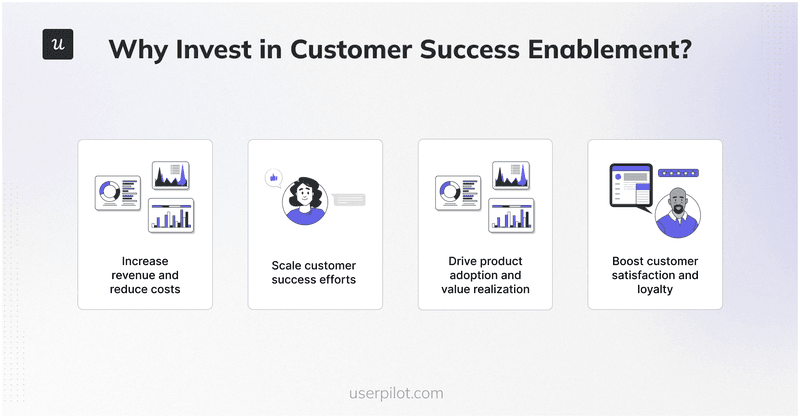
Increase revenue and reduce costs
CS enablement empowers your team to deeply understand customer needs and offer tailored solutions. While these can include everyday problem-solving, they often create opportunities for account expansion.
For example, imagine a customer success manager helping a customer speed up their workflow. During the process, they might identify a need for an add-on or a higher-tier plan with more advanced features. Upselling the customer on this will result in a win-win situation—increased satisfaction for the customer and more revenue for your business.
But that’s not all. Customer success enablement ensures you enjoy reduced costs while your revenue increases. Aberdeen Group’s 2021 research found that companies with robust self-service programs report at least a 2X cost reduction compared to other brands. This is because empowering customers to find solutions on their own reduces the burden on support teams and potentially means lowering costs associated with resolving support tickets.
Scale customer success efforts
Forrester’s 2021 study found that customer-obsessed companies enjoy 2.2 times better customer retention and 2.5 times increased revenue growth. But how do you build a customer-obsessed culture, especially with a rapidly growing user base?
This is where customer success enablement comes in. By leveraging technology and implementing best practices, you can empower your team to deliver exceptional support at scale.
For example, a customer success platform can centralize customer data and communication history. This ensures everyone on your team has the same information and is equipped to support a large number of users without getting overwhelmed.
Drive product adoption and value realization
Enabled customer success managers can deploy the right onboarding flows tailored to each user’s needs. This helps users understand and appreciate your product faster, which naturally results in better adoption rates.
It’s also customary for customer success teams to go beyond initial onboarding and offer continuous support through a variety of channels. This could involve proactive check-ins to assess progress, providing best practice guides, and facilitating access to a comprehensive knowledge base or online community. Such readily available support empowers customers to overcome challenges and confidently explore the product’s full capabilities.
Boost customer satisfaction and loyalty
80% of customers consider the experience a company provides to be as important as its product.
Why? Because a great experience—which is what enablement helps you deliver—makes it easier for customers to maximize the value of their investment. This, in turn, creates a sense of loyalty that encourages them to continue their relationship with your brand.
Customer success enablement vs. customer success: What’s the difference?
To put it simply: Customer success is about helping customers thrive, while customer success enablement focuses on providing your customer success teams with the tools and training programs to achieve that goal.
Here’s a quick comparison table with the nuances:
| Feature | Customer success | Customer success enablement |
|---|---|---|
| Definition | The practice of ensuring customers achieve their desired goals using your platform | The process of equipping your customer success team with the tools and resources they need to drive customer success. |
| Focus | Directly on the customer and their journey towards achieving value. | Internally focused on empowering the customer success team. |
| Goal | Increase customer satisfaction, retention, and lifetime value. | Equip CSMs to effectively execute customer success strategies and drive desired customer outcomes. |
| Activities | Onboarding customers, providing support, building relationships, driving product adoption, identifying upsell/cross-sell opportunities. | Training CSMs, creating knowledge bases, developing playbooks and best practices, implementing tools and technologies. |
| Metrics | Customer Lifetime Value (CLTV), churn rate, customer satisfaction (CSAT), Net Promoter Score (NPS), product adoption rate. | Time to proficiency for new CSMs, utilization of enablement resources, internal CSAT scores for enablement programs, impact on overall customer success metrics. |
| Impact on customer | Directly influences the customer’s experience, product adoption, and overall success with the product. | Indirectly impacts the customer by empowering CSMs to provide better support, guidance, and value. |
Who owns customer success enablement?
Determining who owns customer success enablement isn’t always straightforward.
The answer often depends on the size and structure of your organization. In smaller companies, this responsibility might fall on the shoulders of a customer success leader or even the head of sales. As companies grow, they often dedicate specific roles or teams to focus on enablement. However, regardless of who takes the lead, it’s crucial to have clear ownership and accountability to ensure proper implementation.
It’s also worth noting that effective success enablement thrives on cross-functional collaboration. Here are some of the key players and their typical roles:
- Success enablement manager: This role is responsible for creating training programs, curating knowledge resources, implementing enablement tools, and measuring the effectiveness of initiatives.
- Customer success operations (CS Ops): CS Ops manage the technology stack, analyze customer data to identify enablement needs, and streamline processes to optimize CSM workflows.
- Customer success managers/leadership: CSMs are the direct beneficiaries of enablement efforts, and their feedback is essential for continuous improvement. CS leadership provides strategic direction, ensures alignment with customer success goals, and advocates for the resources needed to support enablement initiatives.
- Others: Members of the marketing, sales, support, and product development teams can often provide valuable insights into customer needs and challenges. It’s good practice to involve them when drafting enablement strategies.
How to implement a customer success enablement strategy
Building a successful customer success enablement strategy requires a thoughtful and structured approach. Here’s a breakdown of how to go about it:
1. Assess your current needs
Begin by taking a few steps back to analyze your current situation. Review customer feedback, support tickets, and churn data to identify common customer pain points and areas where CS can better support customers.
One of the best ways to collect this kind of data is through churn surveys. If customers are downgrading or canceling their subscriptions, then they likely have a lot to complain about.
Use a two-step exit survey to maximize responses. The first question should be a multi-choice that provides several options to choose from (as in the image below). Then, follow up with a space for customers to express themselves.
Here’s an example of how Userpilot makes it easy to create surveys like this from scratch:
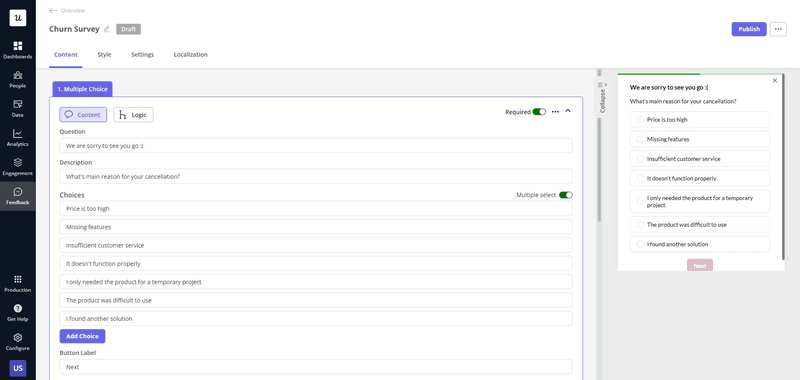
Churn survey built with Userpilot.
Next, conduct thorough interviews with your customer success team members.
Ask open-ended questions to uncover their pain points, knowledge gaps, and resource requirements. What challenges do they face daily? What tools or information would empower them to be more effective? Which training topics would be most beneficial?
Finally, combine all the insights from your customer success teams, user data, and existing resources to gain a clear picture of your enablement needs and set the stage for a successful strategy.
2. Define clear goals and objectives
Once you have a firm grasp of your needs, the next step is to establish clear goals and objectives for your customer success function. These goals should be specific, measurable, achievable, relevant, and time-bound (SMART).
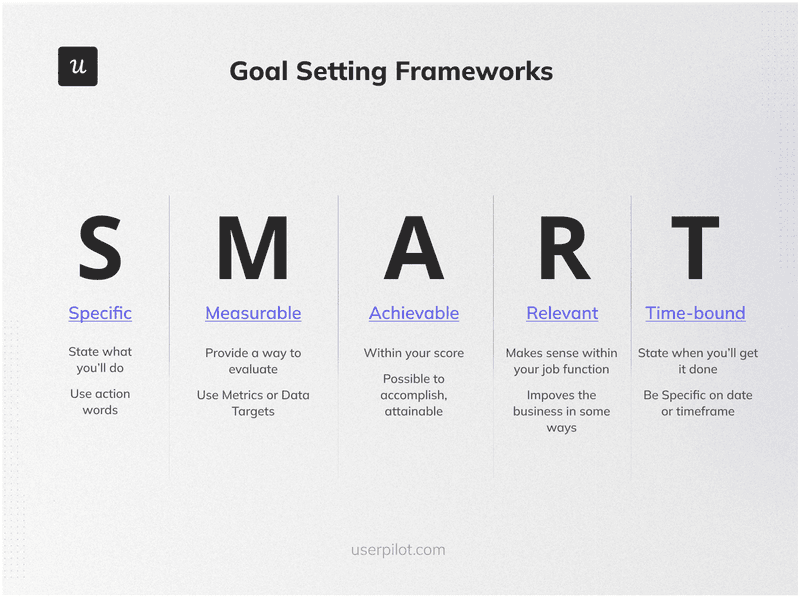
The smart goal-setting framework.
They should also be aligned with your overall customer success strategy and contribute to broader business objectives. To make this happen, consider setting goals across different categories. Here are two examples to inspire you:
- Customer retention: “Reduce customer churn by 10% within the next quarter by providing customer success enablement managers with proactive intervention strategies and early warning signals for at-risk customers.”
- CSM efficiency: “Use automation to reduce the load on customer success teams by 10%”
3. Develop customer-first content
High-quality, relevant, and engaging content is the cornerstone of effective customer success enablement. This content should directly address customer needs and help them succeed with your product.
To achieve this, develop a comprehensive library of resources that address the specific challenges identified in your needs assessment. Mix content formats like videos, interactive walkthroughs, articles, templates, and checklists to cater to different learning styles.
Here’s an example of Userpilot’s resource center:
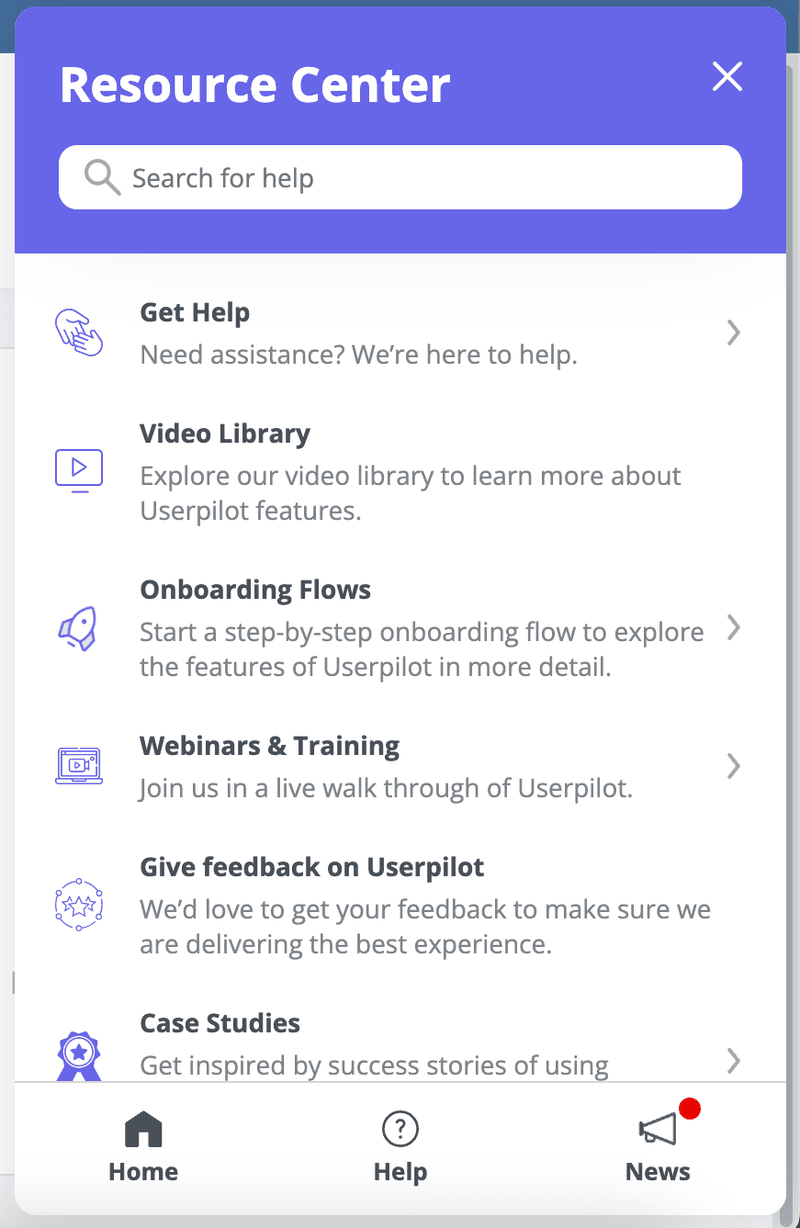
Design effective knowledge bases and answer common customer interactions code-free with Userpilot.
Involve customers in the content development process by triggering contextual surveys at key points in their journey. For example, you can use our platform to make non-intrusive CSAT feedback pop-ups like this:
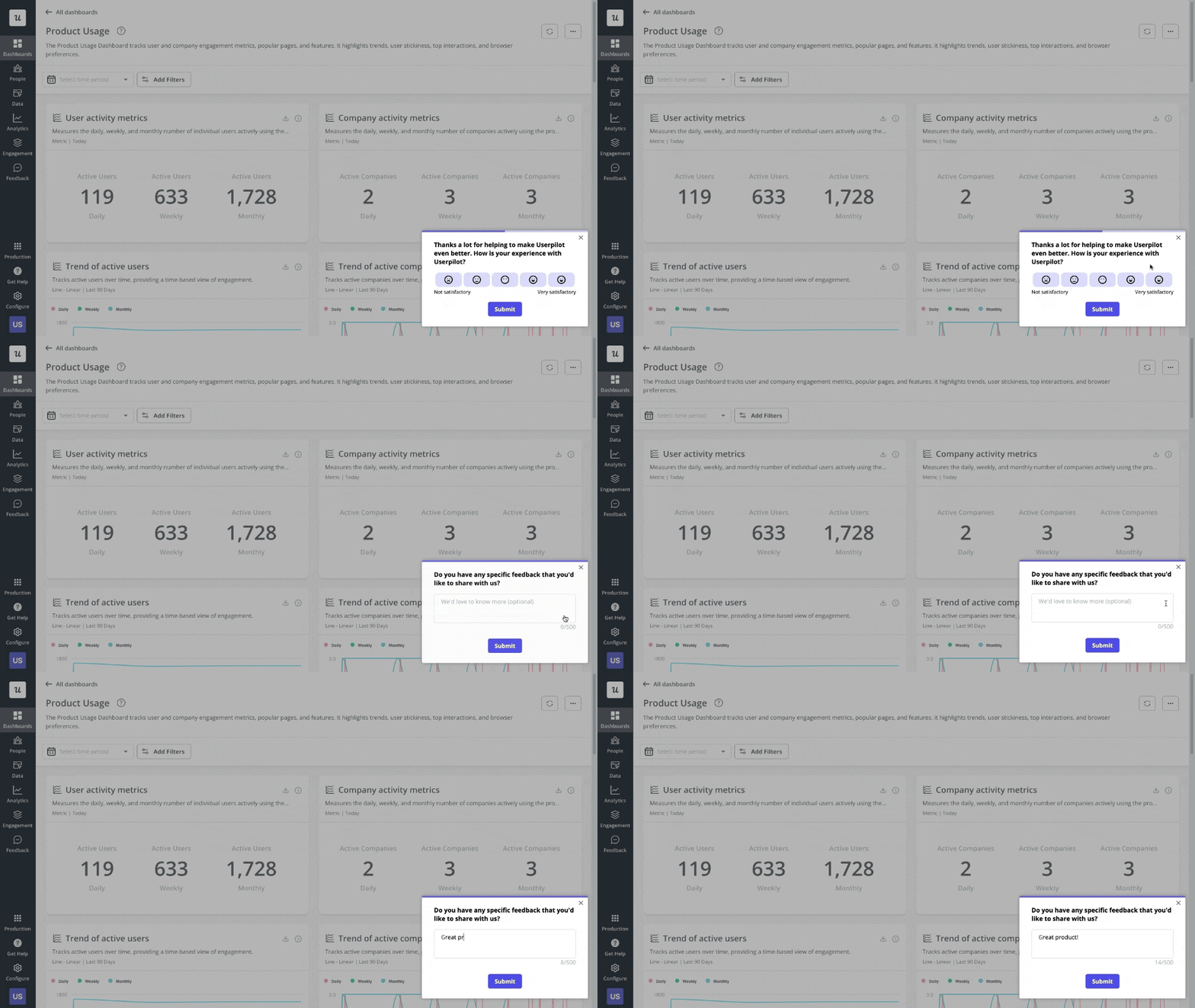
Get started with Userpilot.
4. Align ongoing training with the customer lifecycle
A generic approach to customer success won’t cut it because user needs change as they move through different lifecycle stages.
Below are the key stages in SaaS and how to support customers effectively at each stage:
- Onboarding: New customers require foundational knowledge and a smooth introduction to your product. Offer engaging onboarding experiences that guide them through essential features, setup processes, and best practices for early success.
- Adoption and growth: Once customers are comfortable with the basics, focus on deepening their product knowledge and encouraging them to explore more advanced features. Deliver training resources that showcase different use cases, provide tips for maximizing efficiency, and demonstrate how to achieve specific goals with your product. A good example of this is Userpilot’s product adoption school.
- Renewal/retention: As customers gain experience with your product, their expectations may evolve. Provide ongoing learning opportunities that help them stay ahead of the curve, address potential challenges, and continuously discover new ways to leverage your product to achieve their goals. Where possible, trigger account expansion prompts to help them explore more of your offerings.
- Advocacy: Turn satisfied customers into loyal advocates by delivering power user-only training sessions, early access to new features and beta programs, or opportunities to contribute to your knowledge base and help other customers.
5. Cultivate sales and customer success alignment
Sales and customer success teams share the ultimate goal of customer satisfaction and long-term value.
However, misalignment between these teams can lead to conflicting priorities, inconsistent messaging, and a disjointed customer experience. To create a collaborative environment, establish clear handoff processes and define roles and responsibilities for each team during the customer transition. Don’t forget to share relevant customer information and set the right expectations.
Beyond proper handoffs, put systems in place that encourage close partnerships. For example:
- Align both teams around common customer-centric metrics like customer lifetime value, churn rate, and product adoption.
- Facilitate regular communication through joint meetings, shared analytics dashboards, or collaborative workspaces.
- Create cross-functional training programs to ensure consistent messaging and a unified approach to customer interactions.
Best practices for enablement through the customer journey
Implement the following best practices to maximize your customer success enablement efforts:
Personalize onboarding processes
A one-size-fits-all approach can leave customers feeling lost or overwhelmed. Instead, use onboarding platforms like Userpilot to segment customers based on use cases, industry, company size, or desired outcomes. Then, create personalized onboarding paths that address their unique requirements.
For example, a graphic design tool could have separate onboarding flows for students, solopreneurs, and business teams. Each flow would provide tailored guidance, resources, and support based on the specific needs and goals of that user segment.
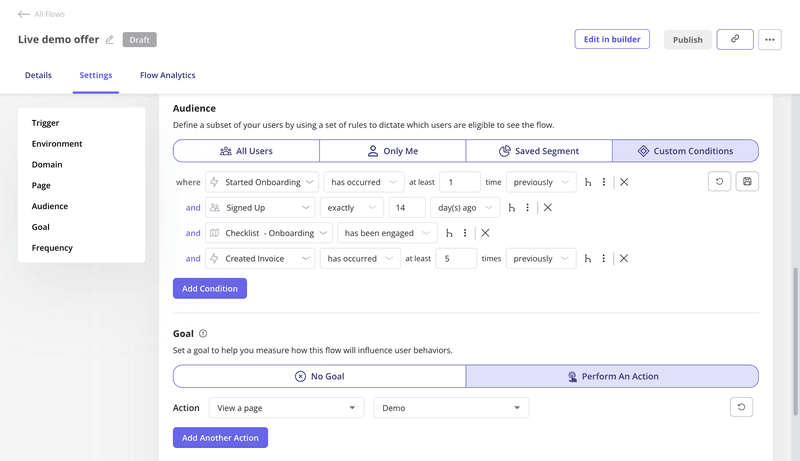
Audience segmentation with Userpilot.
Drive early success with gamification
Gamification is the introduction of game elements into non-game contexts. Done well, it can make learning more interactive and increase adoption rates.
From badges to leaderboards and personalized challenges, there are countless ways to gamify your onboarding process.
However, remember to choose elements that align with your product and target audience.
A safe bet for most onboarding scenarios is using progress bars and gamified checklists. These simple yet effective elements can significantly boost user engagement and accelerate time to value.
Fortunately, Userpilot makes it easy to build these gamified elements. For example, when using our tool to build an interactive onboarding checklist, you can see the preview in real time and make informed adjustments:
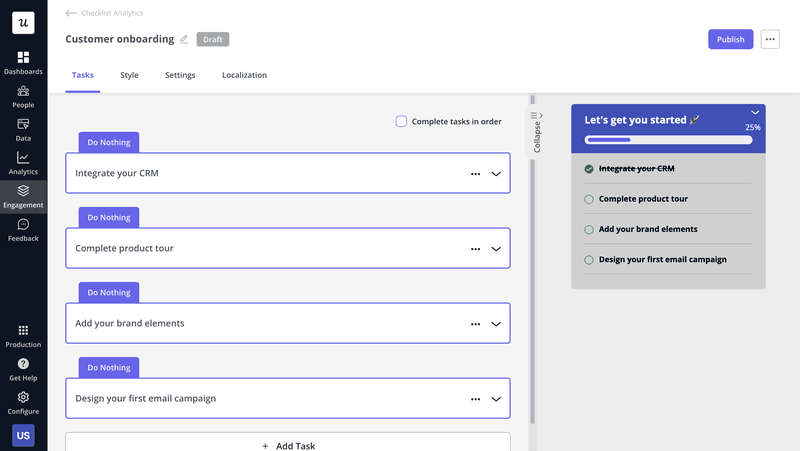
Boost your customer success enablement program with Userpilot.
Provide contextual guidance
Contextual guidance ensures that customers receive the right information at the right time, making their learning journey more efficient and relevant.
You can do this through in-app messages, interactive walkthroughs, and targeted emails. It also helps to incorporate an intuitive search function in your knowledge base—one that surfaces relevant articles based on the user’s current context within the product.
Map the customer journey
A journey map helps you understand the customer’s perspective, identify areas for improvement, and proactively address potential roadblocks.
Begin your journey mapping by defining the different stages customers go through, such as awareness, consideration, decision, activation, adoption, renewal, expansion, and loyalty:
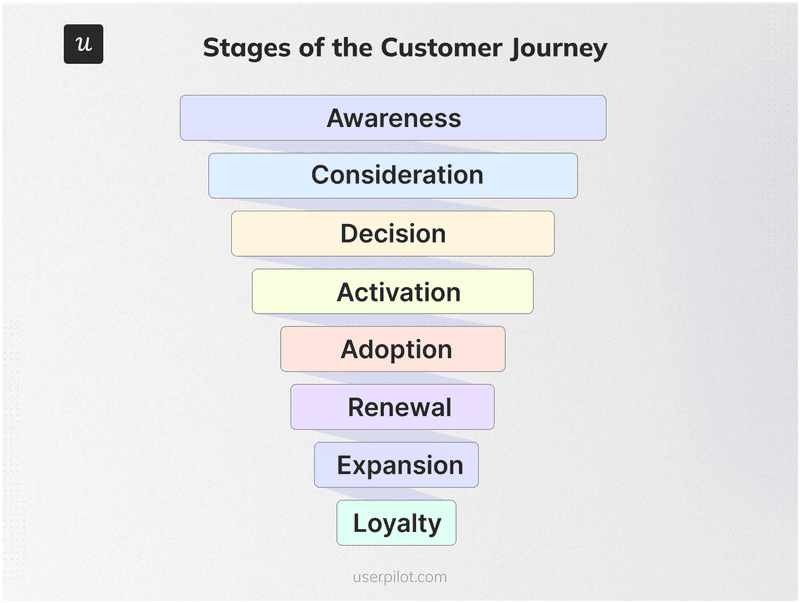
Stages of the customer journey.
Next, outline the key interactions that occur across each of these stages. For example, customers typically visit your website in the awareness stage and explore it to see your offerings, then they take a product demo during the consideration stage, and so on.
After identifying the major touchpoints, it’s time to pinpoint areas where users might be struggling. Userpilot comes in handy here. You can utilize our platform to conduct funnel analysis and visualize where users drop off. Then investigate the data to find possible causes.
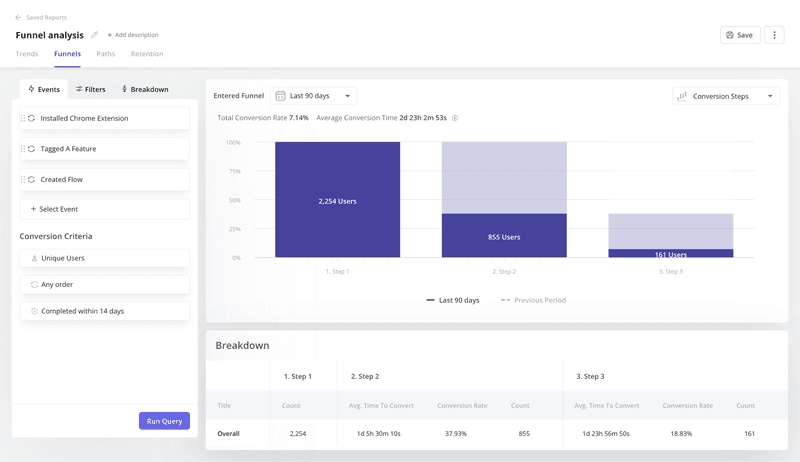
Funnel analysis report generated with Userpilot.
Based on your analysis, develop customer success enablement solutions to address pain points. For example, you may realize that you need to improve your onboarding materials, enhance support channels, or roll out a new feature.
4 top tools for customer success enablement programs
While best practices provide a solid foundation, the right tools can significantly amplify the efficiency and impact of your customer success enablement program. Here are four top contenders to consider:
1. Userpilot
Userpilot is an all-in-one product growth tool that helps SaaS companies improve onboarding flows, product adoption, and in-app engagement.
Key features:
- Interactive walkthroughs: Create personalized, step-by-step guides that walk users through key features and workflows.
- In-app surveys and feedback: Gather valuable insights from users directly within the product to understand their needs and identify areas for improvement.
- Personalized onboarding checklists: Guide users through a customized onboarding experience with checklists that track their progress and offer relevant resources.
- Advanced segmentation and targeting: Deliver tailored in-app experiences based on user behavior, demographics, or product usage.
- A/B testing and analytics: Experiment with different onboarding flows and measure their performance to optimize for better engagement and customer outcomes.
Why it stands out for customer success enablement: Userpilot is completely code-free—anyone on your team can learn to use it.
Additionally, being an all-in-one platform means you can use it to manage all aspects of your customer success enablement function, from onboarding and in-app training to ongoing support and knowledge management.
Get started with Userpilot.
2. Gong
Gong is a revenue intelligence platform that captures and analyzes customer interactions across various channels, providing valuable insights for CS and sales enablement.
Key features:
- Conversation intelligence: Automatically transcribe and analyze customer conversations to gain insights into topics discussed, keywords used, and speaker talk time.
- Deal intelligence: Track deal progress, identify potential roadblocks, and find AI-driven recommendations for improving acquisition rates.
- Coaching: Leverage Gong’s coaching tools to pinpoint specific areas for improvement and provide targeted guidance for individual members of the customer success team.
Why it stands out for customer success enablement: Gong’s AI-powered conversation analysis is considered best-in-class, providing deep insights into customer interactions that are difficult to obtain through manual review.
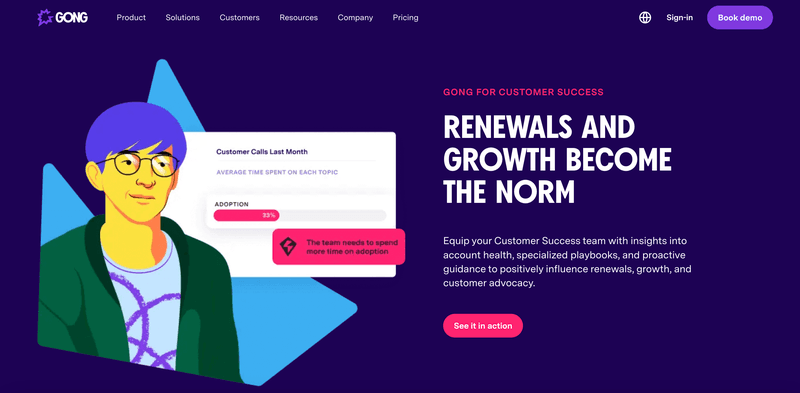
Gong’s website.
3. Dock
Dock is a customer experience software that provides a centralized workspace where teams can collaborate, share content, and track progress throughout the user journey.
Key features:
- Deal rooms: Create dedicated spaces for each deal, where sales teams can communicate with prospects, share proposals, and track progress.
- Onboarding hubs: Build structured onboarding experiences for new customers, providing them with easy access to resources, tasks, and communication channels.
- Content library: Organize and share resources in a centralized library, ensuring consistency and easy access for both internal teams and customers.
Why it stands out for customer success enablement: Dock’s unified workspace simplifies collaboration and partnerships between sales, customer success, and other teams involved in customer success enablement.
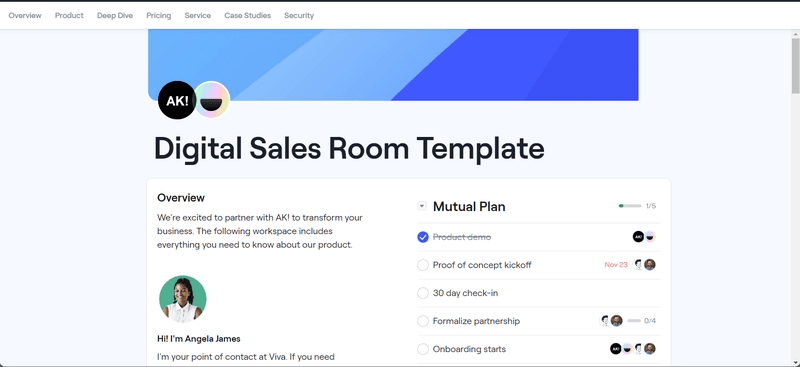
An example of how Dock works.
4. Zendesk
Zendesk is a customer service platform that offers a comprehensive suite of tools for ticketing, knowledge management, and self-service support.
Key features:
- Multi-channel support: Provide customer support across various channels, including email, chat, phone, and social media.
- Self-service knowledge base: Empower customers to find answers to their questions with a comprehensive and searchable knowledge base.
- Analytics and reporting: Track key performance indicators and gain insights into support effectiveness.
Why it stands out for customer success enablement: Zendesk’s suite of CS and customer relationship management tools helps you avoid switching between platforms when brainstorming or implementing your enablement programs.
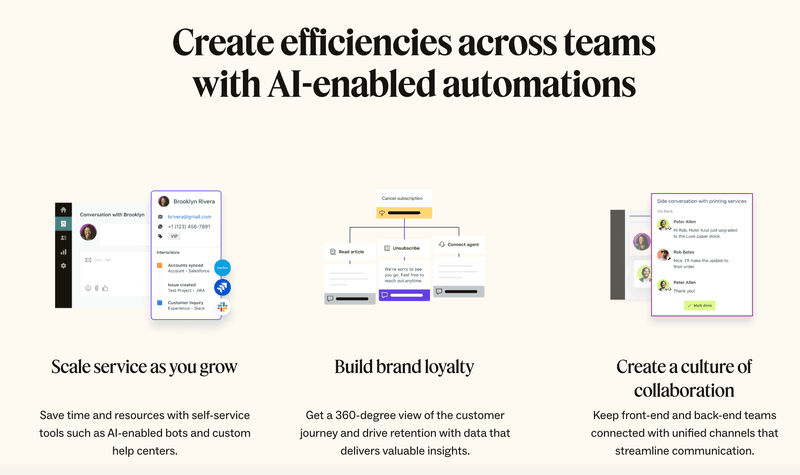
Zendesk’s core CS features.
Conclusion
Customer success enablement is essential for any business that wants to build strong customer relationships and drive sustainable growth. By investing in the right tools, resources, and training, you empower your customer success team to guide customers toward achieving their desired outcomes and maximizing the value of your product.
This translates to a multitude of benefits, including retention, customer loyalty, and revenue growth.
Ready to take action? Book a demo today and see how Userpilot can help you understand customer needs and deploy a customer success enablement strategy tailored to your business.