What is Psychographic Segmentation? A Guide for PLG (original) (raw)
What is psychographic segmentation?
Psychographic segmentation helps group customers based on their psychological characteristics: their beliefs, values, lifestyle choices, social standing, hobbies, interests, and opinions. It helps us understand the motivations behind users’ actions, rather than just the actions themselves.
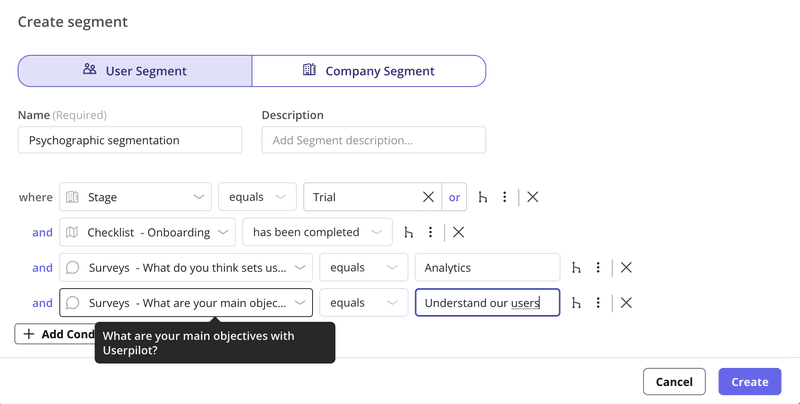
Example: Trial users who are interested in understanding their users.
The purpose of psychographic data for product teams is to make decisions about product development or personalized marketing campaigns.
Why is psychographic segmentation important?
Unlike behavioral segmentation, psychographic data helps me understand the motivations, emotions, and biases behind a user’s actions. For a PLG marketer like me, this lets me realize what drives our users to adopt and engage with our product.
Here’s what I believe are the biggest benefits of psychographic segmentation:
Craft personalized messages
Psychographic data provides a deeper understanding of the user’s attitudes and interests, and reveals the reasons behind their pain points.
This allows me to define my marketing messaging in a way that isn’t possible with demographics or behavioral data. For example, I can personalize the promotion of our AI features based on whether the user is an AI skeptic, neutral, or an evangelist. Additionally, understanding your customers’ psychological traits helps you position your product favorably in a congested market.
Fuel product development with real insights
Psychographic data isn’t just for creating marketing campaigns. It gives our product team valuable insights for product discovery.
For example, if we know a segment of our users values sustainability, we can then push product updates and design experiences that speak directly to that.
Plus, this helps us avoid building features nobody needs, ensuring every development effort adds real product value. It also helps us prioritize features based on our users’ most critical pain points.
Drive loyalty and retention
When users feel a brand truly understands them, they stick around.
Psychographic segmentation provides tools to build deep customer loyalty and boost customer retention. This is because when we personalize product experiences to appeal to our user base’s core values, it creates stronger relationships and turns users into passionate advocates for our product.
Allocate resources to what matters
Knowing exactly who I’m targeting means I can spend our budget more wisely.
First, it allows me to spend more resources on product marketing strategies that will have the biggest impact on specific psychographic segments. It also allows our product team to prioritize the development of features that users will value the most.
The five psychographic segmentation variables
Now, what psychographic information should you focus on to build high-quality, usable segments?
Here’s what, in my experience, are the five most useful psychographic aspects of your customers:
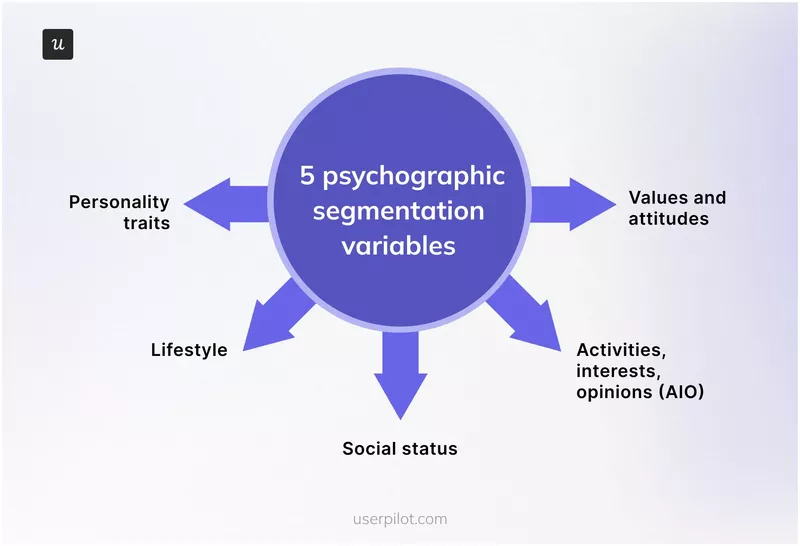
The five psychographic segmentation variables.
Personality traits
Research on Gen Z designers’ subscription to AI drawing tools shows that personality traits can influence the way people perceive and purchase products. While all product types and user bases differ in terms of which personality traits matter most, here are some examples of what it may look like for SaaS companies:
- Action-oriented or extroverted users are more open to actionable language such as “sign up today for free” or “send your first invoice”.
- Risk-averse or neurotic people will prioritize safety signals such as social proof, official certifications, or case studies.
- Analyzers or customers with high conscientiousness will ignore any marketing-sounding messages. They make more “rational” purchase decisions by comparing products, evaluating feature sets, and valuing cost-effectiveness.
Lifestyle
A person’s lifestyle and daily habits can also be a strong indicator of their product preferences, making it a great basis for customer segmentation. For example:
- Users working in remote teams might prefer features that improve asynchronous communications.
- Customers who are constantly traveling for business might appreciate flexibility, such as 24/7 support or time-saving tools like AI note-takers.
- Traditional on-site workers are likely to check their emails at specific times (e.g., before 9 am or at lunch) and have predictable routines. If you figure out a pattern, then you can schedule your marketing campaigns around their routines.
Social status
A customer’s social status says a lot about what they prioritize in products. It might define their product choices, niche markets, preferences, and the prices they’re willing to pay. For example:
- High-earners tend to value privilege and exclusivity, which means you can offer them bespoke plans that nobody else has.
- With middle-class users, highlighting the cost-effectiveness of your product is a way to show the value of your pricing plans without coming off as “cheap” or “overpriced.”
- Lower-income people tend to look for economic opportunities. So if your product can help save costs or earn money, you should emphasize it.
Activities, interests, and opinions
Activities, interests, and opinions (AIO) focus on hobbyists, enthusiasts, and individual interests. These criteria segment customers based on the topics they’re interested in or their opinions on certain matters. For example:
- If a portion of your users are AI enthusiasts, then you can promote AI features to them.
- For users who engage in charity, you could offer a charity card for participating in interviews or usability tests.
- For customers who prioritize sustainable businesses, you can mention how your company uses renewable energy or minimizes carbon emissions.
Values and attitudes
A person’s values and attitudes are a combination of ingrained beliefs, emotional reactions, and past actions associated with a subject. This subject could be your product, the industry, their job, or their career.
These attributes are more complex and linked with personality traits, but when well-researched, they can allow your company to align brand values with its target market. Here are some examples:
- Users who put outcomes and efficiency first will appreciate the proven promise of ROI or revenue growth that they can see in case studies or testimonials.
- For users who value trustworthiness and reliability, you can add certificate badges or offer risk-free options like 60-day trials and refund options.
- If a portion of users prioritize ethical integrity in their buying decisions, promoting DEI programs and transparent data treatment policies can resonate more with them.
How to build psychographic segments?
Without a proper strategy and toolset, you cannot build high-quality psychographic segments that will actually improve the bottom line.
So, I’ll show you a step-by-step process on how to collect user data (even without a dedicated research time) and create segments that you immediately use in your daily product and marketing work.
Step 1: Collect psychographic segmentation data
The first step is to collect psychographic data. While there are many different ways to do it, these are the methods to start with:
Do market research
If you don’t have an existing user base yet, or you feel it’s time to re-evaluate your current user personas, start with market research.
Market research involves gathering data about customers, competitors, and other parties involved in a specific sub-market. This includes external data that already exists, such as industry benchmarks, databases, customer research reports, market trends, etc, or interviewing focus groups.
For instance, if you perform competitor analysis, you’ll find many products in the same category as yours but targeted to different users. Then you can ask yourself: how can our product appeal to that market as well? What psychographic aspects can I target to have a competitive edge?
While market research is a resource-intensive process, it’s an unskippable step for any company looking into a yet untapped market. Take a look at our guide to market research to learn more.
Collect insights with surveys
Your existing customers are the best source of information about your target market. And the easiest way to collect this data from them is through in-app surveys.
This is because you can trigger them contextually (e.g., when they’re engaging with a product), which makes users more likely to respond and provide qualitative data.
With Userpilot, I can easily create surveys and trigger them inside our app based on consumer behavior, to ensure I’m only targeting activated, engaged users, or specific user groups. I can also set up different question types to collect both qualitative and quantitative data. For instance, I can set up an NPS survey to gauge customer loyalty and then add follow-up questions to understand user sentiments with our product.
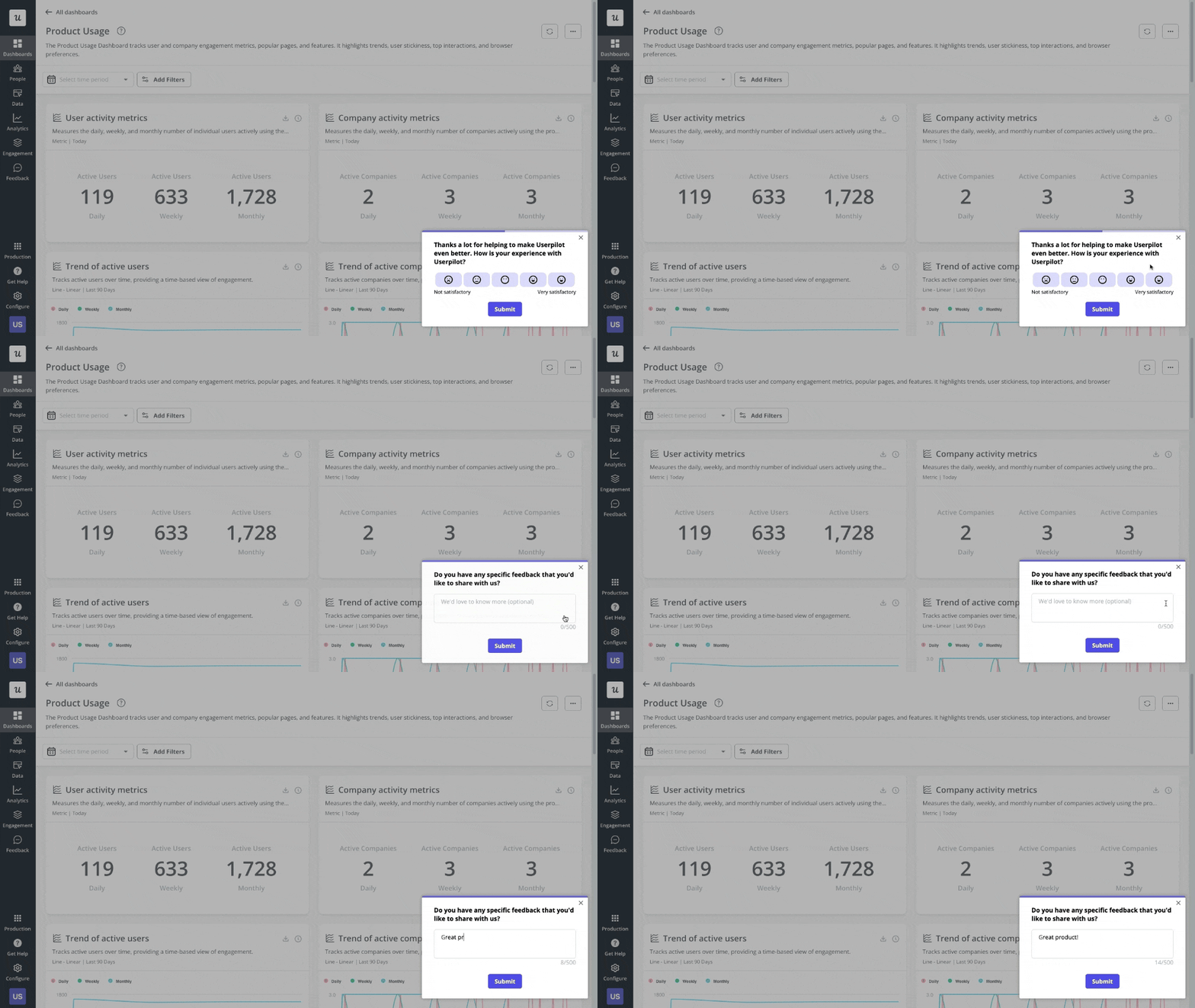
Triggering in-app surveys with Userpilot.
Your open-ended questions should help you understand your customers as individuals and reveal what they want from your product. For instance, you could ask these questions in a welcome survey:
- What are your biggest struggles with [area relating to your product or service]?
- What are your goals in [area relating to your product or service]?
- If [your product or service] could [free X hours, save X dollars, etc.], what would you do with the extra time/money?
Run interviews and focus groups
User interviews and focus groups are the best option for finding deep psychographic insights you can’t usually get with other methods, such as personality traits, personal values, and attitudes.
I use one-on-one interviews to explore motivations behind specific actions (e.g., signing up, upgrading, adopting a new feature, etc) and ask deeper questions about specific pain points. Focus groups allow me to spot patterns among current and prospective customers to understand different perspectives.
Pro tip: If I need to interview users from a specific segment, I can include an invitation in a survey shown only to this group.
Involve the customer support team
Customer support and sales teams interact with customers daily, making them great sources of data about each client. They can recognize similarities in temperaments, personalities, desires, etc.
When I need psychographic insights, I reach out to customer-facing teams to ask for recordings or transcripts of user interactions. Then, I can analyze how users talk about our product when they’re facing friction and what mental biases lead to stagnation.
Step 2: Analyze data and spot patterns
Once I’ve collected customer data, it’s time to analyze it and look for segmentable patterns. Are there groups of users who share personality traits? What’s the social status of most users? What emotions motivate them to sign up or convert?
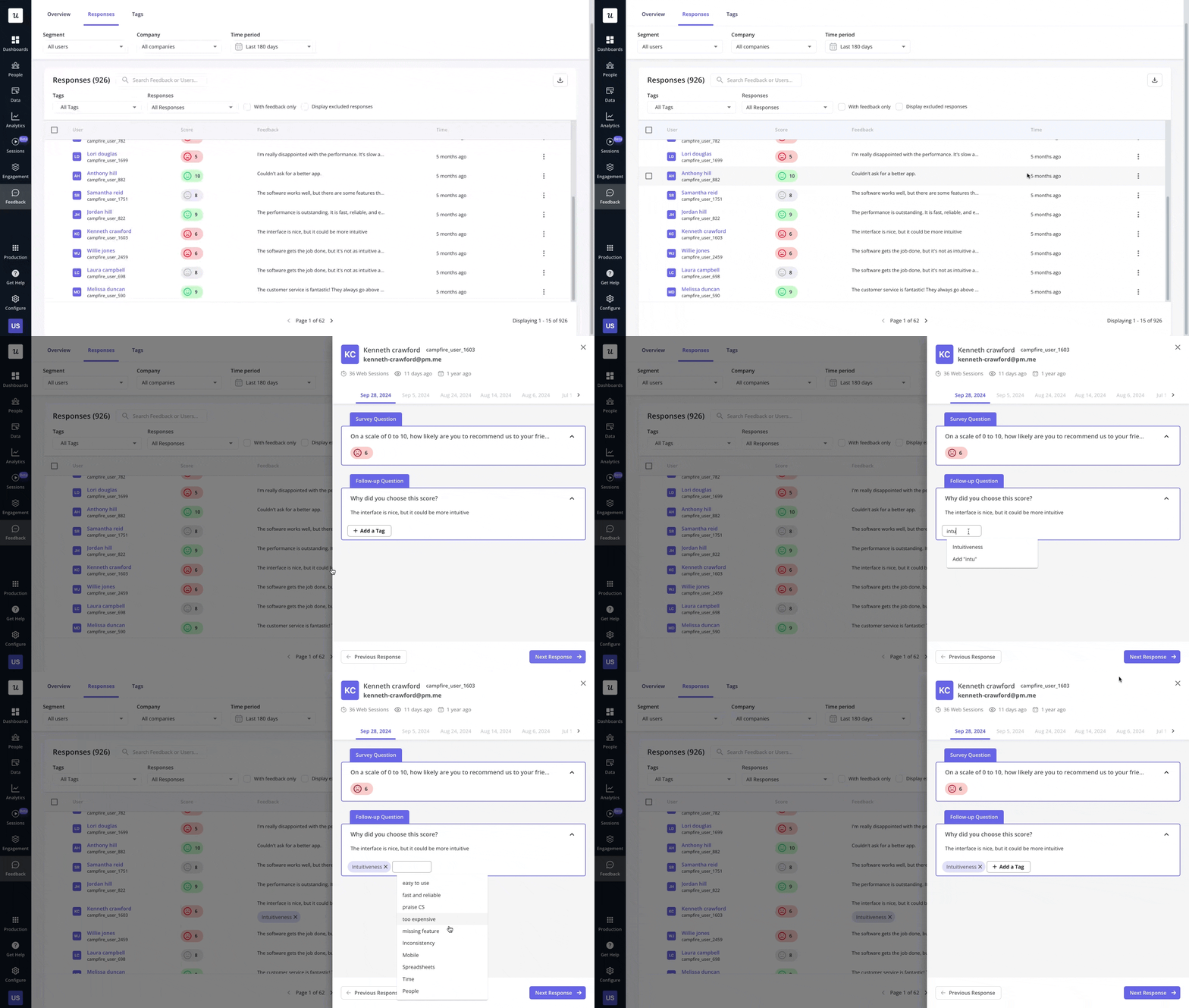
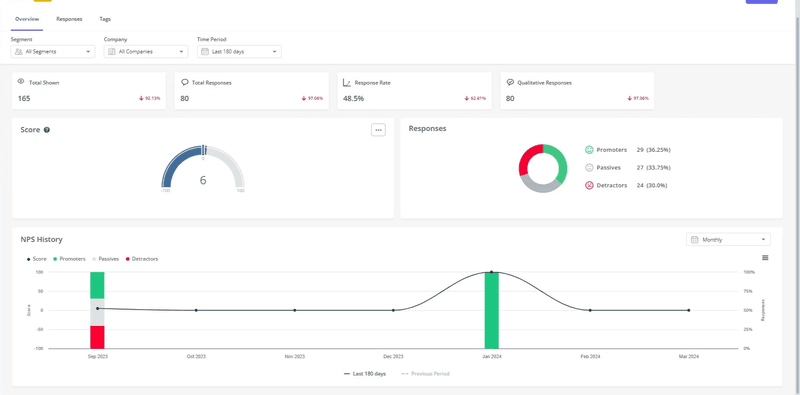
My go-to technique to get started is checking survey dashboards in Userpilot. Besides showing numerical survey results and listing the responses to open-ended questions, it also lets me filter responses or tag them for a more substantial analysis.
‹
›
Analyzing NPS survey responses and tagging them with Userpilot.
Step 3: Build initial psychographic user segments
After finding clear correlations (e.g., dev users are risk-averse, highly conscious, and interested in emerging technologies), you can immediately create segments in Userpilot based on survey responses, product usage data, and user attributes. Since all the collected data is readily available in one platform, setting up a segment requires just a few clicks.
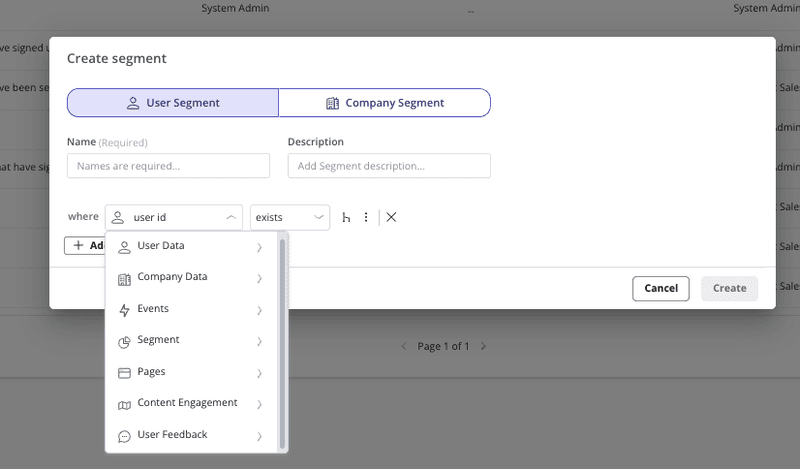
Creating a segment with Userpilot.
Step 3: Add behavioral data and create user personas
After creating a couple of key segments, I thoroughly recommend creating detailed user personas.
This is because a psychographic segment is the perfect basis for creating more meaningful customer profiles. Plus, combined with behavioral data and demographics, it also makes psychographic insights more actionable for regular use.
Now, instead of guessing, this process involves finding correlations between distinct psychographic segments and other personal profiles. With Userpilot, I can create custom dashboards where I can cross-reference psychographic characteristics with real behavioral data. For example, I might find that dev users are not just more rational with their purchase decisions, but are also less likely to engage with onboarding flows. This could mean they prefer getting easier access to technical documents they can check on the go.
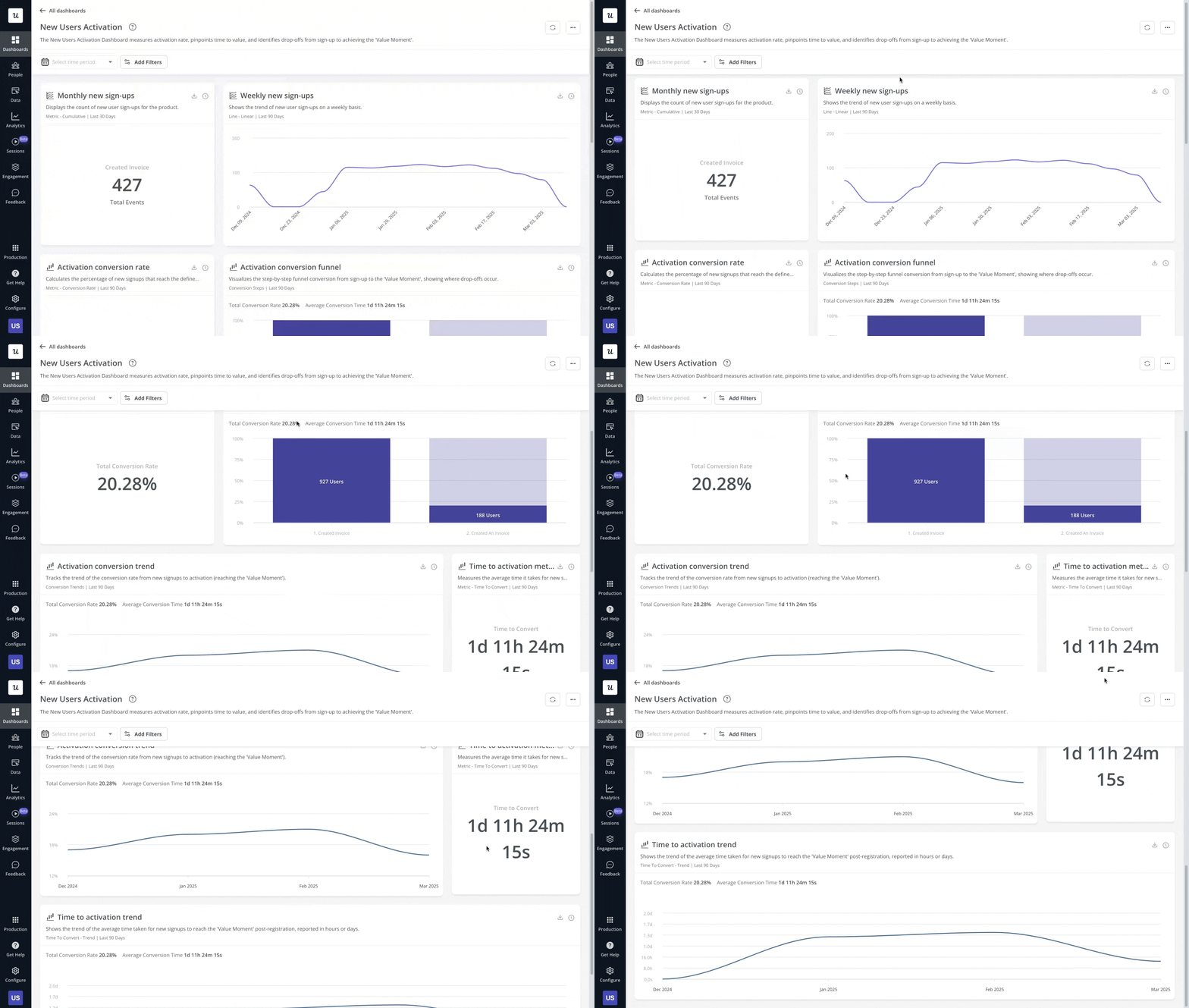
User activation dashboard on Userpilot, with different data sources put together.
With these correlations, I can work on user persona profiles, as well as add details on how these users interact with features, their JTBDs, responsibilities in their company, and lifecycle stages. Other Userpilot tools, like funnel reports and path analysis, increase the range of correlations I can find, too.
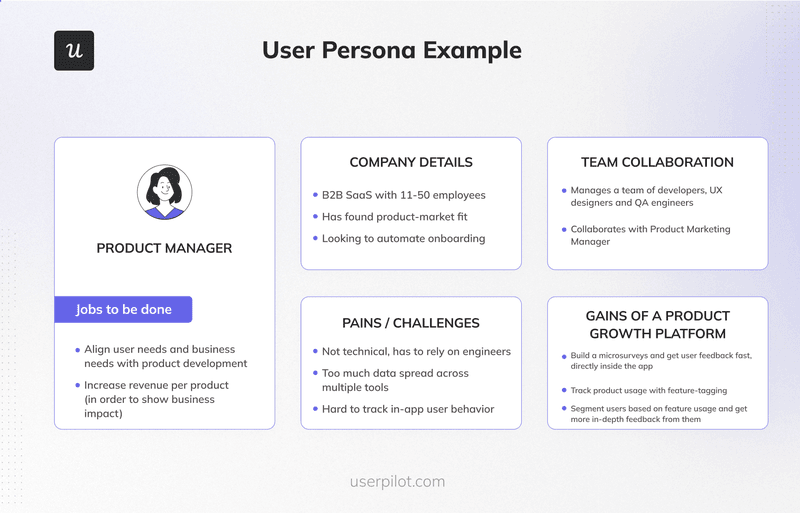
Use our free user persona template.
Finally, it’s important to put together the narrative behind each user persona. Who is this fictional person, and what are their habits, goals, and problems around the product? What have they been trying to achieve but couldn’t? What’s at stake if they don’t reach their goal? What do they need in order to overcome their obstacles?
The psychographic data helps me understand the emotions behind these stories and create personas that anyone in our team can empathize with.
Psychographic segmentation in action: How to use it in PLG?
One advantage I love about Userpilot is that I can readily use my psychographic segments to target personalized flows across our app, mobile, and email, without the need for exports and error-prone implementation.
Here are a few lifecycle marketing strategies where psychographic segments come in handy:
Personalize user onboarding for successful activation
Understanding a new user’s motivation for signing up helps me tailor their initial experience.
For example, if I identify a user who’s driven by community and collaboration (e.g., via a welcome survey), our personalized onboarding might focus on shared features and team settings to help them reach their “Aha! moment” faster.
Userpilot lets me create dynamic onboarding flows and checklists that adapt to these segments. And since segmentation attributes update in real time, the whole personalization happens automatically as soon as the user fulfills the psychographic conditions.
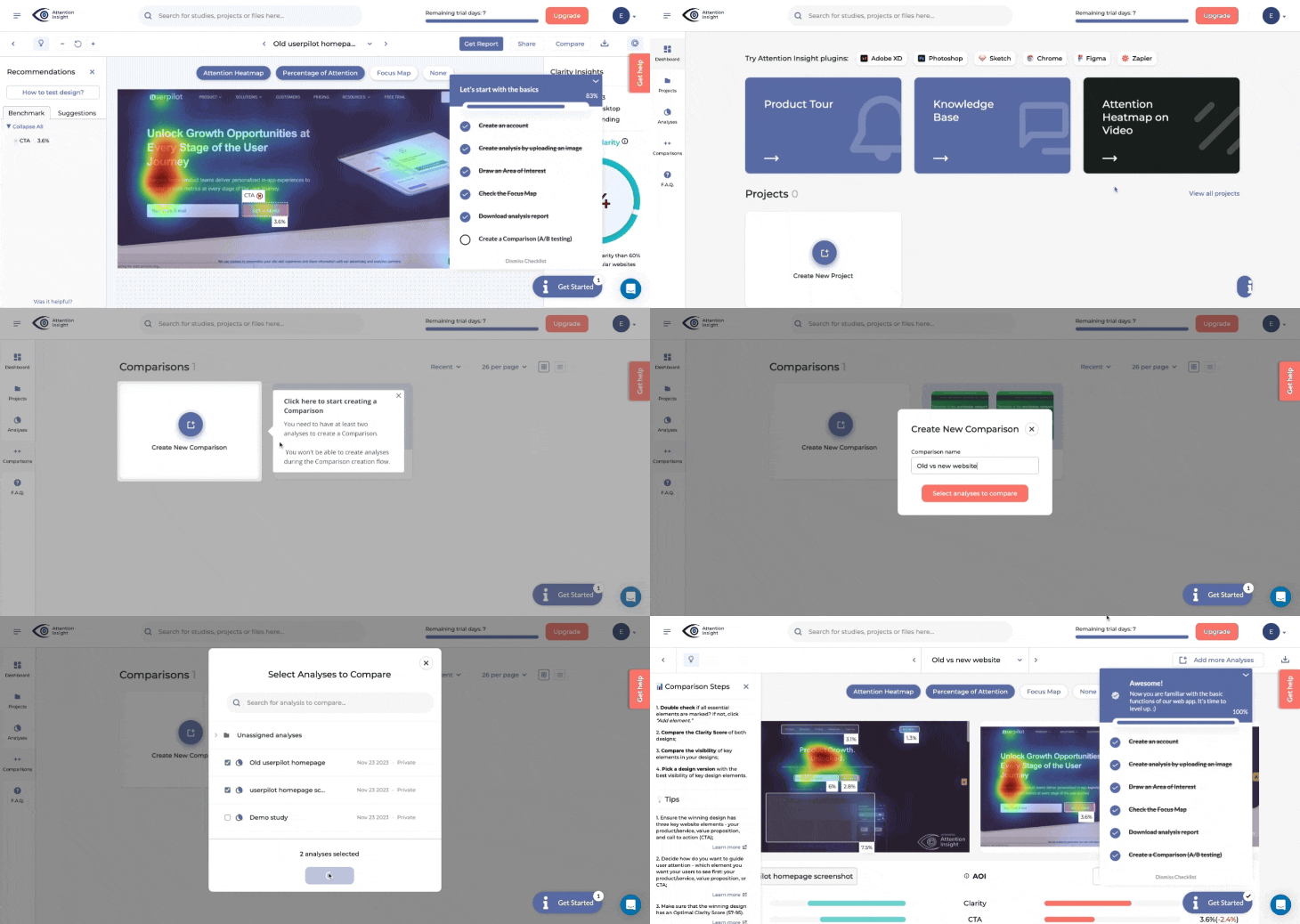
Attention Insight’s onboarding flow, targeted to specific user segments and built with Userpilot.
Send targeted feature announcements for faster adoption
When launching a new feature, apart from a global announcement, I include extra product tours or informative secondary onboarding emails for those user groups who’d find it the most relevant.
I make sure to highlight the benefits that align with specific psychographic segments. For example, for result-driven product managers who care about impact, I’d emphasize the ability to attribute ROI on a new reporting feature, and then trigger an in-app walkthrough to let them experience its value.
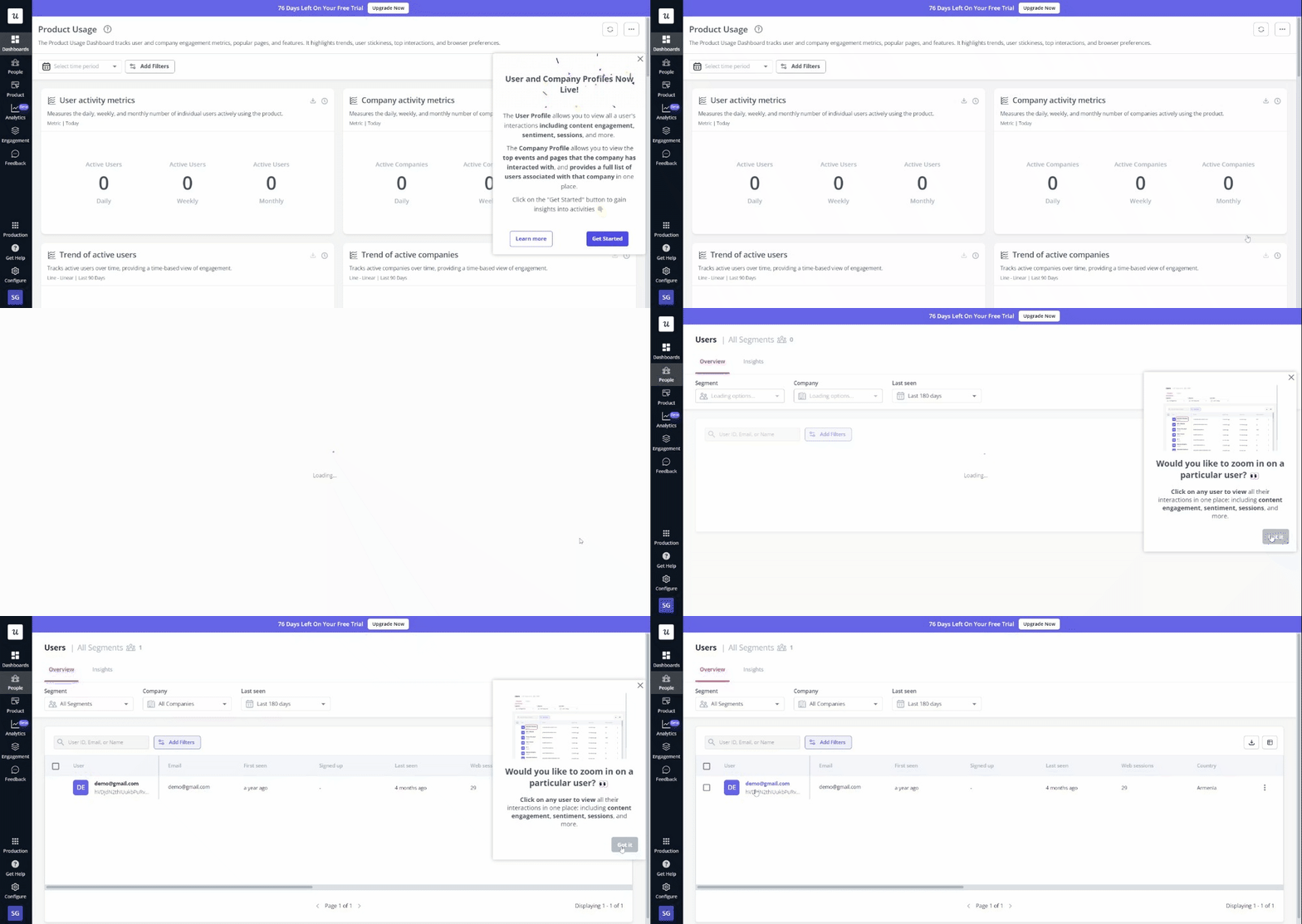
Introducing new features with Userpilot.
Inspire brand messaging with psychographics for better alignment with buyer personas
All kinds of content related to our product, whether these are in-app messages, knowledge base content, or educational blog posts, can benefit from psychographic insights. In customer lifecycle marketing, every stage must target the customer’s deepest pain points and desires, and ensure it’s relevant for their current stage.
Take a look at this review email from Loom. Loom’s brand personality is about saving time and enabling asynchronous communication. The email below resonates perfectly with busy, productivity-driven teams: the recipients can clearly see Loom’s measurable impact on their daily work. The achievement-based gamification additionally appeals to ambitious, goal-obsessed users.
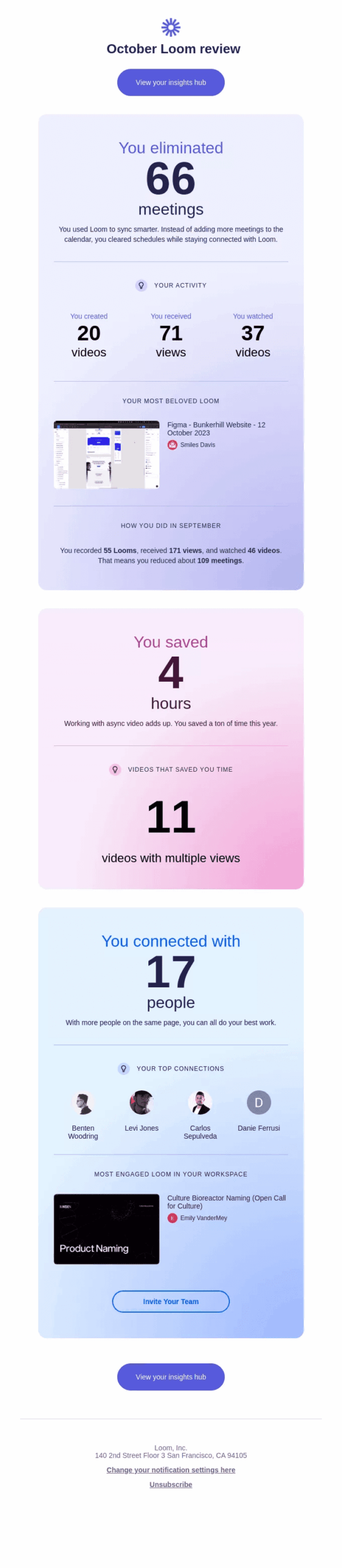
Loom’s monthly review email is in line with brand values and uses gamification for better engagement.
In short, psychographic data can guide your whole branding, including its values, messaging guidelines, mindset, and even its color palette. All of it should align with your customer personas as closely as possible.
Use psychographic segmentation for product growth with Userpilot
Psychographic segmentation offers a clear path to connecting with your audience on a deeper, more meaningful level. It drives effective communication, smarter product development, and ultimately, lasting user loyalty.
For me, Userpilot is the best platform to get started. It lets me collect psychographic insights from in-app surveys, segment users based on their survey answers, analyze their responses to spot patterns, and create personalized in-app flows to improve our product experience. What’s better, it doesn’t require coding, so even non-technical marketing teams can develop the whole strategy from scratch right after installation.
Book a Userpilot demo and build your psychographic user segments.