Tea Tree Oil | American College of Veterinary Pharmacists (original) (raw)
-
- Apply for Membership
* Membership Options for Pharmacists
* Pharmacy Technician Membership Application
* Student Pharmacist Membership Application
* Veterinarian Membership Application
* Affiliate Membership Application
* Become a Corporate Member - Member Benefits
- Student Pharmacists
* Student Pharmacist Membership Application
* Benefits of Student Membership
* Student Pharmacist Campus Chapters
* ACVP Board of Directors Student Member Application - Refer A Colleague to Join ACVP
- Corporate Membership
* Corporate Member Listing
* Become a Corporate Member - Standards of Practice for ACVP Members
* Pharmacist Standards of Practice
* Pharmacy Technician Standards of Practice
- Apply for Membership
-
- Veterinary Acupuncture Continuing Education Webinar | 1 Contact Hour (0.1 CEU)
- On-Demand Webinar: Medicating Without Fear to Improve Veterinary Patient Outcomes
- On-Demand Webinar – Supporting Veterinary Prescribing: Challenges and Solutions
- Molidustat for Felines — ON DEMAND
- Introduction to Homeopathic Medicines for Veterinary Pharmacists—ON-DEMAND
- Pregabalin for Felines—ON-DEMAND
- Improving Antibiotic Use In Companion Animal Medicine: A Team-Based Approach — ON DEMAND
- Compounding Clarity: Decoding USP Standards in Pharmacy Practice Bundle
- 2023 ACVP Veterinary Pharmacy Conference Bundle
-
- Login
- My Account
- Board Member Page
- Benefits for Fellows & Members
- Journal Club
- Resources for Student Pharmacist Members
* Student Pharmacist Resources
* ACVP Student Pharmacist Board Member Application
* ACVP Student Engagement Committee Application
* Student Pharmacist Events
* Student Pharmacist Merchandise - Membership Directory
- Veterinary References
- ACVP Listserv
- Publications
* The Voice of Veterinary Pharmacy
* Vet Talk
* Pet Talk
* Archived Newsletters - ACVP Board Nominations
- Logout
Tea Tree Oilstorey2023-04-25T16:32:14-05:00
If you have any reason to suspect your pet has ingested something toxic, please contact your veterinarian or one of the other resources* listed:
• ASPCA Animal Poison Control Center 24-hour hotline at (888) 426-4435
• Pet Poison Helpline® 24-hour animal poison control service at (855) 764-7661
*The resources listed above are not affiliated with the American College of Veterinary Pharmacists (ACVP), and they may charge a consultation fee. ACVP provides this referral information solely as a public service and does not receive any compensation from these organizations.
Tea Tree Oil
Tea tree oil, also known as melaleuca oil, has increased in popularity with the heightened use of “natural remedies.” This ingredient can be found in gels, body lotions, shampoos, conditioners, balms, toothpaste, insect repellants, and other household products.
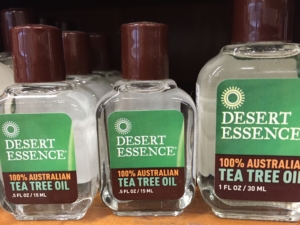
In veterinary practice, tea tree oil has been marketed for use on dogs, cats, ferrets, and horses to treat external parasites. Though appropriate dilutions of tea tree oil can be used, it is extremely important to talk with your veterinarian prior to use. Due to intoxication, 100% tea tree oil should never be used on an animal.
Birds are also indicated for this toxicity.
Signs and symptoms of toxicity: extremely low body temperature, weakness, decreased heart rate, difficulty walking, tremors, and skin irritation. Clinical signs may be seen within 1-2 hours of application but may take up to 8 hours to appear.
Toxic consumption:
The minimum toxicity threshold is unknown. All incidences of exposure should be reported immediately. Dose ranges of 1.9-5 g/kg (0.8 – 2.2 g/lb) or 1.9-2.6 mL/kg (0.8 – 1.1 mL/lb) may be fatal.
Intoxication is most often seen when 100% tea tree oil is used. As little as 7-8 drops (10-20 mL) applied to the skin may be fatal to both cats and dogs. Products with low concentrations (e.g. shampoos, body washes) are generally not considered toxic.
| Dogs: Tea Tree Oil Toxic/Lethal Consumption | |||||
|---|---|---|---|---|---|
| X-SmallYorkie, Chihuahua | SmallPug, Boston Terrier, Poodle | MediumBeagle, Scottish Terrier | LargeBoxer, Cocker Spaniel | X-LargeRetriever, German Shepherd | XX-LargeGreat Dane, St. Bernard |
| 1 – 10 lbs.(0.45 – 4.6 kg) | 11 – 25 lbs.(5 – 11.4 kg) | 26 – 40 lbs.(11.8 – 18.2 kg) | 41 – 70 lbs.(18.6 – 31.8 kg) | 71 – 90 lbs.(32.3 – 40.9 kg) | 91 – 110 lbs.(41.4 – 50 kg) |
 |
 |
 |
 |
 |
 |
| > 0.8 g or mL | > 9.4 g or mL | > 22 g or mL | > 35 g or mL | > 61 g or mL | > 78.5 g or mL |
| Cats: Tea Tree Oil Toxic/Lethal Consumption | |
|---|---|
| Most Cats | Large Cats |
| 1 – 10 lbs.(0.45 – 4.6 kg) | 11 – 25 lbs.(5 – 11.4 kg) |
 |
 |
| > 0.8 g or mL | > 9.4 g or mL |
References:
– Carson CF, Riley TV. Toxicity of the essential oil of Melaleuca alternifolia or tea tree oil. Clin Toxicol 1995; 33:193-194.
– Osweiler, G, et al. (2011). Blackwell’s five-minute veterinary consult clinical companion. Small Animal Toxicology. [Kindle version]. Retrieved from Amazon.com
Pet Poison Control is provided free as a public service by the American College of Veterinary Pharmacists. Today we’re asking you to support us with a small contribution. If you would like to dedicate your gift in honor or memory of a pet or individual, you will have that option before checkout. Your gift of any amount helps us maintain this resource and make it available to the pharmacy and veterinary communities. Thank you!
Related Projects
To provide the best experiences, we use technologies like cookies to store and/or access device information. Consenting to these technologies will allow us to process data such as browsing behavior or unique IDs on this site. Not consenting or withdrawing consent, may adversely affect certain features and functions.
Functional Functional Always active
The technical storage or access is strictly necessary for the legitimate purpose of enabling the use of a specific service explicitly requested by the subscriber or user, or for the sole purpose of carrying out the transmission of a communication over an electronic communications network.
Preferences Preferences
The technical storage or access is necessary for the legitimate purpose of storing preferences that are not requested by the subscriber or user.
Statistics Statistics
The technical storage or access that is used exclusively for statistical purposes. The technical storage or access that is used exclusively for anonymous statistical purposes. Without a subpoena, voluntary compliance on the part of your Internet Service Provider, or additional records from a third party, information stored or retrieved for this purpose alone cannot usually be used to identify you.
Marketing Marketing
The technical storage or access is required to create user profiles to send advertising, or to track the user on a website or across several websites for similar marketing purposes.