Microbial diversity and function in soil: from genes to ecosystems (original) (raw)
Abstract

AI
This paper explores the vast microbial diversity present in soil ecosystems, significantly surpassing that of eukaryotic organisms. It discusses the complexity of microbial communities, highlighting the genetic variability, richness, and functional groups within these ecosystems. Recent advancements in molecular methods are shown to facilitate a better understanding of this diversity, which has vast implications for biotechnological applications, ecosystem functioning, and environmental interactions.
Key takeaways
AI
- Soil microbial diversity significantly exceeds that of eukaryotes, with up to 10 billion microorganisms per gram.
- Metagenomic analysis reveals community genome sizes of 6,000-10,000 E. coli genomes in organic soils.
- Novel methods, including rRNA sequencing and functional genomics, enhance understanding of microbial community dynamics.
- Environmental factors and soil structure critically influence microbial diversity and ecosystem interactions.
- Functional diversity impacts resilience and stability of soil ecosystems under stress and disturbance.
Figures (1)
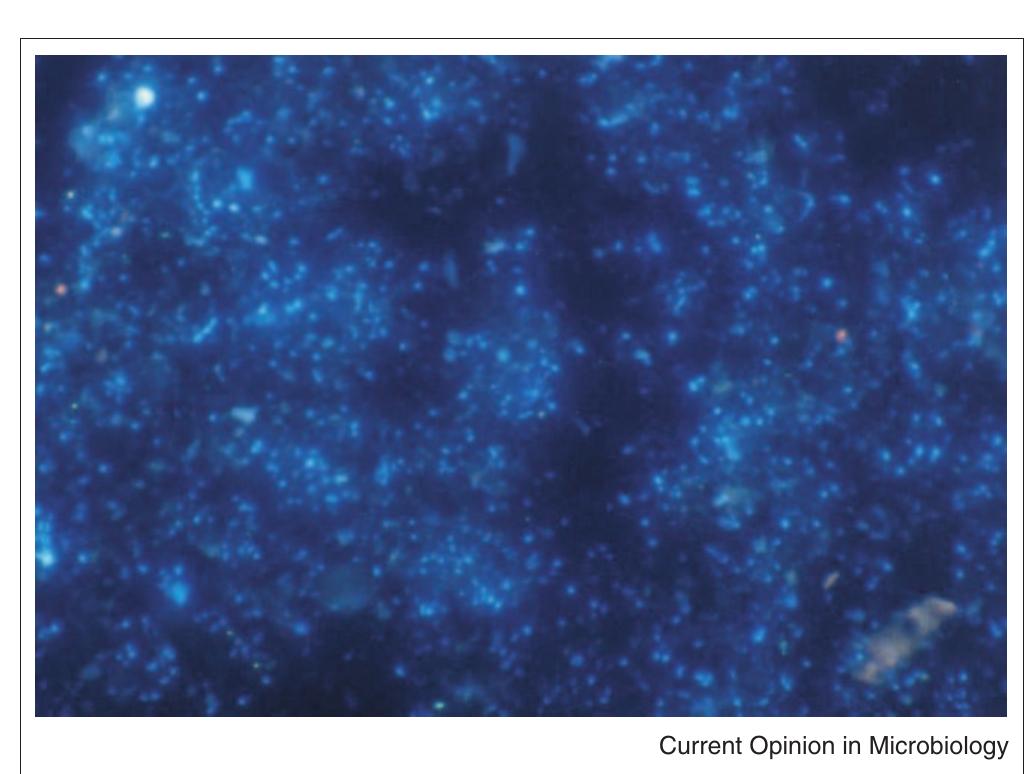
Epifluorescence micrography of soil microorganisms stained with 4’,6-diamidino-2-phenylindole (DAPI). The total bacterial count was 4.2 x 10¹⁹ cells gram~' soil (dry weight) by fluorescent microscopy, and 4.2 x 10⁸ colony-forming units gram~" soil (dry weight) by plating.

Loading Preview
Sorry, preview is currently unavailable. You can download the paper by clicking the button above.
This document is currently being converted. Please check back in a few minutes.
This document is currently being converted. Please check back in a few minutes.
References (6)
- References and recommended reading Papers of particular interest, published within the annual period of review, have been highlighted as: 30. McCaig AE, Glover LA, Prosser JI: Numerical analysis of grassland bacterial community structure under different land management regimens by using 16S ribosomal DNA sequence data and denaturing gradient gel electrophoresis banding patterns. Appl Environ Microbiol 2001, 67:4554-4559.
- Sandaa RA, Torsvik V, Enger O: Influence of long-term heavy-metal contamination on microbial communities in soil. Soil Biol Biochem 2001, 33:287-295.
- Loreau M: Microbial diversity, producer-decomposer interactions and ecosystem processes: a theoretical model. Proc R Soc Biol Sci B 2001, 268:303-309.
- Degens BP, Schipper LA, Sparling GP, Duncan LC: Is the microbial community in a soil with reduced catabolic diversity less resistant to stress or disturbance? Soil Biol Biochem 2001, 33:1143-1153.
- Schipper LA, Degens BP, Sparling GP, Duncan LC: Changes in microbial heterotrophic diversity along five plant successional sequences. Soil Biol Biochem 2001, 33:2093-2103.
- Waldrop MP, Balser TC, Firestone MK: Linking microbial community composition to function in a tropical soil. Soil Biol Biochem 2000, 32:1837-1846.
FAQs
AI
What explains the vast diversity of uncultured microorganisms in soil ecosystems?add
The study indicates that one gram of soil can harbor up to 10 billion microorganisms, with less than 1% being cultivated, highlighting unexplored biodiversity.
How do molecular methods enhance our understanding of soil microbial diversity?add
Molecular methods such as 16S rRNA sequencing reveal novel phylogenetic lineages and integrate structural and functional diversity analyses, providing comprehensive community insights.
What are the implications of genetic complexity in soil microbial communities?add
Analysis shows unperturbed organic soils possess community genomes equaling 6000-10,000 Escherichia coli genomes, underscoring vast genetic potential yet largely untapped.
When do seasonal variations significantly influence soil microbial community composition?add
Research found that while bacterial biomass remains stable seasonally, substantial differences in community composition were detected using molecular fingerprinting, particularly in spring and autumn.
How do environmental conditions impact microbial diversity and functional capabilities?add
Soil structure and nutrient availability were shown to influence microbial community structure, with oligotrophic conditions favoring Acidobacterium over faster-growing proteobacteria.