How old is eh? On the early history of a Canadian shibboleth [published version] (original) (raw)
2018, Wa7 xweysás i nqwal’utteníha i ucwalmícwa: He loves the people’s languages. Essays in honour of Henry Davis
Abstract
The published version in: Dollinger, Stefan. 2018. How old is 'eh'? On the early history of a Canadian shibboleth. In: Wa7 xweysás i nqwal’utteníha i ucwalmícwa: He loves the people’s languages. Essays in honour of Henry Davis, ed. by Lisa Matthewson Erin Guntly, Marianne Huijsmans and Michael Rochemont, 469-488. Vancouver, BC: UBC [UBC Occasional Papers in Linguistics, 6]. The volume can be acquired here: https://lingpapers.sites.olt.ubc.ca/opl-volumes/wa7-xweysas-i-nqwaluttensa-i-ucwalmicwa-he-loves-the-peoples-languages/
Key takeaways

AI
- The paper investigates the early history of 'eh' as a Canadian shibboleth.
- 'Eh' was notably excluded from the DCHP-1 despite its Canadian usage.
- Historical attestations of 'eh' suggest an increase in usage since the 1920s.
- Younger Canadians prefer 'eh' over 'right' as a sentence tag compared to older generations.
- Philological methods enhance understanding of 'eh's' development and usage patterns.
Figures (3)
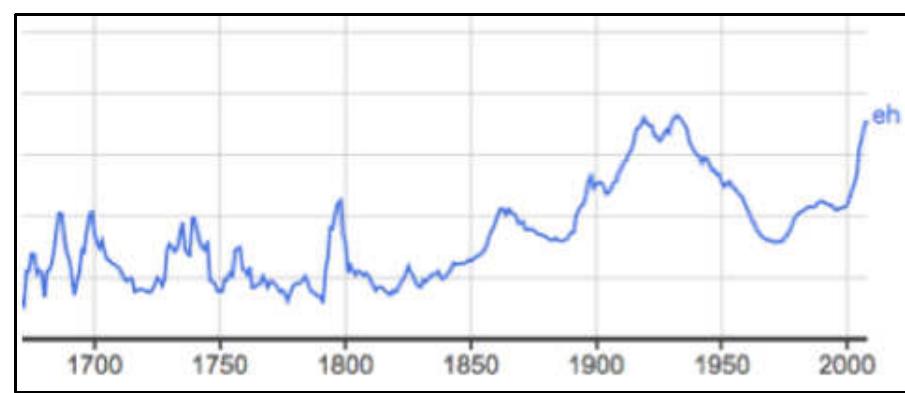
Figure 1: NGram of eh (9 Aug. 2017), English books confronted with problems of its own.
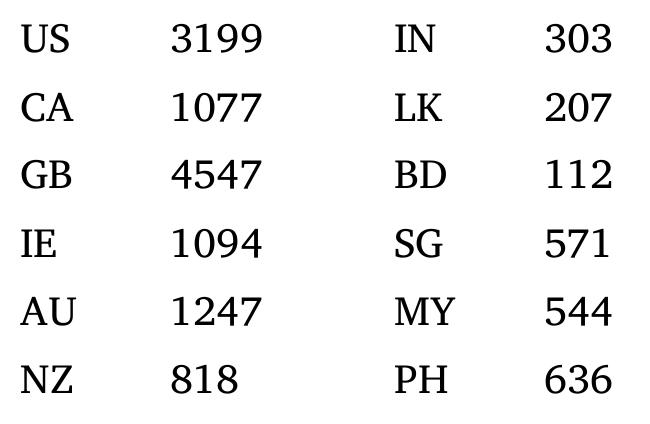
Table 1: Eh in 12 varieties of present-day web English (GloWbE) Around 1700, the excessive noise of earlier periods (up tc
![Some of the oldest quotations are in French, such as in the Hansard Corpus (1803-2005) from the 1820s. A decade later a member of the British parliament, Mr Frederick Shaw, used it in English: “Then, as to the Lord Mayor of Dublin, it did not provide compensation for the loss [...], as now secured to him by the Act of 33rd of George 3rd:, eh: [...]”. By the 1980s, we can see the result of the colloquialization of English, which offers important information with a clear increase in frequency. Some of the oldest quotations are in French, such as in the Table 2: Eh in three corpora. COHA, Time (both written & US)](https://figures.academia-assets.com/62078340/table_002.jpg) ](
](Some of the oldest quotations are in French, such as in the Hansard Corpus (1803-2005) from the 1820s. A decade later a member of the British parliament, Mr Frederick Shaw, used it in English: “Then, as to the Lord Mayor of Dublin, it did not provide compensation for the loss [...], as now secured to him by the Act of 33rd of George 3rd:, eh: [...]”. By the 1980s, we can see the result of the colloquialization of English, which offers important information with a clear increase in frequency. Some of the oldest quotations are in French, such as in the Table 2: Eh in three corpora. COHA, Time (both written & US)

Loading Preview
Sorry, preview is currently unavailable. You can download the paper by clicking the button above.
References (42)
- Agha, A. (2007). Language and Social Relations. Cambridge: Cambride University Press.
- Allen, H. B. (1959). Can-Am differences along the middle border. Canadian Journal of Linguistics 5: 17-24.
- Amador-Moreno, Carolina, Kevin McCafferty & Elaine Vaughan (eds.) 2015. Pragmatic Markers in Irish English. Amsterdam: Benjamins.
- Anon. (1685). The [Factious] citizen, or, The melancholy visionary. London: Maddocks.
- Avis, W. S. (1972). So Eh? is Canadian, Eh? Canadian Journal of Linguistics 17(2): 89-104.
- Avis, W. S., C. Crate, P. Drysdale, D. Leechman, M. H. Scargill and C. J. Lovell (eds). (1967). A Dictionary of Canadianisms on Historical Principles. Toronto: Gage.
- Avis, W. S., C. Crate, P. Drysdale, D. Leechman, M. H. Scargill and C. J. Lovell (eds). (1973). A Concise Dictionary of Canadianisms. Toronto: Gage Educational Publishing.
- Boberg, Charles. (2010). The English Language in Canada. Cambridge: CUP.
- Chambers, J. K. (2010). English in Canada. In Canadian English: A Linguistic Reader, ed. by Elaine Gold and Janice McAlpine, 1-37.
- Kingston, ON: Strathy Language Unit.
- Cassidy, F. & J. Hall (eds.) (2013). Dictionary of American Regional English. Cmbrdge: Belknap.
- Columbus, G. (2010). 'Nice day, eh?': Canadian and New Zealand eh compared. In: Proceedings of Methods XIII, ed. by B. Hesewood and C. Upton, 219-224. Frankfurt/Main: Peter Lang.
- Clyne, M. (ed.) (1992). Pluricentric Languages: Different Norms in Different Nations. Berlin: Mouton. How old is eh? On the early history of a Canadian shibboleth
- Denis, D. (2015). The development of pragmatic markers in Canadian English. Ph.D. U of T.
- Denis, D. & S. Tagliamonte (2016). Innovation, right? Change, you know? Utterance-final tags in CanE. In Discourse-Pragmatic Variation and Change in English, ed. by H. Pichler, 82-112. CUP.
- Dollinger, S. (2016). On the regrettable dichotomy between philology & linguistics. In Studies in the History of English VII, eds. D. Chapman, C. Moore & M. Wilcox, 61-89. Berlin: de Gruyter.
- Dollinger, Stefan. In press. Creating Canadian English: the Professor, the Mountaineer and a National Variety of English. Cambridge: Cambridge University Press. https://www.academia.edu/35184221/ (29 May 2018)
- Dollinger, S., L. Brinton & Ma. Fee (eds.) (2013). DCHP-1 Online. Based on W. S. Avis et al. 1967. www.dchp.ca/dchp1
- Dollinger, S. & M. Fee (2017). DCHP-2: Dictionary of Canadianisms on Historical Principles 2 nd ed. With assist, B. Ford, A. Gaylie, & G. Lim. Vancouver: UBC, www.dchp.ca/dchp2
- Dollinger, S. & W. Geist (2010). Why Do Canadians Say Eh? NBC's Today Show with Willie Geist, 16/02/2010, http://www.today.com/id/35017294/vp/35421159#35505797 (3/09/2913)
- Drysdale, Patrick D. (1980). Obituary for Walter S. Avis. English World- Wide 1(1): 125-28.
- Eliot, John. 1671. Indian Dialogues for their Instruction in the Great Service of Christ. Bodleian Library. Early English Books Online.
- Fee, M. & J. McAlpine (eds). (1997). Guide to Canadian English Usage. 1 st ed. Toronto: OUP.
- Fell, J.] (1784). An Essay Towards an English Grammar. London: Printed for C. Dilly.
- Stefan Dollinger Goldsmith, O. (1773). She Stoops to Conquer. http://www.history1700s.com/etext/html/pdf/sstcq.pdf
- Guarna, Andrea (1569). Bellum Grammaticale: A Discourse of Great War and Dissention betwene […] the Noune and the Uerbe. Transl. 2 nd ed. (EEBO Chadwyck-Healey, 5 Aug 2017).
- Hickey, R. (2007). Irish English: History and Present-Day Forms. Cambridge: Cambridge Univeristy Press.
- M.; M. Nissel, P. Maiwald & B. Widlitzki (2012). The Old Bailey Corpus: Spoken English in the 18th and 19th centuries. www1.uni- giessen.de/oldbaileycorpus.
- Karchut, P. (2017). Origins of 'eh': How 2 little letters came to define Canadians. CBC News. 16 May 2017. http://www.cbc.ca/news/canada/calgary/origins-of-eh-canadians- 1.4115715
- Keay, A. (2011). It's eh gender thing, eh? The usage patterns of a Canadian discourse marker. ENGL 508A: "Language and Identity: Canadian Constructions", UBC Department of English.
- Kytö, M. & T. Walker (2006). Corpus of English Dialogues 1560-1760. Uppsala: Acta Univ.
- Mathews, M. M. (1969). Review of DCHP-1. Journal of English Linguistics. 3 (March 1969): 89-91.
- Moore, M. (1967). How we talk Canadian. Review of DCHP-1. Saturday Night. Nov., 54-55.
- Rissanen, M. (1989). Three problems conn. w/ the use of diachronic corpora. ICAME Jrnl 13: 16-19.
- Ruggle, George and Robert Codrington. 1662. Ignoramus. Transl. by Robert Codrington. London: Printed for W. Gilbertson.
- Scargill, M. & H. Warkentyne (1972). Survey of CanE: a report. English Quarterly 5(3): 47-104. How old is eh? On the early history of a Canadian shibboleth
- Scargill, M. (1974). Modern Canadian English Usage. Toronto: McClelland and Stewart.
- Schecter, S. (1979-80). Eh? revisited: is it or is it not Canadian? Engl. Qrtly. 12(4): 37-44.
- Scottish National Dictionary = accessed (16 Sep 2017) http://www.dsl.ac.uk/entry/snd/eh.
- Tagliamonte, S. (2006). "So cool, right?" CanE entering the 21 cent. Canadian Journal of Linguistics. 51:309-31.
- Trudgill, Peter. 1986. Dialects in Contact. Malden, MA: Blackwell.
- Wiltschko, M. & J. Heim (2016). The syntax of confirmationals. In: Outside the Clause, ed. by G. Kaltenböck, E. Keizer & A. Lohmann, 305- 40. Amsterdam: Benjamins.
FAQs
AI
What explains the absence of 'eh' in DCHP-1 despite its Canadian significance?add
The paper reveals that 'eh' was excluded from DCHP-1 due to its prevalent use in British, American, Australian, and New Zealand English, leading Avis to deem it non-Canadian. As a result, despite its unique frequency in Canadian English narratives, its Canadian identity remained underappreciated.
How does the use of 'eh' differ across age and gender in Canada?add
The research indicates that 79% of female grade 9 students reported using 'eh' while only 70% of male students did. Furthermore, 'pardon eh' was used more by males, illustrating gender-based differences in pragmatic marker usage.
When did research on the historical usage of 'eh' begin to emerge?add
The literature review shows that studies regarding 'eh' were scarce prior to World War II, indicating a gap in historical linguistic research. Since the 1970s, however, various scholarly works have contributed to understanding its regional significance.
What methodological challenges arise when studying the origins of 'eh'?add
The paper notes that multiple spellings of 'eh' complicate its study, with historical data showing skewed usage patterns. Tools like Google NGrams struggle to differentiate Canadian data from British and American contexts, undermining etymological clarity.
How do contemporary corpora situate 'eh' within global English varieties?add
The GloWbE corpus suggests that 'eh' appears predominantly in British English today, with over 4500 tokens, compared to about 1100 in Canadian English. This distribution underscores the ongoing British influence on the expression's usage.
Last updatedOctober 11, 2025