Owen Jones and the Oriental Perspective (original) (raw)
2015, The Myth of the Orient. Architecture and Ornament in the Age of Orientalism, edited by Francine Giese and Ariane Varela Braga
Abstract
This article examines the place held by Islamic ornamentation of Cairo in Owen Jones's theory of ornament and his Grammar of Ornament.
Key takeaways

AI
- Owen Jones's Grammar of Ornament emphasizes Islamic ornamentation, particularly from Cairo, as a key influence.
- Jones's travels in Egypt and the Alhambra shaped his understanding of Islamic design principles.
- The Great Exhibition of 1851 served as a pivotal moment for Jones's analysis of global ornamentation.
- Jones proposed 37 principles for ornamental composition, linking historical styles to contemporary culture.
- The text critiques the historical flattening of Islamic art while promoting its dynamic evolution through various styles.
Figures (5)
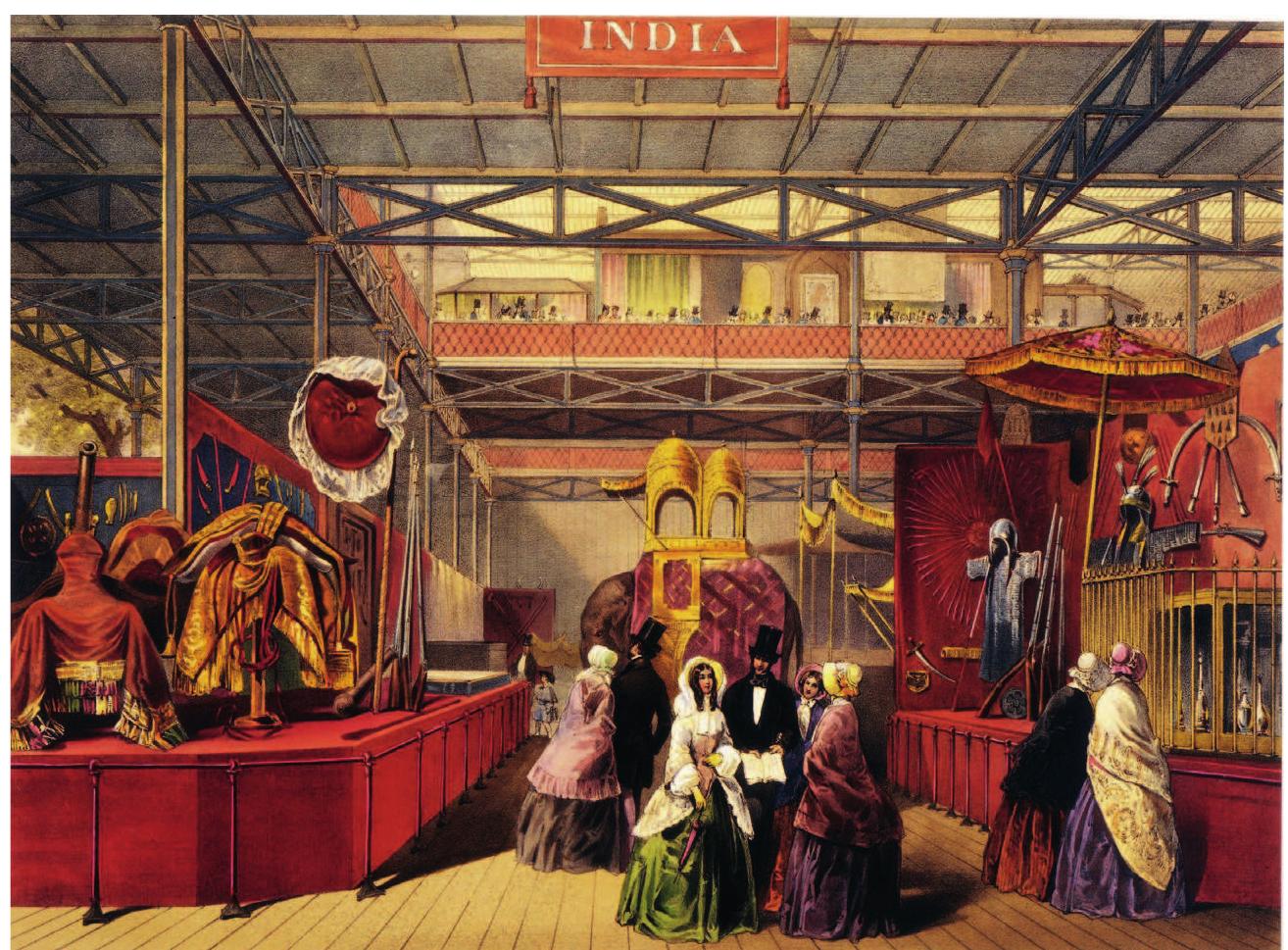
Fig. 2 — The Indian Court and Elephant Trappings (after a drawing by Goodall), London Great Exhibition, 1851. Hand-coloured lithograph, 275 x 375mm. London, Victoria and Albert Museum, 19538:13.
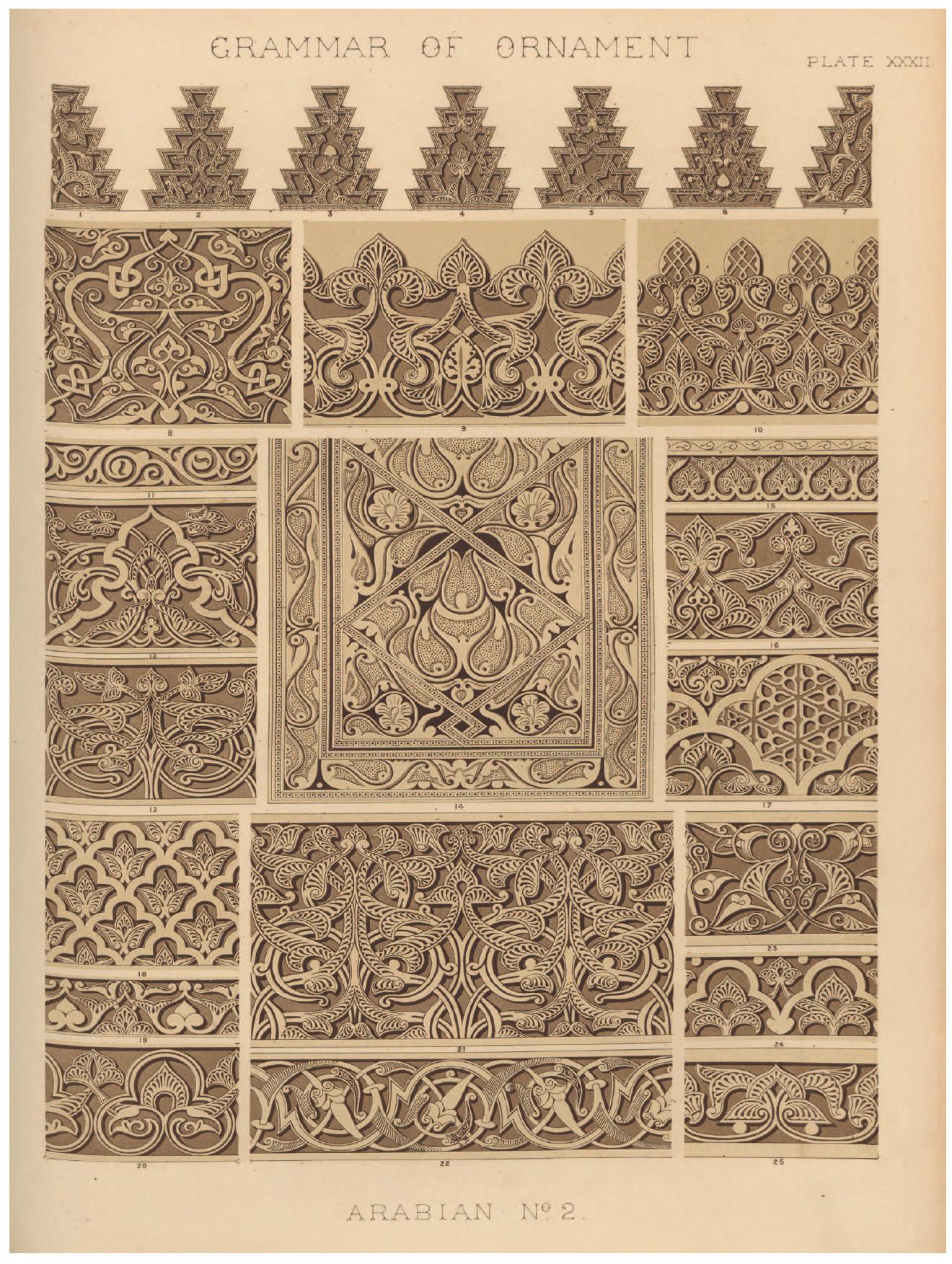
Fig. 3 — Arab ornament, in: Owen Jones, The Grammar of Ornament, 1856, chromolithograph, plate 32. Bibliothek des Kunsthistorischen Instituts, Universi- tat Zurich.
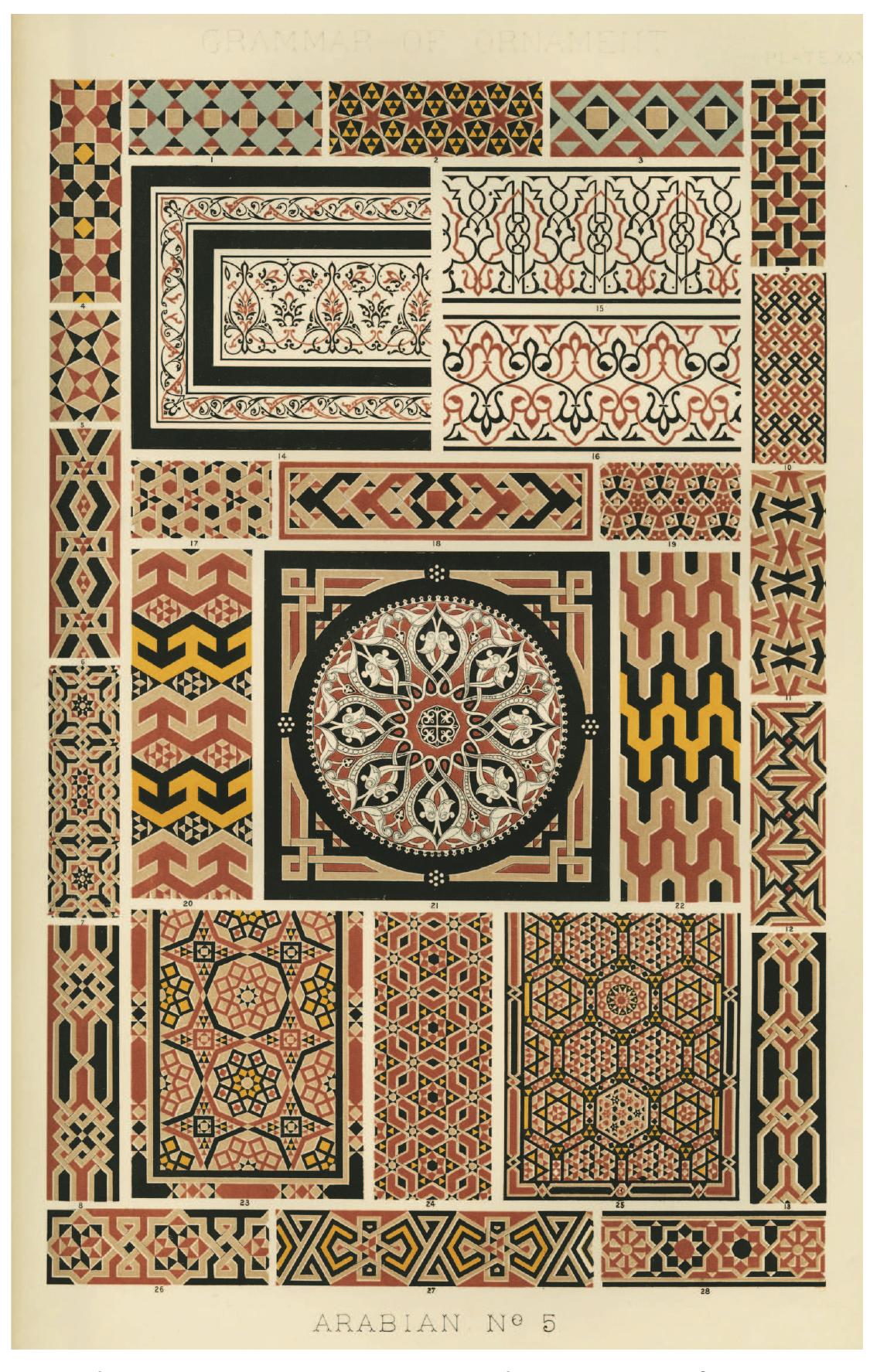
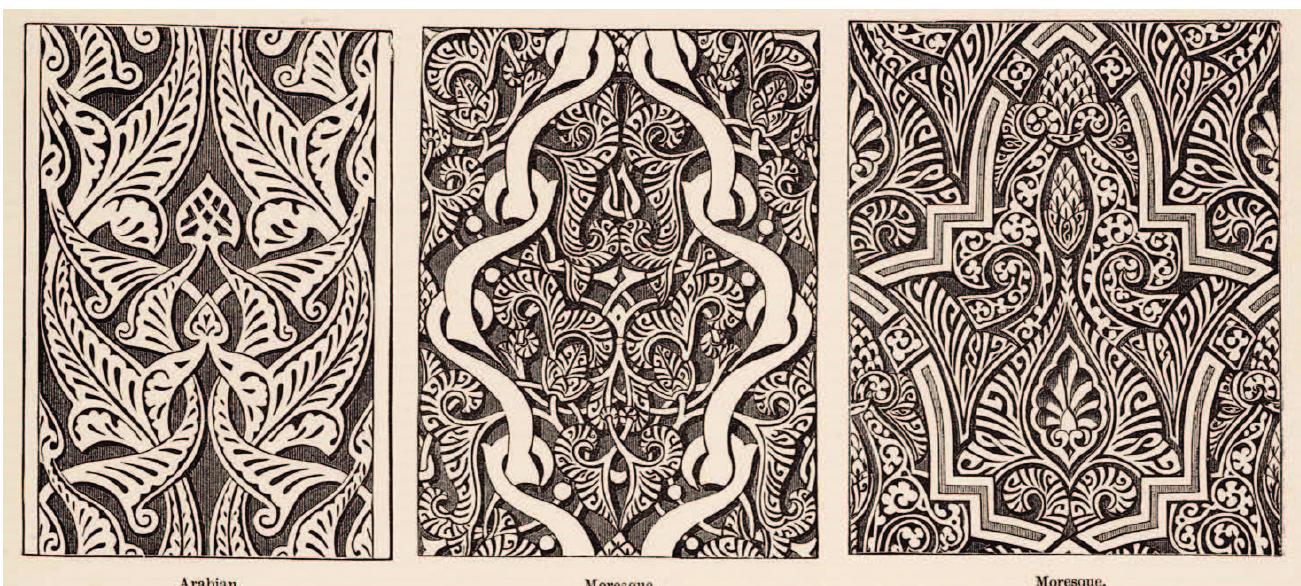
This double reference to the East and to Nature has often been viewed as falling within the traditional vision of an undeveloped and child- ish East?°. Yet, this juxtaposition also refers to the academic model of the Antique and Nature, to the pair Greece/Nature. Substituting the East to the Antique, Jones establishes a model for the ornament, which is defined in relation, yet in opposition, to the academic model of the Fine Arts. Rejecting naturalistic representation in favour of styl- ised shapes and colours, ornament will thus largely be defined by its abstract nature, and not by figurative and geometric characteristics, as opposed to the mimesis dominating painting and the fine arts. Islamic ornament—conventional, predominantly two-dimensional, with its use of colour fields and geometrical forms, its respect for the surface of the object, yet lacking relief or shadow — seemed to be per- Plo cg ee Or cn Ne ce ee sere TS pe we OMe eg? af ce a ee ee

Loading Preview
Sorry, preview is currently unavailable. You can download the paper by clicking the button above.
References (10)
- K . R . Ferry, Awakening a higher ambition: the influence of travel upon the early career of Owen Jones, unpublished PhD dissertation, Cambridge University, 2004 . Flores 2006
- C . A . H . Flores, Owen Jones, design, ornament, architecture and theory in an age of transition, New York, Rizzoli, 2006 . JesPersen 1984 J . K . JesPersen, Owen Jones's "The Grammar of Ornament" of 1856: Field Theory in Victorian Design at the Mid-Century, unpublished PhD dissertation, Brown University, 1984 . Jones 1851
- O . Jones, "Gleanings from the Great Exhibition of 1851", Journal of Design and Manufactures, vol . V, 89-93, 177; vol . VI, 57-59, 137-139 and 174-176 . Jones 1856 o. Jones, The Grammar of Ornament, illustrated by examples from various styles of ornament, London, Day and Son, 1856 . laBrusse 2007 R . laBrusse, "Une traversée du malheur occidental" in R . laBrusse (ed .), Purs décors? Arts de l'Islam, regards du XIX e siècle. Collections des Arts Décoratifs, exhibition catalogue (Paris, Musée des Arts Décoratifs), Paris, Musée des Arts Décoratifs and Musée du Louvre, 2007, 32-53 .
- Makariou 2007
- S . Makariou, "Arabes versus Persans: genie des peoples et histoire des arts de l'Islam", in R . laBrusse (ed .), Purs décors? Arts de l'Islam, regards du XIX e siècle. Collections des Arts Décoratifs, exhibition catalogue (Paris, Musée des Arts Déco- ra tifs), Paris, Musée des Arts Décoratifs and Musée du Louvre, 2007, 188-197 . Mitter [1977] 1992
- P. Mitter, Much Maligned Monsters. A History of European Reactions to Indian Art, Chicago, The University of Chicago Press, [1977] 1992 . Moser 2012 s. Moser, Designing antiquity: Owen Jones, ancient Egypt and the Crystal Palace, New Haven, Yale University Press, 2012 . rhodes 1983 J. G. rhodes, Ornament and Ideology: a Study in mid-nineteenth-century British Design Theory, PhD dissertation, Harvard University, 1983 .
- Varela BraGa 2012 A . Varela BraGa, "Les enjeux de la préférence pour les arts extra-européens dans le discours sur l'ornement en Grande-Bretagne au milieu du XIX e siècle", Images Revues 10, 2012, <http://imagesrevues .revues .org/2141> .
- Varela BraGa 2016 A . Varela BraGa, La Grammar of Ornament d'Owen Jones. Une théorie uni- verselle au milieu du XIX e siècle, Roma, Campisano, 2016 ( forthcoming) . sWeetMan 1998 J. sWeetMan, The Oriental Obsession. Islamic Inspiration in the British and American Art and Architecture 1500-1920, Cambridge, Cambridge University Press, 1988 . troelenBerG 2011 E .-M troelenBerG, Eine Ausstellung wird besichtigt: die Müncher "Ausstellung von Meisterwerken muhammedanischer Kunst" 1910 in kultur-und wissenschafts- geschichtlicher Perspektive, Frankfurt am Main, Lang, 2011 . WainWriGht 2002 c. WainWriGht, "The making of the South Kensington Museum II: Collect- ing modern manufactures: 1851 and the Great Exhibition", edited by Ch . Gere, Journal of the History of Collections, 14, 1, 2002, 25-44 .
- WatanaBe 1994 t. WatanaBe, "Owen Jones The Grammar of Ornament: Orientalism subvert- ed?", Aachener Kunstblätter, 60, 1994, 439-442 .
- zanten 1977 D . van zanten, The Architectural Polychromy of the 1830's, New York, Gar- land, 1977 .
FAQs
AI
What role did Jones's travels play in his understanding of Islamic ornamentation?add
Jones's travels, particularly to Egypt in 1832-33, significantly influenced his appreciation for Islamic ornamentation, yet he primarily focused on ancient art during this time. This initial exposure set the stage for his later works, including the influential Grammar of Ornament published in 1856.
Which exhibitions influenced Jones's perspective on ornamentation in the 19th century?add
Jones's role in the Great Exhibition of 1851 highlighted a juxtaposition between British and Islamic artifacts, suggesting the latter were perceived as superior. His observations during this exhibition profoundly shaped his understanding of decorative principles that he later articulated in the Grammar of Ornament.
How did Jones categorize different styles of Islamic ornamentation?add
In his Grammar of Ornament, Jones classified Islamic ornamentation by region, detailing Arabic, Turkish, Moorish, Persian, and Indian styles. This comprehensive approach aimed to demonstrate the evolution and unique characteristics inherent in each style, particularly focusing on the ornamentation from Cairo.
What were the principles Jones outlined for ornamental design?add
Jones proposed thirty-seven principles in his Grammar of Ornament, advocating for a new style based on natural laws of form and color rather than historical mimicry. These principles emphasized the significance of mathematical and geometric foundations prevalent in Islamic art.
What observations did Jones make about Egyptian art in relation to Islamic art?add
Jones noted that Islamic ornamentation in Egypt served as a template for innovative artistic expression, influenced by Greco-Roman and Byzantine styles. He highlighted the evolution and originality of Islamic designs, contrasting them with their classical predecessors.