LEMERCIER O. (2018) - Think and Act. Local Data and Global Perspectives in Bell Beaker Archaeology, Journal of Neolithic Archaeology, 20, 2018S, p. 77-96 (original) (raw)
Abstract
In the north-western Mediterranean (Spain, France, Italy), the variety of decorative styles of Bell Beakers, the existence of a common ware, the examination of the discovery contexts and the objects associations make it possible to propose chronological phases of the Bell Beakers styles. This makes it possible to observe the appearance and insertion of the Bell Beakers in the local sequences as well as its developments and the acculturation of the local groups. If the first phenomenon marked by the arrival of elements of foreign origin to the region (objects, ideas, individuals?) showing a wide movement on a continental scale, the recent phase of Bell Beakers, marked by multiple regional groups from the point of view of ceramic decoration shows, at the same time, the existence of large cultures from the point of view of the common ware and a very large community or European network of exchanges of objects, practices or ideas format perhaps a broad Bell Beaker Civilization.
Key takeaways

AI
- The Bell Beaker phenomenon spans distinct phases: initial arrival, regional development, and connections to Early Bronze Age cultures.
- Bell Beakers did not replace local Late Neolithic cultures, which evolved alongside them for centuries.
- The diffusion of Bell Beaker practices involved complex exchanges of objects, ideas, and individual movements across Europe.
- Studies suggest up to 30% of the population in certain areas experienced displacement during the Bell Beaker phase.
- The research aims to clarify the Bell Beaker's role in European prehistory through local and global perspectives.
Figures (8)
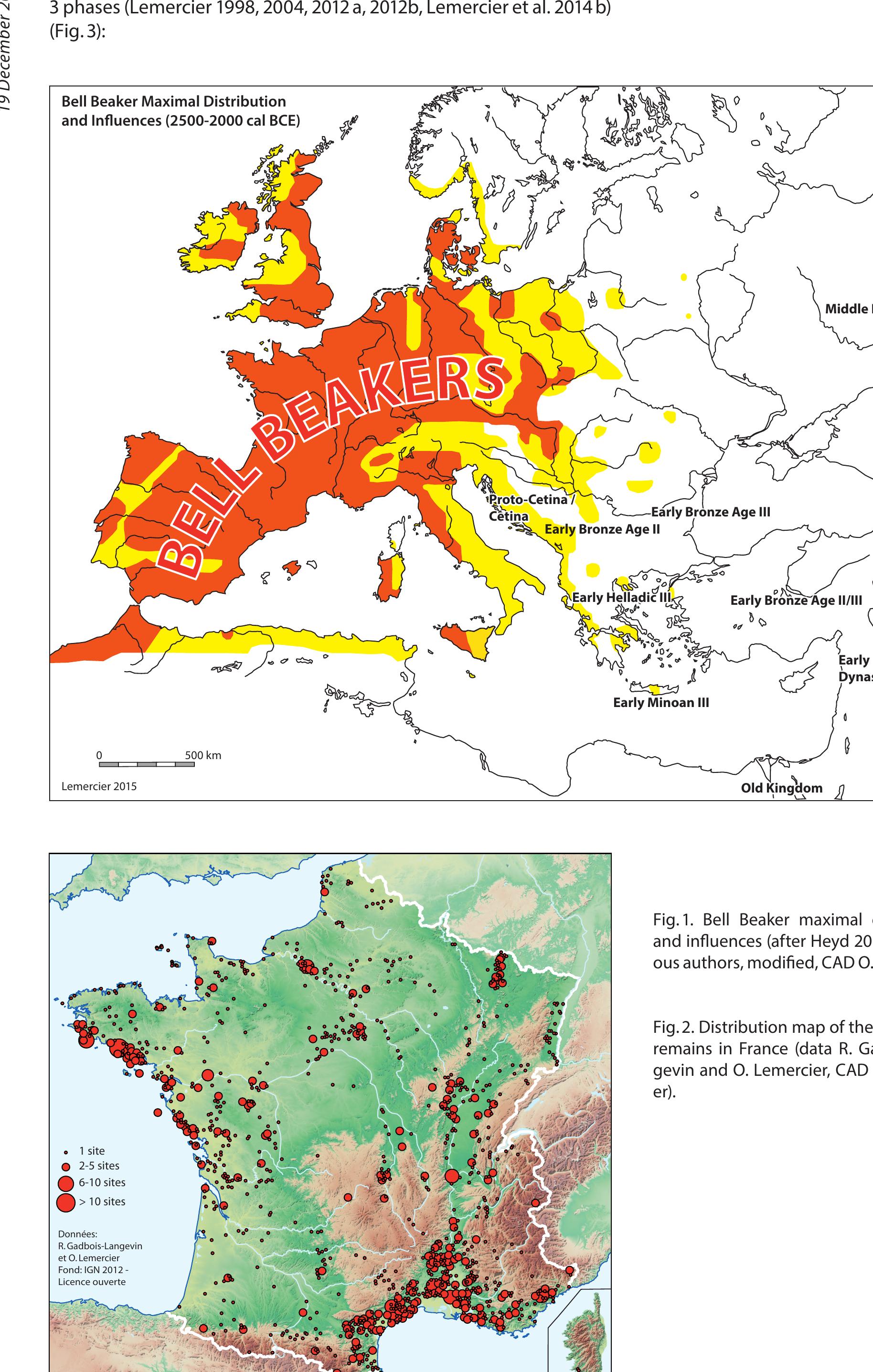
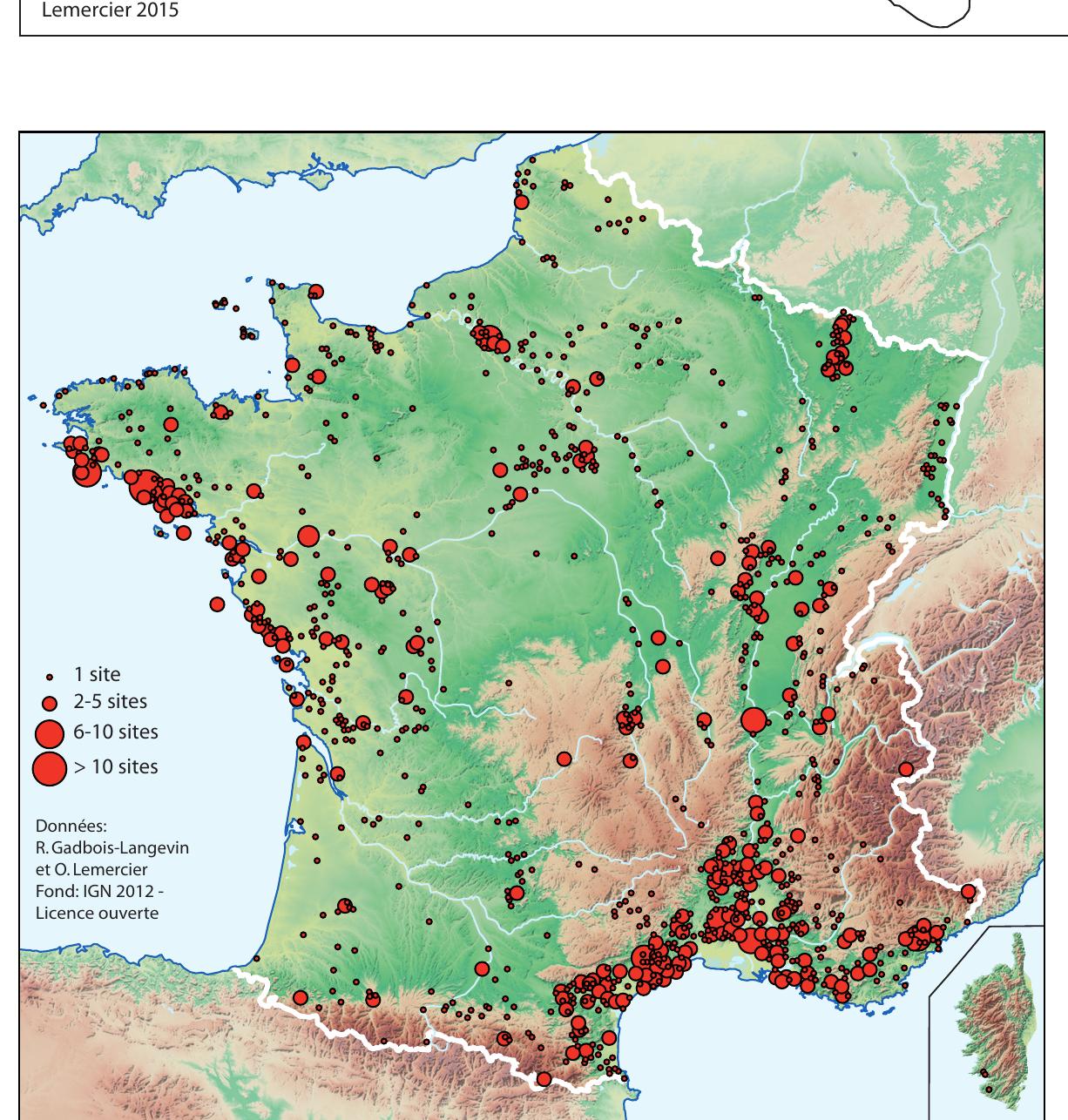
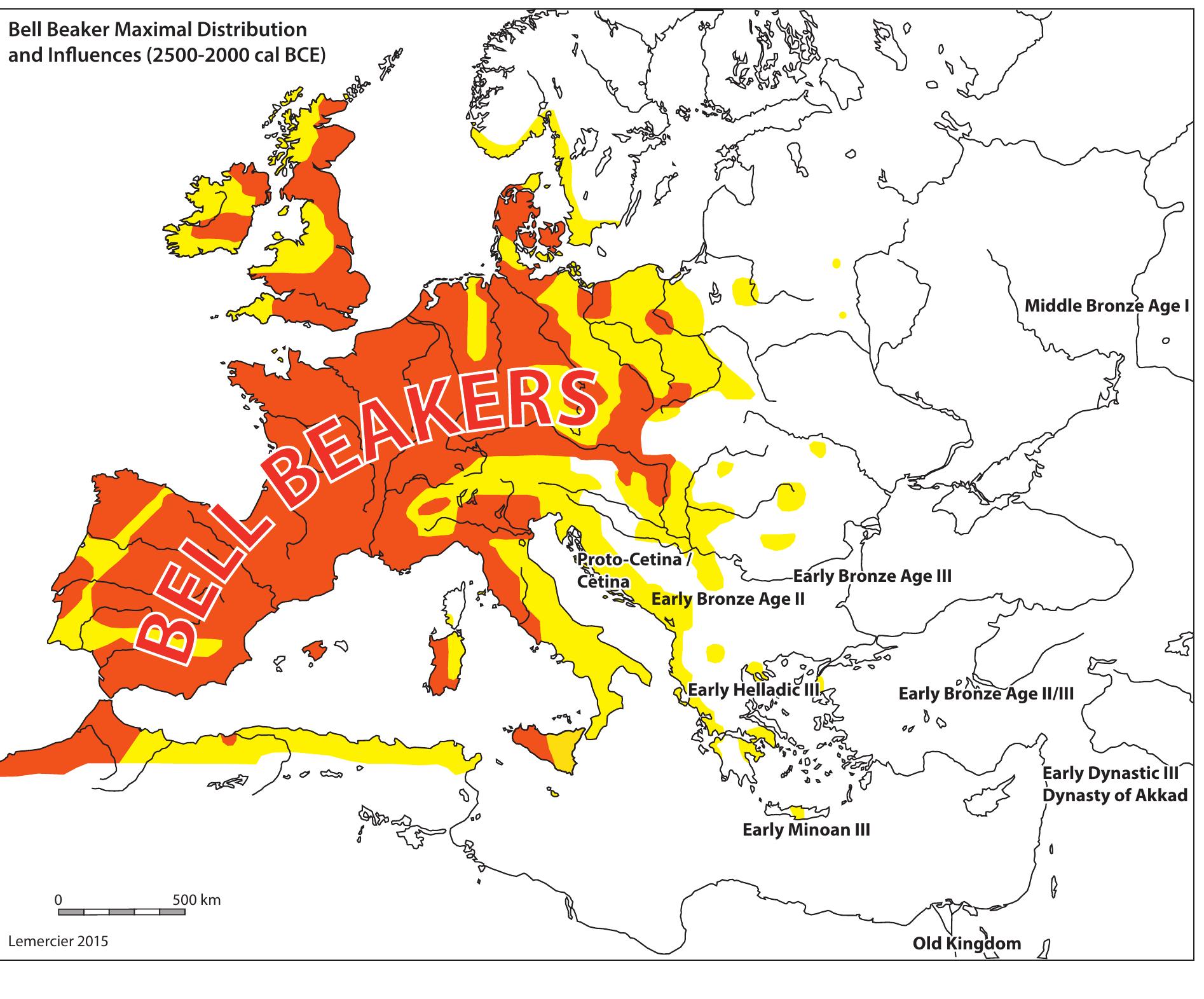
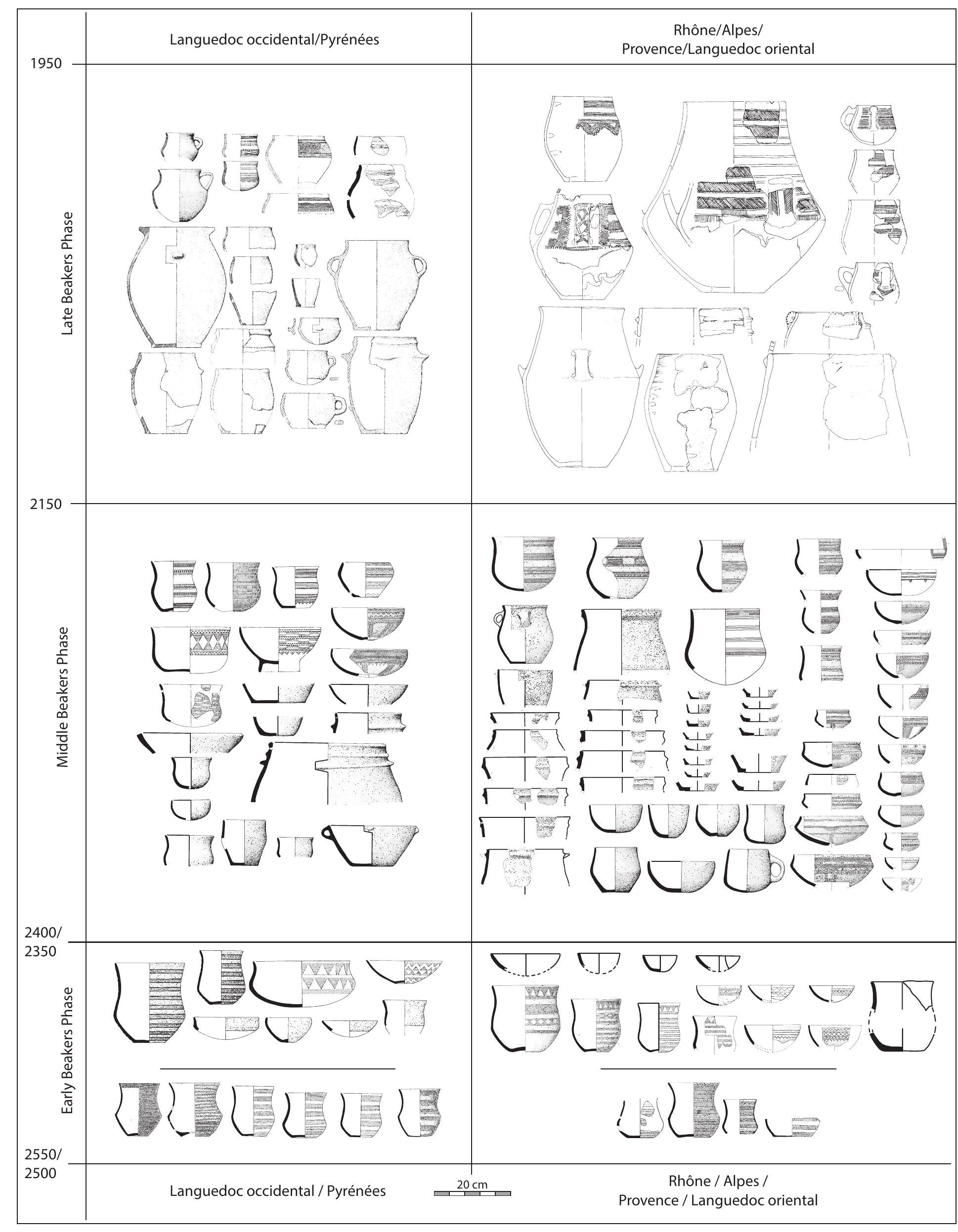
The result is a division of the Beakers of Mediterranean France into 3 phases (Lemercier 1998, 2004, 2012 a, 2012b, Lemercier et al. 2014 b) (Fig. 3):
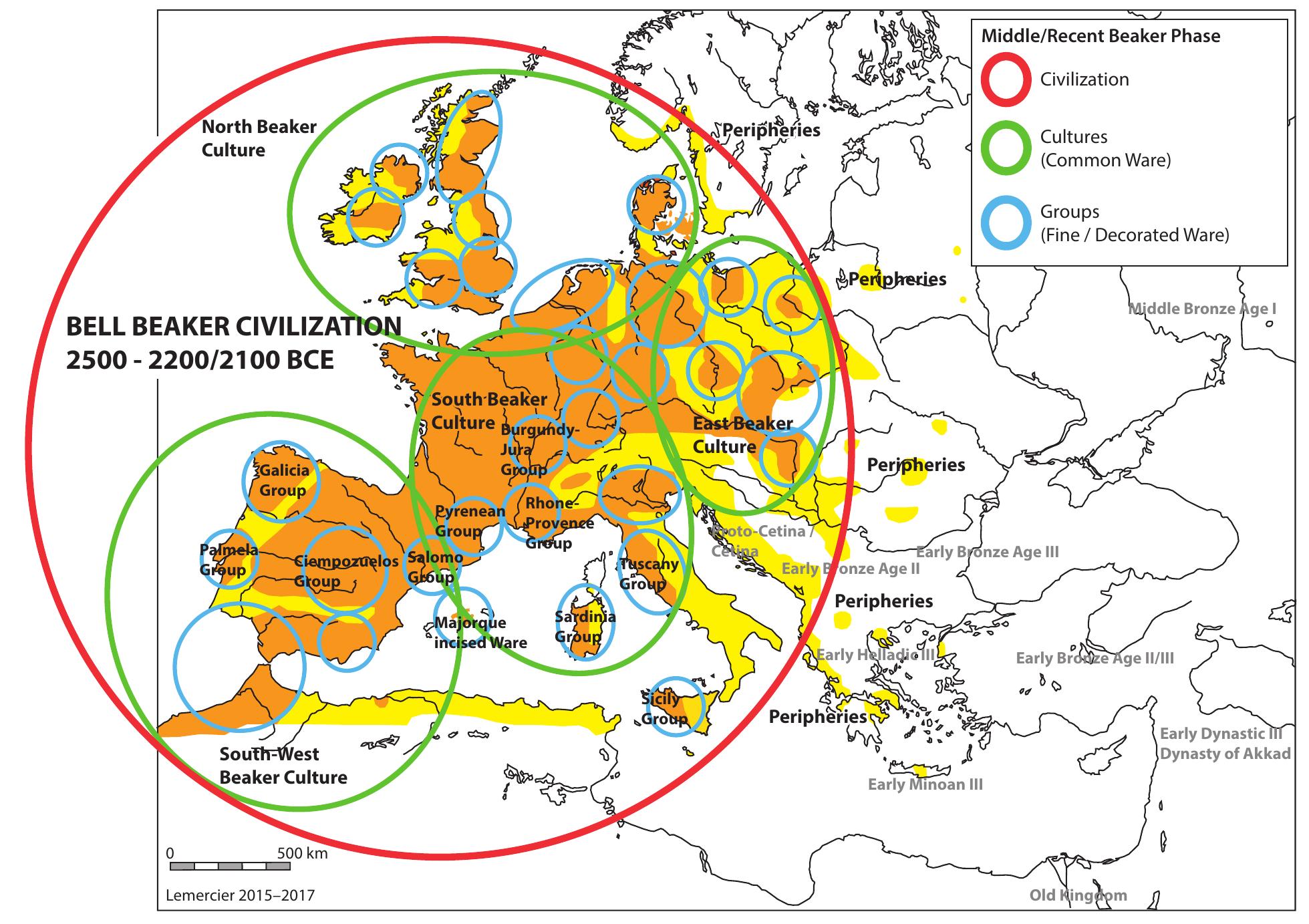
3— This first Bell Beaker phenomenon is followed, in a second phase and in a number of areas, by something that could be con- sidered a Bell Beaker “Civilization” (Fig. 4), formed of a number of re- gional “groups” with a specific material culture and regional tradi- tions of settlement types and economic practices. That is to say, the degree of acculturation is dependent in part on the local cultural mi- lieu. Bell Beaker groups separated by their decorated ceramics share, at a larger scale, the same common ware (Besse 2003, Piguet/ Besse 2009). There are probably three or four macro-regional Bell Beaker “cultures” identified by a specific common ware: the cultures of cen- tral Europe, Western Europe, Iberian Peninsula and British islands. 4— By the early phase of the Bell Beaker, settlement and domes- tic contexts with associated Bell Beaker objects and large quantities of elements of local cultures are recognized in some areas. These Bell Beaker assemblies therefore cannot be considered as a simple funer- ary package. Fig.4. Bell Beaker Civilization (CAD O. Lemercier).
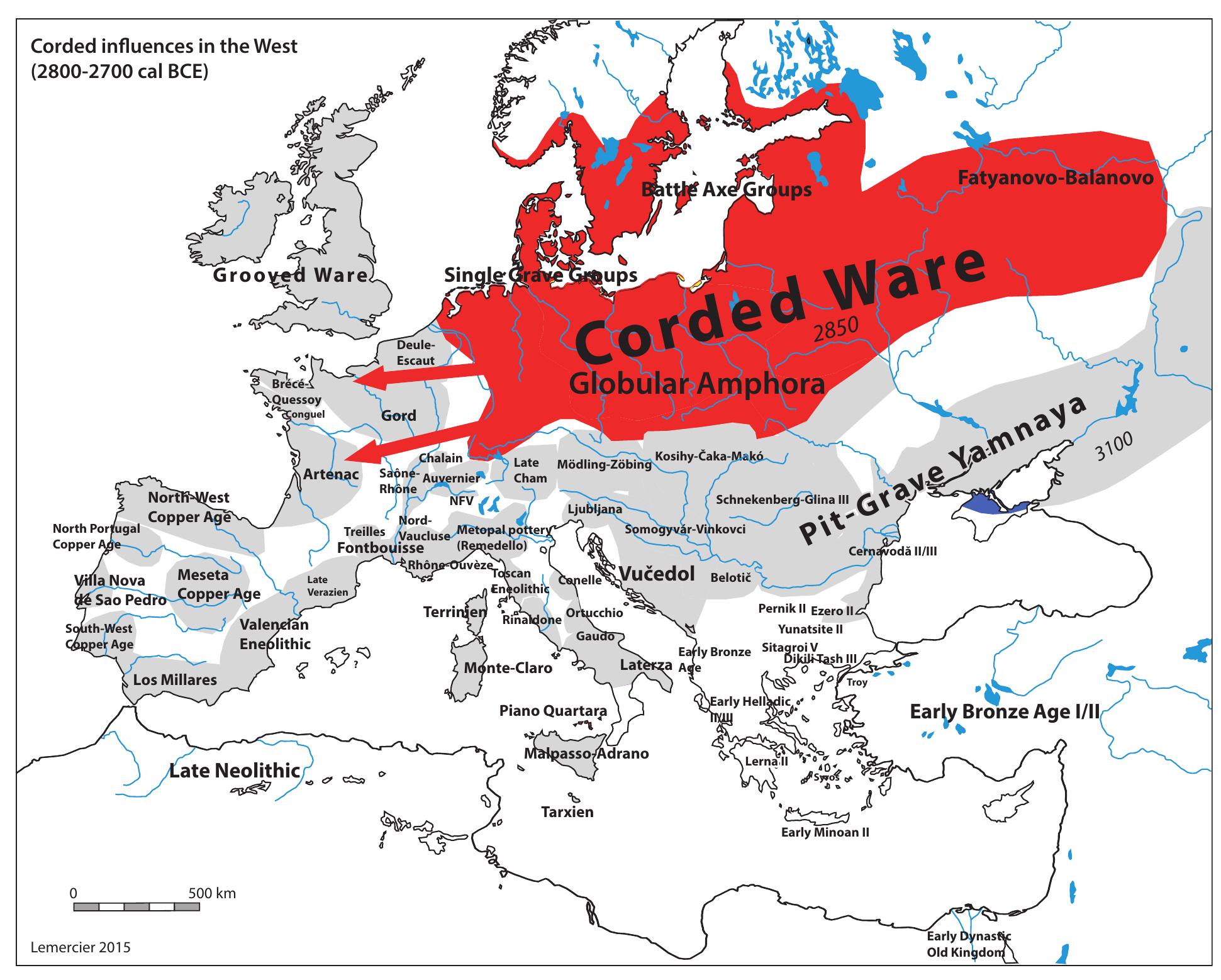
7— Based on current knowledge drinking vessels, codified individ- ual burials without mounds, and the warrior idea come from a set of cultures that stretch across Europe from their source in the eastern steppes (Harrison/ Heyd 2007, Heyd 2007, 2012, Jeunesse 2015, 2017). We will not enter here into the exciting debate about the nature of these diffusions / migrations etc. However, and this is very important, Western Europe seems to know these innovations prior to the emer- gence of the Bell Beakers (Fig. 5). It is therefore not possible to consid- er these innovations as arriving from the east with the Bell Beakers. These eastern innovations contribute instead to highlight an “atmos- phere” of Eastern origin in a big area between the boundaries of the extension of the Corded Ware and the Atlantic Ocean. Fig.5. Corded influences in the West (2800-2700 cal BCE) (after Guilaine 1998, Demoule 2007, Harrison/Heyd 2007 and various authors, CAD O.Lemercier). 8— More than 50 years after some researchers claimed that searching for the geographical origin of the Bell Beakers was use- less or nonsense (Shennan 1976, 1977a, 1977b, Clarke 1976, Burgess/ Shennan 1976, etc.), the debate is still alive (Beckerman 2012, Fokkens
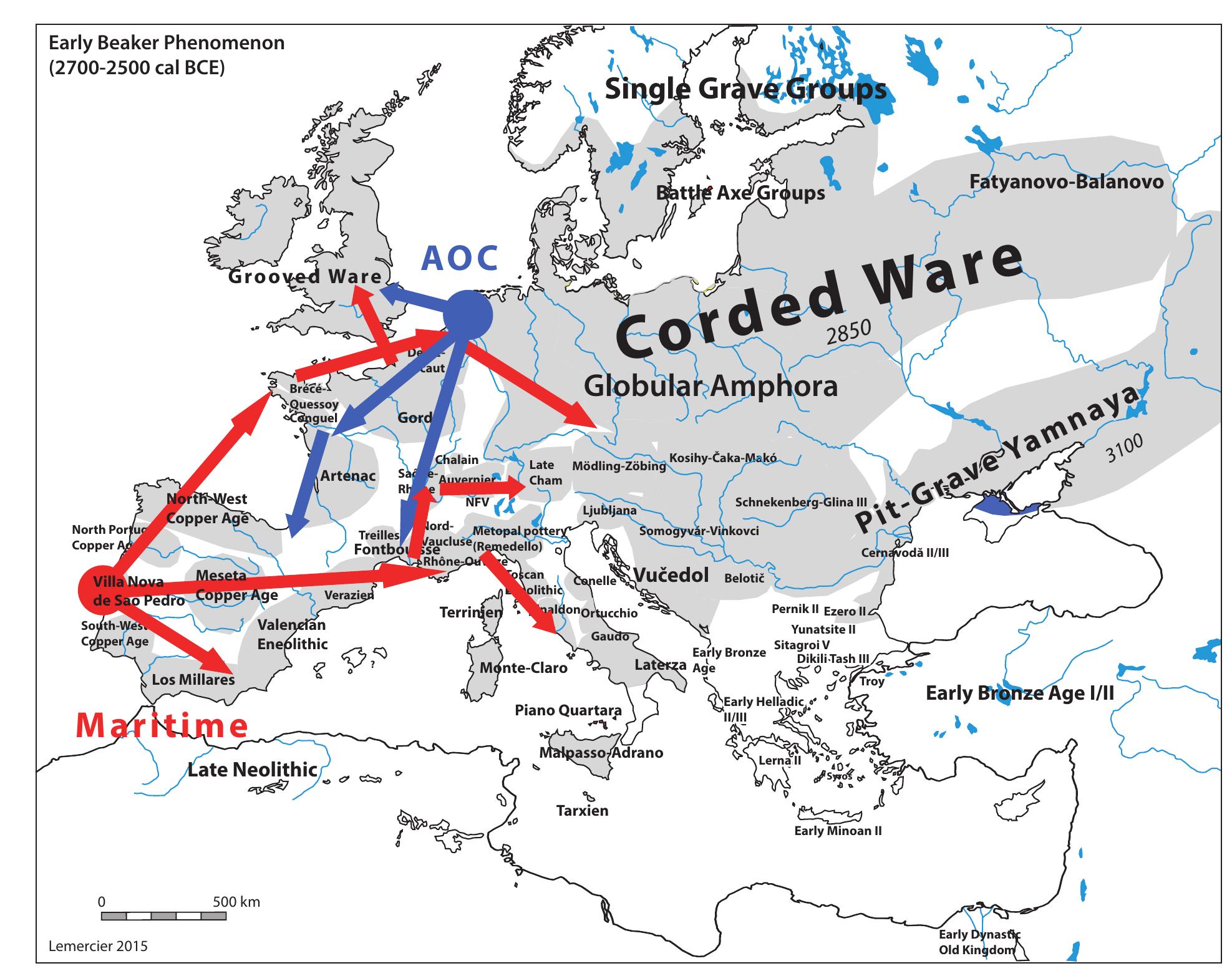
2012a, Guilaine 2004, Jeunesse 2015, Lanting 2008, Salanova 2004, 2009, Turek 2012, Vander Linden 2012, Miller 2013, for example). Fig.6. The Early Beaker Phenomenon (General Beakers map after Heyd 2013 modified, CAD O.Lemercier).
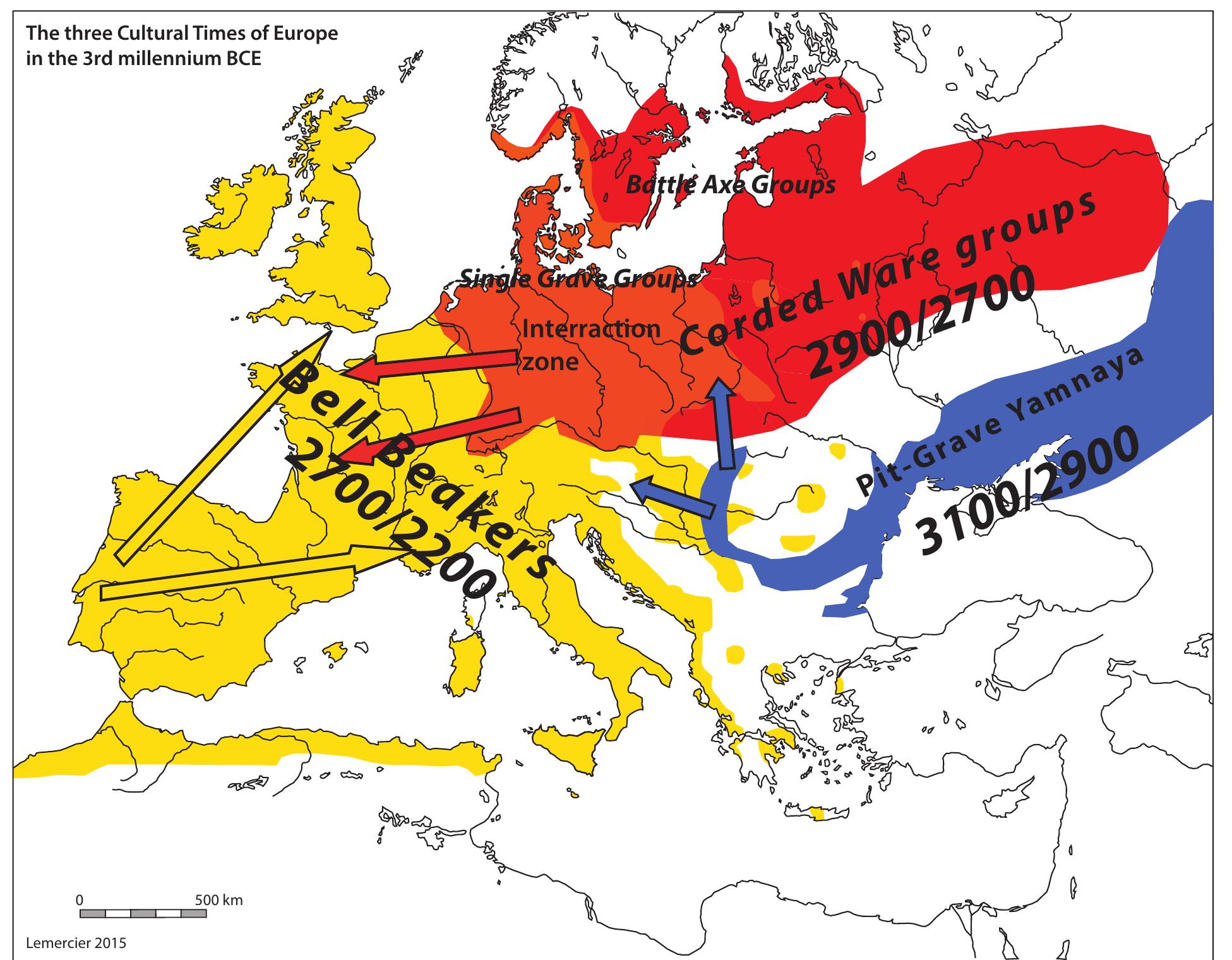
Fig. 7. The three cultural times of Europe during the 3 Millennium BCE (Gener- al Beaker map after Heyd 2013 modified, CAD O. Lemercier). 12— The social dimension of the Bell Beaker phenomenon is dif- ficult to prove on an archaeological basis. It is probably possible approach by observing different funerary assemblages, particular linked to some armed adult men (Case 2004, Fokkens 2012b, Heyd 2007a, Lemercier 2011, Salanova 2007, 2012, Salanova/Sohn 2007, Sa- rauw 2007, Turek 2014, 2015, 2017, Vandkilde 2006) and commensali ty rituals (Garrido Pena et al. 2011). The ideological dimension of the Bell Beaker phenomenon (Strahm 1998) seems easier to perceive. fe) y However, it is not unique to Bell Beaker, but belongs more broadly the “beaker cultures” of east origin. tO

Loading Preview
Sorry, preview is currently unavailable. You can download the paper by clicking the button above.
References (140)
- Allentoft et al. 2015: M.E. Allentoft/ M. Sikora/ K.-G. Sjogren/ S. Rasmussen/ M. Rasmussen/ J. Stenderup/ P.B. Damgaard/ H. Schroeder/ T. Ahlstrom/ L. Vinner/ A.-S. Malaspinas/ A. Margaryan/ T. Higham/ D. Chivall/ N.Lyn- nerup/ L. Harvig/ J. Baron/ P.D. Casa/ P. Dabrowski/ P.R. Duffy/ A.V.Ebel/ A. Epimakhov/ K. Frei/ M. Furmanek/ T. Gralak/ A. Gromov/ S. Gronkie- wicz/ G. Grupe/ T. Hajdu/ R. Jarysz/ V. Khartanovich/A. Khokhlov/V. Kiss/ J. Kolar/ A. Kriiska/ I. Lasak/ C. Longhi/ G. McGlynn/ A. Merkevicius/I. Mer- kyte/ M. Metspalu/ R. Mkrtchyan/ V. Moiseyev/ L. Paja/ G. Palfi/D. Pokutta/ L. Pospieszny/ T.D. Price/ L. Saag/ M. Sablin/ N. Shishlina/V. Smrcka/ V.I. Soenov/ V. Szeverenyi/ G. Toth/ S.V. Trifanova/L. Varul/ M. Vicze/L. Yepis- koposyan/ V. Zhitenev/ L. Orlando/ T. Sicheritz-Ponten/ S. Brunak/R. Niel- sen/ K. Kristiansen/ E. Willerslev, Population genomics of Bronze Age Eurasia. Nature 522, 2015, 167 -172.
- Ambert/Vaquer 2005: P. Ambert/ J. Vaquer (eds.) La première métallurgie en France et dans les pays limitrophes, actes du colloque international de Carcassonne 28 -30 septembre 2002. Mémoire de la Société Préhisto- rique Française 37 (Paris 2005).
- Bailly 2014: M. Bailly, Discordance des temps, concordance des espaces ? Re- marques sur les armatures de flèches en contexte campaniforme. De l'Arc jurassien à l'Isthme européen. In: R.-M. Arbogast/A. Greffier-Richard (eds.) Entre archéologie et écologie, une Préhistoire de tous les milieux. Mélanges offerts à Pierre Pétrequin (Besançon 2014), 355 -385.
- Baioni et al. 2008: M. Baioni/ V. Leonini/ D. Lo Vetro/ F. Martini/ R. Poggiani Keller/ L. Sarti, Bell Beaker in Everyday Life. Proceedings of the 10 th Meet- ing "Archéologie et Gobelets" (Florence -Siena -Villanuova sul Clisi, May 12 -15, 2006). Studi di archeologia preistorica 6 (Firenze 2008).
- Barge/Arnal 1985: H. Barge/ J. Arnal, Les boutons perforés en V en France. Leur contexte européen. Bulletin du Musée d'Anthropologie Préhisto- rique de Monaco 28, 1985, 63 -99.
- Beckerman 2012: S. M. Beckerman, Dutch Beaker chronology re-examined. Palaeohistoria 53/54, 64.
- Bermond Montanari 2001: G. Bermond Montanari, Forme insediative e aspet- ti sepolcrali nel Campaniforme dell'Italia settentrionale. In: F. Nicolis (ed.) Bell beakers today. Pottery, people, culture, symbols in prehistoric Europe. Proceedings of the International Colloquium Riva del Garda (Trento, Italy), May 11 -16 1998 (Trento 2001), 199 -206.
- Besse 2003: M. Besse, L'Europe du 3 e millénaire avant notre ère. Les céra- miques communes au Campaniforme. (Lausanne 2003).
- Besse/ Desideri 2005: M. Besse/ J. Desideri, La diversidad campaniforme: há- bitats, sepulturas y cerámicas. In: M.A. Rojo-Guerra/R. Garrido-Pena/ I. García-Martínez de Lagrán (eds.) El Campaniforme en la Península Ibé- rica y su Contexto Europeo = Bell Beakers in the Iberian Peninsula and their European Context (Valladolid 2005), 61 -106.
- Besse et al. 2009: M. Besse/ M. Piguet/ F. Cattin/ J. Desideri, L'imbroglio cam- paniforme : une céramique, des céramiques. In: De Méditerranée et d'ailleurs...Mélanges offerts à Jean Guilaine (Toulouse 2009), 97 -115. References Blaise 2010: E. Blaise, Economie animale et gestion des troupeaux au Néo- lithique final en Provence : approche archéozoologique et contribution des analyses isotopiques de l'émail dentaire. 2080 (Oxford 2010).
- Blaise et al. 2010: E. Blaise/ S. Brehard/ I. Carrere/ T. Favrie/ L. Gourichon/ D. Helmer/ J. Riviere/ A. Tresset/ J.-D. Vigne, L'élevage du Néolithique moyen 2 au Néolithique final dans le Midi méditerranéen de la France: état des données archéozoologiques. In: O. Lemercier/ R. Furestier/ E. Blaise (eds.) 4 e Millénaire. La transition du Néolithique moyen au Néo- lithique final dans le sud-est de la France et les régions voisines (Lattes 2010), 261 -284.
- Blaise et al. 2014: E. Blaise/ D. Helmer/ F. Convertini/ R. Furestier/ O. Lemercier, Bell Beakers herding and hunting in south-eastern France: technical, his- torical and social implications. In: M. Besse (ed.) Around the Petit-Chas- seur Site in Sion (Valais, Switzerland) and New Approaches to the Bell Beaker Culture (Oxford 2014), 163 -180.
- Brandt et al. 2013: G. Brandt/ W. Haak/ C.J. Adler/ C. Roth/ A. Szécsényi-Nagy/ S. Karimnia/ S. Möller-Rieker/ H. Meller/ R. Ganslmeier/ S. Friederich/ V. Dresely, Ancient DNA reveals key stages in the formation of central European mitochondrial genetic diversity. Science 342, 2013, 257 -261.
- Brotherton et al. 2013: P. Brotherton/ W. Haak/ J. Templeton/ G. Brandt/ J. Sou- brier/ C. Jane Adler/ S.M. Richards/ C. Der Sarkissian/ R. Ganslmeier/ S. Friederich/ V. Dresely/ M. van Oven/ R. Kenyon/ M.B. Van der Hoek/ J. Korlach/ K. Luong/ S.Y.W. Ho/ L. Quintana-Murci/ D.M. Behar/H. Meller/ K.W. Alt/ A. Cooper/ C. Genographic, Neolithic mitochondrial haplogroup H genomes and the genetic origins of Europeans. Nat Commun 4, 2013, 1764. Bueno Ramírez et al. 2008: P. Bueno Ramírez/ R. Barroso Bermejo/ A. Vázquez, The Beaker phenomenon and the funerary contexts of the International Tagus. In: P. Bueno Ramírez/ R. Barroso Bermejo/ R. De Balbín Berhmann (eds.) Graphical markers and megalith builders in the International Ta- gus, Iberian Peninsula (Oxford 2008), 141 -155.
- Burgess/Shennan 1976: C.B. Burgess/ S.J. Shennan, The Beaker Phenomenon: some suggestions. In: C.B. Burgess/ R. Miket (eds.) Settlement and Econ- omy in the Third and Second Millennia B.C. (Oxford 1976), 309 -331.
- Cardoso 2014: J.L. Cardoso, Absolute chronology of the Beaker phenome- non North of the Tagus estuary: demographic and social implications. Trabajos de Prehistoria 71, 2014, 56 -75.
- Cardoso 2014: J.L. Cardoso, Manifestazioni del Vaso Campaniforme nel ter- ritorio portoghese. In: R.C. De Marinis (ed.) Le manifestazioni del sacro e l'età del Rame nella regione alpina e nella pianura padana. Studi in me- moria di Angelo Rampinelli Rota, Atti del Convegno di Brescia, 23 -24 maggio 2014 (Nuvolera 2014), 279 -319.
- Case 1987: H.J. Case, Postscipt: Oxford International Western Mediterrane- an Beaker Conference. In: W.H. Waldren/ R.C. Kennard (eds.) Bell Beakers of the Western Mediterranean. Definition, Interpretation, Theory and New Site Data, The Oxford International Conference 1986 (Oxford 1987), 115 -127.
- Case 2004: H.J. Case, Beaker burial in Britain and Ireland. In: M. Besse/ J. Desi- deri (eds.) Graves and funerary rituals during the Late Neolithic and Early Bronze Age in Europe (2700 -2000 BC). proceedings of the International Conference held at the Cantonal Archaeological Museum, Sion (Switzer- land) October 4 -7 2001 (Oxford 2004), 195 -201.
- Cattin 2008: F. Cattin, Modalités d'approvisionnement et modalités de con- sommation du cuivre dans les Alpes au 3 e millénaire avant notre ère : apport des analyses métalliques à la connaissance des peuplements du Néolithique final, du Campaniforme et du Bronze ancien (Genève 2008). Chambon 2004: P. Chambon, Collective graves in France during the Bell Beaker phenomenon. In: M. Besse/ J. Desideri (eds.) Graves and funer- ary rituals during the Late Neolithic and Early Bronze Age in Europe (2700 -2000 BC). proceedings of the International Conference held at the Cantonal Archaeological Museum, Sion (Switzerland) October 4 -7 2001 (Oxford 2004), 69 -79.
- Christin et al. 2016: L. Christin/ F. Ducreux/ C. Fossurier, The Bell Beaker crema- tions at Genlis (Bourgogne, France). Musaica Archaeologica 1, 2016, 21 -36.
- Clarke 1976: D.L. Clarke, The Beaker Network -Social and Economic Mod- els. In: J.N. Lanting/ J.D. Van der Waals (eds.) Glockenbecher Symposion Oberried 1974 (Bussum/Haarlem 1976), 459 -477.
- Convertini 1996: F. Convertini, Production et signification de la céramique campaniforme à la fin du 3 e millénaire av. J.-C. dans le Sud et le Centre- Ouest de la France et en Suisse occidentale. British Archaeological Re- ports: International Series 656 (Oxford 1996).
- Convertini 2009: F. Convertini, Céramiques campaniformes et sépultures collectives de l'Aude: origine et statut du standard. In: De Méditerranée et d'ailleurs. Mélanges offerts à Jean Guilaine (Toulouse 2009), 221 -234.
- Convertini 2017: F. Convertini, Les dégraissants des céramiques des sites d'Avignon (Vaucluse) : nouvelles données, nouvelles visions de l'implan- tation du Campaniforme dans le Midi de la France. Bulletin de la Société Préhistorique Française 114, 2017, 691 -710.
- Convertini et al. 2004: F. Convertini/ R. Furestier/ L. Astruc/ V. Forest/ L. Jallot, Le Mas de Vignoles IV à Nîmes (Gard) : résultats préliminaires des fouilles d'un fossé à occupation campaniforme. In: H. Dartevelle (ed.) Auvergne et Midi. Actualités de la recherche. Actes des 5 e Rencontres Méridio- nales de Préhistoire Récente, Clermont-Ferrand 2002 (Cressensac 2004), 493 -507.
- Czebreszuk 2003: J. Czebreszuk, Bell Beakers in the Sequence of the Cultural Changes in South-western Baltic Area. In: J. Czebreszuk/ M. Szmyt (eds.) The Northeast Frontier of Bell Beakers (Oxford 2003), 21 -38.
- Czebreszuk/Szmyt 2012: J. Czebreszuk/ M. Szmyt, Bell Beakers and the cul- tural milieu of north European plain. In: H. Fokkens/ F. Nicolis (eds.) Back- ground to Beakers. Inquiries into regional cultural backgrounds of the Bell Beaker complex (Leiden 2012), 157 -175.
- Demoule 2007: J.P. Demoule (ed.) La révolution néolithique en France. (Paris 2007). Desideri 2011: J. Desideri, When Beakers met Bell Beakers, An analysis of dental remains British Archaeological Reports: International Series 2292 (Oxford 2011).
- Desideri/Besse 2010: J. Desideri/ M. Besse, Swiss Bell Beaker population dy- namics: eastern or southern influences? Archaeological and Anthropo- logical Sciences 2010, Desideri/Besse 2012: J. Desideri/ M. Besse, De la dent à l'individu, du groupe humain à son histoire: le phénomène campaniforme dans le nord de l'Espagne. Bulletins et Mémoires de la Société d'Anthropologie de Paris, nouveau séries 24, 2012, 39 -50.
- Desideri et al. 2012: J. Desideri/ M. Piguet/ R. Furestier/ F. Cattin/ M. Besse, The end of the Neolithic in Western Switzerland. In: H. Fokkens/ F. Nicolis (eds.) Background to Beakers. Inquiries into regional cultural backgrounds of the Bell Beaker complex (Leiden 2012), 81 -116.
- Desideri et al. 2010: J. Desideri/ T.D. Price/J. Burton/ P. Fullagar/ M. Besse, Mo- bility evidence during the Bell Beaker period in Western Switzerland through strontium isotope study. American Journal of Physical Anthro- pology 141, 2010, 93.
- Drenth 2014: E. Drenth, Cremation graves of the Bell Beaker Culture from the Netherlands: social, spatial and temporal aspects. In: M. Besse (ed.) Around the Petit-Chasseur Site in Sion (Valais, Switzerland) and New Ap- proaches to the Bell Beaker Culture (Oxford 2014), 307 -318.
- Edmonds 1995: M.R. Edmonds, Stone Tools and Society: Working Stone in Neolithic and Bronze Age Britain. (London/New York 1995).
- Endrődi 2014: A. Endrődi, Effects of cultural contacts on the burial rites of the Bell Beaker -Csepel Group. In: M. Besse (ed.) Around the Petit-Chasseur Site in Sion (Valais, Switzerland) and New Approaches to the Bell Beaker Culture. Proceedings of the International Conference held at Sion (Swit- zerland) October 27 -30, 2011 (Oxford 2014), 259 -275.
- Fokkens 2012: H. Fokkens, Dutchmen on the move? A discussion of the adop- tion of the Beaker package. In: M.J. Allen/ J.P. Gardiner/ J.A. Sheridan/ D. McOmish (eds.) Is there a British Chalcolithic? People, Place and Polity in the late 3 rd millennium (Oxford 2012), 115 -125.
- Fokkens 2012: H. Fokkens, Background to Dutch Beakers. A critical review of the Dutch model. In: H. Fokkens/ F. Nicolis (eds.) Background to Beakers. Inquiries into regional cultural backgrounds of the Bell Beaker complex (Leiden 2012), 9 -35.
- Furestier 2007: R. Furestier, Les industries lithiques campaniformes du sud-est de la France. British Archaeological Reports: International Series 1684 (Oxford 2007).
- Furholt 2018: M. Furholt, Massive Migrations? The Impact of Recent aDNA Studies on our View of Third Millennium Europe. European Journal of Archaeology 2018, Gadbois-Langevin 2013: R. Gadbois-Langevin, Le Campaniforme en France : étude spatiale de l'évolution d'un territoire. 1684 (Dijon 2013).
- Gallay 1979: A. Gallay, Le phénomène campaniforme : une nouvelle hypo- thèse historique. In: R. Menck/ A. Gallay (eds.) Anthropologie et archéo- logie: le cas des premiers âges des Métaux: actes du Symposium de Sils-Maria, 25 -30 septembre 1978 (Genève 1979), 231 -257.
- Gallay 1997: A. Gallay, L'énigme campaniforme. Archéologia HS 9, 1997, 14 -19.
- Gallay 2001: A. Gallay, L'enigme campaniforme. In: F. Nicolis (ed.) Bell beakers today. Pottery, people, culture, symbols in prehistoric Europe. Proceed- ings of the International Colloquium Riva del Garda (Trento, Italy), May 11 -16 1998 (Trento 2001), 41 -57.
- García Puchol et al. 2013: O. García Puchol/ J. Bernabeu/ Y. Carrión/ L. Molina/ G. Pérez/ M. Gómez, Una perspectiva funeraria sobre el periodo cam- paniforme en el Mediterráneo occidental. Leyendo el contexto social de los enterramientos individuales de La Vital (Gandía, Valencia). Trabajos de Prehistoria 70, 2013, 264 -277.
- Garrido-Pena et al. 2011: R. Garrido-Pena/ M.A. Rojo-Guerra/ I. García/ C. Teje- dor, Drinking and eating together: the social and the symbolic con- text of commensality rituals in the Bell Beakers of the Interior of Ibe- ria (2500 -2000 cal BC). In: G. Aranda/ S. Montón/ M. Sánchez (eds.) Guess who's coming to dinner: Commensality Rituals in the Prehistoric Socie- ties of Europe and Near East (Oxford 2011), 109 -129.
- Guilaine 1998: J. Guilaine (ed.) Atlas du Néolithique européen, vol. 2. L'Europe occidentale. (Liège 1998).
- Guilaine 2004: J. Guilaine, Les Campaniformes et la Méditerranée. Bulletin de la Société Préhistorique Française 101, 2004, 239 -249.
- Guilaine et al. 2001: J. Guilaine/ F. Claustre/ O. Lemercier/ P. Sabatier, Cam- paniformes et environnement culturel en France méditerranéenne. In: F. Nicolis (ed.) Bell beakers today. Pottery, people, culture, symbols in prehistoric Europe. Proceedings of the International Colloquium Riva del Garda (Trento, Italy), May 11 -16 1998 (Trento 2001), 229 -275.
- Harrison/Heyd 2007: R.J. Harrison/ V. Heyd, The Transformation of Europe in the Third Millennium BC: the example of 'Le Petit-Chasseur I + III' (Sion, Valais, Switzerland). Prähistorische Zeitschrift 82, 2007, 129 -214.
- Heyd 1998: V. Heyd, Die Glockenbecherkultur in Süddeutschland -Zum Stand der Forschung einer Regionalprovinz entlang der Donau. In: M. Benz/ S. Van Willigen (eds.) Some New approaches to The Bell Beaker 'Phenomenon'. Lost Paradise...?, Proceedings of the 2 nd Meeting of the « Association Archéologie et Gobelets », Feldberg (Germany), 18 -20 avril 1997 (Oxford 1998), 87 -106.
- Heyd 2001: V. Heyd, On the earliest Bell Beakers along the Danube. In: F. Nico- lis (ed.) Bell beakers today. Pottery, people, culture, symbols in prehistor- ic Europe. Proceedings of the International Colloquium Riva del Garda (Trento, Italy), May 11 -16 1998 (Trento 2001), 387 -409.
- Heyd 2007: V. Heyd, Families, Prestige Goods, Warriors & Complex Societies: Beaker Groups of the 3 rd Millennium cal BC Along the Upper and Middle Danube. Proceedings of the Prehistoric Society 73, 2007, 327 -379.
- Heyd 2007: V. Heyd, When the West meets the East: The Eastern Periphery of the Bell Beaker Phenomenon and its Relation with the Aegean Early Bronze. In: I. Galanaki/ I. Galanakis/ H. Tomas/ R. Laffineur (eds.) Between the Aegean and Baltic Seas: Prehistory across the Borders. Proceedings of the International Conference, University of Zagreb/Croatia, April 10 -14 2005 (Liège 2007), 91 -107.
- Heyd 2012: V. Heyd, Growth and Expansion: social, economic and ideolog- ical structures in the European Chalcolithic. In: M.J. Allen/ J.P. Gardiner/ J.A. Sheridan/ D. McOmish (eds.) Is there a British Chalcolithic? People, Place and Polity in the Later 3 rd Millennium (Oxford 2012), 98 -114.
- Heyd 2013: V. Heyd, Europe at the Dawn of the Bronze Age. In: V. Heyd/ G. Kulcsar/ V. Szeverenyi (eds.) Transitions to the Bronze Age. Interre- gional Interraction and Socio-Cultural Change in the Third Millennium BC Carpathian Basin and Neighbouring Regions (Budapest 2013), 9 -66.
- Heyd 2016: V. Heyd, Das Zeitalter der Ideologien: Migration, Interaktion und Expansion im prähistorischen Europa des 4. und 3. Jahrtausends v. Chr. In: M. Furholt/ R. Großmann/ M. Szmyt (eds.) Transitional Landscapes? The 3 rd Millennium BC in Europe. Proceedings of the International Work- shop "Socio-Environmental Dynamics over the Last 12,000 Years: The Creation of Landscapes III (April 15 -18 2013)" in Kiel (Bonn 2016), 53 -84.
- Heyd 2017: V. Heyd, Kossinna's smile. Antiquity 91, 2017, 348 -359.
- Heyd et al. 2005: V. Heyd/ B. Winterholler/ K. Böhm/ E. Pernicka, Mobilität, Strontiumisotopie und Subsistenz in der süddeutschen Glockenbe- cherkultur. Bericht der Bayerischen Bodendenkmalpflege 43/44, 2005, 109 -135.
- Jeunesse 2014: C. Jeunesse, The dogma of the Iberian origin of the Bell Beaker: attempting its deconstruction. Journal of Neolithic Archaeology 16, 2014, 158 -166.
- Jeunesse 2014: C. Jeunesse, Pratiques funéraires campaniformes en Europe -faut-il remettre en cause la dichotomie Nord-Sud ? La question de la réutilisation des sépultures onumentales dans l'Europe du IIIe millé- naire. In: P. Lefranc/ A. Denaire/ C. Jeunesse (eds.) Données récentes sur les pratiques funéraires néolithiques de la Plaine du Rhin supérieur (du Rubané au Campaniforme), actes de la table ronde de Strasbourg, 1 er juin 2011 (Oxford 2014), 211 -228.
- Jeunesse 2015: C. Jeunesse, Les statues-menhirs de Méditerranée occiden- tale et les steppes. Nouvelles perspectives. In: G. Rodriguez/ H. Marche- si (eds.) Statues menhir et pierres levées du Néolithique à aujourd'hui, Actes du 3 e colloque international sur la statuaire mégalithique, Saint- Pons-de-Thomières, 12 -16 septembre 2012 (Montpellier 2015), 123 -138.
- Jeunesse 2017: C. Jeunesse, Emergence of the Ideology of the Warrior in the Western Mediterranean during the second Half of the fourth Millennium BC. Eurasia Antiqua 14, 2017, 171 -184.
- Kalicz-Schreiber/Kalicz 2001: R. Kalicz-Schreiber/ N. Kalicz, Were the Bell Beakers as Social indicators of the Early Bronze Age in Budapest? In: F. Nicolis (ed.) Bell beakers today. Pottery, people, culture, symbols in prehistoric Europe. Proceedings of the International Colloquium Riva del Garda (Trento, Italy), May 11 -16 1998 (Trento 2001), 439 -458.
- Kern 2012: D. Kern, Migration and mobility in the latest Neolithic of the Trais- en valley, Lower Austria: Archaeology. In: E. Kaiser/ J. Burger/ W. Schi- er (eds.) Population Dynamics in Prehistory and Early History. New Ap- proaches by Using Stable Isotopes and Genetics (Berlin 2012), 213 -224.
- Knipper et al. 2017: C. Knipper/ A. Mittnik/ K. Massy/ C. Kociumaka/ I. Ku- cukkalipci/ M. Maus/ F. Wittenborn/ S.E. Metz/ A. Staskiewicz/ J. Krause/ P.W. Stockhammer, Female exogamy and gene pool diversification at the transition from the Final Neolithic to the Early Bronze Age in cen- tral Europe. Proceedings of the National Academy of Sciences Sep 2017, 201706355, 2017, Kopacz et al. 2008: J. Kopacz/ A. Přichystal/ L. Šebela, Bell Beaker lithic in- dustry in Moravia (Czech Republic). In: M. Baioni/ V. Leonini/ D. Lo Vetro/ F. Martini/ R. Poggiani Keller/ L. Sarti (eds.) Bell Beaker in Everyday Life. Proceedings of the 10 th Meeting "Archéologie et Gobelets" (Florence - Siena -Villanuova sul Clisi, May 12 -15, 2006) (Firenze 2008), 257 -270.
- Kristiansen et al. 2017: K. Kristiansen/ M.E. Allentoft/ K.M. Frei/ R. Iversen/ N.N. Johannsen/ G. Kroonen/ Ł. Pospieszny/ M. Sikora/ E. Willerslev, Retheorising mobility and the formation of culture and language among the Corded Ware Culture in Europe. Antiquity 91, 2017, 334 -347.
- Kunst 2005: M. Kunst, Bell Beakers in Portugal. A short summary. In: M.A. Rojo/ R. Garrido/ I. García (eds.) El Campaniforme en la Península Ibérica y su contexto europeo (Valladolid 2005), 209 -225.
- Labaune 2016: M. Labaune, Le métal et la métallurgie campaniforme en Eu- rope occidentale. Usage et circulation dans la 2 e moitié du III e millénaire av. n. è. 1684 (Dijon 2016).
- Lanting 2008: J.N. Lanting, De NO-Nederlandse/NW-Duitse Klokbeker- groep: Culturele achtergrond, typologie van het aardewerk, datering, verspreiding en grafritueel. Palaeohistoria 49/50, 2008, 11 -326.
- Lazaridis et al. 2014: I. Lazaridis/ N. Patterson/ A. Mittnik/ G. Renaud/ S. Mal- lick/ K. Kirsanow/ P.H. Sudmant/ J.G. Schraiber/ S. Castellano/ M. Lipson/ B. Berger/ C. Economou/ R. Bollongino/ Q. Fu/ K.I. Bos/ S. Nordenfelt/ H. Li/ C. de Filippo/ K. Prufer/ S. Sawyer/ C. Posth/ W. Haak/ F. Hallgren/ E. Fornander/ N. Rohland/ D. Delsate/ M. Francken/ J.M. Guinet/ J. Wahl/ G. Ayodo/ H.A. Babiker/ G. Bailliet/ E. Balanovska/ O. Balanovsky/ R. Bar- rantes/ G. Bedoya/ H. Ben-Ami/ J. Bene/ F. Berrada/ C.M. Bravi/F. Brisighel- li/ G.B. Busby/ F. Cali/ M. Churnosov/ D.E. Cole/ D. Corach/ L. Damba/ G. van Driem/ S. Dryomov/ J.M. Dugoujon/ S.A. Fedorova/ I. Gallego Romero/ M. Gubina/ M. Hammer/ B.M. Henn/ T. Hervig/ U. Hodoglugil/ A.R. Jha/ S. Karachanak-Yankova/ R. Khusainova/ E. Khusnutdinova/ R. Kittles/ T. Kivisild/ W. Klitz/ V. Kucinskas/ A. Kushniarevich/ L. Laredj/ S. Litvinov/ T. Loukidis/ R.W. Mahley/ B. Melegh/ E. Metspalu/ J. Molina/ J. Mountain/ K. Nakkalajarvi/ D. Nesheva/ T. Nyambo/ L. Osipova/ J. Parik/ F. Platonov/ O. Posukh/ V. Romano/ F. Rothhammer/I. Ru- dan/ R. Ruizbakiev/ H. Sahakyan/ A. Sajantila/ A. Salas/ E.B. Starikovs- kaya/ A. Tarekegn/ D. Toncheva/ S. Turdikulova/ I. Uktveryte/ O. Utevs- ka/ R. Vasquez/ M. Villena/ M. Voevoda/ C.A. Winkler/ L. Yepiskoposyan/ P. Zalloua/ T. Zemunik/ A. Cooper/C. Capelli/ M.G. Thomas/ A. Ruiz-Lina- res/ S.A. Tishkoff/ L. Singh/K. Thangaraj/ R. Villems/ D. Comas/ R. Suker- nik/ M. Metspalu/ M. Meyer/ E.E. Eichler/ J. Burger/ M. Slatkin/ S. Paa- bo/ J. Kelso/ D. Reich/ J. Krause, Ancient human genomes suggest three an- cestral populations for present-day Europeans. Nature 513, 2014, 409 -13.
- Lemercier 2004: O. Lemercier, Les Campaniformes dans le Sud-est de la France. Monographies d'Archéologie Méditerranéenne 18 (Lattes 2004).
- Lemercier 2011: O. Lemercier, Le geurrier dans l'Europe du 3 e millénaire avant notre ère. L'arc et le poignard dans les sépultures individuelles campan- iformes. In: L. Baray/ M. Honegger/ M.-H. Dias-Meirinho (eds.) Actes de la Table ronde internationale et interdisciplinaire Sens, CEREP (Dijon 2011), 121 -224.
- Lemercier 2012: O. Lemercier, Interpreting the Beaker phenomenon in Medi- terranean France: an Iron Age analogy. Antiquity 86, 2012, 131 -143.
- Lemercier 2012: O. Lemercier, The Mediterranean France Beakers Transition. In: H. Fokkens/ F. Nicolis (eds.) Background to Beakers. Inquiries into the regional cultural background to the Bell Beaker complex (Leiden 2012), 81 -119.
- Lemercier 2014: O. Lemercier, Bell Beakers in Eastern France and the Rhone- Saone-Rhine axis question. In: M. Besse (ed.) Around the Petit-Chasseur Site in Sion (Valais, Switzerland) and New Approaches to the Bell Beaker Culture (Oxford 2014), 181 -204.
- Lemercier 2015: O. Lemercier, "I did not entirely understand your argument, yet I disagree." Histoire et perspectives de la recherche campaniforme. (Dijon 2015).
- Lemercier in press: O. Lemercier, Campaniforme : fin du Néolithique et/ou début de l'âge du Bronze? In: N. Buchez/ O. Lemercier/ I. Praud/ M. Talon (eds.) La fin du Néolithique et la genèse du Bronze ancien dans l'Europe du nord-ouest (Paris in press).
- Lemercier 2018: O. Lemercier, La question campaniforme. In: J. Gui- laine/ D. Garcia (eds.) La Protohistoire de la France (Paris 2018), 205 -217.
- Lemercier et al. 2014: O. Lemercier/ E. Blaise/ F. Cattin/ F. Convertini/ J. Desi- deri/ R. Furestier/ R. Gadbois-Langevin/ M. Labaune, 2500 avant notre ère : l'implantation campaniforme en France méditerranéenne. In: L. Mercuri/ R.G. Villaescusa/ F. Bertoncello (eds.) Implantations humaines en milieu littoral méditerranéen : facteurs d'installation et processus d'appro- priation de l'espace (Préhistoire, Antiquité, Moyen-Age) (Antibes 2014), 191 -203.
- Lemercier et al. 2014: O. Lemercier/ R. Furestier/ R. Gadbois-Langevin/ B.S. Paulsson, Chronologie et périodisation des campaniformes en France mé- diterranéenne. In: I. Sénépart/ F. Leandri/ J. Cauliez/ T. Perrin/ E. Thirault (eds.) Chronologie de la Préhistoire récente dans le sud de la France: Acquis 1992 -2012. Actualité de la recherche (Toulouse 2014), 175 -195.
- Lemercier et al. 2011: O. Lemercier/ R. Furestier/ A. Müller/ E. Blaise/ C. Bou- ville/ F. Convertini/ L. Salanova, La sépulture individuelle campaniforme de La Fare, Forcalquier (Alpes-des-Haute-Provence). In: L. Salanova/ Y. Tcheremissinoff (eds.) Les sépultures individuelles campaniformes en France (Paris 2011), 145 -159.
- Lemercier et al. 2005: O. Lemercier/ V. Leonini/ P. Tramoni/ R. Furestier, Cam- paniformes insulaires et continentaux de France et d'Italie méditerra- néennes. Relations et échanges entre Corse, Sardaigne, Toscane et Midi français dans la seconde moitié du troisième millénaire avant notre ère. In: A. D'Anna/ J. Cesari/ L. Ogel/ J. Vaquer (eds.) La Corse dans les rela- tions et échange en Méditerranée occidental padent la préhistoire et protohistoire, Comité des Travaux historiques et scientifiques (128 e Con- grès des Sociétes historiques et scientifiques, Bastia 2003) (Paris 2005), 241 -251.
- Lemercier/Strahm 2018: O. Lemercier/ C. Strahm, Nids de coucous et grandes maisons. L'habitat campaniforme, épicampaniforme et péricam- paniforme en France dans son contexte européen. In: O. Lemercier/ I. Senepart/ M. Besse/ C. Mordant (eds.) Habitations et habitat du Néo- lithique à l'âge du Bronze en France et régions voisines (Toulouse 2018), 459 -479.
- Lemercier/Tcheremissinoff 2011: O. Lemercier/ Y. Tcheremissinoff, Du Néoliti- hque final au Bronze ancien: les sépultures individuelles campaniformes dans le sud de France. In: L. Salanova/ Y. Tcheremissinoff (eds.) Les sépul- tures individuelles campaniformes en France (Paris 2011), 177 -194.
- Lewthwaite 1987: J.G. Lewthwaite, The Braudelian Beaker: a Chalcolithic Con- joncture. In: W. Waldren/ R.C. Kennard (eds.) Bell Beakers of the Western Mediterranean (Oxford 1987), 31 -60.
- Martín Cólliga 2001: A. Martín Cólliga, État de la question du campaniforme dans le contexte culturel chalcolithique du Nord-Est de la Péninsule Ibe- rique. In: F. Nicolis (ed.) Bell beakers today. Pottery, people, culture, sym- bols in prehistoric Europe. Proceedings of the International Colloquium Riva del Garda (Trento, Italy), May 11 -16 1998 (Trento 2001), 155 -171.
- Martiniano et al. 2017: R. Martiniano/ L.M. Cassidy/ R. Ó'Maoldúin/ R. McLaugh- lin/ N.M. Silva/ L. Manco/ D. Fidalgo/ T. Pereira/ M.J. Coelho/ M. Serra/ J. Burger, The population genomics of archaeological transition in West Iberia: Investigation of ancient substructure using imputation and hap- lotype-based methods. PLoS genetics 13, 2017, e1006852. Mertens 2003: K. Mertens, Einflüsse der Glockenbecherkultur in Nord- deutschland. In: J. Czebreszuk/ M. Szmyt (eds.) The Northeast Frontier of Bell Beakers. Proceedings of the symposium held at the Adam Mickie- wicz University, Poznań (Poland), May 26 -29 2002 (Oxford 2003), 51 -72.
- Metzinger-Schmitz 2004: B. Metzinger-Schmitz, Die Glockenbecherkultur in Mähren und Niederösterreich. (PhD Thesis Universität Saarlandes 2004).
- Mikołajczak/Szczodrowski 2012: K. Mikołajczak/ R. Szczodrowski, The Bell Beaker phenomenon: meanings of regional transmission. In: H. Fokkens/ F. Nicolis (eds.) Background to Beakers. Inquiries into the regional cultural background to the Bell Beaker complex (Leiden 2012), 177 -189.
- Müller 1998: A. Müller, Geschlechtsspezifische Totenlage und geschlechts- spezifische Beigaben bei der Böhmisch-Mährischen Gruppe bzw. Ost- gruppe der Glockenbecherkultur. In: M. Benz/ S. Van Willigen (eds.) Some New approaches to The Bell Beaker 'Phenomenon'. Lost Paradise...?, Pro- ceedings of the 2 nd Meeting of the « Association Archéologie et Gobe- lets », Feldberg (Germany), 18 -20 avril 1997 (Oxford 1998), 121 -128.
- Müller 2013: J. Müller, I vasi campaniformi. Il mosaico di una rete. In: R.C. De Marinis (ed.) L'età del rame. La pianura padana e le Alpi al tempo di Otzi. Catalogo della Mostra (Brescia 2013), 483 -502.
- Müller/Van Willigen 2001: J. Müller/ S. Van Willigen, New radiocarbon evi- dence for european Bell Beakers and the consequences for the diffusion of the Bell Beaker Phenomenon. In: F. Nicolis (ed.) Bell beakers today. Pottery, people, culture, symbols in prehistoric Europe. Proceedings of the International Colloquium Riva del Garda (Trento, Italy), May 11 -16 1998 (Trento 2001), 59 -80.
- Needham 2005: S.P. Needham, Transforming beaker culture in North-West Europe: process of fusion and fission. Proceedings of the Prehistoric Society 71, 2005, 171 -217.
- Needham 2007: S.P. Needham, Isotopic aliens: Beaker movement and cultur- al transmissions. In: M. Larsson/ M.G. Parker Pearson (eds.) From Stone- henge to the Baltic (Oxford 2007), 41 -46.
- Neugebauer/Neugebauer-Maresch 2001: J.-W. Neugebauer/ C. Neugebau- er-Maresch, Bell Beaker Culture in Austria. In: F. Nicolis (ed.) Bell beakers today. Pottery, people, culture, symbols in prehistoric Europe. Proceed- ings of the International Colloquium Riva del Garda (Trento, Italy), May 1998 11 -16 (Trento 2001), 429 -437.
- Nicolas 2017: C. Nicolas, Arrows of Power from Brittany to Denmark (2500- 1700 BC). Proceedings of the Prehistoric Society 83, 2017, 247 -287.
- Nicolis/Mottes 1998: F. Nicolis/ E. Mottes, Simbolo ed Enigma. Il bicchiere campaniforme e l'Italia nella preistoria europea del III millenio a.C. (Tren- to 1998).
- Olalde et al. 2018: I. Olalde/ S. Brace/ M.E. Allentoft/ I. Armit/ K. Kristians- en/ N. Rohland/ S. Mallick/ T. Booth/ A. Szécsényi-Nagy/ A. Mittnik/ E. Al- tena/ M. Lipson/ I. Lazaridis/ N.J. Patterson/ N. Broomandkhoshbacht/ Y. Diekmann/ Z. Faltyskova/ D.M. Fernandes/ M. Ferry/ E. Harney/ P. de Knijff/ M. Michel/ J. Oppenheimer/ K. Stewardson/ A. Barclay/ K.W. Alt/ A. Avilés Fernández/ E. Bánffy/ M. Bernabò-Brea/ D. Billoin/ C. Blasco/ C. Bonsall/ L. Bonsall/ T. Allen/ L. Büster/ S. Carver/ L. Castells Navarro/ O.E. Craig/ G.T. Cook/ B. Cunliffe/ A. Denaire/ K.E. Dinwiddy/ N. Dodwell/ M. Ernée/ C. Evans/ M. Kuchařík/ J. Francès Farré/ H. Fokkens/ C. Fowler/ M. Gazenbeek/ R. Garrido Pena/ M. Haber-Uriarte/ E. Haduch/G. Hey/ N. Jowett/ T. Knowles/ K. Massy/ S. Pfrengle/ P. Lefranc/O. Lemer- cier/ A. Lefebvre/ J. Lomba Maurandi/ T. Majó/ J.I. McKinley/ K. McSwee- ney/ M. Balázs Gusztáv/ A. Modi/ G. Kulcsár/V. Kiss/A. Czene/ R. Patay/ A. Endródi/ K. Köhler/T. Hajdu/ J.L. Cardoso/C. Liesau/ M. ParkerPearson/ P. Włodarczak/ T.D. Price/ P. Prieto/ P.-J. Rey/P. Ríos/ R. Risch/M.A. Rojo Guerra/ A. Schmitt/ J. Serralongue/ A.M. Silva/V. Smrčka/L. Vergnaud/ J. Zilhão/ D. Caramelli/ T. Higham/ V. Heyd/ A. Sheridan/K.-G. Sjögren/ M.G. Thomas/ P.W. Stockhammer/ R. Pinhasi/ J. Krause/W. Haak/ I. Barnes/ C. Lalueza-Fox/ D. Reich, The Beaker Phenomenon And The Genomic Transformation Of Northwest Europe. Nature 555, 2018, 190 -196.
- Parker Pearson et al. 2016: M. Parker Pearson/ A. Chamberlain/ M. Jay/ M.P. Rich- ards/ J.A. Sheridan/ N. Curtis/ J. Evans/ A.M. Gibson/ M. Hutchison/ P. Ma- honey/ P. Marshall, Beaker people in Britain: migration, mobility and diet. Antiquity 90, 2016, 620 -637.
- Pellegrini et al. 2016: M. Pellegrini/ J. Pouncett/ M. Jay/ M.P. Pearson/ M.P. Rich- ards, Tooth enamel oxygen "isoscapes" show a high degree of human mobility in prehistoric Britain. Sci Rep 6, 2016, 34986.
- Piguet/Besse 2009: M. Piguet/ M. Besse, Chronology and Bell Beaker common ware. Radiocarbon 51, 2009, 817 -830.
- Price et al. 2004: T.D. Price/ C. Knipper/ G. Grupe/ V. Smrcka, Strontium isotopes and prehistoric human migration: the Bell Beaker period in Central Europe. European Journal of Archaeology 7, 2004, 9 -40.
- Riquet et al. 1963: R. Riquet/ J. Guilaine/ A. Coffyn, Les campaniformes Fran- çaises. Gallia Préhistoire 6, 1963, 63 -128.
- Rojo Guerra et al. 2005: M.A. Rojo Guerra/ R. Garrido Pena/ I. García (eds.) El Campaniforme en la Península Ibérica y su contexto europeo / Bell Beak- ers in the Iberian Peninsula and their European context. (Valladolid 2005).
- Salanova 2000: L. Salanova, La question du Campaniforme en France et dans les îles anglo-normandes: productions, chronologie et rôles d'un stan- dard céramique. Documents Préhistoriques 13 (Paris 2000).
- Salanova 2001: L. Salanova, Technological, ideological or economic Europe- an union? The variability of Bell Beaker decoration. In: F. Nicolis (ed.) Bell beakers today. Pottery, people, culture, symbols in prehistoric Europe. Proceedings of the International Colloquium Riva del Garda (Trento, Ita- ly), May 11 -16 1998 (Trento 2001), 91 -101.
- Salanova 2005: L. Salanova, Los orígenes del campaniforme: Descomponer, analizar, cartografiar. In: M.A. Rojo/ R. Garrido/ I. García (eds.) El Campani- forme en la Península Ibérica y su contexto europeo (Valladolid 2005), 7 -27.
- Salanova 2007: L. Salanova, Les sépultures campaniformes: lecture sociale. In: J. Guilaine (ed.) Le Chalcolithique et la construction des inégalités (Paris 2007), 213 -228.
- Salanova 2008: L. Salanova, Le temps d'une diffusion: la céramique campani- forme en Europe. In: A. Lehöerff (ed.) Construire le temps. Histoire et mé- thodes des chronologies et calendriers des derniers millénaires avant notre ère en Europe occidentale. Actes du XXX e colloque international HAL- MA-IPEL, 7 -9 décembre 2006 (Glux-en-Glenne, Bibracte 2008), 135 -149.
- Salanova 2009: L. Salanova, Émergence du Campaniforme en Atlantique ou en Méditerranée? Retour à la typologie des vases. In: De Méditerranée et d'ailleurs. Mélanges offerts à Jean Guilaine (Toulouse 2009), 685 -692.
- Salanova 2012: L. Salanova, Qualité des productions céramiques et sta- tuts des morts : le cas du Campaniforme en Europe occidentale. In: M. Sohn/ J. Vaquer (eds.) Sépultures collectives et mobiliers funéraires de la fin du Néolithique en Europe occidentale (Toulouse 2012), 147 -157.
- Salanova et al. 2005: L. Salanova/ F. Ducreux/ A. Argant/ F. Convertini/ O. Gros/ A.-C. Gros/ S. Saintot, L'habitat campaniforme de La Noue à Saint-Marcel (Saône-et-Loire): éléments de définition du groupe bourguignon-ju- rassien. Gallia Préhistoire 47, 2005, 33 -146.
- Salanova/Heyd 2007: L. Salanova/ V. Heyd, Du collectif à l'individu, de la ré- gion à l'Europe. Le III e millénaire avant J.-C. entre le bassin parisien et la vallée rhénane. Archaeologia Mosellana 7, 2007, 469 -493.
- Salanova/Sohn 2007: L. Salanova/ M. Sohn, Mobilier funéraire et modes de différenciation des morts à la fin du Néolithique en Europe occiden- tale. In: L. Baray/ P. Brun/ A. Testart (eds.) Pratiques funéraires et sociétés. Nouvelles approches en archéologie et en anthropologie sociale (Dijon 2007), 77 -90.
- Sangmeister 1963: E. Sangmeister, La civilisation du vase Campaniforme. In: P.R. Giot (ed.) les Civilisations Atlantiques du Néolithique à l'âge du Fer. Actes du premier Colloque Atlantique, Brest, 11 -9-1961 (Rennes 1963), 25 -56.
- Sarauw 2007: T. Sarauw, Male symbols or warrior identities? The 'archery burials' of the Danish Bell Beaker Culture. Journal of Anthropological Ar- chaeology 26, 2007, 65 -87.
- Sarauw 2008: T. Sarauw, Danish Bell Beaker Pottery and Flint Daggers -the Dis- play of Social Identities? European Journal of Archaeology 11, 2008, 23 -47.
- Shennan 1976: S.J. Shennan, Bell Beakers and their context in Central Europe. In: J.N. Lanting/ J.D. Van der Waals (eds.) Glockenbecher Symposion Oberried 1974 (Bussum/Haarlem 1976), 231 -239.
- Shennan 1977: S.J. Shennan, The appearance of the Bell Beaker assemblage in Central Europe. In: R.J. Mercer (ed.) Beakers in Britain and Europe: four studies (Oxford 1977), 51 -70.
- Shennan 1977: S.J. Shennan, Bell Beakers and their context in Central Eu- rope: A new Approach. (PhD Thesis University of Cambridge 1977).
- Shennan 1986: S.J. Shennan, Interaction and change in the third millennium BC in western and central Europe. In: A.C. Renfrew/ J.F. Cherry (eds.) Peer polity interaction and socio-political change (New York 1986), 137 -148.
- Sheridan 2012: J.A. Sheridan, A Rumsfeld Reality Check: what we know, what we don't know and what we don't know we don't know about the Chal- colithic in Britain and Ireland. In: M.J. Allen/ J.P. Gardiner/ J.A. Sheridan/ D. McOmish (eds.) Is there a British Chalcolithic? People, Place and Polity in the late 3 rd millennium (Oxford 2012), 40 -55.
- Strahm 1998: C. Strahm, Il bicchiere campaniforme: fenomeno e cultura. In: F. Nicolis/ E. Mottes (eds.) Simbolo ed enigma. Il bicchiere campaniforme e l'Italia nella preistoria europea del III millennio a.C. [Catalogo della mostra tenuta a Riva del Garda nel 1998] (Trento 1998), 20 -44.
- Szecsenyi-Nagy et al. 2017: A. Szecsenyi-Nagy/ C. Roth/ G. Brandt/ C. Rihuete- Herrada/ C. Tejedor-Rodriguez/ P. Held/ I. Garcia-Martinez-de-Lagran/ H. Arcusa Magallon/ S. Zesch/ C. Knipper/ E. Banffy/ S. Friedrich/ H. Meller/ P. Bueno-Ramirez/ R. Barroso Bermejo/ R. de Balbin Behrmann/ A.M. Her- rero-Coral/ R. Flores Fernandez/ C. Alonso Fernandez/ J. Jimenez Eche- varria/ L. Rindlisbacher/ C. Oliart/ M.-I. HerreroFregeiro/ I. Soriano/ O. Vin- cente/ R. Mico/ V. Lull/ J. Soler Diaz/ J.A. Lopez HerreroPadilla/ C. Roca de Togores Munoz/ M.S. Hernandez Perez/ F.J. Jover Maestre/ J. Lomba Maurandi/ A. Aviles Fernandez/ K.T. Lillios/ A.M. Silva/ M. Magalhaes Ramalho/ L.M. Oosterbeek/ C. Cunha/ A.J. Waterman/ J. Roig Buxo/ A. Martinez/ J. Ponce HerreroMartinez/ M. Hunt Ortiz/ J.C. Mejias-Gracia/ J.C. Pecero Espin/ R. Cruz-Aunon Briones/ T. Tome/ E. Carmona Ballestero/ J.L. Cardoso/ A.C. Araujo/ C. Liesau von Lettow-Vorbeck/ C. Blasco Bos- qued/ P. Rios Mendoza/ A. Pujante/ J.I. Royo-Guillen/ M.A. Esquembre Bevia/ V.M. Dos Santos Goncalves/ R. Parreira/ E. Moran Hernandez/ E. Mendez Izquierdo/ J. Vega de Miguel/ R. Menduina Garcia/ V. Martinez Calvo/ O. Lopez Jimenez/ J. Krause/ S.L. Pichler/ R. Garrido-Pena/ M. Kunst/ R. Risch/ M.A. Rojo-Guerra/ W. Haak/ K.W. Alt, The maternal genetic make-up of the Iberian Peninsula between the Neolithic and the Early Bronze Age. Nature Scientific Reports 7, 2017, 15644.
- Treinen 1970: F. Treinen, Les Poteries Campaniformes en France. Gallia Préhistoire 13, 1970, 53 -107, 263 -332.
- Turek 2005: J. Turek, Kultura Zvoncovitých Pohárů. In: M. Lutovský/ L. Smej- tek (eds.) Archeologie v názvech pražských ulic (Praha 2005), 147 -169.
- Turek 2008: J. Turek, Significance of cremation in the funerary practices of the Bell Beaker Eastern Province. In: M. Baioni/ V. Leonini/ D. Lo Vetro/ F. Martini/ R. Poggiani Keller/ L. Sarti (eds.) Bell Beaker in Everyday Life. Proceedings of the 10 th Meeting "Archéologie et Gobelets" (Florence - Siena -Villanuova sul Clisi, May 12 -15, 2006) (Firenze 2008), 271 -280.
- Turek 2012: J. Turek, Origin of the Bell Beaker phenomenon. The Moroccan connection. In: H. Fokkens/ F. Nicolis (eds.) Background to Beakers. In- quiries into regional cultural backgrounds to the Bell Beaker complex (Leiden 2012), 191 -203.
- Turek 2013: J. Turek, Echoes and Traditions of the Bell Beaker Phenomenon. In: M. Bartelheim/ J. Peška/ J. Turek (eds.) From Copper to Bronze. Cultur- al and Social Transformations at the Turn of the 3 rd /2 nd Millennia B.C. in Central Europe. Gewidmet PhDr. Václav Moucha, CSc. anlässlich seines 80. Geburtstages (Langenweissbach 2013), 9 -23.
- Turek 2014: J. Turek, Social and symbolic foundations of the Beaker Phenom- enon. In: M. Besse (ed.) Around the Petit-Chasseur Site in Sion (Valais, Switzerland) and New Approaches to the Bell Beaker Culture (Oxford 2014), 285 -293.
- Turek 2015: J. Turek, Bell Beaker Stone Wrist-Guards as Symbolic Male Orna- ment. The Significance of Ceremonial Warfare in 3 rd Millenium BC Cen- tral Europe. In: M.P. Prieto Martinez/ L. Salanova (eds.) The Bell Beaker Transition in Europe. Mobility and local evolution during rhe 3 rd millen- nium BC (Oxford 2015), 28 -40.
- Turek 2017: J. Turek, Prehistoric Ceremonial Warfare: Beginning of Institu- tionalized Violence. Archaeologies 13, 2017, 535 -548.
- Tusa 2001: S. Tusa, Mediterranean perspective and cultural integrity of Sicilian Bell Beakers. In: F. Nicolis (ed.) Bell beakers today. Pottery, people, culture, symbols in prehistoric Europe. Proceedings of the International Colloqui- um Riva del Garda (Trento, Italy), May 11 -16 1998 (Trento 2001), 173 -186.
- Van der Waals 1984: J.D. Van der Waals, Discontinuity, cultural evolution and the historic event. Proceedings of the Society of Antiquaries of Scotland 114, 1984, 1 -14.
- Van Willigen 2017: S. Van Willigen, Les premiers objets en cuivre au sud et à l'ouest des Alpes. In: P. Pétrequin/ E. Gauthier/ A.-M. Pétrequin (eds.) Jade 2- Objets-signes et interprétations sociales des jades alpins dans l'Europe néolithique (Besançon 2017), 911 -931.
- Vander Linden 2007: M. Vander Linden, What linked the Bell Beakers in the third millennium BC Europe. Antiquity 81, 2007, 343 -352.
- Vander Linden 2012: M. Vander Linden, The Importance of Being Insular: Britain and Ireland in their north-western European context during the 3 rd millennium BC. In: M.J. Allen/ J.P. Gardiner/ J.A. Sheridan/ D. McOmish (eds.) Is there a British Chalcolithic? People, Place and Polity in the late 3 rd millennium (Oxford 2012), 71 -84.
- Vander Linden 2016: M. Vander Linden, Population history in third-millennium- BC Europe: assessing the contribution of genetics. World Archaeology 48, 2016, 714 -728.
- Vandkilde 2001: H. Vandkilde, Beaker Representation in the Danish Late Ne- olithic. In: F. Nicolis (ed.) Bell beakers today. Pottery, people, culture, sym- bols in prehistoric Europe. Proceedings of the International Colloquium Riva del Garda (Trento, Italy), May 11 -16 1998 (Trento 2001), 333 -360.
- Vandkilde 2006: H. Vandkilde, Warriors and Warrior Institutions in Copper Age Europe. In: T. Otto/ H. Thrane/ H. Vandkilde (eds.) Warfare and Society: Archaeological and Social Anthropological Perspectives (Aarhus 2006), 393 -422.
- Vital et al. 2012: J. Vital/ F. Convertini/ O. Lemercier, Composantes culturelles et premières productions céramiques du Bronze ancien dans le sud-est de la France. Résultats du Projet Collectif de Recherche 1999 -2009. Brit- ish Archaeological Reports: International Series 2446 (Oxford 2012). Voruz 1996: J.-L. Voruz, Chronologie absolue de l'âge du Bronze ancien et moyen. In: C. Mordant/ O. Gaiffe (eds.) Cultures et sociétés du Bronze an- cien en Europe, Actes du 117 e Congrès National des Sociétés Historiques et Scientifiques, Clermont-Ferrand 1992 (Paris 1996), 97 -164.
FAQs
AI
What explains the regional variations in Bell Beaker ceramic decoration?add
The research identifies multiple regional groups, such as the Rhodano-Provençal and Pyrenean Groups, that influenced specific ceramic styles during the Middle Beaker phase (2400/2350 -2150 BCE). This suggests a broad network of cultural exchange within a possible Bell Beaker civilization.
How did the transition to the Bronze Age affect Bell Beaker practices?add
The Late Beaker phase (2150 -1950 BCE) showed an emergence of incised and barbed wire-decorated ware, indicating a cultural adaptation during this transition. Additionally, the introduction of new metal working styles reflected shifts in technological practices.
What role did local Neolithic cultures play in the development of Bell Beaker groups?add
Evidence indicates that local Late Neolithic cultures coexisted with and influenced the evolving Bell Beaker traditions rather than being entirely replaced. For centuries, these local cultures contributed to the genesis of regional Early Bronze Age practices.
When did significant individual migrations occur among Bell Beaker populations?add
Bioanthropological studies suggest that around 30% of the population at sites like Sion-Petit Chasseur reflected displaced individuals from diverse origins during the Early Bronze Age. These findings indicate profound genetic and cultural interactions across Europe.
What were some key characteristics of Bell Beaker burial rites?add
The analysis suggests a codified burial practice across Europe involving collective burials without mounds, indicating a distinct social structure. However, cremation practices were also recognized in certain areas, highlighting variations in funerary customs.