Koroshi Balochi (original) (raw)
Abstract
Koroshi is the Balochi dialect spoken by the Korosh (Koroš), a group associated with the Qashqa’i tribes of Fārs in southwestern Iran. Entirely isolated from the main body of the Baloch habitat, Koroshi distinguishes itself in grammar and lexicon among Balochi varieties. The phonology of Koroshi demonstrates a solid Balochi pedigree but not without major mu-tations. Likewise, the nominal case-number system of Koroshi shows significant deviation from most other Balochi dialects. In verb morphosyntax a salient peculiarity is the coexist-ence of two parallel systems of the imperfective, which appear to be stabilizing in an evolu-tionary process of Koroshi aspect system. Borrowing from the neighboring languages is salient in the lexical domain, where Persian, the Fārs dialects, and Qashqa’i Turkish each play a part as the source language. Given all these peculiarities the degree of mutual intelli¬gibility between Koroshi and other Balochi dialects is yet to be established.
Key takeaways

AI
- Koroshi, an endangered Balochi dialect, diverges significantly in grammar and lexicon from other varieties.
- The Korosh population was estimated to be over 200 households, indicating a growing community.
- Koroshi features a unique three-case system and has lost historical vowel-length distinctions.
- Phonologically, Koroshi lacks retroflexes and has assimilated sounds from neighboring Fārs dialects.
- The dialect exhibits significant lexical borrowing from Persian and Qashqa’i Turkish.
Figures (5)
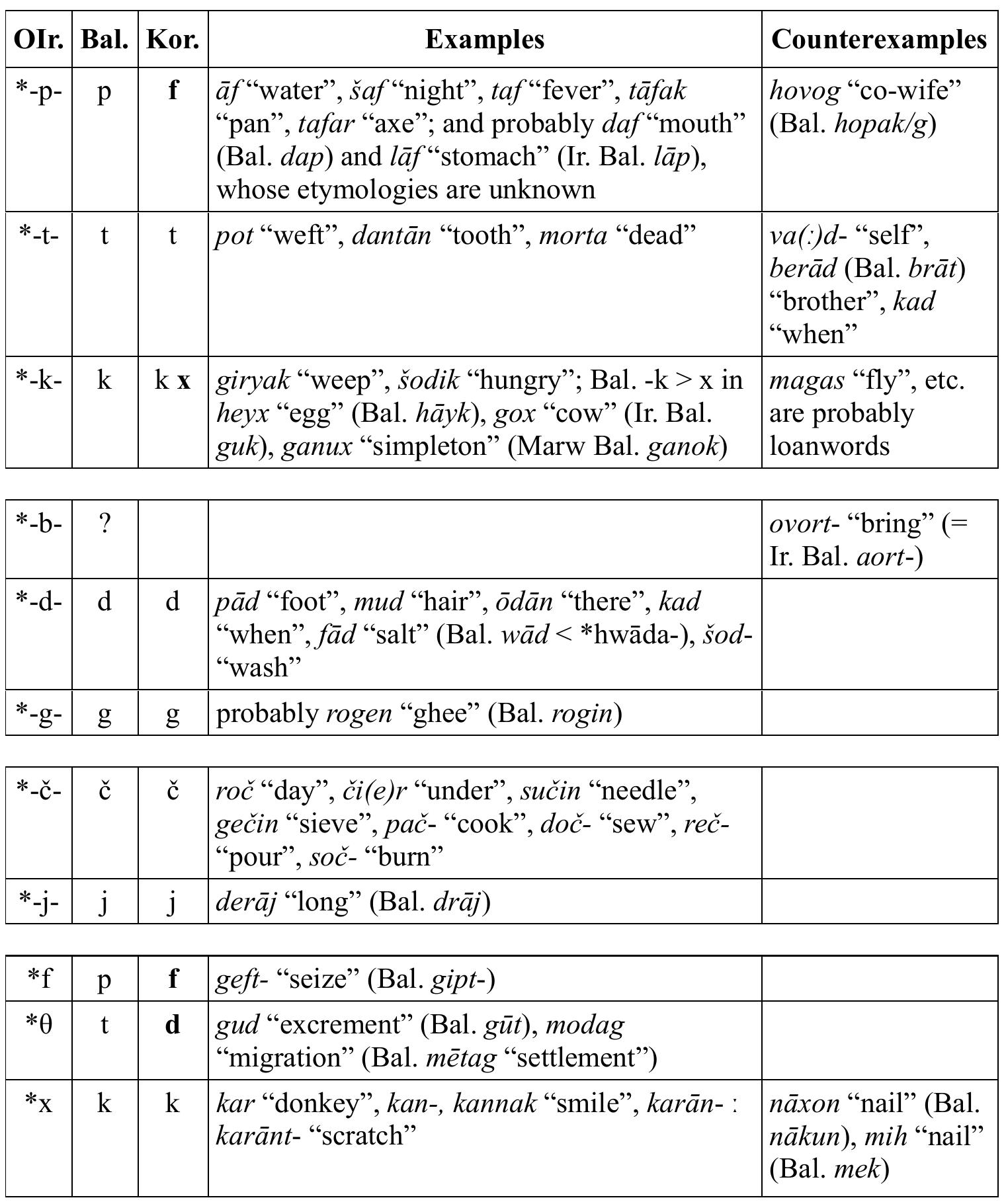
Table 1. Diachrony of Stops, Affricates, and Fricatives 7 Should go (in gd-ham “together’) be related to Pers. ba “with” (< Middle Pers. abag) —a not very likely proposition — it would attest to a relatively late chronology of *w- > g sound change. See also Korn (2005, p. 181).
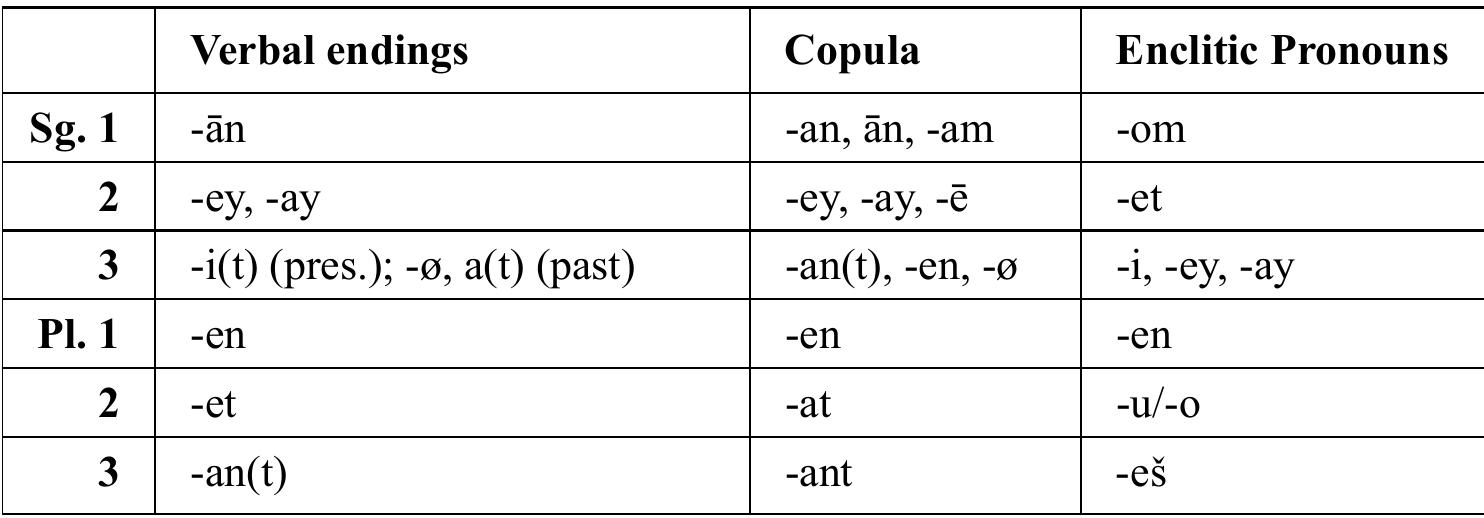
Koroshi has three strategies in using possessive pronouns: (1) With freestand- ing pronouns, e.g., 7 bozobar ma:ni/asaniceyn “these goats are (lit. is) mine/theirs”. (2) With enclitic pronouns, e.g., ketab-ay “his book”. (3) Combining both the Balochi and Persian strategies: Table 3. Verbal Endings, Copula, and Pronominal Suffixes
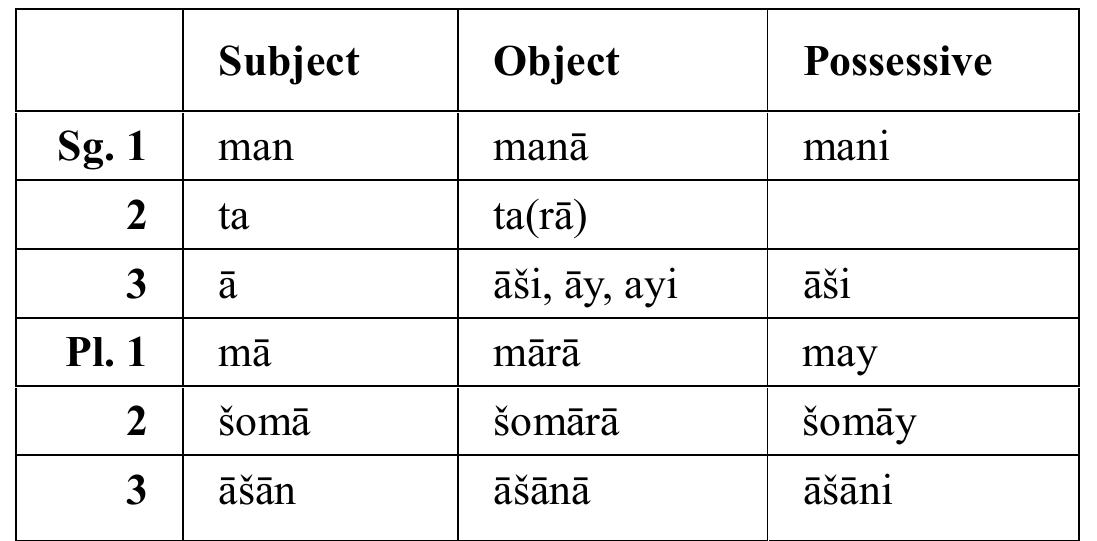
Table 2. Personal Pronouns 9. Adjectives. Attributive adjectives precede the head noun and normally receive the suffix -eyn. Examples: séz-eyn deraxtobar “green trees”, sih-eyn asp “black horse”, mazzanoyn baé “big boy”, gott-eyn ko “large stone”. The adjectival suffix is super- seded by clitics: consider gott “large” in Jalal-i bag xeyli gotten, “Jalal’s garden is, very large”.
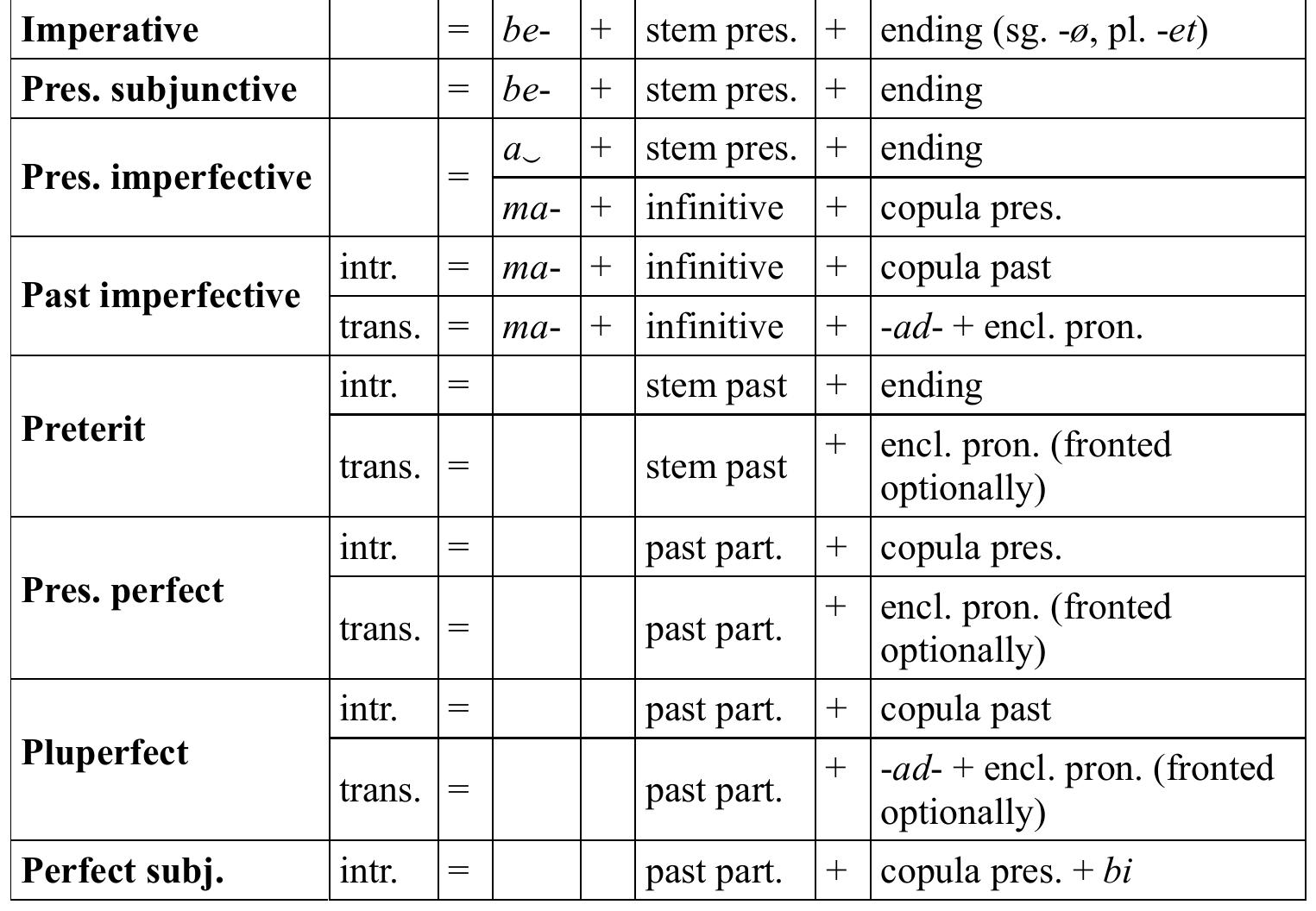
participle are also used as verbal nouns: pakka “cooked”, dokka “sewn”, J-N man bowo-ey saz-ey jandg-d yad-om mohd “I remember instrument playing of Father”. Table 4. Verb Structure
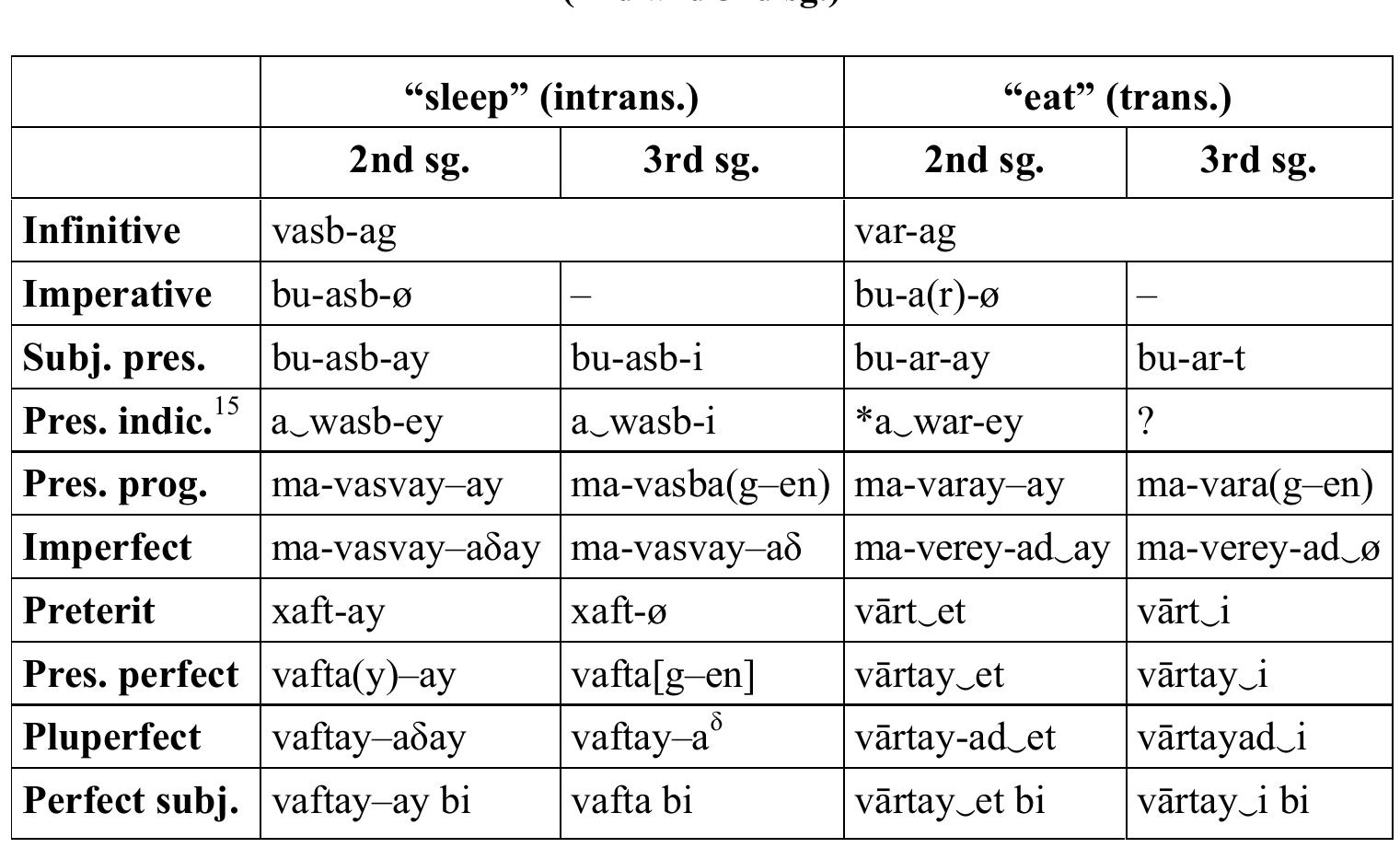
The past imperfective is marked in all available data only with ma-, indicating a merge between the simple and progressive past, e.g., HM ma-rrawag—adan “I would go, I used to go, I was going”, ma-gaSag—adan “I would say, I was saying”. See also section 18.

Loading Preview
Sorry, preview is currently unavailable. You can download the paper by clicking the button above.
References (14)
- Bellew, H. W. (1891): An Inquiry into the Ethnography of Afghanistan. London.
- Borjian, H. (2013): Farvi Dialect. In: Encyclopaedia Iranica Online; at http://www.iranicaonline. org/ articles/farvi-dialect.
- Elfenbein, J. (1963): A Vocabulary of Marw Baluchi. Naples, Istituto Universitario Orientale di Na- poli.
- Elfenbein, J. (1989): Balōčī. In: Schmitt, R. (ed.): Compendium linguarum iranicarum. Wiesbaden, Reichert, pp. 350 -362.
- Jahani, C. -Korn, A. (2009): Balochi. In: Windfuhr, G. (ed.): The Iranian Languages. London, Routledge, pp. 634 -688.
- Jahani, C. -Nourzaei, M. (2011): A Folktale in Koroshi Dedicated to Joy Edelman. In: Leksika, ėtimologija, jazykovye kontakty. Moscow, pp. 62 -70; at http://www.lingfil.uu.se/digital Assets/133/133434_die-sbornik-jahani-nourzaei-2.pdf.
- Korn, A. (2005): Towards a Historical Grammar of Balochi: Studies in Balochi Historical Phonol- ogy and Vocabulary. Wiesbaden, Reichert.
- Korn, A. (2006): Counting Sheep and Camels in Balochi. In: Bogoljubov, M. N. et al. (eds): Indo- iranskoe jazykoznanie i tipologija jazykovyx situacij. Sbornik stat'ej k 75-letiju professora A. L. Grjunberga (1930 -1995). St. Petersburg, Nauka, pp. 201 -212.
- Mahamedi, H. (1979): On the Verbal System in Three Iranian Dialects of Fars. Studia Iranica Vol. 8, pp. 277 -297.
- Morgenstierne, Georg (1927): An Etymological Vocabulary of Pashto. Oslo, Dybwad.
- Rossi, A. V. (1979): Iranian Lexical Elements in Brāhūī. Naples, Istututo Universitario Orientale.
- Salāmi, ʿA. Pur-e Davān (2004a): Ganjina-ye guyeššenāsi-e Fārs. Vol. 3. Tehran, Farhangestān.
- Salāmi, ʿA. (2004b): Barrasi-e ejmāli-e guyeš-e koroši. Guyeššenāsi Vol. 1, No. 3, pp. 39 -56.
- Spooner, B. (1967): Notes on the Baluchī Spoken in Persian Baluchistan. Iran Vol. 5, pp. 51 -71.
FAQs
AI
What explains the Korosh's significant linguistic divergence from other Balochi dialects?add
The Koroshi dialect has diverged from Baluchi through phonetic innovations and the integration of Fārs dialect features, notably lacking retroflex sounds and adopting new vowel distinctions.
How does the Koroshi case-number system differ from other Balochi dialects?add
Koroshi employs a simplified three-case system independent of number, developing regularized plurals marked with the suffix -obār for both animate and inanimate nouns.
What insights do recent studies provide on the Koroshi phonology?add
Recent studies reveal that Koroshi's phonology exhibits significant vowel and consonant changes, including a lack of historical vowel-length distinctions and unique fricative adaptations.
When did the Korosh begin to face language endangerment?add
Language endangerment for Koroshi is evident since the 1970s, influenced by the dominance of Persian language in education and media among its speakers.
What is the impact of Persian loanwords on Koroshi vocabulary?add
Koroshi vocabulary consists of numerous Persian loanwords, crucial in adapting local terms, particularly for family relations and commonplace objects, demonstrating cultural influences from Fārs.