A critical analysis of Building Information Modelling systems used in construction projects (original) (raw)
Abstract
Building Information Modelling (BIM) is now a global digital technology which is widely believed to have the potential to revolutionise the construction industry. This has been mainly a result of worldwide government initiatives promoting BIM uptake to improve efficiency and quality in delivering construction projects. This push has been accompanied by the release of a tremendous amount of BIM software systems which are now available in the market. Although this can be seen as a positive development, one cannot ignore how it has overwhelmed many professionals who cannot easily distinguish between the uses of these software systems. Previous studies about different BIM systems have generally been limited in scope focusing predominantly on operational issues. This study aims to conduct a comprehensive and critical appraisal of a wide range of BIM software systems currently being used in managing construction project information. To achieve this, five main methods are adopted. These include a systematic review of the literature, a structured questionnaire survey, action learning, focus group discussions and email surveys. It has to be noted that, although it is impossible to examine the totality of BIM systems, the study adopts a holistic approach looking at most of the major BIM system categories and 122 application examples which are common in the architecture, engineering and construction (AEC) industry.
Key takeaways

AI
- The study critically evaluates 122 BIM software systems in the architecture, engineering, and construction industry.
- Interoperability is essential for effective collaboration among diverse BIM software systems.
- Cost barriers significantly hinder BIM adoption, with 67% of users citing it as a challenge.
- Numerous software options lead to confusion, with 34% of respondents identifying this as a key barrier.
- The research employs a mixed-methods approach, including literature review, surveys, and focus groups.
Figures (12)
![Fig. 1. Research framework. To facilitate understanding, this work is divided into seven sec- tions. Section 1 presents the background and context of this study. In Section 2, the research methods used to achieve the aim of this study are discussed. In Section 3, the concept of BIM is in- troduced to facilitate understanding. A state-of-the-art classifica- tion of BIM systems is undertaken in Section 4. The findings of this study are reported in Section 5. In Section 6, challenges en- countered during the process of BIM software systems identifica- tion are discussed. The paper is concluded by a way of summary in Section 7. The purposes of a literature review are many [50]. Gall et al. [30] argued that a literature review can delimit the research problem, seek new lines of inquiry, avoid fruitless approaches, gain method- ological insights, identify recommendations for further research, and seek support for grounded theory. For the purpose of this study,](https://figures.academia-assets.com/93131743/figure_001.jpg) ](
](Fig. 1. Research framework. To facilitate understanding, this work is divided into seven sec- tions. Section 1 presents the background and context of this study. In Section 2, the research methods used to achieve the aim of this study are discussed. In Section 3, the concept of BIM is in- troduced to facilitate understanding. A state-of-the-art classifica- tion of BIM systems is undertaken in Section 4. The findings of this study are reported in Section 5. In Section 6, challenges en- countered during the process of BIM software systems identifica- tion are discussed. The paper is concluded by a way of summary in Section 7. The purposes of a literature review are many [50]. Gall et al. [30] argued that a literature review can delimit the research problem, seek new lines of inquiry, avoid fruitless approaches, gain method- ological insights, identify recommendations for further research, and seek support for grounded theory. For the purpose of this study,

Criteria for inclusion and exclusion. Table 1
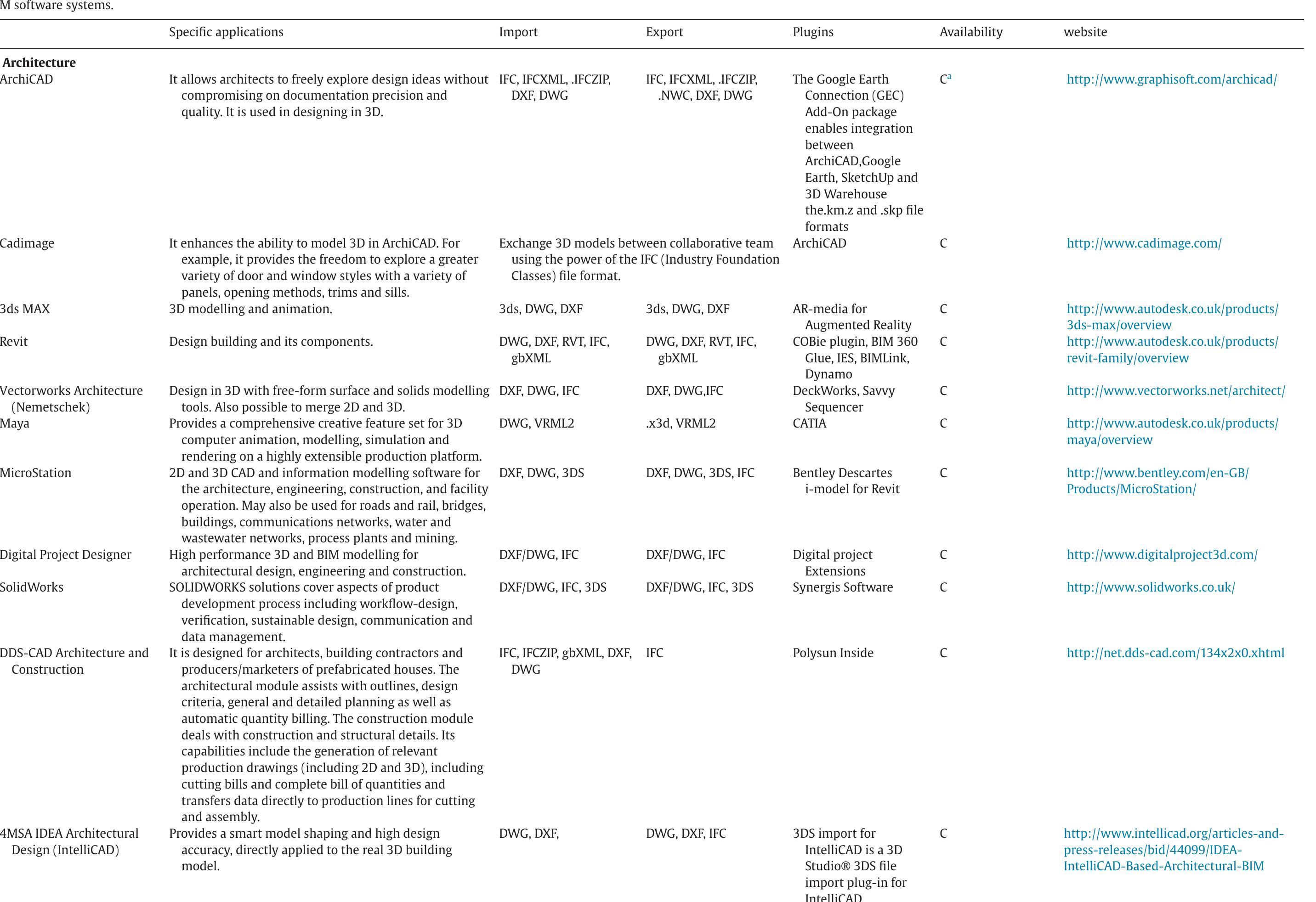
Table 2
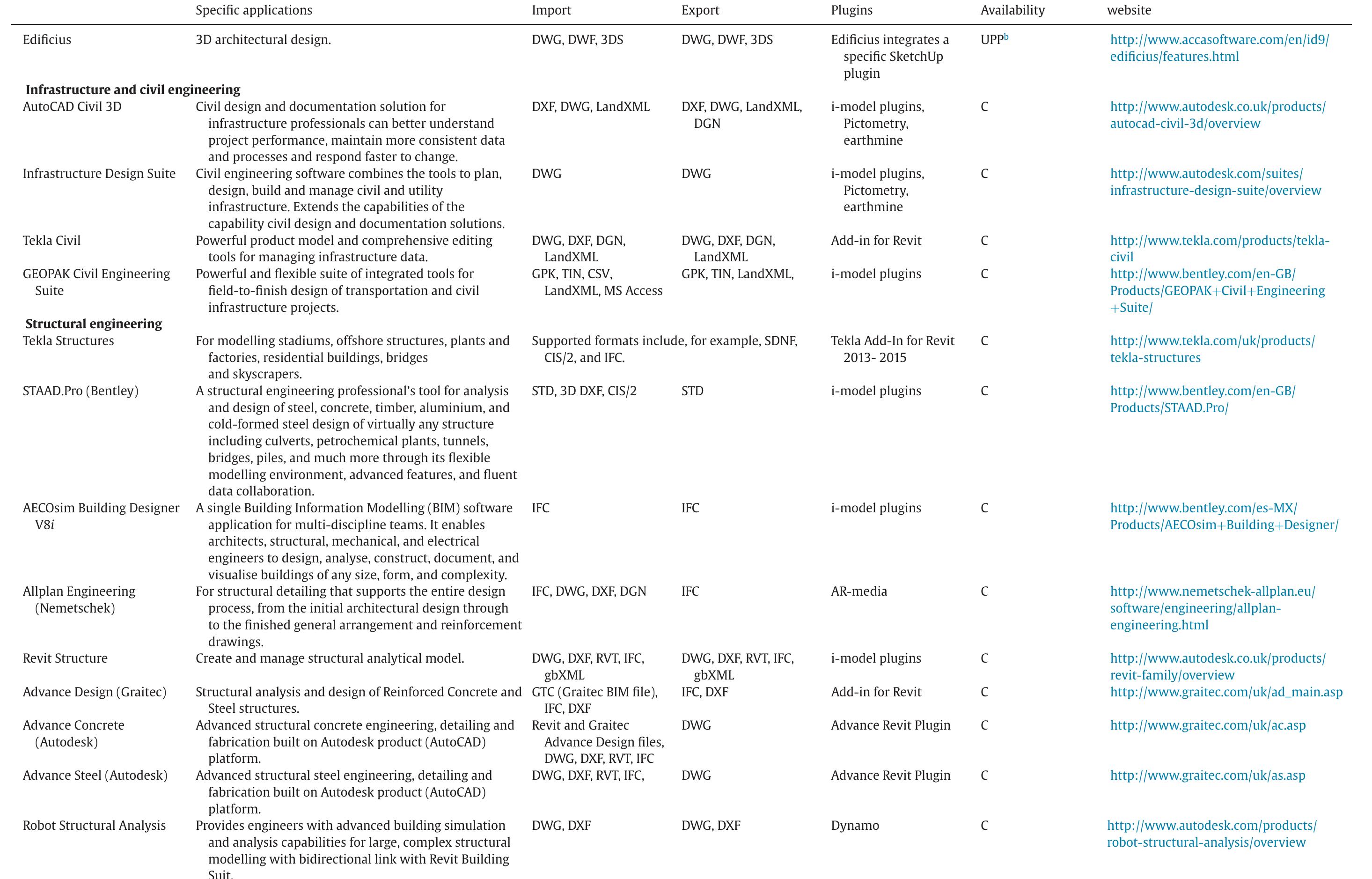
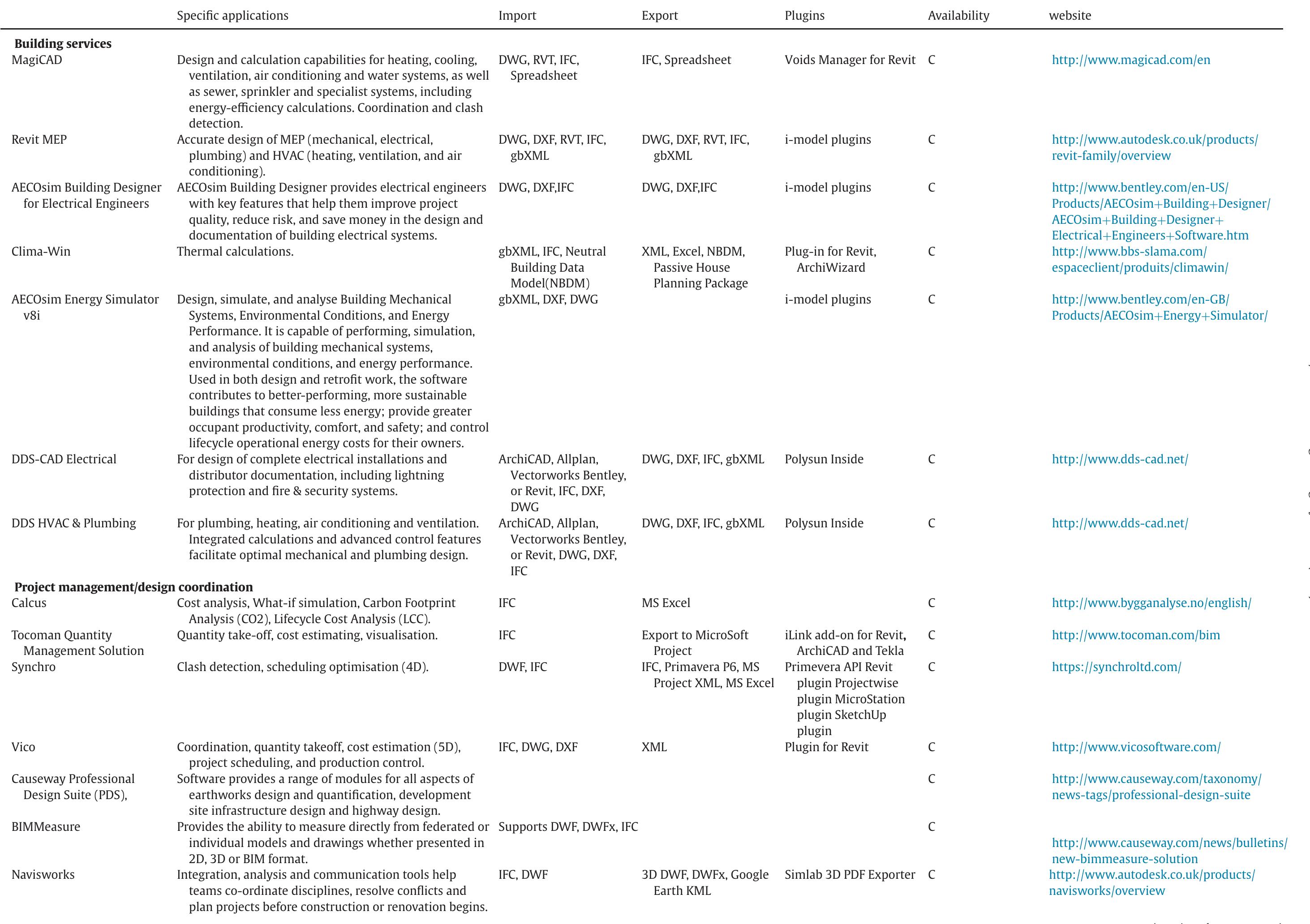
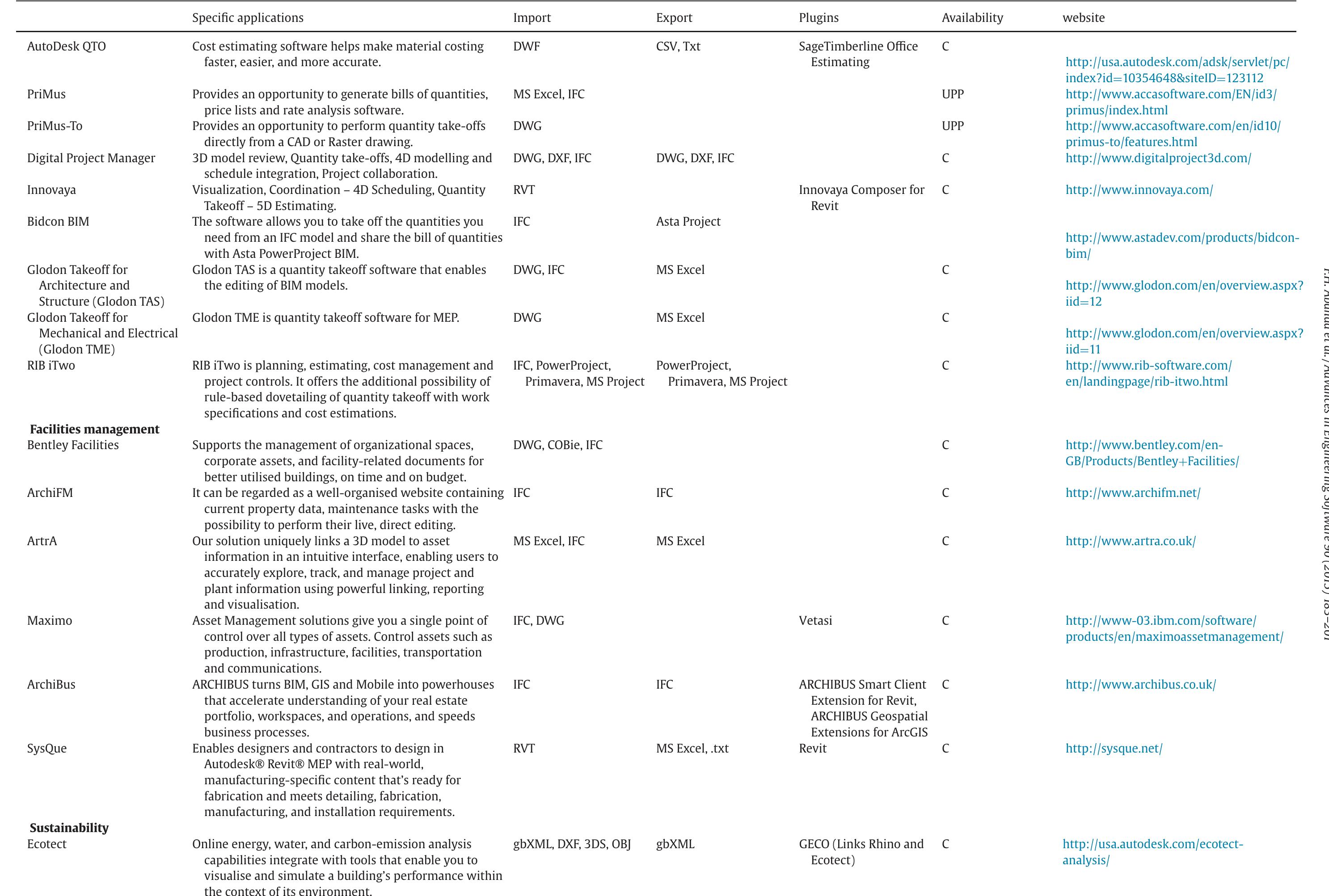
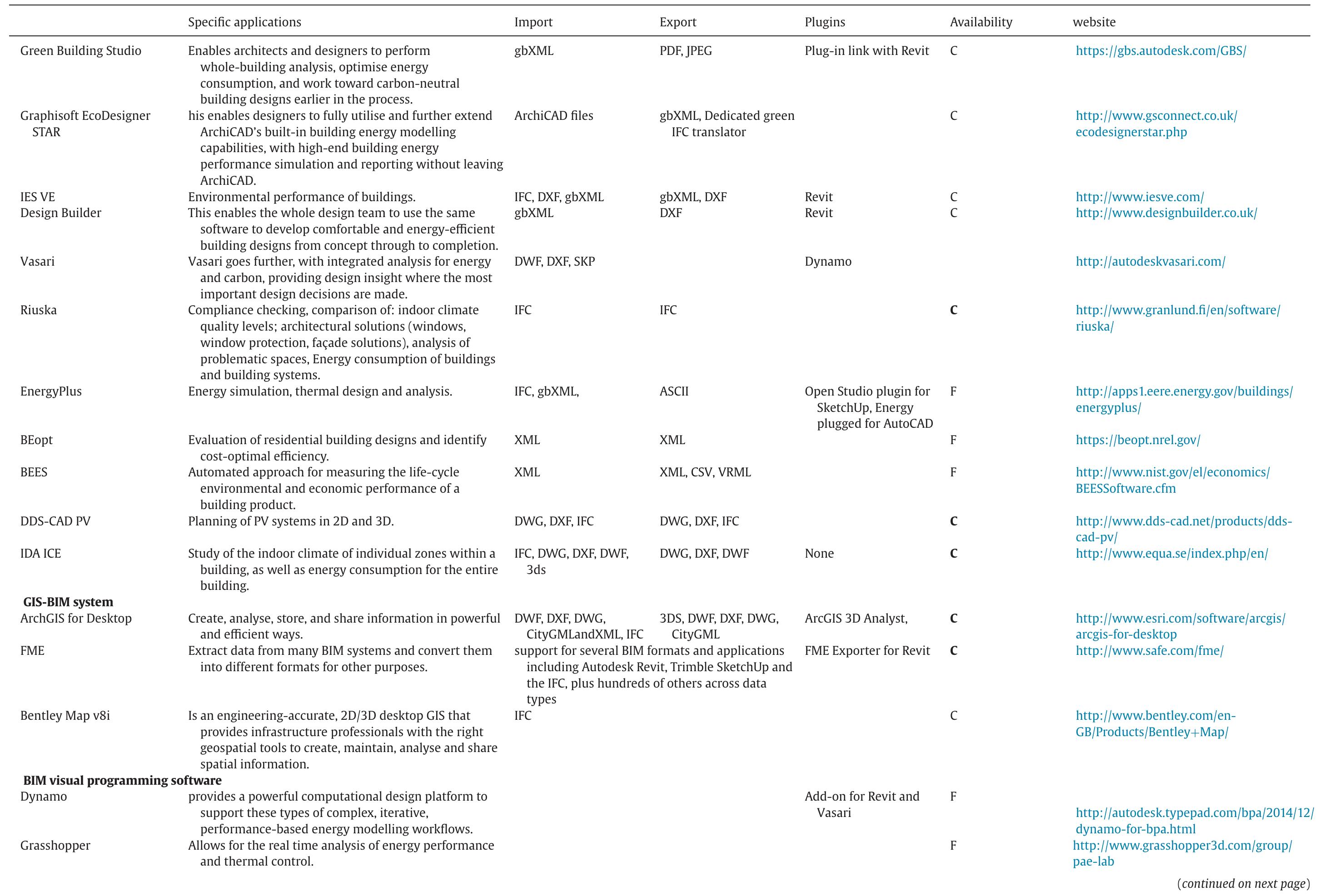
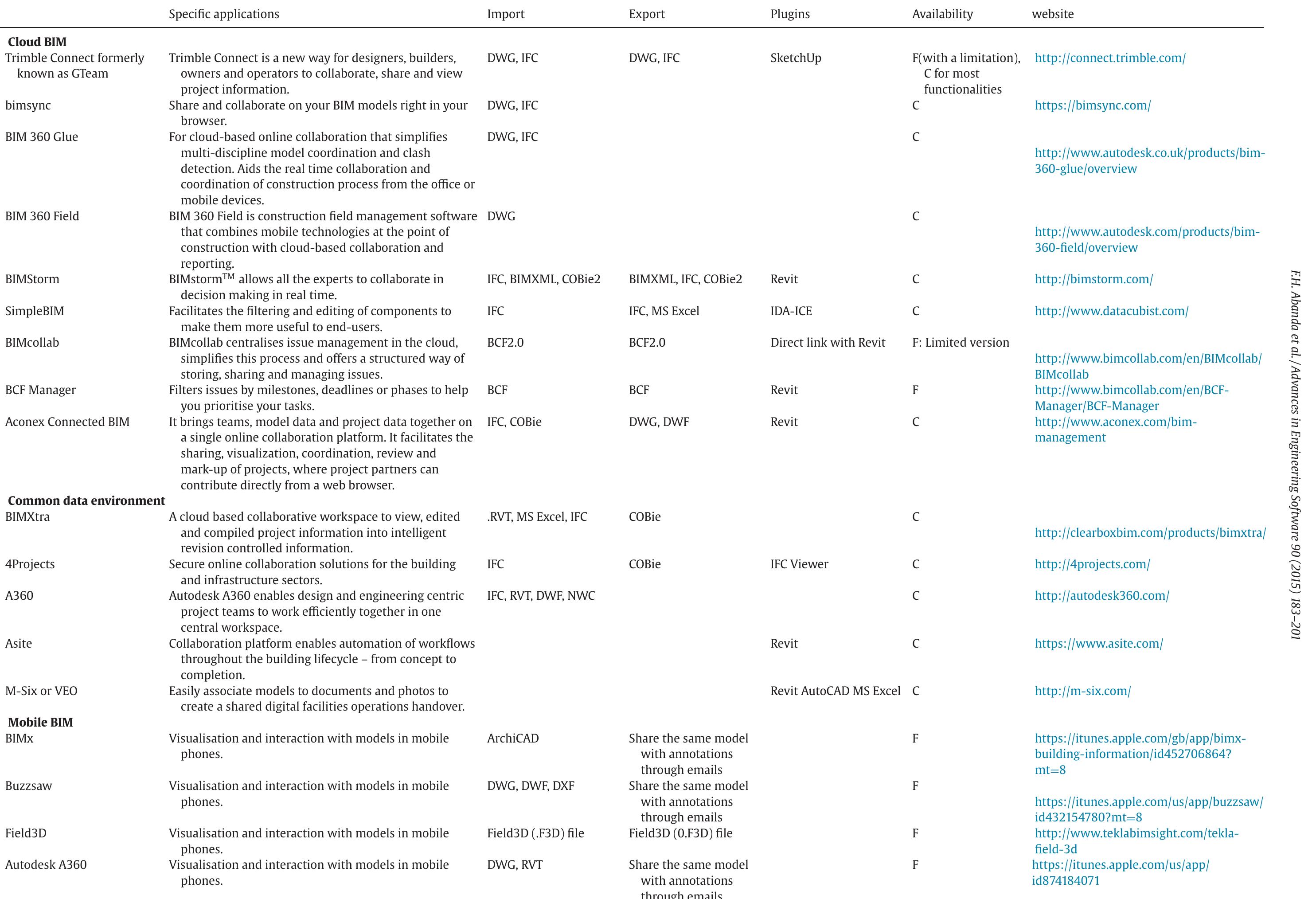
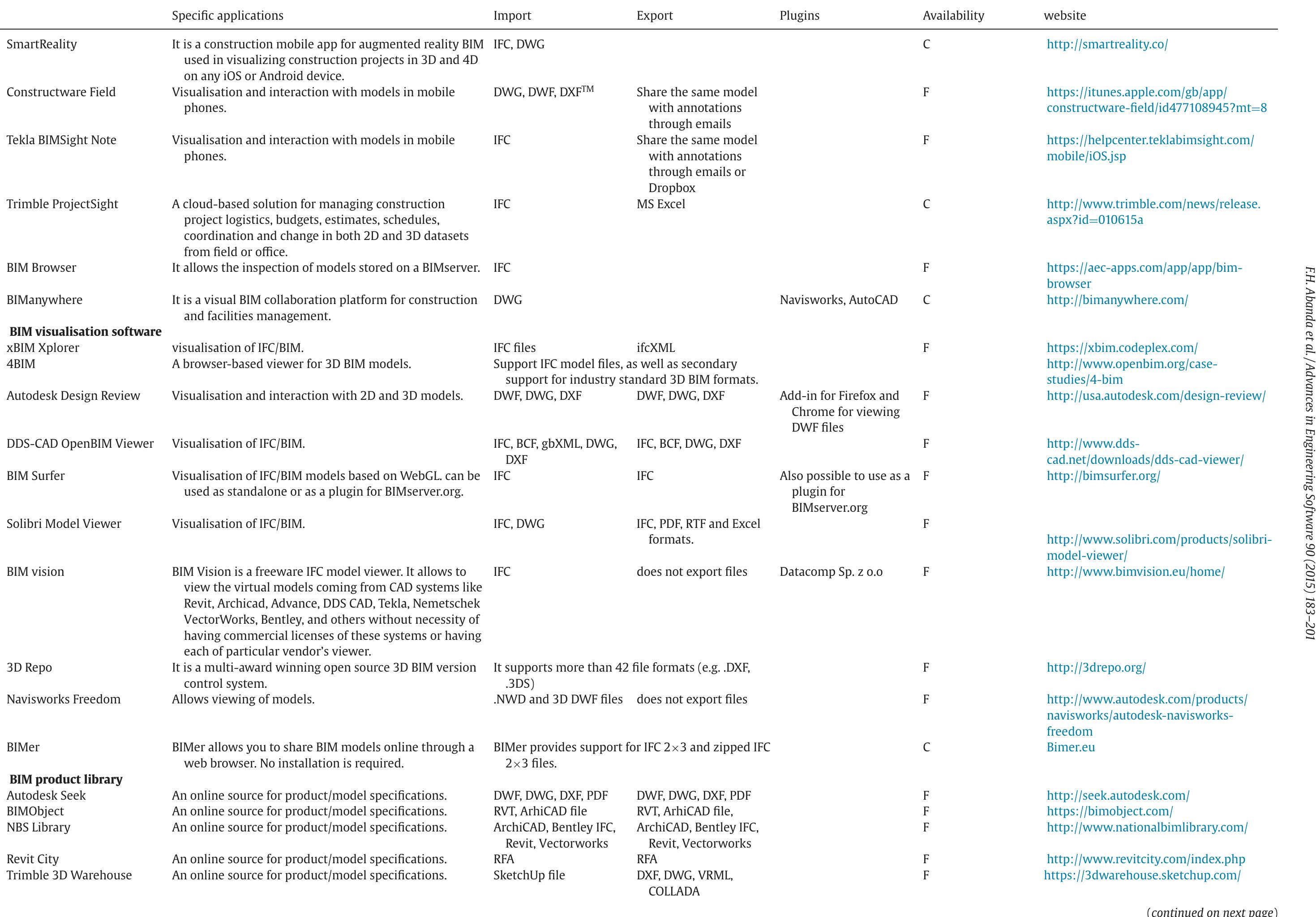
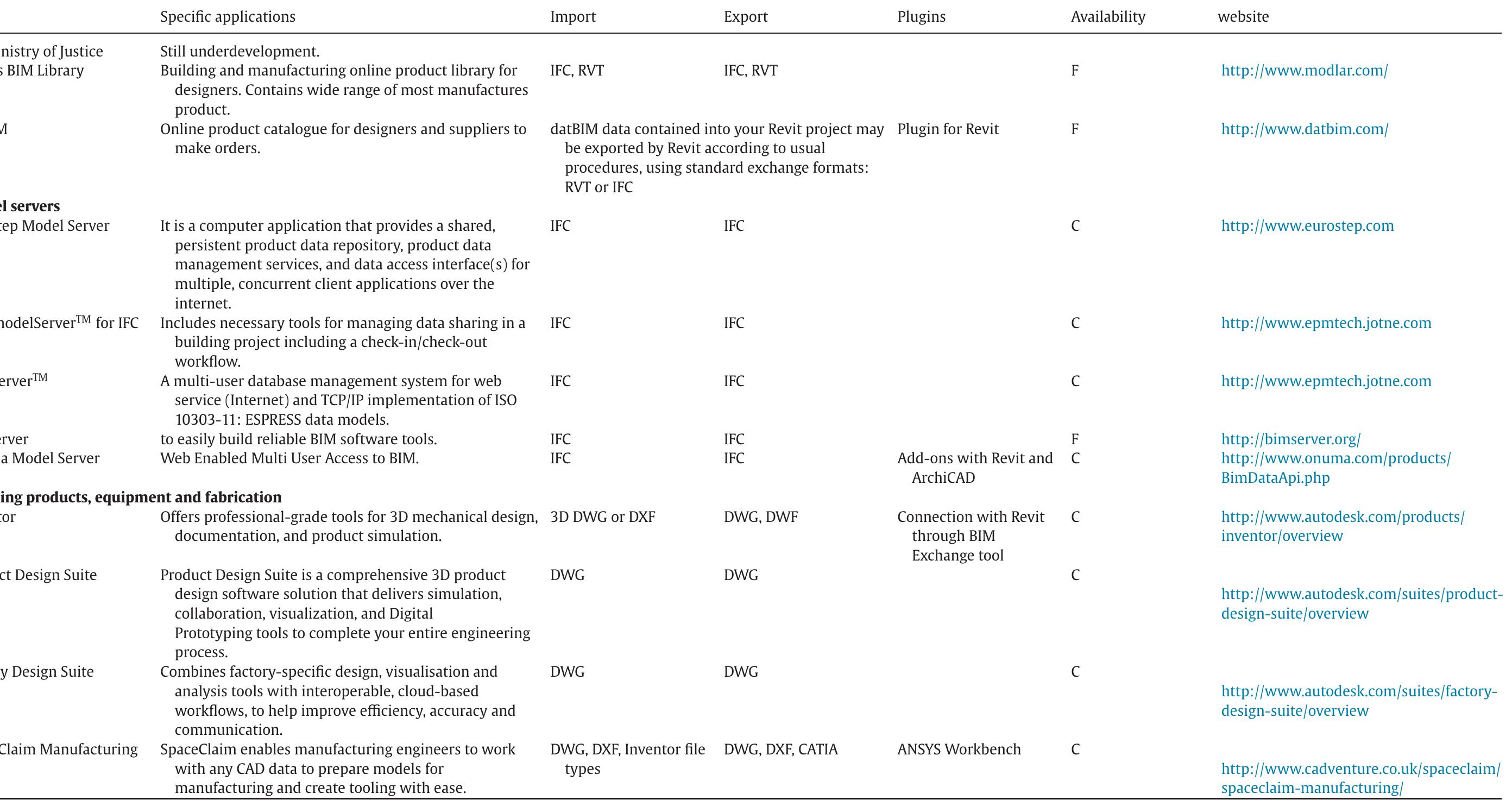
> UPP (Free Use Pay Print): With Free UPP software, use, program updates, training and support are completely free. The customer pays only when needing to print (a very convenient cost for each A4 sheet), and with no expiry date.
![Fig. 4. Knowledge of BIM packages. Across examination of Fig. 4 yields the revelations that more than 75% of the companies have little experience or no knowledge at all of any of the 17 BIM software applications considered in the survey. Although, there is a growing level in the understanding of BIM, it appears there is still some confusion amongst professionals about which software packages are BIM software systems. For example in AutoCAD Architecture [6], a useful argument is mounted defending the capability of AutoCAD Architecture as a very powerful modelling and drafting tool that can also be used in organising information. The discussion ended with individuals wondering why Autodesk is not marketing AutoCAD Architecture as BIM software. This discus- sion is similar to that about AutoCAD MEP in AutoCAD MEP [7], where some professionals are arguing in favour or against AutoCAD MEP be- ing considered as BIM. This argument also emerged in one of the fo- cus group discussions when participants argued that AutoCAD Archi- tecture is a BIM software. Interestingly, three workshop participants who use Vectorworks (see the Architecture section in Table 2) still wondered whether it was a BIM software or not. Thus, a general find- ing is that, while the definition of BIM is clear in books, its practical definition is still very vague and subjective depending mostly on pro- fessionals’ ability to use the software. Is it the software that is part of a BIM process or the way the software is used? If a software applica- tion developed with a BIM work flow or metaphor (e.g. Revit) is used without embracing a BIM philosophy, then the whole concept of BIM is defeated. However, that does not stop Revit from being a BIM soft- ware. On the other hand if a software developed with an AutoCAD workflow (e.g. AutoCAD Architecture) is used in an intelligent way](https://figures.academia-assets.com/93131743/figure_002.jpg) ](
](Fig. 4. Knowledge of BIM packages. Across examination of Fig. 4 yields the revelations that more than 75% of the companies have little experience or no knowledge at all of any of the 17 BIM software applications considered in the survey. Although, there is a growing level in the understanding of BIM, it appears there is still some confusion amongst professionals about which software packages are BIM software systems. For example in AutoCAD Architecture [6], a useful argument is mounted defending the capability of AutoCAD Architecture as a very powerful modelling and drafting tool that can also be used in organising information. The discussion ended with individuals wondering why Autodesk is not marketing AutoCAD Architecture as BIM software. This discus- sion is similar to that about AutoCAD MEP in AutoCAD MEP [7], where some professionals are arguing in favour or against AutoCAD MEP be- ing considered as BIM. This argument also emerged in one of the fo- cus group discussions when participants argued that AutoCAD Archi- tecture is a BIM software. Interestingly, three workshop participants who use Vectorworks (see the Architecture section in Table 2) still wondered whether it was a BIM software or not. Thus, a general find- ing is that, while the definition of BIM is clear in books, its practical definition is still very vague and subjective depending mostly on pro- fessionals’ ability to use the software. Is it the software that is part of a BIM process or the way the software is used? If a software applica- tion developed with a BIM work flow or metaphor (e.g. Revit) is used without embracing a BIM philosophy, then the whole concept of BIM is defeated. However, that does not stop Revit from being a BIM soft- ware. On the other hand if a software developed with an AutoCAD workflow (e.g. AutoCAD Architecture) is used in an intelligent way
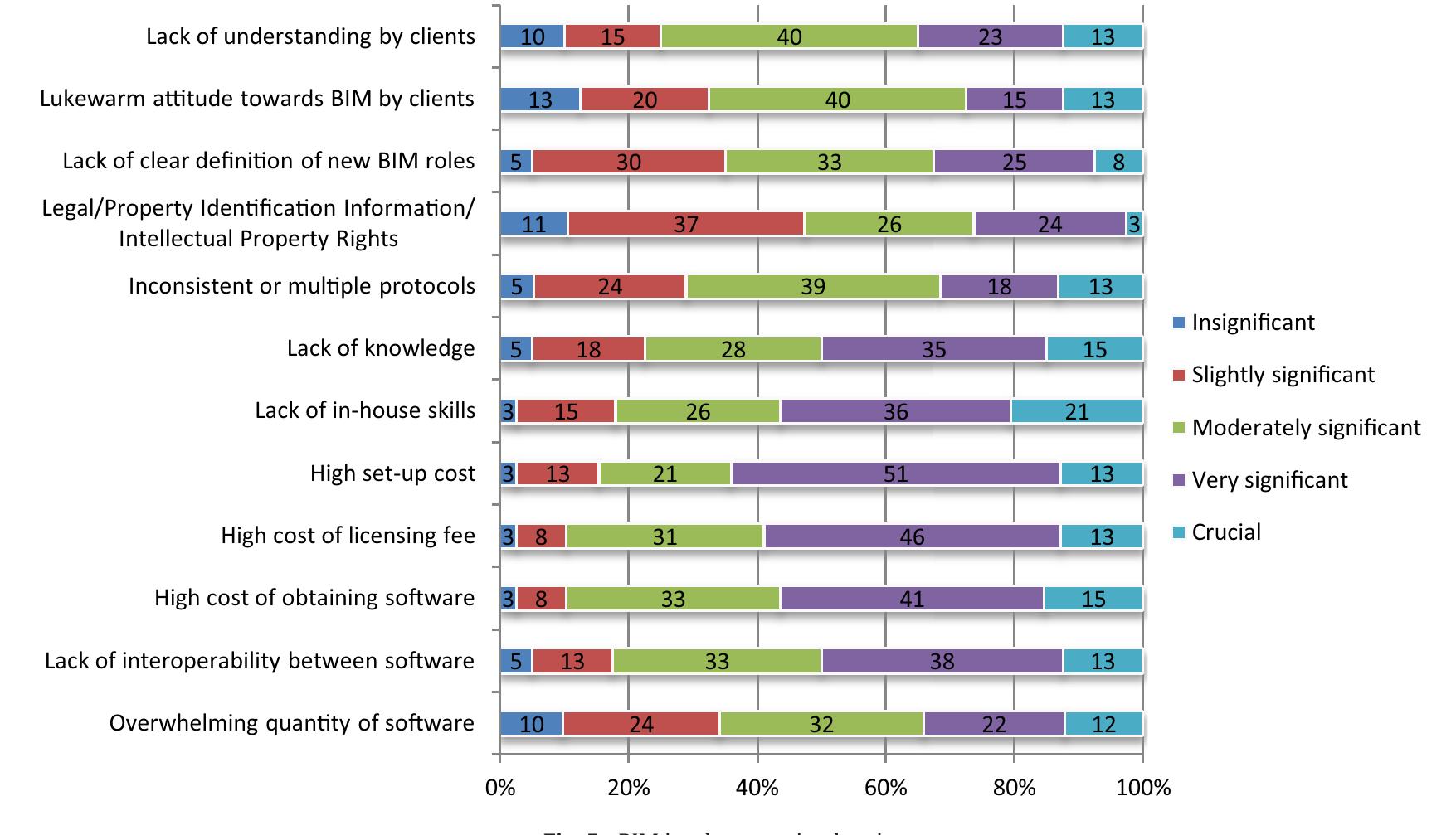
Looking beyond this revelation makes it apparent that the consider- ations around these commonly featured tools bring the ‘technology aspect’ of BIM into focus and the tendency to ignore the ‘processes aspect’. It is therefore imperative for BIM tools featuring in assess- ment surveys to be holistic in terms of technology and process. Such an approach would help to achieve a more realistic picture of how the BIM concept has actually been already enshrined in the industry. Based on this suggestion, BIM software packages in the construction sector can be said to be numerous and likely to continue increasing in number with advances in technology. This is partly due to the frag- mented nature of the industry and the need for specialty applications in the various professional domains. Technology is yet to advance to the level of developing some all-purpose software. As a result, many software packages are tailored towards specific needs of professional domains. Although, this may appear to be a complementary progress of the industry, it could also be a source of confusion for profes- sionals who struggle to identify appropriate BIM software applica- tions and implementation pathways. As the survey results illustrate (Fig. 5), overwhelming quantity of software systems also poses a chal- lenge and barrier to BIM implementation. interoperability was a barrier. Of the 13, 4 considered this a crucial barrier while 9 indicated that it was a very significant barrier. Fur- thermore, another parameter was used; “the relative level of knowl- edge of use of 4D/5D BIM software” (e.g. Navisworks) (factor 4) to measure the level of understanding of interoperability. Of the 16 out 56 respondents that had at least “moderate” expertise of Navisworks, 15 of them thought interoperability was “crucial” and 1 suggested it was “very significant” as a barrier to the uptake of BIM. This clearly indicates that the lack of knowledge about BIM has not influenced the understanding of interoperability as a barrier.

Loading Preview
Sorry, preview is currently unavailable. You can download the paper by clicking the button above.
References (64)
- Abanda H, Tah JHM. Free and open source building information modelling for de- veloping countries. In: ICT for Africa 2014 conference, Yaoundé, Cameroon; 2014 October 1-4, 2014.
- Abanda FH, Manjia MB, Pettang C, Tah JHM, Nkeng GE. Building information modelling in Cameroon: overcoming existing challenges. Int J 3-D Inf Model 2014;3(4):1-25.
- AIA (undated). Preparing for Building Information Modeling. [Online]American Institute of Architects. http://www.aia.org/practicing/groups/kc/AIAS077631 (January 2015)
- Arayici Y, Coates P, Koskela L, Kagioglou M, Usher C, O'Reilly K. BIM adoption and implementation for architectural practices. Struct Surv 2011;29(1):7-25.
- Asl MR, Bergin M, Menter A, Yan W. BIM-based parametric building energy per- formance multi-objective optimization. In: Fusion, proceedings of the 32nd in- ternational conference on education and research in computer aided architec- tural design in Europe. Newcastle upon Tyne, UK: Northumbria University; 2014,. p. 455-64. vol. 2. eCAADe: Conferences 22014.
- AutoCAD Architecture (2008). AutoCAD Architecture: The unsung BIM applica- tion. [Online] http://whosafraidofthebigbadbim.blogspot.co.uk/2008/08/autocad- architecture-unsung-bim.html (Accessed January 2015).
- AutoCAD MEP (2012). AutoCAD MEP BIM software? [Online] http://forums. autodesk.com/t5/autocad-mep-general-discussion/autocad-mep-bim-software/ td-p/3658242
- Autodesk (2014). Cloud computing and your autodesk product plug-ins. [On- line] http://usa.autodesk.com/adsk/servlet/item?siteID=123112&id=17136545 (Accessed January 2015).
- Bahar YN, Pere C, Landrieu J, Nicolle C. A thermal simulation tool for building and its interoperability through the Building Information Modeling (BIM) platform. Buildings 2013;3(2):380-98.
- Bergin MS. (2012) A brief history of BIM. [Online] http://www.archdaily. com/302490/a-brief-history-of-bim (Accessed July 2015)
- Bossom AC. Building to the skies, the romance of the skyscraper. The Studio Pub- lications; 1934.
- Bridge C, Carnemolla P. An enabling BIM block library: an online repository to facilitate social inclusion in Australia. Construct Innov 2014;14(4):477-92.
- Bynum II WP. (2010). Building Information Modeling in support of sustainable design and construction. A thesis presented in the partial fulfillment of the re- quirements of the degree of Master of Science in Building Construction in the Graduate School at University of Florida, USA.
- Bynum P, Issa RR, Olbina S. Building Information Modelling in support of sustain- able design and construction. J Construct Eng Manage 2013;139(1):24-34.
- Cann A, Dimitriou K, Hooley T. Social media: A guide for researchers. London: Research Information Network; 2011.
- Charalabidis Y, Gionis G, Hermann KM, Martinez C. (2008) Enterprise Interoper- ability Research Roadmap, European Commission.
- Charalabidis Y, Panetto H, Loukis E, Mertins K. Interoperability approaches for enterprises and administrations worldwide. Electron J E-Commerce Tools Appl 2008;2(3):1-10.
- CIC (2013) CIC publish 'Growth through BIM' by Richard G Saxon, CBE. [Online] http://cic.org.uk/news/article.php?s=2013-04-25-cic-publish-growth-through- bim-by-richard-g-saxon-cbe (Accessed July 2015).
- Crawley DB, Hand JW, Kummert M, Griffith BT. Contrasting the capabilities of building energy performance simulation programs. Build Environ 2008;43:661- 73.
- Cronholm S, Goldkuhl G. Reflected action learning-A method for collective com- petence development. In: Proceedings of the 11th European conference on knowl- edge management (ECKM), September 2-3, Portugal; 2010.
- Delcambre, B. (2014). Mission numérique bâtiment. [Online] http://www. territoires.gouv.fr/IMG/pdf/rapport_mission_numerique_batiment.pdf (Accessed December 2014).
- Driscoll DL, Appiah-Yeboah A, Salib P, Rupert DJ. Merging qualitative and quan- titative data in mixed methods research: how to and why not. Ecol Environ An- thropol 2007;3(1):19-28.
- Eadie R, Browne M, Odeyinka H, McKeown C, McNiff S. BIM implementation throughout the UK construction project lifecycle: an analysis. Autom Construct 2013;36:145-51.
- Eastman C. General purpose building description systems. Comput-Aided Des 1976;8(1):17-26.
- Eastman C, Henrion M. GLIDE: a language for design information systems. In: Pro- ceedings of the 4th annual conference on computer graphics and interactive tech- niques, SIGGRAPH'77. New York, NY, USA: ACM; 1977. p. 24-33.
- Eastman C, Fisher D, Lafue G, Lividini J, Stoker D, Yessios C. (1974) An outline of the Building Description System. Research Report No. 50, Institute of Physical Plan- ning, Carnegie-Mellon University, Pittsburgh, USA.
- El-Ammari, KH, (2006). Visualisation, data sharing and interoperability issues in model-based facilities management systems. A thesis presented in the partial ful- fillment of the requirements of the degree of Master of Applied Science in the Department of Building, Civil and Environmental Engineering at Concordia Uni- versity, Canada.
- Engelbart DC, (1962) Augmenting human intellect: a conceptual framework. SRI Summary Report AFOSR-3223 Prepared for: Director of Information Sciences, Air Force Office of Scientific Research, Washington DC, Contract AF 49(638)-1024 SRI Project No. 3578 (AUGMENT, 3906).
- Fernandes, RPL, (2013). Advantages and disadvantages of BIM platforms on con- struction site. A thesis presented in the partial fulfillment of the requirements of the degree of Master of Science to the Departamento de Engenharia Civil, Facul- dade de Engenharia da Universidade do Porto, Porto, Portugal.
- Gall MD, Borg WR, Gall JP. Education research: An introduction. 6th ed. White Plains, NY: Longman; 1996.
- Jiao Y, Zhang S, Li Y, Wang Y, Yang B. Towards cloud Augmented Reality for con- struction application by BIM and SNS integration. Autom Construct 2013;33:37- 47.
- Jones M, Alony I. Blogs -the new source of data analysis. J Issues Informing Sci Inf Technol 2008;5:433-46.
- Kia S. Review of BIM software packages based on assets management. Iran: Amikarbir University of Technology; 2009.
- Kiviniemi A, Tarandi V, Karlshøj J, Bell H, Karud OJ. (2008). Review of the development and implementation of IFC compatible BIM. [Online] http:// erhvervsstyrelsen.dk/file/9498/ReviewoftheDevelopmentandImplementation ofIFCcompatibleBIM.pdf
- Kurul E, Abanda FH, Tah JHM, Cheung F. Rethinking the build process for BIM adoption. In: CIB world building congress construction and society, 5-9 May 2013, Australia; 2013.
- Landscape Institute (2015) What is BIM? [Online] http://www.landscape institute.org/knowledge/WhatisBIM.php (Accessed July 2015).
- Lennert LP. (2012). Use of 4D BIM for general contractors: with focus on con- structability analysis through clash detection and 4D simulation. A thesis submit- ted in partial fulfillment of the requirements for the degree of Master of Science to the Technical University of Denmark.
- Lin Y-C, Su Y-C, Chen Y-P. Developing mobile BIM/2D barcode-based automated facility management system. Sci World J 2014 (ID 374735).
- McGraw Hill Construction (2014). The business value of BIM for con- struction in major global markets: how contractors around the world are driving innovation with Building Information Modelling. [Online] https:// synchroltd.com/newsletters/Business%20Value%20Of%20BIM%20In%20Global %20Markets%202014.pdf (May 2015).
- Meža S, Turk Z, Dolenc M. Component based engineering of a mobile BIM-based augmented reality system. Autom Construct 2014;42:1-12.
- Migiro SO, Magangi BA. Mixed methods: a review of literature and the future of the new research paradigm. Afr J Bus Manage Acad J Rev 2011;5(10):3757-64.
- Mott MacDonald (2015) Building Information Modelling. [Online] https://www. mottmac.com/article/2385/building-information-modelling-bim (Accessed July 2015).
- NBIMS (2015). About the national BIM standard-United States. [Online] http://www.nationalbimstandard.org/about.php (January 2015).
- NBS (2012). National BIM report 2012. National Building Specifiaction (NBS). [On- line] http://www.thenbs.com/pdfs/NBS-NationalBIMReport12.pdf (Accessed July 2015).
- NBS (2013). NBS National BIM Survey. [Online] http://www.thenbs.com/pdfs/ NBS-NationlBIMReport2013-single.pdf (May 2015).
- NBS (2011). Building Information Modelling report. [Online] http://www.thenbs. com/pdfs/bimResearchReport_2011-03.pdf (May 2015).
- NBS (2015). Building Information Modelling report. [Online] http://www.thenbs. com/pdfs/NBS-National-BIM-Report-2015.pdf .
- NBS (2014). NBS national BIM survey [Online] http://www.thenbs.com/pdfs/NBS- National-BIM-Report-2014.pdf (May 2015).
- Nicholas D, Watkinson A, Rowlands I, Jubb M. Social media, academic research and the role of university libraries. J Acad Librarianship 2011;37(5):373-5.
- Randolph JJ. A guide to writing the dissertation literature review. Pract Assess Res Eval 2009;14(13) http://pareonline.net/getvn.asp?v=14&n=13.
- Redmond A, Hore A, Alshawi M, West R. Exploring how information exchanges can be enhanced through cloud BIM. Autom Constr 2012;24:175-83.
- Ren Y. (2011). Building Information Modeling integrated with electronic com- merce material procurement and supplier performance management system. A thesis submitted in partial fulfillment of the requirements for the degree of Mas- ter of Science to the Faculty of the Graduate School of the University of Maryland, College Park, USA.
- Rezaei R, Chiew TK, Lee SP, Aliee ZS. A semantic interoperability framework for software as a service systems in cloud computing environments. Expert Syst Appl 2014;41(13):5751-70.
- Revans R. The origins and growth of action learning. Bromley: Chartwell-Bratt; 1982.
- Rezaei R, Chiew TK, Lee SP, Aliee ZS. Interoperability evaluation models: a sys- tematic review. Comput Ind 2014;65(1):1-23.
- Richards M, Churcher D, Shillcock P. Throssell, D. (2013). Pre-contract award Building Information Modelling (BIM) execution plan (BEP). [Online] http://www.cpic.org.uk/wp-content/uploads/2013/06/cpix\_pre-contract\_bim\_ execution_plan_bep_v2.0.pdf (May 2015).
- Richards, M, Churcher, D, Shillcock, P, Throssell, D. (2013). Post con- tract award Building Information Modelling (BIM) execution plan (BEP) http://www.cpic.org.uk/wp-content/uploads/2013/06/cpix\_post\_contract\_bim\_ execution_plan_bep_r1.0.pdf (May 2015).
- Ruiz JM. (2009). BIM software evaluation model for general contractors. A the- sis presented in partial fulfillment of the requirements for the degree of Master of Science in Building Construction to the graduate school of the University of Florida, USA.
- Sampaio AZ, Ferreira MM, Rosário DP, Martins OP. 3D and VR models in civil engi- neering education: construction, rehabilitation and maintenance. Autom Constr 2010;19(7):819-28.
- Wang J, Wang X, Shou W, Xu B. Integrating BIM and augmented reality for inter- active architectural visualisation. Constr Innov 2014;14(4):453-76.
- Williams G, Gheisari M, Chen P, Irizarry J. BIM2MAR: an efficient BIM trans- lation to mobile Augmented Reality applications. J Manage Eng 2015;31(1). doi:10.1061/(ASCE)ME.1943-5479.0000315.
- Wong J, Wang X, Li H, Chan G, Li H. A review of cloud-based BIM technology in the construction sector. ITcon 2014;19:281-91.
- Wu W, Issa RRA. Leveraging cloud-BIM for LEED automation. J Inf Technol Constr 2012;17:367-84.
- Wu S, Wood G, Ginige K, Jong SW. A technical review of BIM based cost estimating in UK quantity surveying practice, standards and tools. ITcon 2014;19:534-62.
FAQs
AI
What are the main challenges of BIM software adoption in construction projects?add
The research finds that 67% of BIM users cite costs as a major barrier, with 64% of non-BIM users agreeing. Additionally, a lack of knowledge about different software packages is consistently noted as a significant obstacle.
How does the proliferation of BIM software impact interoperability?add
The study identifies that more than 51% of respondents view software interoperability challenges as a crucial barrier to BIM adoption. This issue is exacerbated by the growing number of over 150 different BIM software packages in the market.
What methodologies were employed to assess BIM software systems?add
A mixed methods approach was used, combining literature review, questionnaire surveys, focus groups, and action learning techniques. This strategy allowed for triangulation of data and deeper insights into BIM software applications.
How does cost influence BIM software selection among practitioners?add
Approximately 34% of survey participants indicated a significant barrier to BIM adoption due to the overwhelming quantity of available software and associated costs. This correlation highlights the financial implications of investing in dual systems that may overlap in functionality.
What classifications emerge from the analysis of BIM systems in this study?add
BIM systems were classified into various domains such as architecture, sustainability, and project management. Key criteria for classification included interoperability formats, specific applications, and the availability of each software system, culminating in 122 major BIM software systems being identified.