Diethylzinc | AMERICAN ELEMENTS ® (original) (raw)
Chemical Structure
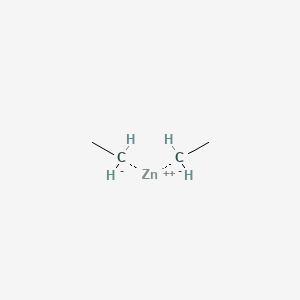

Linear Formula:
Zn(C2H5)2
Question? Ask an American Elements Materials Science Engineer
Diethylzinc is one of numerous organo-metallic compounds (also known as metalorganic, organo-inorganic and metallo-organic compounds) sold by American Elements under the trade name AE Organo-Metallics™ for uses requiring non-aqueous solubility such as recent solar energy and water treatment applications. Similar results can sometimes also be achieved with Nanoparticles and by thin film deposition. Note American Elements additionally supplies many materials as solutions. Diethylzincis generally immediately available in most volumes. High purity, submicron and nanopowder forms may be considered. Additional technical, research and safety information is available.
| Compound Formula | C4H10Zn |
|---|---|
| Molecular Weight | 123.51 |
| Appearance | Colorless liquid |
| Melting Point | -28 °C |
| Boiling Point | 124 °C0 |
| Density | 0.9-1.205 g/mL |
| Solubility in H2O | N/A |
| Exact Mass | 122.007393 |
| Monoisotopic Mass | 122.007393 |
DEZ, DEZn, Et2Zn, Zincdiethyl, Zinc diethanide; Zinc ethide
| Signal Word | Danger |
|---|---|
| Hazard Statements | H225-H250-H260-H314-H410 |
| Hazard Codes | F,C,N |
| Risk Codes | 14-17-34-50/53 |
| Safety Statements | 16-43-60-61 |
| RTECS Number | N/A |
| Transport Information | UN 3394 4.2/PG 1 |
| WGK Germany | 3 |
| Linear Formula | Zn(C2H5)2 |
|---|---|
| Pubchem CID | 11185 |
| MDL Number | MFCD00009021 |
| EC No. | 209-161-3 |
| IUPAC Name | zinc; ethane |
| Beilstein/Reaxys No. | 3587207 |
| SMILES | CC[Zn]CC |
| InchI Identifier | InChI=1S/2C2H5.Zn/c2*1-2;/h2*1H2,2H3; |
| InchI Key | HQWPLXHWEZZGKY-UHFFFAOYSA-N |
| Chemical Formula | |
| Molecular Weight | |
| Standard InchI | |
| Appearance | |
| Melting Point | |
| Boiling Point | |
| Density |
Customer Reviews
Typical bulk packaging includes palletized plastic 5 gallon/25 kg. pails, fiber and steel drums to 1 ton super sacks in full container (FCL) or truck load (T/L) quantities. Research and sample quantities and hygroscopic, oxidizing or other air sensitive materials may be packaged under argon or vacuum. Shipping documentation includes a Certificate of Analysis and Safety Data Sheet (SDS). Solutions are packaged in polypropylene, plastic or glass jars up to palletized 440 gallon liquid totes, and 36,000 lb. tanker trucks.

May 11, 2026 Los Angeles, CA
Each business day American Elements' scientists & engineers post their choice for the most exciting materials science news of the day
See more Zinc products. Zinc (atomic symbol: Zn, atomic number: 30) is a Block D, Group 12, Period 4 element with an atomic weight of 65.38. The number of electrons in each of zinc's shells is 2, 8, 18, 2, and its electron configuration is [Ar] 3d10 4s2.  The zinc atom has a radius of 134 pm and a Van der Waals radius of 210 pm. Zinc was discovered by Indian metallurgists prior to 1000 BC and first recognized as a unique element by Rasaratna Samuccaya in 800. Zinc was first isolated by Andreas Marggraf in 1746. In its elemental form, zinc has a silver-gray appearance. It is brittle at ordinary temperatures but malleable at 100 °C to 150 °C.
 It is a fair conductor of electricity, and burns in air at high red producing white clouds of the oxide. Zinc is mined from sulfidic ore deposits. It is the 24th most abundant element in the earth's crust and the fourth most common metal in use (after iron, aluminum, and copper). The name zinc originates from the German word "zin," meaning tin.