Ferrocene | AMERICAN ELEMENTS ® (original) (raw)
Chemical Structure
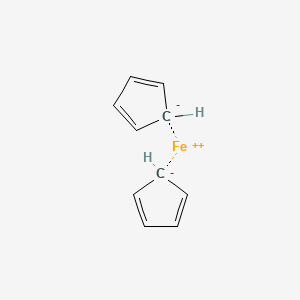


Cp2Fe
Linear Formula:
Fe(C5H5)2
Question? Ask an American Elements Materials Science Engineer
Ferrocene (also known as Bis(cyclopentadienyl)iron) is an organometallic iron complex known as a metallocene, consisting of an iron atom sandwiched between two cyclopentadienyl rings. Ferrocene is a versatile compound that can serve as a precursor material for numerous types of organic compounds, a fuel additive, and a source of iron nanoparticles for the production of carbon nanotubes. HAmerican Elements produces to many standard grades when applicable, including Mil Spec (military grade); ACS, Reagent and Technical Grade; Food, Agricultural and Pharmaceutical Grade; Optical Grade, USP and EP/BP (European Pharmacopoeia/British Pharmacopoeia) and follows applicable ASTM testing standards. Additional technical, research and safety (MSDS) information is available. Please request a quote above to receive pricing information based on your specifications.
| Compound Formula | C10H10Fe |
|---|---|
| Molecular Weight | 186.03 |
| Appearance | Orange crystalline solid |
| Melting Point | 172-174 °C |
| Boiling Point | 249 °C |
| Density | 1.1-1.49 g/cm3 |
| Solubility in H2O | Insoluble |
| Exact Mass | 186.013188 |
| Monoisotopic Mass | 186.013188 |
| Sensitivity | Moisture and air sensitive |
| Absorption | λmax 358 nm |
Bis(cyclopentadienyl)iron; di(cyclopentadienyl)iron; dicyclopentadienyl iron; Di-1, 3-cyclopentadien-1-yliron; Iron(2+) dicyclopenta-1, 3-dienide; Catane; Dicyclopentadienyliron(II); iron bis(cyclopentadienide); bis(η(5)-cyclopentadienyl)iron(II); FeCp2
| Signal Word | Danger |
|---|---|
| Hazard Statements | H228-H302 |
| Hazard Codes | F, Xi |
| Precautionary Statements | P210-P240-P241-P264-P270-P280-P301+P312-P330-P370+P378-P501 |
| Risk Codes | 11-22 |
| Safety Statements | N/A |
| Harmonized Tariff Code | 2931.90 |
| RTECS Number | LK0700000 |
| Transport Information | UN 1325 4.1/PG 2 |
| WGK Germany | 2 |
| GHS Pictogram | Image  , Image , Image  |
| Linear Formula | Fe(C5H5)2 |
|---|---|
| Pubchem CID | 504306 |
| MDL Number | MFCD00001427 |
| EC No. | 203-039-3 |
| IUPAC Name | cyclopenta-1,3-diene; iron(2+) |
| Beilstein/Reaxys No. | |
| SMILES | [CH-]1C=CC=C1.[CH-]1C=CC=C1.[Fe+2] |
| InchI Identifier | InChI=1S/2C5H5.Fe/c2*1-2-4-5-3-1;/h2*1-5H;/q2*-1;+2 |
| InchI Key | KTWOOEGAPBSYNW-UHFFFAOYSA-N |
| Chemical Formula | |
| Molecular Weight | |
| Standard InchI | |
| Appearance | |
| Melting Point | |
| Boiling Point | |
| Density |
Customer Reviews
Typical bulk packaging includes palletized plastic 5 gallon/25 kg. pails, fiber and steel drums to 1 ton super sacks in full container (FCL) or truck load (T/L) quantities. Research and sample quantities and hygroscopic, oxidizing or other air sensitive materials may be packaged under argon or vacuum. Shipping documentation includes a Certificate of Analysis and Safety Data Sheet (SDS). Solutions are packaged in polypropylene, plastic or glass jars up to palletized 440 gallon liquid totes, and 36,000 lb. tanker trucks.

May 12, 2026 Los Angeles, CA
Each business day American Elements' scientists & engineers post their choice for the most exciting materials science news of the day
See more Iron products. Iron (atomic symbol: Fe, atomic number: 26) is a Block D, Group 8, Period 4 element with an atomic weight of 55.845. The number of electrons in each of Iron's shells is 2, 8, 14, 2 and its electron configuration is [Ar] 3d6 4s2.  The iron atom has a radius of 126 pm and a Van der Waals radius of 194 pm. Iron was discovered by humans before 5000 BC. In its elemental form, iron has a lustrous grayish metallic appearance. Iron is the fourth most common element in the Earth's crust and the most common element by mass forming the earth as a whole. Iron is rarely found as a free element, since it tends to oxidize easily; it is usually found in minerals such as magnetite, hematite, goethite, limonite, or siderite.
 Though pure iron is typically soft, the addition of carbon creates the alloy known as steel, which is significantly stronger.