Aerobic bacteria - Definition and Examples - Biology Online Dictionary (original) (raw)

Aerobic bacteria
n., singular: aerobic bacterium
[əˈɹoʊbɪk bækˈtɪɹ.i.ə]
Definition: Bacteria that utilize oxygen for growth and oxygen-based metabolism (e.g. aerobic respiration).
Table of Contents
Toggle
- Aerobic Bacteria Definition
- Types of Aerobic Bacteria
- Aerobic Bacteria Examples
- Biological/Ecological Role of Aerobic Bacteria
- Quiz
- References
What does aerobic mean in biology? As the name suggests, ‘aerobe’ in biology means organisms that depend on air or aerobic conditions for their survival. So, What are aerobic organisms, particularly aerobic bacteria?
Aerobic bacteria (or aerobes) are the bacteria that survive and grow only in the presence of oxygen in their environment. Aerobes grow and live in an ambient air environment, i.e., 21% oxygen and 0.03% carbon dioxide. So if we have to define aerobic bacteria, we can say that they are aerobic organisms that will not be able to survive in the absence of oxygen. Synonym: aerobe. Compare: anaerobic bacteria
But, what do aerobic bacteria require for survival and growth, and why?
Aerobic bacteria need molecular oxygen for survival and growth. The reason is aerobic respiration in bacteria is used to derive energy from oxidative phosphorylation and Krebs cycle (also called TCA cycle or citric acid cycle) and some part of the energy from glycolysis.
Briefly, what is the Krebs cycle?
The Krebs cycle is the metabolic pathway undertaken by aerobic organisms to generate energy or ATP molecules, which are required to carry out various cellular processes.
In aerobes, molecular oxygen serves as a terminal electron acceptor during respiration. Hence, aerobic microorganisms exhibit aerobic growth and cannot survive in the absence of oxygen. An example of aerobic bacteria is Bacillus cereus.
In contrast, to define anaerobic bacteria, that would be bacteria that do not require oxygen. They are also referred to as anaerobes.
Anaerobic bacteria do not require oxygen for survival; in fact, oxygen can be toxic and lethal for some anaerobic bacteria. So how do they derive energy? Anaerobic bacteria derive their energy from anaerobic respiration and by lactic acid or alcoholic fermentation. In fermentation, they use Nicotinamide Adenine Dinucleotide Hydrogen (NADH) as an electron carrier. During glycolysis, NADH traps the energy of the electrons and converts them into ATP molecules. Here, let us also understand the difference between aerobic bacteria and anaerobic bacteria.
| Table 1: Aerobic bacteria vs Anaerobic bacteria | |
|---|---|
| Aerobic bacteria | Anaerobic bacteria |
| Define aerobic bacteria: Aerobic bacteria are bacteria that thrive and grow in an aerobic environment (with oxygen). A single bacterium that needs oxygen for survival is referred to as an aerobic bacterium. | Define anaerobic bacteria: Anaerobic bacteria are bacteria that thrive and grow in the absence of oxygen. Such bacteria can not tolerate the presence of oxygen in their environment |
| Bacterial cellular respiration – Aerobically | Bacterial cellular respiration – Anaerobically |
| Molecular oxygen serves as the terminal electron acceptor | Varies; carbon dioxide, sulfur, ferric, nitrate, or fumarate may serve as an electron acceptor |
| Survive only in the presence of molecular oxygen | Anaerobes cannot survive in the presence of molecular oxygen. In addition, molecular oxygen is toxic for such bacteria. |
| Such bacteria possess catalase, peroxidase, and superoxide dismutase enzymes to neutralize the reactive oxygen species generated due to aerobic respiration | Nitrate, acetate, methane, and sulfide, like products, are generated. |
| The amount of energy produced by aerobes is greater than in anaerobes | The amount of energy produced by anaerobes could be less than in aerobes |
| Aerobes can be found in different areas like water, soil, etc. | Anaerobes are located in regions that are deficient in oxygen or oxygen-depleted areas. |
| Aerobes get localized at the surface of the liquid growth medium (Fig 1) | Aerobes localize themselves at the bottom of the liquid growth medium (Fig 1) |
| Lactobacillus, Nocardia, Mycobacterium tuberculosis, etc. are examples of aerobic bacteria | Clostridium, Bacteroides, etc. are examples of anaerobic bacteria |
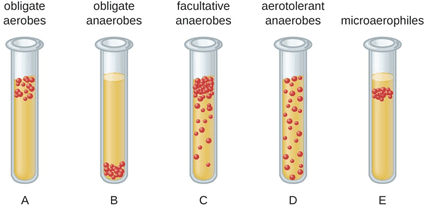
Figure 1: Bacteria can be identified based upon their oxygen requirement in a thioglycolate growth medium. Depending upon their oxygen requirement, bacterial populations localize themselves in a different region of the growth medium, ranging from high oxygen requirement or aerobes found near the surface of the growth medium to anaerobes that are located at the bottom of the growth medium (Image Credit: OpenStax Microbiology)
Types of Aerobic Bacteria
Aerobic Bacteria can be classified as:
- Obligate Aerobes
- Facultative Aerobes
- Microaerophiles
- Aerotolerant Aerobes
Obligate aerobes
Obligate aerobes are organisms that cannot survive in the absence of oxygen. Therefore, obligatory aerobes mandatorily need the presence of oxygen in their environment for survival and growth. Aerobic bacteria utilize molecular oxygen as a terminal electron acceptor, oxidize sugar and fats, and generate ATP/energy by the process of glycolysis, electron transport chain, and the Krebs TCA cycle. The enzymes involved in the respiratory chain in obligate aerobes are catalase, peroxidase, and superoxide dismutase. These three enzymes are essential for the aerobic biology of the aerobes as they help to counter the toxic effects of the reactive oxygen species generated due to the presence of molecular oxygen.
Examples of obligate aerobes are Bacillus, Mycobacterium, and Pseudomonas.
Facultative aerobes
Facultative aerobic bacteria do not entirely rely on the availability of oxygen in their environment. Instead, these bacteria utilize anaerobic methods to produce ATP/energy molecules. They can therefore survive even in the absence of oxygen.
An example of a facultative aerobe is Enterobacteriaceae.
Microaerophiles
As the name suggests, microaerophiles need only a small amount of oxygen for the generation of energy. The presence of oxygen in higher amounts can be lethal to microaerophiles. Microaerophiles lack an electron transport system and are dependent on the fermentation reaction to generate energy.
Examples of microaerophiles are Helicobacter and Campylobacter.
Aerotolerant aerobes
Aerotolerants do not utilize oxygen for a metabolic activity or for the generation of energy. They are also not adversely affected by the presence of oxygen. Aerotolerant bacteria do not possess enzymes (particularly, catalase, peroxidase, and superoxide dismutase) required for aerobic respiration.
Examples of aerotolerant aerobes are Lactobacilli and Streptococci.
Aerobic Bacteria Examples
- Pseudomonas aeruginosa is a rod-shaped Gram-negative bacterial species that may cause disease in plants and animals, including humans (infections in lungs or blood)
- Nocardia is a genus of rod-shaped Gram-positive bacteria. Certain species may cause nocardiosis, a lung disease caused by breathing in dust particles containing infective Nocardia species.
- Mycobacterium tuberculosis is a causative agent of another lung disease, tuberculosis.
- E. Coli
- Proteus is a saprophyte found widely in manure soil, sewage, animal feces
- Salmonella is a genus of rod-shaped Gram-negative bacteria certain species are commonly associated with food-borne illnesses.
- Achromobacter is a genus of rod-shaped Gram-negative bacteria characterized by the presence of peritrichous flagella. They are strictly aerobic, thriving in water and soils.
- Klebsiella is a genus of rod-shaped Gram-negative bacteria that are ubiquitous in nature and part of the normal flora of the digestive tract of humans.
- Citrobacter is a genus of Gram-negative coliform bacteria. The species are opportunistic pathogens. In humans, certain species can cause urinary tract infections, pneumonia, CNS infections, and neonatal infections.
Biological/Ecological Role of Aerobic Bacteria
Bacteria form a significant part of the global ecosystem and are involved in several ecological as well as biologically essential functions. Some of the biological/ecological roles of aerobic bacteria are listed below.
- Aerobic bacteria play an essential role in biological degradation. The presence of oxygen accelerates hydrocarbon degradation. Such decomposition can be seen on the forest floor wherein aerobes are engaged in the process of degrading the leaves and other organic material. Decomposition of organic material is an aerobic process. The rate of decomposition decreases on the increase in the level of carbon dioxide. Interestingly, aerobic composting does not result in a stinking smell. Here it is essential to understand what an aerobic process is. An aerobic process is a process carried out in the presence of oxygen.
· Aerobic bacteria are used in wastewater treatment to degrade pollutants. Aerobes utilize dissolved oxygen in the water and degrade its pollutants to generate energy and thrive in it.
· The majority of the soil bacteria are aerobic bacteria that utilize molecular oxygen present in the soil to degrade the contaminant of the soil. Examples are Aerobacter sp, Actinomycetes bacteria, and genus Streptomyces.
· Certain disease-causing bacteria are also aerobic bacteria. For example, Mycobacterium tuberculosis causes tuberculosis and can remain dormant for years. Another disease-causing aerobic bacterium is Escherichia coli that can cause diarrheal illnesses. Leptospira is also an aerobic pathogenic bacterium that causes leptospirosis. Anthrax-causing Bacillus anthracis is also an aerobic bacterium.
Try to answer the quiz below to check what you have learned so far about aerobic bacteria.
References
- Brook, I. (1988). Enhancement of growth of aerobic, anaerobic, and facultative bacteria in mixed infections with anaerobic and facultative gram-positive cocci. The Journal of surgical research, 45(2), 222–227. https://doi.org/10.1016/0022-4804(88)90068-6.
- Hentges, DJ. (1996). Anaerobes: General Characteristics. In: Baron S, editor. Medical Microbiology. 4th edition. Galveston (TX): University of Texas Medical Branch at Galveston; Chapter 17. Available from: https://www.ncbi.nlm.nih.gov/books/NBK7638/
- Stieglmeier, M., Wirth, R., Kminek, G., & Moissl-Eichinger, C. (2009). Cultivation of anaerobic and facultatively anaerobic bacteria from spacecraft-associated clean rooms. Applied and environmental microbiology, 75(11), 3484–3491. https://doi.org/10.1128/AEM.02565-08
- Bradley, L. A., & Rettger, L. F. (1927). Studies on aerobic bacteria commonly concerned in the decomposition of cellulose. Journal of bacteriology, 13(5), 321–345. https://doi.org/10.1128/jb.13.5.321-345.1927
- Brockmann, M., Aupperle-Lellbach, H., Gentil, M., Heusinger, A., Müller, E., Marschang, R. E., & Pees, M. (2020). Challenges in microbiological identification of aerobic bacteria isolated from the skin of reptiles. PloS one, 15(10), e0240085. https://doi.org/10.1371/journal.pone.0240085
©BiologyOnline.com. Content provided and moderated by Biology Online Editors.