Benign - Definition and Examples - Biology Online Dictionary (original) (raw)

Benign
n., adjective
[bɪˈnaɪn]
Definition: Not aggressive or posing any serious threat especially to health
Table of Contents
Toggle
- Benign Definition
- Benign Examples
- Types of Benign Tumors
- What are Treatment Options for benign tumors?
- Quiz
- References
How to define benign? The meaning of benign in a general sense is “beneficial” and “pleasant”. Benign is something that apparently describes something that does not cause harm or that is being “kind”. Conversely, the term “_malignant_” is the opposite of benign and it is used to describe things that aren’t pleasant or that intend to harm.
What does benign mean medically?
In oncology, the term “benign” is used to describe a condition or an outgrowth, such as a tumor, that is non-progressive (meaning it will not change or progress to an advanced state) and non-metastatic (meaning it does not spread). A benign tumor would therefore be one that is not dangerous and can be cured or treated. Benign conditions are not recurrent and harmless, as opposed to malignant tumors (or cancer).
Benign conditions are usually harmless and not serious or dangerous. Therefore, benign tumors are not cancerous. The opposite of benign is malignant. Malignant is a term used to describe harmful metastatic and cancerous tumors that spread disease all over the body.
For example, benign tumors are not usually harmful and tend to grow rather slowly and in one place. Malignant tumors, on the contrary, have a faster rate of growth and can grow new blood vessels (angiogenesis) and thus, the cancer cells can detach from the tumor and use the blood vessel to spread, eventually harming the affected tissues and nerves. Therefore, benign conditions may only result in local problems without causing systemic problems.
What is benign in biology?
Benign is a word used to describe something that is not essentially posing a danger to one’s health, such as a benign tumor. In medical definition, “_benign_” is used to describe noncancerous tumors or masses. A benign tumor does not spread to other areas in the body. A tumor that leaves its site and invades the surrounding tissue or distant body parts is not benign but cancerous (or malignant). See also: cancer
Can benign conditions be serious?
Benign conditions can be serious if they are near nerves or blood vessels. Benign tumors can produce pressure that decreases the blood flow to a certain area of the body causing ischemia and tissue death or even organ damage. These conditions may sometimes be serious and the benign tumor must be treated and removed.
What factors contribute to the formation of benign tumors?
The formation of tumors usually occurs without any reason. However, some factors may contribute to its formation such as:
- genetic factors
- toxins in the environment such as radiation and chemicals
- unhealthy diet
- stress
- local injury or trauma
- infection or inflammation
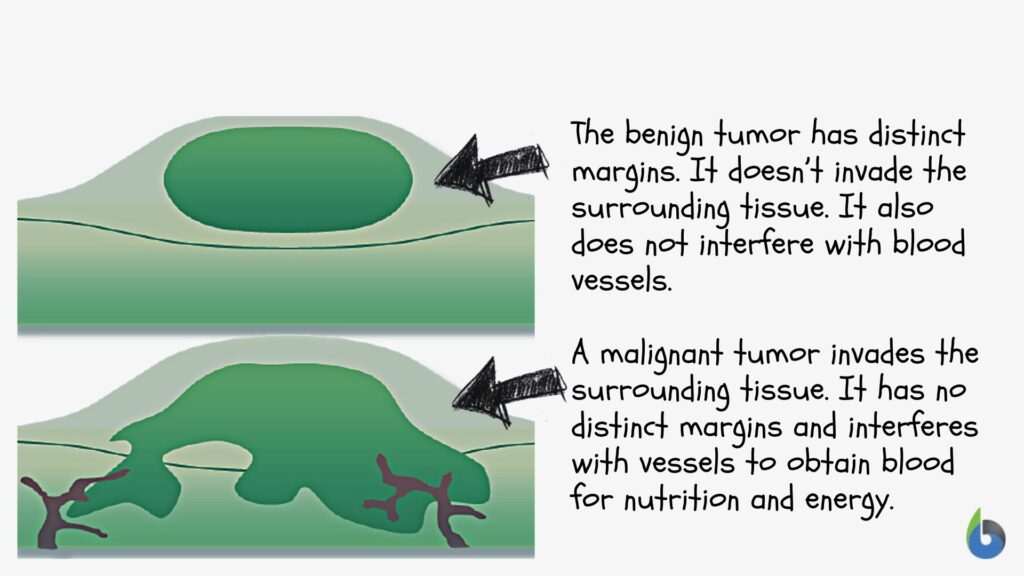
Figure 1: Benign tumor and malignant tumor (diagram). Image Source: Simon Caulton, CC BY-SA 3.0, modified by Maria Victoria Gonzaga of Biology Online.

Benign Examples
The most significant benign condition that occurs in humans is the development of benign tumors. Benign tumors remain in their primary location where they are formed. They do not move to other sites of the body to invade them. Benign tumors are usually formed slowly with visible outer borders of connective tissue and fibrous sheath whereas malignant tumors are less differentiated.
Benign tumors are not harmful; however, they may produce pressure on the surrounding tissue causing pain, discomfort, or other complications. For example, the formation of a benign tumor may produce pressure on the trachea causing breathing difficulties. Other benign tumors can be life-threatening such as brain tumors. Endocrine tumors are formed due to the abnormal production of some hormones. Examples of endocrine tumors are adrenocortical adenomas (benign tumors of the adrenal cortex with the abnormal production of the adrenal hormone, commonly due to overproduction) and thyroid adenomas (thyroid nodules).
After surgical removal, benign tumors do not usually form again but malignant tumors can sometimes grow again after removal. Radiation may be used to treat benign tumors which cannot be removed.
Some benign tumors may become malignant tumors over time. These tumors should be monitored and may be removed surgically to avoid the formation of a malignant tumor. For example, benign tumors in the colon usually become malignant so they are removed.
When a benign tumor becomes malignant (a depiction). Source: Maria Victoria Gonzaga of Biology Online.
Types of Benign Tumors
There are different types of benign tumors depending on their origin, the most common benign tumors are:
- Adenomas arise in glands or gland-like epithelial tissue. The most common type of adenomas is the polyp in epithelial tissue of the colon. However, they may also be formed in the pituitary, adrenal, or thyroid gland. Adenomas are not commonly removed, but in some cases, they must be removed surgically if they become malignant.
- Fibroids or fibroma are benign tumors of connective tissue. Thus, they can be present in almost any organ. The most common site of fibromas development is the uterus. Even though it is not a malignant tumor, uterine fibroids may lead to problems in the bladder, heavy vaginal bleeding, pain, or pressure in the pelvis.
- Hemangiomas grow from a group of blood vessel cells in internal organs or the skin on the neck, head, or trunk. This condition often goes away on its own. Otherwise, treatment may be required if it affects hearing, vision, or eating.
- Lipomas are benign tumors formed of fat cells. Lipomas are the most common benign tumors. They grow slowly in the form of a movable, rounded, and soft mass. Surgery, liposuction, or corticosteroid shot are common options for the treatment of a fast-growing or painful lipoma.
- Meningiomas are the most dangerous type of benign tumor. They grow around the spinal cord and brain from the membrane surrounding them. Meningioma symptoms include seizures, change in personality, headache, one-side weakness, and visual problems.
- Moles or nevi are benign tumors that grow over the skin. However, they look different from ordinary skin conditions. Moles may develop into skin cancer (melanoma), these moles are usually without distinct borders, have a different color, are fast-growing, or their shape is changing over time. So suspected moles must be removed to check for skin cancer.
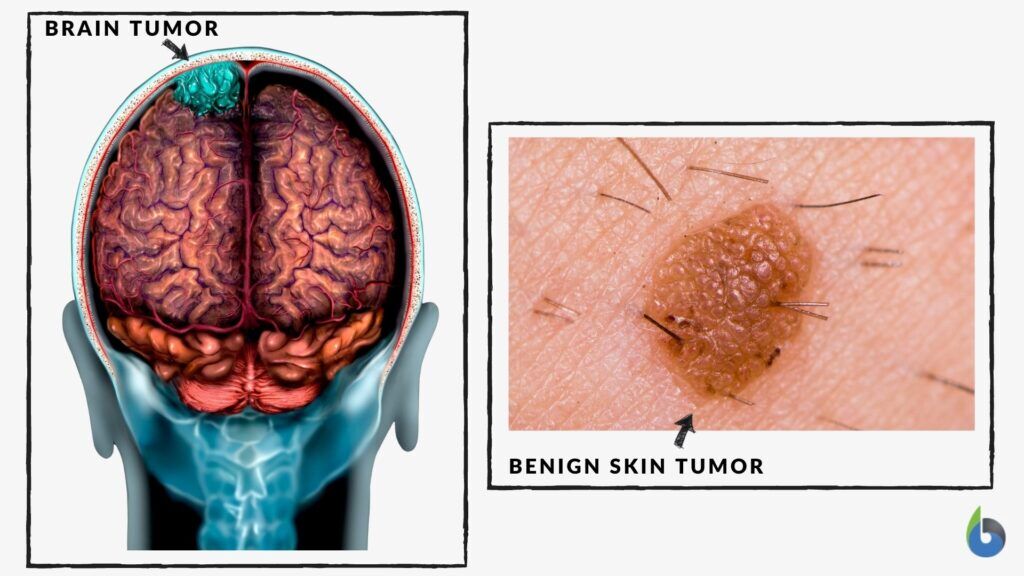
Figure 2: Examples of benign tumors. Image Source: Maria Victoria Gonzaga of Biology Online.
What are Treatment Options for benign tumors?
These are the common management and/or treatments for benign tumors.
- Monitoring and watchful waiting
- Medications
- Radiation
- Surgical removal
Choosing one of the treatment options for a tumor depends on several factors including the site of the tumor, symptoms including pain and discomfort, health condition of the patient, the prognosis of the tumor, and the impact of the tumor on surrounding tissue.
Surgery is the most convenient approach for removing benign tumors. Benign tumors are removed to stop or avoid their complications including seizures, pain, and cosmetic concerns. Sclerotherapy is another method for the treatment of benign tumors, this approach is usually used to treat rectal adenomas. Chemical treatment shrinks blood vessels so it is used to stop the blood supply to the tumor; thus, preventing its development. Chemotherapy and radiation are usually used to control intracranial benign tumors where surgery is life-threatening. Also, rectal hemangiomas are treated by radiation. Benign tumors of the skin are removed by surgery or other methods such as laser, chemical peel, dermabrasion, and topical medications.
Try to answer the quiz below to check what you have learned so far about benign.
References
- Aisha Patel, M. B. B. S. (2020, September 1). Benign vs malignant tumors. JAMA Oncology. Retrieved October 26, 2021, from https://jamanetwork.com/journals/jamaoncology/fullarticle/2768634.
- Benign. Cambridge Dictionary. (n.d.). Retrieved October 26, 2021, from https://dictionary.cambridge.org/dictionary/english/benign.
- Dictionary.com. (n.d.). Benign definition & meaning. Dictionary.com. Retrieved October 26, 2021, from https://www.dictionary.com/browse/benign.
- MedicineNet. (2018, March 16). Brain cancer symptoms, diagnosis, and treatment. MedicineNet. Retrieved October 26, 2021, from https://www.medicinenet.com/brain\_cancer\_symptoms\_diagnosis\_treatment/article.htm.
- Merriam-Webster. (n.d.). Benign. Merriam-Webster. Retrieved October 26, 2021, from https://www.merriam-webster.com/dictionary/benign.
- Stuart, A. (n.d.). Benign tumors: Types, causes, and treatments. WebMD. Retrieved October 26, 2021, from https://www.webmd.com/a-to-z-guides/benign-tumors-causes-treatments.
- Team, the H. E. (2018, September 17). Benign tumors: Causes, symptoms & diagnosis. Healthline. Retrieved October 26, 2021, from https://www.healthline.com/health/benign.
- U.S. National Library of Medicine. (n.d.). Benign: Medlineplus medical encyclopedia. MedlinePlus. Retrieved October 26, 2021, from https://medlineplus.gov/ency/article/002236.htm.
©BiologyOnline.com. Content provided and moderated by Biology Online Editors.