Host cell - Definition and Examples - Biology Online Dictionary (original) (raw)
Host cell
n., plural: host cells
[hoʊst sɛl]
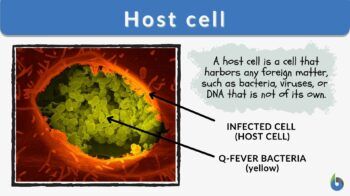
Definition: a cell harboring a foreign molecule or microorganism
Table of Contents
Toggle
What is a host cell? A host cell is a living cell that serves as a shelter and a food source to the foreign organism. When two organisms live together and share a close and prolonged biological relationship, the two organisms are said to be in a symbiotic relationship. This symbiotic relationship can be of different types. Depending upon the extent of dependency of the foreign organism or guest, the relationship between host and guest can be:
- Parasitic: A relationship between host cell and guest organism wherein the parasite or the guest cell derive benefits at the expense of the host cell. Parasites need a host to survive.
- Mutualistic: A relationship wherein both host cell and guest coexist without harming each other.
- Commensalism: A relationship wherein both host cell and guest derive benefit from each other.
In the above context, one may wonder, What is a host cell in a human?
In humans, any cell that a pathogenic organism can invade is a host cell, e.g., human immune cells like CD4+ cells and macrophages are the host cell for HIV.
It is essential to understand that only certain species of hosts or certain cells can serve as hosts for viruses or bacteria. Host cells that allow viruses or bacteria to invade them are called permissive cells. All cells are not permissive cells. Molecular receptor specificity on the surface of the host cells determines the probability of invasion by a bacteria or virus. Further, the permissive cell must provide the invading organism with the required nutrients and substances for survival and reproduction.
Viruses are considered to be obligate parasites that invade the host cell entirely for all their nutritional requirements. However, a contrary fact to this obligate parasitic relationship is that viruses totally depend upon the structural and synthetic machinery of the host cell to survive and, in this process, lose upon a certain level of flexibility to adapt to the environmental changes.
This, in a way, hostage virus is totally dependant upon the host cell for its survival. So this also answers the query, what do host cells provide for viruses?
Biology definition:
A host cell is a cell that harbors foreign molecules, viruses, or microorganisms. It may also be a cell that has been introduced with DNA (or RNA), such as a bacterial cell acting as a host cell for the DNA isolated from a bacteriophage. Etymology: host, from Latin “hospitem”, “hospes”, meaning “sojourner”, “visitor”, or “guest” and cell, from Latin “cella”, meaning “chamber” or “small room”.
One may question, why do viruses depend on host cells?
Viruses do not have the suitable machinery required for the transcription and replication of the genetic material. Viruses need a host cell for the replication of the genetic material. Viruses use host cells to carry out the replication and transcription process.
In some instances, viral genetic material interacts with the host cell DNA and gets integrated into it, resulting in the formation of malfunctioning cells like cancerous cells.
Host for a parasite
In general, the majority of parasites do not spend their entire life span in only one host. Depending upon their life stage, the host to a parasite may be:
- Primary or definitive host: The parasite attains adulthood and reproduces by the sexual method. This host can also be termed the final host for the parasite.
- Examples:
* For Plasmodium vivax, female Anopheles is the primary host.
* For Wuchereria bancrofti, humans are the primary host.
- Examples:
- Secondary or intermediate host: The secondary host is the one that harbours the immature parasitic stage. This host is essential for the parasite’s lifecycle as immature parasite undergoes development.
- Examples:
* For Plasmodium vivax, humans are the secondary host
* For Wuchereria bancrofti, female culex is the secondary host
- Examples:
Figure 1: The life cycle of Plasmodium spp. This shows that the species uses two hosts: the female anopheline mosquito and humans. In the mosquito, Plasmodium sporozoites have been found in its salivary glands, such as in the cytoplasm of the secretory cells. (Wells & Andrew, 2019) In humans, the sporozoites could invade the liver cells to become schizonts (Exo-erythrocytic cycle), and red blood cells, such as reticulocytes (Erythrocytic cycle). Image Credit: CDC.gov

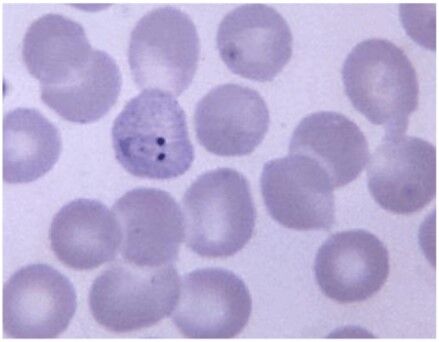
Figure 2: Plasmodium vivax ring trophozoites in the reticulocyte (blood smear). Image Credit: CDC Public Health Image Library.
Apart from these two basic types of the host to a parasite, a host can be:
- Dead end host (also accidental or incidental host): The host cell that does not allow further transmission of the parasite to the definitive host, thereby terminating the parasite’s life cycle before completion. For example, the dead-end host for the West Nile virus is humans and horses.
- Reservoir host: The host that serves as a source for the infection as it harbors the parasite.
For example, monkeys serve as a reservoir host for Plasmodium. - Paratenic host: The host harbors the immature parasite and lets them multiply; however, such hosts are not essential for the parasite’s life cycle.
Another important aspect here is to understand the term, host range. The host range for a parasite is the possible host for a parasite, e.g., the influenza virus can harbor and infect pigs, birds, and humans. Therefore, the outcome of the host range determines the spread of the disease, i.e., epidemiology.
Further, the spread of the virus from one host to the other host provides an opportunity for the virus to acquire genes and undergo mutation resulting in the generation of new viral strains. This is also the primary reason because the influenza vaccination needs to be carried out annually.
Therefore, the influenza vaccine is optimized according to the new strain in prevalence every year.
Watch this vid to see how a virus enters a host cell.
Host for a mutualistic guest
The host-guest relationship wherein both guest and host mutually benefit from their association. An example is the symbiosis between the leguminous plants and the nitrogen-fixing bacteria, Rhizobium spp.
Watch this vid to see how the rhizome endosymbionts enter the root cells as their host cells.
Host Cell Examples
Some of the host cells of viruses include:
- CD4+T lymphocytes, monocytes, macrophages, and dendritic cells (DC) are the host cells for HIV (Human immune deficiency virus)
- Respiratory tract epithelial cells are the host cells for the Influenza virus
- Macrophages, dendritic cells, and fibroblasts are the host cells for the Ebola virus
- Nerve cells and salivary gland epithelial cells serve as host cells for the Rabies virus
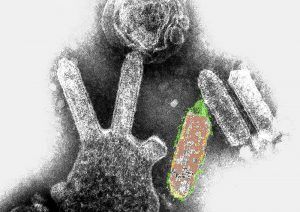
A colored transmission electron micrograph of Australian bat lyssavirus (finger-like projections and the one that buds off from a host cell). Credit: Electron Microscopy Unit AAHL, CSIRO, CC 3.0 Unported license
Try to answer the quiz below to check what you have learned so far about host cells.
References
· Alberts B, Johnson A, Lewis J, et al. (2002). Molecular Biology of the Cell. 4th edition. New York: Garland Science; Cell Biology of Infection. Available from: https://www.ncbi.nlm.nih.gov/books/NBK26833/
· Louten J. (2016). Features of Host Cells: Cellular and Molecular Biology Review. Essential Human Virology, 31–48. https://doi.org/10.1016/B978-0-12-800947-5.00003-X
· Shang, J., Wan, Y., Luo, C., Ye, G., Geng, Q., Auerbach, A., & Li, F. (2020). Cell entry mechanisms of SARS-CoV-2. Proceedings of the National Academy of Sciences of the United States of America, 117(21), 11727–11734. https://doi.org/10.1073/pnas.2003138117
· Wells, M. B., & Andrew, D. J. (2019). Anopheles Salivary Gland Architecture Shapes Plasmodium Sporozoite Availability for Transmission. MBio, 10(4). https://doi.org/10.1128/mbio.01238-19
Whitaker-Dowling, P., & Youngner, J. S. (1999). Virus-Host Cell Interactions. Encyclopedia of Virology, 1957–1961. https://doi.org/10.1006/rwvi.1999.0343
©BiologyOnline.com. Content provided and moderated by Biology Online Editors.