Red algae - Definition and Examples - Biology Online Dictionary (original) (raw)
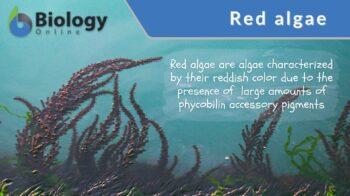
Red algae
n., singular: red alga
[ɹɛd ˈæl.dʒi]
Definition: a rhodyphyte
Table of Contents
Toggle
- Red Algae Definition
- Classification
- Sub-groups
- General Characteristics of Red Algae
- Evolution and Phylogeny
- Biological Importance
- Quiz
- References
The red algae belong to the phylum Rhodophyta, which literally was derived from the Greek word ῥόδον (rhodon), meaning “rose” and φυτόν (phyton), meaning “plant”.
They are characterized by having a reddish color due to the predominance of the accessory pigments, such as phycoerythrobilin, phycocyaniobilin, phycourobilin, and phycobiliviolin in phycobillisomes, in addition to the green pigment (i.e., chlorophyll, often, chlorophyll a).
They store their carbohydrate reserve as Floridian starch. They are considered one of the earliest eukaryotic algae. (Ref.1) The group could be the largest set, with over 7,000 species recognized. (Ref. 2) Over 90% of the red algal species are found in the marine habitats, the rest, in freshwater, and the two species, in coastal caves.
Examples of red algal species are Rhodella, Compsopogon, Stylonema, Bangia, Porphyra, Porphyridium cruentum, Hildenbrandia, Nemalion, Corallina officinalis, Ahnfeltia, Gelidium, etc.
Classification
In the old scheme of classification, i.e. the five-kingdom scheme, Protista is one of the taxonomic kingdoms. It is comprised of animal-like protozoa, plant-like algae, and fungus-like slime molds and water molds. Accordingly, Protista is divided into several phyla.
The plant-like or algal species are further divided into the following phyla: Euglenophyta, Chrysophyta (diatoms), Pyrrophyta (dinoflagellates), Chlorophyta, Phaeophyta, and Rhodophyta. (Ref.3) Recent studies and findings, though, could lead to changes in the taxonomic positions and to newer systems of classification. (Ref.4)
Sub-groups
As of 2019(5), Rhodophyta has the following taxonomic classes:
- Bangiophyceae
- Compsopogonophyceae
- Cyanidiophyceae (a class consisting of unicellular and thermoacidophilic extremophiles)
- Florideophyceae
- Porphyridiophyceae
- Rhodellophyceae
- Rhodophyta classis incertae sedis
- Stylonematophyceae
General Characteristics of Red Algae

Examples of red algae: A-D: Chondrus crispus Stackhouse, E-F : Mastocarpus stellatus. The major distinction of red algae is the reddish color as a result of the predominance of the pigments, phycoerythrobilin, phycocyaniobilin, phycourobilin, and phycobiliviolin in phycobillisomes, in addition to the green pigment, chlorophyll pigments.
- As their name implies, the red algae are algal species that appear reddish in color due to the abundance of the phycobilin accessory pigments, such as phycoerythrobilin, phycocyanobilin, phycourobilin, and phycobiliviolin localized into the phycobilisomes.
- Other pigments are present: chlorophyll a and d, α- and β-carotene, lutein, and zeaxanthin.
- Their carbohydrate reserve is Floridian starch, i.e. α1-4 branched glucose polymer dispersed throughout the cytoplasm.
- Their cell wall is two-layered; the outer layer contains agarose and agaropectin whereas the inner layer is chiefly made up of cellulose.
- Another distinctive feature of red algae is the absence of flagella and centrioles. They also form pit connections and pit plugs. The pit connections and pit plugs form during cytokinesis following mitosis. These structures are unique to red algae. The pit connections are thought to play a role in cell-to-cell communication and/or symplastic transport.
- Red algae reproduce sexually or asexually. Sexual reproduction is by the union of gametes. However, the male gamete is not motile as it lacks flagellum. It has to rely on water current for it to be transported to the female gamete. Asexual reproduction is usually through spore production, fragmentation, and propagules production.
- Their life cycle involves the alternation of generations, similar to other algal groups. However, in red algae, there are three generations occurring in succession. The gametophyte generation may have two subsequent sporophyte generations. The first sporophyte is referred to as the carposporophyte (as carpospores are produced) and the second sporophyte is called tetrasoporophyte (as tetraspores are produced). Briefly, the life cycle begins in the gametophyte generation where male and female gametes are produced. This phase culminates in the union of two gametes as the event leads to the formation of a diploid zygote. The zygote develops into carposporophyte that eventually produces carpospores. The carpospore germinates into a tetrasporophyte that in turn produces spore tetrads. The tetrads germinate into gametophytes. There are instances though that tetrasporophyte generation is skipped when the carposporophyte produces carpospores that germinate directly into thalloid gametophytes.
- The forms are diverse – from single-celled to multicellular.
- Many of them are marine species and are found on the coastal and continental shelf areas of tropical, temperate, and cold-water regions. (Ref.6)
Evolution and Phylogeny
According to the endosymbiotic theory, an early eukaryotic phagotroph engulfed a photosynthetic prokaryote. The symbiosis between the two primitive life forms led to the incorporation of the prokaryote inside the eukaryotic cell and became an organelle, particularly a plastid. This event is presumed to have led to the rise of clades of autotrophs, such as the green algae, the red algae, and the glaucophytes. (Ref.7)
The red algae, though, are presumed to have been involved in two endosymbiosis events. A secondary event might have involved an ancestral red alga and a eukaryotic heterotroph and it led to the further diversification of the algal species, giving rise to other clades, such as Cryptophyta, Haptophyta, Alveolata, and the heterokonts. (Ref.8)
Watch this vid about red algae, descendants of primary endosymbiosis 2:
Biological Importance
Red algae are the limestone-reef builders of the ecosystem. Th_e coralline algae_ are an example. They help build coral reefs by secreting calcium carbonate. Some species, such as nori (Porphyra) and dulse (Palmaria palmata), are part of Asian and European cuisines, respectively.
Because of the cell wall component, some red algae (e.g. Gracilaria, Gelidium, Porphyra, Palmaria, and Euchema) are harvested for the manufacture of products from agar and/or carrageenan.
Take the Red Algae Biology Quiz!
References
- Lee, R.E. (2008). Phycology (4th ed.). Cambridge University Press. ISBN 978-0-521-63883-8.
- Taxonomy Browser :: Algaebase. (2019). Retrieved from Algaebase.org website: https://www.algaebase.org/browse/taxonomy/?id=97240
- Pascher, A. (1914). “Über Flagellaten und Algen “. Berichte der deutsche botanischen Gesellschaft 32: 136–160.
- The NCBI taxonomy database. Retrieved from http://www.ncbi.nlm.nih.gov/taxonomy.
- Taxonomy Browser :: Algaebase. (2019). Retrieved December 6, 2019, from Algaebase.org website: https://www.algaebase.org/browse/taxonomy/?id=97240
- Rhodophyta. Retrieved from ://www.eol.org/pages/4524/overview.
- De Clerck, O., Bogaert, K. A., & Leliaert, F. (2012). “Diversity and Evolution of Algae”. Genomic Insights into the Biology of Algae. Advances in Botanical Research. 64. pp. 55–86
- McFadden, G.I. (2001). “Primary and Secondary Endosymbiosis and the Evolution of Plastids”. Journal of Phycology. 37 (6): 951–959.
© Biology Online. Content provided and moderated by Biology Online Editors