Biological Cell Introduction - Biology Online Tutorial (original) (raw)
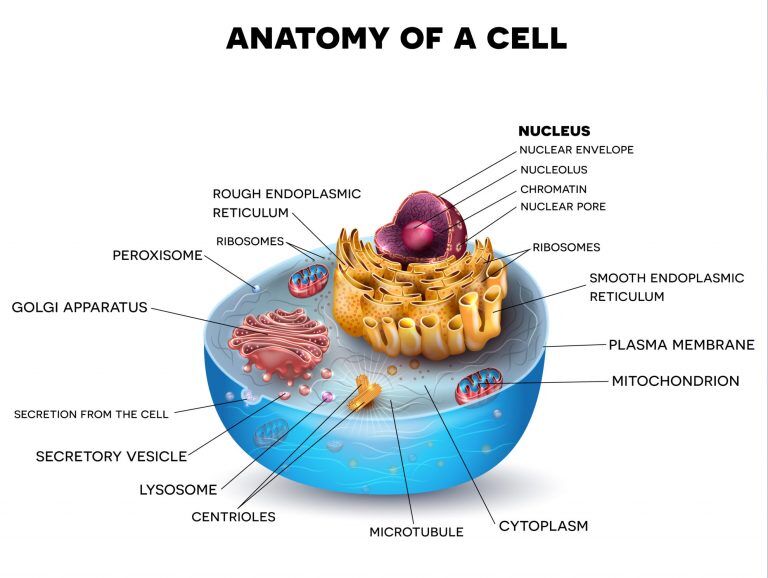
Schematic diagram of a typical cell with its parts
Table of Contents
Toggle
- Cell Specialisation
- The Cell Membrane
- Cell Transport
- The Breakdown of Materials in a Cell
- Absorption and Secretion
- Quiz
It only takes one biological cell to create an organism. In fact, there are countless species of single-celled organisms, and indeed multi-cellular organisms like ourselves.
A single cell is able to keep itself functional by owning a series of ‘_miniature machines_‘ known as organelles. The following list looks at some of these organelles and other characteristics typical of a fully functioning cell.
- Mitochondrion
An important cell organelle involved in respiration - Cytoplasm
A fluid surrounding the contents of a cell and forms a vacuole - Golgi Apparatus
The processing area for the creation of a glycoprotein - Endoplasmic Reticulum
An important organelle heavily involved in protein synthesis. - Vesicles
Packages of substances that are to be used in the cell or secreted by it. - Nucleus
The “brain” of a cell containing genetic information that determines every natural process within an organism. - Cell Membrane
Also known as a plasma membrane, this outer layer of a cell assists in the movement of molecules in and out the cell plays both a structural and protective role - Lysosomes
Membranous sacs that contain digestive enzymes - Cell Wall
A structure that characteristically is found in plants and prokaryotes and not animals that plays a structural and protective role.
Compares and contrasts prokaryote cells and eukaryote cells before exploring organelle structures and functions! Video includes the modern cell theory and plant vs. animal cell comparisons.
Credit: Amoeba Sisters
Cell Specialisation
Cells can become specialized to perform a particular function within an organism, usually as part of a larger tissue consisting of many of the same cells working in tandem, for example;
- Nerve cells to operate as part of the nervous system to send messages back and forth via the brain at the center of the nerve system.
- Skin cells for waterproof protection and protection against pathogens in the open-air environment.
- Xylem tubes to transport water around plants and to provide structural support for the plant as a whole.
Cells combine their efforts in these tissue types to perform a common cause. The task of the specialized cell will determine in what way it is going to be specialized, because different cells are suited to different purposes, as illustrated in the above list and below example:
- Muscle cells are long and smooth in structure and their elastic nature allows these cells to perform flexible movements, just as they do in our own bodies.
- Some white blood cells contain powerful digestive enzymes to eliminate pathogens by breaking them down to the molecular level.
- Cells at the back of the eye are sensitive to light stimuli, and thus can interpret differences in light intensity which can, in turn, be interpreted by our nervous system and brain.
Many of these cells contain organelles, though after some cells are specialized, they do not possess particular characteristics as they do not require them to be there. i.e. efficiency is the key, no resources are wasted and the resources available are put to their idyllic optimum.
The Cell Membrane
The cell membrane, otherwise known as the plasma membrane is a semi-permeable structure consisting mainly of phospholipid (fat) molecules and proteins. They are structured in a fluid mosaic model, where a double layer of phospholipid molecules provide a barrier accompanied by proteins.
It is present around the circumference of a cell to acts as a barrier, keeping foreign entities out of the cell and its contents (like cytoplasm) firmly inside the cell.
The plasma membrane allows only selected materials to pass in and out of a cell, and is thus known as a selectively permeable membrane. There are a number of methods that allow the exchange of materials in and out of the cell possible, mentioned below.
Cell Transport
There are three methods in which ions are transported through the cell membrane into the cell,
- Active Transport – Active transport is the transport of molecules with the active assistance of a carrier that can transport the material against a natural concentration gradient.
- Passive Transport (Diffusion) – The movement of molecules from areas of high concentration (i.e. outside a cell) to areas of low concentration (i.e. within a cell) via a carrier. This process does not require energy.
- Simple Diffusion – The movement of molecules from areas of high concentration to areas of low concentration in a free state. Osmosis of water involves this type of diffusion through a selectively permeable membrane (i.e. plasma membrane)
The Breakdown of Materials in a Cell
In cells, sometimes it is required to breakdown more complex molecules into more simple molecules, which can then be ‘re-built’ into what is needed by the body with these new raw materials.
‘_Pinocytosis_‘ where to contents of a structure (such as bacteria) are drank, essentially by breaking down molecules into a drinkable form.
‘_Phagocytosis_‘ where contents are ‘eaten’. See cell defense for more information.
Absorption and Secretion
Absorption is the uptake of materials from a cells’ external environment. Secretion is the ejection of material.
This tutorial is designed to give you an introductory overview of a single cell. The continuing cell biology tutorials elaborate on the concepts mentioned here, and will give you a fuller understanding of the biological cell at work.
 CELL – LABEL THE PARTS (pdf) CELL – LABEL THE PARTS (pdf) |
CELL – LABEL THE PARTS This worksheet is useful in helping the students assess their familiarity with the different parts of the cell, both the eukaryotic and the prokaryotic types. This is useful in genetics as it helps gauge the student’s knowledge of the difference between the two cell types, especially in terms of the location of the genetic material. Subjects: Genetics & Evolution, Cell Biology Lesson: Introduction to Genetics Grades: 9th, 10th, 11th, 12th Type: Worksheet |
|---|
Test your knowledge: Overview of the Cell Quiz
Post navigation
You will also like...

Animal Water Regulation
Animals adapt to their environment in aspects of anatomy, physiology, and behavior. This tutorial will help you understa..
Plant Water Regulation
Plants need to regulate water in order to stay upright and structurally stable. Find out the different evolutionary adap..
The Water Cycle
The water cycle (also referred to as the hydrological cycle) is a system of continuous transfer of water from the air, s..
Adaptation Tutorial
Adaptation, in biology and ecology, refers to the process or trait through which organisms or the populations in a habit..
Plant Biology
Plantlife can be studied at a variety of levels, from the molecular, genetic and biochemical level through organelles, c..
The Origins of Life
This tutorial digs into the past to investigate the origins of life. The section is split into geological periods in the..