Gap Analysis: What 20,000+ Strategic Plans Reveal About the Gaps That Don't Close (original) (raw)
A gap analysis template you can fill in five lines, the four steps that close the gap, and the finding that reframes it: 78% of strategic goals have no owner.

Senior Vice President of Growth & BBQ Master
Sean is the Vice President of Sales at ClearPoint. He leads the Sales department and focuses on developing impactful, consultative sales teams.
A gap analysis template you can fill in five lines, the four steps that close the gap, and the finding that reframes it: 78% of strategic goals have no owner.
A gap analysis is the discipline of comparing where you are to where you said you'd be, then diagnosing why the difference exists. Three questions do the work: Where are we now? Where did we plan to be? And what is the gap actually telling us? Most teams answer the first two and skip the third. That's the one that matters.
Here's the whole template in five lines. Copy it, fill it once per gap, and you've done a real gap analysis:
- Current state — the metric today, with a date and a source.
- Future state — the target, the deadline, and the assumption behind it.
- The gap — the difference, and which of four kinds it is (performance, tracking, definition, strategy).
- Root cause — five whys, run once, until you hit something you can change.
- Closing plan — one owner who controls the inputs, one action, one check-in date.
That's it. The structure is easy. The reason most gap analyses fail is line 5: the gap gets handed to someone who can't actually move it. Across 20,582 strategic plans we analyzed on the ClearPoint platform, the single most common pattern isn't a strategy problem or a math problem. It's an ownership problem. We'll show you the numbers, give you a filled-in example, and walk the four steps the way they should be run.
No hypothetical bank. No imaginary soup kitchen. Just the data and the work.
A filled-in gap analysis template (steal this)
Templates are easier to use than to describe. Here's the five-line template above, filled in for a real-shaped example — a mid-size city trying to cut emergency response time. Swap the specifics for yours.
| 1. Current state | Median EMS response time = 8.4 minutes (FY24 CAD data, pulled Jan 2026). |
|---|---|
| 2. Future state | Under 7 minutes by Q4 2026 — assuming the new west-side station opens on schedule and dispatch headcount holds. |
| 3. The gap | 1.4 minutes. Trend flat for three quarters. Type: performance — the work isn't moving the number (not a tracking or target problem). |
| 4. Root cause (5 whys) | Why is response time flat? → Crews stage too far from the west side. → Why? → No station there yet. → Why is the station late? → Permitting stalled. → Why? → No single owner for the permit. Root cause: ownership, not strategy. |
| 5. Closing plan | Owner: Deputy City Manager (controls permitting). Action: clear the permit blocker. Check-in: 90 days. Re-baseline the target if the station slips past Q3. |
Notice what the template forced. A vague "improve response times" became a defended number, a dated target, a named gap type, and one owner who can actually pull the lever. Four of the five lines are easy. The fifth is where strategy lives or dies.
Download our free eBook on 8 effective strategic planning templates.
What is a gap analysis, really?
Strip away the jargon and a gap analysis is a reading, not a report. You take where you are, hold it against where you said you'd be, and ask the difference what it means.
The third question is where most teams stop short. They treat the gap as a target to close. We've watched 20,582 plans run, and the teams who close gaps reliably treat the gap as a diagnosis — a signal that something upstream is wrong with the plan, the owner, the metric, or an assumption baked in years ago.
The rest of this article is about reading that diagnosis well. And the diagnosis, more often than not, points to the same place.
The gap nobody measures: nobody owns the goal
Before the four steps, three findings from our platform that change the framing. They come from 20,582 strategic plans and 31.2 million data rows — not a survey, not a guess.
Finding 1 — Nearly 8 in 10 strategic goals have no owner
Across the strategic objectives on our platform, 78% have no owner assigned at all. Not a phantom owner who forgets to log in. No name in the box. The goal exists, it sits on a dashboard, and no single human is accountable for moving it.
This is the gap your gap analysis can't see, because it's a gap in the plan's wiring, not in its numbers. You can run a flawless current-state-versus-target analysis and hand the result to no one. Most plans do exactly that.
And it's worse in the sectors that plan the most.
Share of strategic goals with no owner, by sector
Based on 49,817 strategic objectives across the ClearPoint platform.
State Government96%
Education (K-12)91%
Healthcare90%
Higher Education81%
Municipal Government81%
County Government72%
Financial Services64%
Source: ClearPoint Strategy platform data, 2026 (20,582 plans analyzed).
Finding 2 — Give a goal an owner and it's nearly 3× more likely to be on track
This is the finding that turns ownership from a nice-to-have into the whole game. We split every objective into two piles — owned and unowned — and looked at how many ever reached "on track."
Owned goals: 42% have hit green. Unowned goals: 15%. That's a 2.8× difference, from one variable. And it compounds — unowned goals are twice as likely to go their entire life without a single status update. No owner, no reading, no chance.
The owner effect
Share of strategic goals that ever reached "on track," owned vs. unowned.
42%
Owned goals
15%
Unowned goals
Source: ClearPoint Strategy platform data, 2026. Based on 49,817 strategic objectives.
Finding 3 — Projects look healthy. The goals they serve don't.
Here's the trap that catches everyone. Look at the work — the initiatives, the projects teams run to close gaps — and most of it looks fine. Among projects that get a status, 79% are on track. Now look at the goals those projects serve: among the ones that get a status, only 57% are on track — and most goals never get a status at all.
Read that again. Projects almost always look healthy. Goals often don't. Teams charter the project, work the project, ship the project — and the goal it was meant to serve still isn't where the plan said it would be. If your gap analysis stops at "are we delivering the projects?" the answer is usually yes. That's not the gap that's hurting you.
“
After helping run gap analyses across more than 1,000 organizations, the pattern I keep seeing is this. Teams chase the number they can see, not the system that produced it. Closing a gap on paper is easy. Closing it in the dashboard takes ownership the org chart isn't drawn for.
TJ
Ted Jackson
Co-Founder, ClearPoint Strategy
How to do a gap analysis: 4 steps that actually close the gap
The structure works. The execution is where teams lose. Here's the four-step process, anchored to what the data shows.
Step 1 — Anchor the current state to a metric you can defend
Pick one metric per gap analysis. One. The temptation is to run the analysis across every department at once, and the result is a 40-tab spreadsheet nobody reads. Defend the metric with three tests:
- It's owned by someone who controls the inputs.
- It updates at least monthly.
- A real person can answer "what would it take to move this by 10%?"
If it fails those tests, you don't have a metric. You have a placeholder.
Are you tracking the right strategic objectives? Claim your free library of 56 strategic objectives.
Step 2 — Set the target on a date, not a vibe
The future state needs three parts: the value, the date, and the assumption that justifies the trajectory. Most plans skip the third.
"30% growth by 2029" is not a target. "30% growth by Q4 2029, assuming we close two enterprise deals per quarter and churn stays under 5%" is. The second version tells you exactly what to look for when the gap opens up. It also matters for timing — the median strategic project on our platform takes nearly 10 months. If your target window is shorter than that and your plan needs new initiatives, the analysis is already wrong about timing.
Step 3 — Identify the gap, then ask what kind of gap it is
There are four kinds. They look identical on a chart. They need different fixes.
The four kinds of gap
They look identical on a chart. They require different fixes.
Performance gap
Metric is below target.
The work isn't producing the result. Fix: add an initiative + a 90-day check-in.
Tracking gap
Metric hasn't updated.
No real owner watching it. Fix: assign an owner before adding new work.
Definition gap
Metric moved, target didn't.
The target was set against assumptions that no longer apply. Fix: re-baseline. Document what changed.
Strategy gap
Projects deliver, goal still misses.
The strategy itself is wrong, not the execution. Fix: pause projects. Run a strategy review.
The 5 Whys exercise works as a triage here. Run it once. The answer at "Why #5" tells you which type of gap you're actually looking at. And across our platform, the most common "Why #5" is the same: the plan inherited the org chart instead of being designed around who can actually move the metric. A goal gets assigned to a department because the department's name matches the goal's keyword. Nobody checked whether that department could move it.
Step 4 — Build the closing plan around ownership, not action items
Once you know the kind of gap, the closing plan is short:
- Performance gap? Add an initiative. Set a 90-day check-in. Projects, on average, do get worked.
- Tracking gap? Assign a real owner before adding any new initiatives. There's no point launching a project to move a metric nobody is watching.
- Definition gap? Re-baseline. Move the target. Document the assumption that changed. It's politically uncomfortable and almost always right.
- Strategy gap? Pause the projects. Run a strategy review. This is rare. When it happens, doing more of what you were doing makes things worse.
The four gap analysis mistakes we see most often
We get asked to look at gap analyses every week. These four show up over and over.
Mistake 1 — Running the analysis at the project level instead of the goal level
Teams ask "are our projects on track?" The answer is almost always yes. Then they wonder why the strategy is drifting. Run the gap analysis on the goal, not the work that's supposed to serve it.
Mistake 2 — Confusing a delay with a gap
A project running 60 days late is a delay. A goal whose trend line is moving away from target is a gap. The delay can be project-managed. The gap has to be diagnosed. Treat one as the other and you lose months.
Mistake 3 — Never re-baselining
Targets set in 2022 against 2022 assumptions are still sitting in plans today. The gap they describe is partly real and partly an artifact of stale assumptions. We see this most in healthcare and higher education, where the post-COVID re-planning never fully landed. If a gap has stayed wider than 30% for four straight quarters, the issue may not be the work. It may be the target.
Mistake 4 — Assigning the goal to someone who can't move it
This is the big one, and the data backs it. With 78% of goals carrying no owner, and owned goals nearly 3× more likely to hit green, a closing plan that names the wrong owner — or no owner — is a plan launched into a void. Before you finalize the closing actions, check one thing: does the named owner actually control the inputs? If not, the gap is not where you think it is.
Two real gap analyses, two real turnarounds
Replacing the hypothetical bank and the imaginary soup kitchen — here's what this looks like in our customer base.
San Juan Regional Medical Center — the tracking gap that wasn't a strategy gap
San Juan Regional is a 198-bed Level III trauma center in Four Corners, New Mexico. Their gap analysis started simple: leadership needed faster, more reliable reporting against the hospital's Balanced Scorecard. The current state was half a day per management report, with departments tracking metrics in spreadsheets and printing them.
The team assumed the gap was a strategy execution problem. After running the diagnosis, it was a tracking gap. The old performance management software had been reduced to a data-storage tool. Reports couldn't be tailored. Metrics that once mattered were buried, no longer reviewed, no longer current.
The fix wasn't more strategy. It was giving each department its own scorecard tied to the master Balanced Scorecard, plus the ability to attach analysis and audit-traceable evidence. The result ClearPoint published with San Juan: an 89% reduction in reporting time for management reports and an 83% improvement in build time for new reporting requirements. Their DNV stroke accreditation audit, in the words of the hospital's quality control manager, "went flawlessly." The strategy hadn't been broken. The instrument measuring it had.
Source: ClearPoint case study — San Juan Regional Medical Center
City of Durham, NC — the gap analysis they had to run twice
Durham is the fourth-largest city in North Carolina, about 283,000 residents. The city launched its first formal strategic plan in 2011, on ClearPoint. By 2012 — one year in — most departments had reverted to spreadsheets. A second gap analysis turned up something uncomfortable: the gap wasn't in the strategy, and it wasn't even in the software. It was in ownership. There was no clear accountability for performance measures. Updates were optional in practice. Without ownership, the plan went stale on contact with operations.
In 2014, Durham re-launched. This time, department directors were given explicit responsibility for their measures. Performance was linked to budget requests and employee evaluations. The city went from 22 spreadsheets with over 100 tabs to a single ClearPoint instance shared with Durham County for joint initiatives. The outcomes the city published:
- Reduced background-check staffing by four positions with no impact on community safety, because the data showed the workload didn't justify the headcount.
- Avoided hiring four to five communication officers per year after data showed the city was already hitting a 95% emergency-response level.
- A joint city-county CPR/AED training program that has trained over 1,700 Durham Public Schools students.
Durham's strategic plan project manager Jay Reinstein put it plainly: "With data now driving decision making, it's all about results." The first gap analysis Durham ran was correct on the math and wrong on the diagnosis. The second one — the one that worked — looked past the metrics and into who was responsible for moving them.
Source: ClearPoint case study — City of Durham
Closing the gap with ClearPoint
A gap analysis produces three things at minimum: a defended metric, a target with a date, and a closing plan with an owner. ClearPoint's job, after the analysis, is to keep those three things from quietly falling apart over the ten months the work takes.
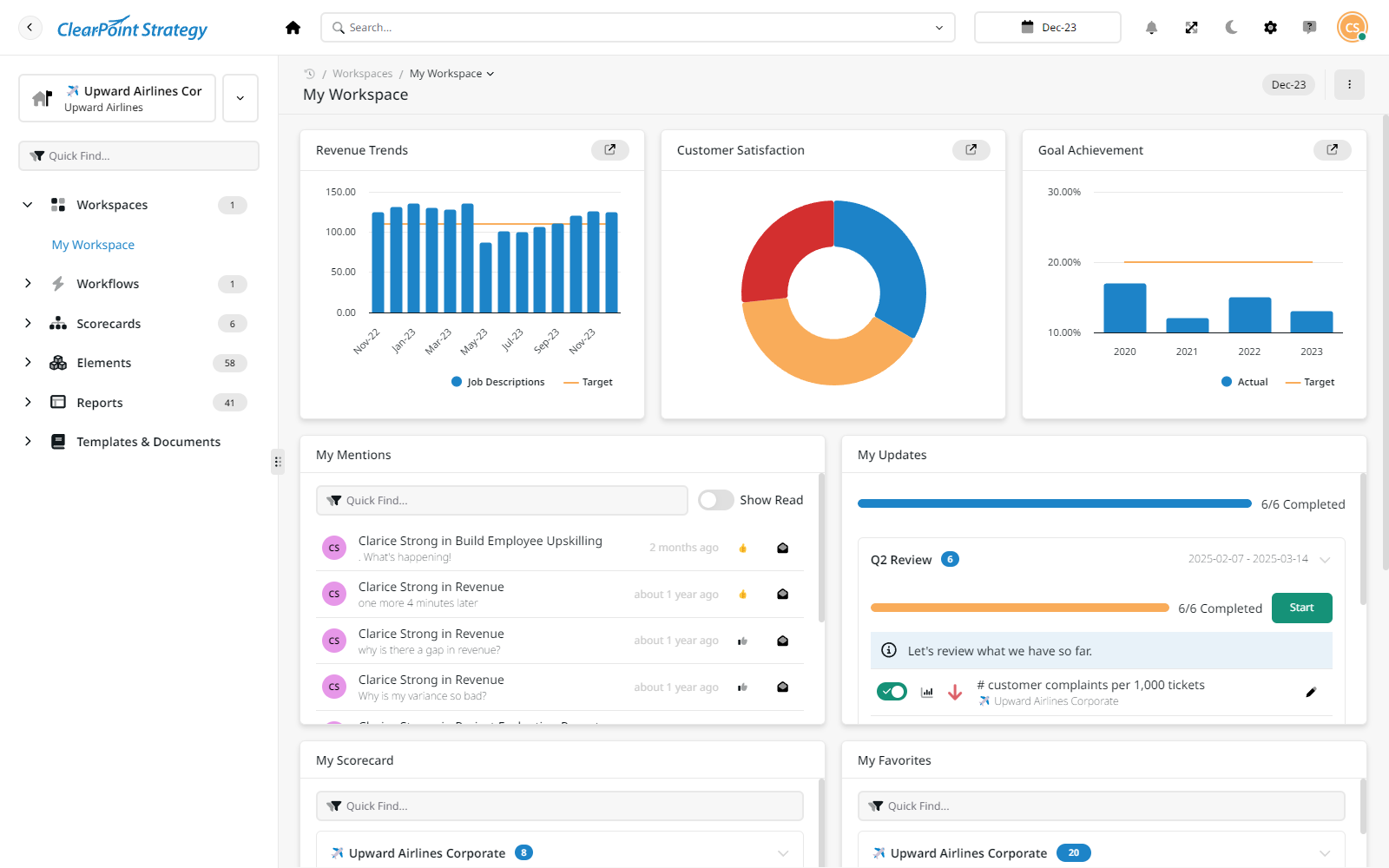
Wire each gap to the metric and the goal it serves. Every gap gets linked to the measure it tracks and the objective it supports. When the measure updates, the goal updates, and the dashboard shows the closing trajectory in real time. You stop running the gap analysis quarterly because the gap is reported daily.
Make ownership visible — and make non-update visible too. The no-owner problem costs real money. ClearPoint shows the last-update date on every measure, sends automated reminders to assigned owners on the cadence you set, and escalates when measures go stale. Make accountability impossible to hide and the 78% gap starts to close.
Run the closing plan as projects, with the same rigor as the goal. Initiatives live alongside the measures they're meant to move — dashboards, Gantt charts, RAG status, dependencies, one view. When an initiative is on track but the measure isn't, the system shows you the gap between the two. That's the diagnostic from Step 3, automated.
Report once, distribute everywhere. Reporting is what kills follow-through. ClearPoint assembles monthly, quarterly, and annual scorecards from the same data — different audiences, one source of truth. San Juan's 89% reduction in reporting time is what happens when the report stops being built by hand.
Book your free 1-on-1 demo with ClearPoint Strategy.
See your gap analysis through
A gap analysis is not a document. It's a question you keep asking until the answer stops surprising you. Most plans don't fail because the gap was too wide. They fail because the goal belonged to no one.
The hard part was never the math. It's making sure someone owns the gap you just found.
Frequently Asked Questions
What is a gap analysis?
A gap analysis compares where you are now to where you planned to be, then diagnoses why the difference exists. It has three parts: the current state (a defended metric), the future state (a target with a date and an assumption), and the gap itself — read not as a number to close but as a signal about what's wrong upstream in the plan, the owner, the metric, or the assumptions.
What goes in a gap analysis template?
Five things: a current-state metric with a date and source; a target with a deadline and the assumption behind it; the gap and which of four types it is (performance, tracking, definition, strategy); a root cause from running the 5 Whys once; and a closing plan with a single owner who controls the inputs, one action, and a check-in date. The template is easy to fill — the discipline is in naming an owner who can actually move the metric.
What are the four types of strategic gap?
Performance, tracking, definition, and strategy. A performance gap means the work isn't producing the result. A tracking gap means the metric isn't being updated because no one is really watching it. A definition gap means the target was set against assumptions that no longer apply. A strategy gap means the projects are delivering but the goal is still wrong. Each looks identical on a chart and needs a different fix.
What is the most common mistake in a gap analysis?
Running it at the project level instead of the goal level. On the ClearPoint platform, projects that get a status are on track 79% of the time, but the goals they serve are on track only 57% of the time — and most goals carry no owner at all (78%). Teams chase project completion and miss the gap between projects-delivering and goal-still-failing.
How often should you run a gap analysis?
Once a quarter as a formal exercise, but the underlying gap should be visible daily. The median strategic project on our platform takes nearly 10 months — long enough that quarterly reviews can lag the work. The teams who close gaps reliably treat the gap analysis as a continuous reading, not an annual event.