What is TLD? - ClouDNS Blog (original) (raw)
The TLD is one of the fundamental things you will have to consider when choosing a domain name once you want to create your website. But what exactly is TLD, and how to choose the best one for you? Don’t worry, and keep reading! In today’s article, we will explain everything! So, let’s start!
Table of Contents
Toggle
- Domain name explained
- What does TLD stand for?
- The Evolution of TLDs
- Types of TLDs
- Who’s accountable for managing TLDs?
- How to choose the right TLD for you?
- Why TLDs Matter?
- The Impact of TLDs on SEO
- Common Mistakes to Avoid When Choosing a TLD
- The Importance of TLD in Branding
- Future Trends in TLDs: What’s on the Horizon?
- Conclusion
Domain name explained
The domain name is a unique identifier that is utilized for accessing websites. Thanks to the Domain Name System (DNS) – a hierarchical naming system that translates domain names into IP addresses, users can connect to websites using domain names. Compared to IP addresses, domain names are very easy to remember for regular users.
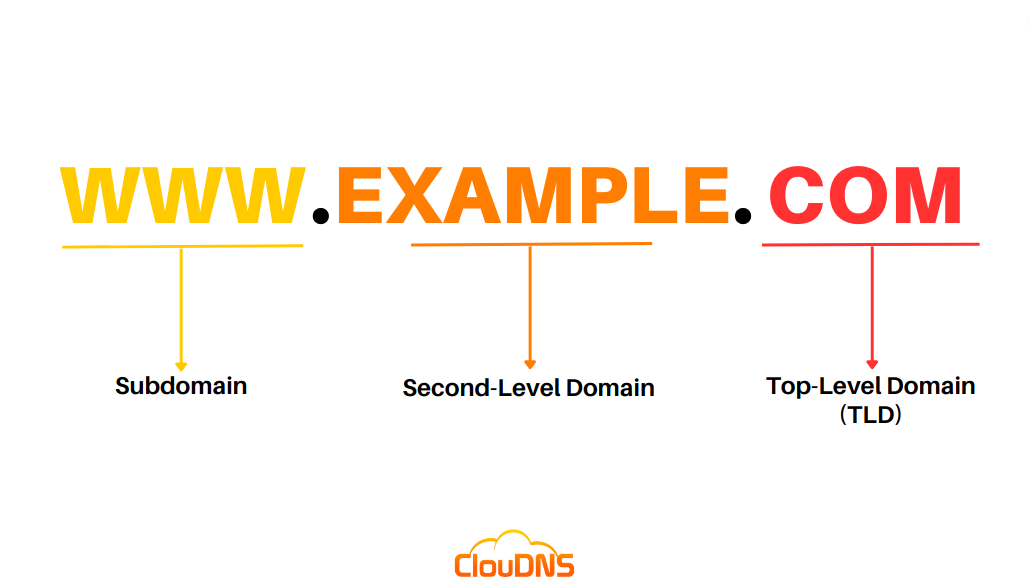
The structure of a domain name, starting from left to right, is the following:
- Subdomain: It is located on the left side of a secondary domain and serves as an extension to the primary domain. A subdomain, such as blog.site.com, represents a separate website section. It should be noted that not every domain has a subdomain.
- Second-Level Domain: It is positioned in the middle of a domain name and is usually the most memorable part of the domain structure. People commonly use their personal or business names.
- Top-Level Domain (TLD): It is the extension at the very end of the domain name, such as .com or .net.
The complete version of a domain name, also known as the Fully Qualified Domain Name (FQDN), also includes the hostname.
Now that you know more about domain names and the position of the TLD (Top-Level Domain), let’s explain a little bit more about what it actually is.
What does TLD stand for?
The short acronym TLD stands for Top-Level Domain and represents the last part of the domain name, located after the last dot. Also known as domain extensions, TLDs can help to recognize some aspects of a website, such as its purpose or geographical area.
In the Domain Name System (DNS) hierarchy, the TLD (Top-Level Domain) defines the first stop after the Root zone. Additionally, it has an extremely vital role in the DNS lookup process (DNS resolution). When a user types a domain name into their browser, like example.net, the Recursive DNS server searches the corresponding IP address by communicating with many servers, including the TLD server. In this case, the TLD is .net, so the Recursive DNS server will contact the TLD server responsible for all domains with the extension .net. Then the search continues until the Recursive DNS server gets the requested IP address from the Authoritative DNS server of example.net.
Experience Industry-Leading DNS Speed with ClouDNS!
Ready for ultra-fast DNS service? Click to register and see the difference!
The Evolution of TLDs
In the early days of the Internet, there were only several TLDs, and securing a .com domain was the ultimate goal for businesses looking to establish an online presence. However, as the Internet expanded, the demand for domain names grew as well. That led to the introduction of a more diverse range of TLDs.
The introduction of new gTLDs (generic top-level domains) has been a game-changer. These gTLDs are more specific and offer a wider collection of choices for domain names. Some popular gTLDs include .app, .blog, .guru, .tech, and .io, to name just a few. These new gTLDs have opened up a world of creative possibilities for domain names and allow businesses and individuals to craft web addresses that are more relevant to their specific niche.
Types of TLDs
There are several main types of TLD (Top-Level Domain).
Generic Top-level Domains (gTLD)
They are the most popular TLDs, and they can serve so many different purposes. Here are some of the most popular generic TLDs:
- .com – At present days, it’s the most widely used TLD. Yet, originally it was used for commercial sites.
- .net – At first, it was utilized by businesses working with networking technology. Currently, all sorts of organizations and companies benefit from it.
- .org – It comes from “organization,” and that is why it is very suitable for many nonprofit associations.
- .tech – A very suitable and preferred choice for tech companies.
- .biz – A great extension of all kinds of businesses.
Choose your Generic or Country TLD from ClouDNS
Country Code Top-level Domains (ccTLD)
The ccTLDs illustrate different countries and geographical areas. They are usually two-letter codes specified by ISO 3166-1 alpha 2. An interesting fact is that there are more than 300 ccTLDs in the IANA’s list. The reason for that is simple ccTLDs can also illustrate sovereign states and dependent territories. Here are several examples of popular ccTLDs:
- .us – United States
- .ca – Canada
- .de – Germany
- .fr – France
- .cn – China
- .es – Spain
Sponsored Top-level Domains (sTLD)
Sponsored Top-Level Domains, according to the name, are proposed and supervised by private organizations. Usually, these entities are businesses, government agencies, and different organized groups.
The Sponsored Top-Level Domains (sTLD) list only contains a short number of alternatives. Back in the day, such types of TLDs were only .edu, .gov, and .mil. Yet, in recent years have been created new Sponsored Top-Level Domains and their number has increased.
Here are some of the most popular sTLDs:
- .gov – for United States governmental agencies
- .edu – for higher educational organizations
- .mil – for usage by the US military
- .museum – for museum institutions
- .travel – for travel industry companies
Infrastructure Top-Level Domain (ARPA)
The Infrastructure Top-Level Domain is a special category that actually includes just one single TLD, which is the Address and Routing Parameter Area (ARPA). In addition, IANA directly manages the domain extension .arpa for the Internet Engineering Task Force (IETF) under the guidance of the Internet Architecture Board (IAB). It is utilized only for technical infrastructure purposes.
Test Top-Level Domains (tTLD)
The Test Top-Level Domains, also known as tTLD, are extensions reserved for local testing and documentation objectives only. Therefore, they can not be established in the global Domain Name System (DNS).
Here are the four tTLDs:
- .test – reserved for testing various scenarios or software
- .localhost – used for testing local networks.
What is Localhost (IP 127.0.0.1)?
- .example – dedicated for placeholders and documentation objectives
- .invalid – displays invalid domain names
Who’s accountable for managing TLDs?
ICANN is responsible for managing the TLDs. The short acronym stands for Internet Corporation for Assigned Names and Numbers, which is actually a non-profit organization. That is possible thanks to a division of ICANN known as IANA (Internet Assigned Numbers Authority).
In addition, ICANN/IANA delegates some of the responsibilities for certain Top-Level Domains to other organizations.
How to choose the right TLD for you?
Choosing a TLD could sometimes be overwhelming. So here are a little bit more details and tips that will help you make your decision more effortlessly.
- Choose a TLD that corresponds to your business characteristics.
- Keep it short. That way, you make it clear and concise, and your visitors don’t get confused when writing your domain name into their browsers.
- Check availability. The combination of your SLD and your chosen TLD could be already taken.
- Target your market. Choose a specific ccTLD, in case you want to focus on a precise county.
- Exact match with your brand. Make sure to register a domain name that is not misspelled. That would confuse your visitors.
- Popular TLDs, like .com, .org, net, and .info, are usually considered more trustworthy by regular users.
- Consider new gTLDs. By selecting a newer TLD, you can distinguish your business from opponents. Additionally, some of them help you create amazing domain names. For example, there are industry TLDs like .film, .press, .digital, and more.
Why TLDs Matter?
When it comes to establishing a web presence, your choice of a Top-Level Domain (TLD) isn’t just a matter of aesthetics. It’s a strategic decision that can significantly impact your online identity.
Top Level Domains play a crucial role in defining the purpose, scope, and geographic relevance of your website. They help your visitors understand the nature of your online presence. For instance, a .com TLD traditionally signifies a commercial website, while .org often indicates a nonprofit organization.
We’ll also discuss how TLDs influence search engine optimization (SEO) and user trust. Understanding the importance of Top Level Domains can help you make an informed choice that aligns with your brand, target audience, and marketing goals.
The Impact of TLDs on SEO
The choice of TLD can impact your website’s search engine optimization (SEO) efforts. While it’s true that Google’s algorithms treat all TLDs equally, user behavior can differ depending on the domain extension. Here’s how your Top Level Domain can influence SEO:
- Credibility and Trust: Traditional TLDs like .com, .org, and .net are often associated with credibility and trust. Users tend to trust websites with these domain extensions more, which can indirectly affect your SEO.
- Keyword Relevance: If you include relevant keywords in your domain name, they can contribute to your SEO efforts. For instance, if you run a plumbing business, a domain like “_www.yourplumbingexperts.com_” can help your website rank higher for plumbing-related keywords.
- Geotargeting: Country code TLDs (ccTLDs) can help your website rank well in local searches. If you’re a local business, using a ccTLD can be beneficial for your SEO in your target region.
- Niche Relevance: Using a domain extension that is relevant to your niche can signal to both users and search engines that your website is focused on a specific topic, potentially improving your rankings for related keywords.
It’s important to mention that while the choice of TLD can have an impact on SEO indirectly, it is just one of many factors. High-quality content, backlinks, website speed, and mobile-friendliness still play more critical roles in your website’s ranking on search engine results pages (SERPs).
Common Mistakes to Avoid When Choosing a TLD
Choosing the right TLD is more than just picking what looks good—it affects trust, SEO, and user experience. Here are common mistakes to avoid:
- Using a TLD that doesn’t match your website’s purpose: For example, .org is traditionally used by nonprofit organizations. Using it for a commercial business might mislead users or appear unprofessional.
- Overlooking your target region: If your audience is mostly local, using a country-specific TLD (like .de for Germany or .ca for Canada) can boost local SEO and build user trust in that area.
- Picking an overly creative or obscure TLD: Extensions like .ninja or .xyz may be fun, but not all users recognize or trust them. This can hurt your credibility or make your domain harder to remember.
- Failing to register other key TLDs: If you only register .net, someone else could take the .com version of your domain. This could confuse your audience or even damage your brand.
Not checking availability or legal conflicts: A domain might be available with your chosen TLD but already trademarked by someone else. Always research thoroughly to avoid future legal or branding issues.
The Importance of TLD in Branding
Top-Level Domains (TLDs) play a crucial role in branding by shaping the first impression of a website and influencing user perception. Traditional TLDs like .com, .org, and .gov are widely recognized and associated with established, reputable organizations. Users often perceive sites with these TLDs as more credible, which can reinforce brand identity. For nonprofits, the .org TLD is often preferred because it signals authenticity and a mission-driven focus, while government and educational institutions use .gov and .edu, respectively, to communicate authority and reliability.
Newer, industry-specific TLDs like .tech, .store, and .design allow businesses to communicate their niche directly through their domain, making them instantly recognizable to targeted audiences. Selecting the right TLD is essential as it communicates brand credibility, relevance, and industry focus, which can enhance customer trust and reinforce the brand message.
Future Trends in TLDs: What’s on the Horizon?
The future of Top-Level Domains (TLDs) points toward increased diversity, personalization, and regional relevance. With thousands of TLD options now available, businesses and individuals are looking beyond traditional options like .com to more unique and memorable TLDs that better reflect their brand identity. We can expect a continued rise in specialized TLDs that cater to niches like .tech, .shop, and .media, enabling brands to create highly specific web addresses that stand out in search results and user memory while also making their purpose immediately clear to users.
Geographic and regional TLDs are also expected to see more growth. TLDs like .nyc, .paris, and .tokyo are gaining popularity as businesses aim to establish local relevance. These TLDs support geotargeting in SEO strategies and appeal to users who seek local services, thus building brand trust and visibility within specific regions.
Another significant trend is the focus on cybersecurity. New TLDs with enhanced security protocols, such as .bank and .insurance, are on the rise, providing users with added assurance. For example, a company offering cheap auto insurance could use a specialized domain extension to clearly communicate affordability and relevance, helping it stand out while building trust with potential customers. This shift reflects a broader trend of using TLDs to express trustworthiness and enhance user confidence in online interactions.
Finally, the rise of new technologies, including blockchain, has introduced decentralized domains. These TLDs operate outside traditional ICANN regulations, allowing users more control over their digital presence without intermediaries. While still experimental, this trend hints at a future where decentralized domains could play a larger role as blockchain technology advances.
TLDs for Domain Flipping: How to Choose the Best Extensions for Profitable Resales
Conclusion
The Top-Level Domain (TLD) is very important and provides details about your business purpose or location. Additionally, it helps you reach the desired market. That is why it is crucial to confuse your audience. There are lots of different types of TLDs. So, make sure to choose one that better suits your needs.
(Visited 5,031 times, 1 visits today)
Enjoy this article? Don't forget to share.
Tags: ARPA, ccTLD, Country Code Top-level Domains, domain name, Generic Top-level Domains, gTLD, Infrastructure Top-Level Domain, Sponsored Top-level Domains, sTLD, Test Top-Level Domains, TLD, Top-Level Domain, tTLD Last modified: May 4, 2026