david szakonyi (original) (raw)
academic research
I am an associate professor of political science and international affairs at George Washington University. My research focuses on corruption, autocracy, bureaucracy and money in politics, with current projects underway on Russia, the Democratic Republic of Congo, Germany, the United Kingdom and the United States. This work has been published in numerous journals, including the American Political Science Review, American Journal of Political Science, Journal of Politics, and American Economic Review.
I am the author of three books, most recently Workplace Politics: How Politicians and Employers Subvert Elections (Oxford University Press, 2025) co-authored with Timothy Frye and Ora John Reuter. Our book offers the first cross-national investigation of how, where, and why employees are mobilized politically at their workplaces around the world.
My newest book manuscript The Technocrats: Competent Loyalists and Authoritarian Rule (currently under review) looks at the growing trend of technocrats working for dictators, with a special focus on Putin-era Russia.
For more information, see my CV as well as lists of my books and published papers.
anti-corruption and policy work

I am co-founder of the Anti-Corruption Data Collective, a new type of nonprofit organization that brings together leading journalists, data analysts, academics and policy advocates to expose transnational corruption flows and push for policy change. Since launching in 2020, our work has been featured in dozens of investigations in media outlets across United Kingdom, France, Italy, Germany, and the United States. We are grateful for funding provided by Luminate, Open Society Foundation, GI-ACE, Stewart R. Mott Foundation, and IJ4EU, among others.

I also serve as the co-Director of PONARS Eurasia, a network of over 140 academics advancing new approaches to research on Russia and Eurasia. We connect scholarship to policy by fostering an academic community, especially of mid-career and rising scholars, committed to developing policy-relevant and collaborative research.
I have appeared on television, radio, podcasts and in print for major international outlets to speak on contemporary events in Russia, its war in Ukraine, money laundering, and corruption. I have also served as an expert witness on a number of legal cases related to the region.
working papers
- UK property markets are thought to be a common destination for corrupt and criminal assets, who often invest through offshore shell companies. Following the Russian invasion of Ukraine in 2022, we study the impact of the introduction of a policy in the UK intended to eliminate the anonymous ownership of property by requiring offshore companies to file their beneficial owners on public register. We find that new purchases by companies based in tax havens fell substantially following government announcements that the policy would be introduced that year, and further declines following the establishment of a register of ownership. While the policy has effectively led the offshore market to slow, between £45–78 billion worth of UK real estate is still owned by companies based in tax havens, some of which have yet to comply with their reporting obligations. We do not find strong evidence of price effects nor substitution into ownership through suspicious domestic companies, although larger movements may manifest as firms respond finalization of the policy in January 2023.
- Despite the private equity industry’s rapidly growing presence in the U.S. economy, we know far more about its influence on corporate governance than its role in shaping public policy. In this paper, we document how private equity's distinctive ownership structure facilitates coordinated political activity among its portfolio companies, revealing a covert channel of influence over policymaking. First, we assemble a novel dataset of U.S. leveraged buyouts from 2000-2018 and match them to federal lobbying records. Applying a doubly robust difference-in-differences estimator, we show that portfolio companies acquired by private equity subsequently increase their federal lobbying. Then using an issue-level dataset, we find that after a buyout, portfolio companies are five times more likely to lobby on the very issues their PE acquirers had themselves lobbied on before. These findings demonstrate that private equity’s success owes not just to financial and operational engineering, but also to a deliberate coordination and optimization of political influence across portfolios.
- Does higher education undermine authoritarian stability? While classic modernization theory posits that education fosters democratization, recent scholarship suggests autocrats can strategically use higher education to achieve ideological control and prolong their rule. We reconcile these perspectives by theorizing that elite and non-elite universities in autocracies produce divergent political outcomes. To test this, we exploit Russia's prestigious Olimpiada competition in Russia, which grants top competitors across 21 subjects automatic admission into the Russian university of their choice. Using a brand new dataset of over 22,000 students combined with a novel behavioral measure of support for Alexey Navalny's Anti-Corruption Foundation, we show that Olimpiada's top performers are significantly more likely to support the opposition than their counterparts. Our findings reveal a paradox: while autocrats invest in higher education to drive economic growth, elite institutions may incubate dissent.
- High value real estate is a popular destination for corrupt and criminal foreign assets, in part caused by limited oversight and lack of transparency in real estate transactions. In response to these concerns, the US Treasury began implementing a series of Geographic Targeting Orders (GTOs) in 2016, forcing corporate buyers making all-cash purchases in targeted counties to report the company’s ultimate owner. To estimate the causal effect of GTOs on these types of transactions, we combine data on on millions of real estate transactions over the period 2014-2019 with a staggered difference-in-differences design. Our analysis suggests the absence of an aggregate effect of the GTOs on corporate all-cash purchases in targeted counties, as well as little evidence of substitution into other types of purchases. We contend that the lack of overt enforcement and validation of the ownership requirements failed to create a sufficient deterrent effect to drive out participation in the sector by illicit actors.
- When can autocrats subvert democracy without paying electoral costs? Although ideological and partisan attachments are weak in many contemporary autocracies, regime supporters often have a strong emotional aversion toward the opposition, who the regime portrays as traitors. Drawing on the literature on affective polarization, we investigate whether regime supporters who hold such attitudes are less likely to punish regime candidates who behave undemocratically using a vignette survey experiment conducted in Russia. We find little evidence that regime supporters are more likely to excuse most types of undemocratic actions by their copartisan candidates. However, those supporters who express antipathy toward the regime’s staunchest opposition—Alexei Navalny and his supporters—are more likely to condone anti-democratic actions that specifically sideline Navalny’s movement. Negative affect toward the opposition may thus help explain how autocrats survive the periodic rise of challengers; yet it does not guarantee that they will avoid backlash for undemocratic actions.
- Corruption is often rampant within state bureaucracies and judicial systems, yet we know little about its micro-level consequences on policymaking and the provision of public goods. In this paper, we investigate how corruption shapes property rights protection in one prominent autocracy: Russia. First, we use income and asset disclosures to construct novel individual-level measures of corruption for 366 commercial court judges working in and around Moscow. Then, drawing on data from more than 400,000 court cases heard between 2011-2018, we leverage random assignment of cases to judges to show that corrupt judges are much more likely to find in favor of private firms in their disputes with government agencies. Not only are these decisions of lower judicial quality, but they tend to favor disreputable firms. In contrast to existing studies' emphasis on political pressure's impact on Russian court cases, we show that judicial corruption enables firms to capture the state, depriving it of financial resources and undermining the rule of law.
recent publications
- How does the opposition govern under autocracy? Most authoritarian regimes tolerate some degree of internal opposition, allowing it to contest and even take power. Yet we know little about how such power-sharing dynamics affect governance. In this paper, I exploit a unique instance where the opposition won control of political institutions in a prominent electoral autocracy: the 2017 Moscow municipal elections. Using a difference-in-differences design, I find that opposition control of municipal councils reduced the financial returns from office for ruling party deputies. This decrease in earnings comes from opposition-held councils removing rent-seeking opportunities by organizing more competitive procurement, reducing unnecessary budget expenditures, and curbing over-the-top compensation. Using a survey experiment, I then show that voters prefer opposition candidates with municipal governing experience over ruling party ones without it. Even in repressive environments, challenging autocratic rule may be well served by joining rather than boycotting institutions.
- Do corrupt officials govern differently in elected office? This article develops a theoretical framework and analyzes new data from financial disclosures to estimate the governing costs of corruption. First, I uncover substantial hidden wealth held by roughly one quarter of the legislators in the Russian Duma; these “kompromat deputies” are vulnerable to damaging information being used against them by the regime. Analyzing their behavior in office, I find that these deputies are less active and more absent members of parliament. When called to vote, kompromat deputies from the opposition also more eagerly support the regime’s political agenda. Finally, kompromat deputies are less likely to win reelection, suggesting that they have shorter time horizons as well as that parties have incentives to rotate them out. Autocrats permit and then monitor corruption in order to co-opt potential challengers, who in turn trade loyalty to the regime in exchange for opportunities to self-enrich.
- Bureaucrats implement policy. How important are they for a state’s productivity? And do the tradeoffs between policies depend on their effectiveness? Using data on 16 million public purchases in Russia, we show that 39 percent of the variation in prices paid for narrowly defined items is due to the individual bureaucrats and organizations who manage procurement. Low-price buyers also display higher spending quality. Theory suggests that such differences in effectiveness can be pivotal for policy design. To illustrate, we show that a common one—bid preferences for domestic suppliers—substantially improves procurement performance, but only when implemented by ineffective bureaucrats.
- Does the passage of anticorruption reforms affect the types of people that want to serve in government? This article evaluates the effects of a common tool to fight corruption—financial disclosures—using data on 25,642 elections in Putin-era Russia. I argue that financial disclosures function like a personal audit, generating information for journalists and prosecutors to investigate illicit gains earned inside and outside of government. Exploiting staggered elections, I find that requiring financial disclosures leads to roughly 25% fewer incumbents seeking reelection and 10% fewer candidates with suspicious financial histories. Greater media freedom and law enforcement capacity further increase the risk of corruption and tax evasion being uncovered, resulting in even fewer candidacies from those criminally exposed. Increasing transparency changes the incentives for serving in elected office, even in settings where other political motives may be at play.
- Incumbents have many tools to tip elections in their favor, yet little is known about how they choose between strategies. By comparing various tactics, this article argues that electoral malpractice centered on manipulating institutions offers the greatest effectiveness while shielding incumbents from public anger and criminal prosecution. To demonstrate this, the study focuses on a widespread institutional tactic: preventing candidates from accessing the ballot. First, in survey experiments, Russian voters respond less negatively to institutional manipulations, such as rejecting candidates, than to blatant fraud, such as ballot box stuffing. Next, using evidence from 25,935 Russian mayoral races, the article shows that lower societal and implementation costs enable incumbents to strategically reject candidacies from credible challengers and then reduce their electoral vulnerability. In all, the technology behind specific manipulations helps determine when and how incumbents violate electoral integrity.
- Does electoral fraud stabilize authoritarian rule or undermine it? The answer to this question rests in part on how voters evaluate regime candidates who engage in fraud. Using a survey experiment conducted after the 2016 elections in Russia, the authors find that voters withdraw their support from ruling party candidates who commit electoral fraud. This effect is especially large among strong supporters of the regime. Core regime supporters are more likely to have ex ante beliefs that elections are free and fair. Revealing that fraud has occurred significantly reduces their propensity to support the regime. The authors’ findings illustrate that fraud is costly for autocrats not just because it may ignite protest, but also because it can undermine the regime’s core base of electoral support. Because many of its strongest supporters expect free and fair elections, the regime has strong incentives to conceal or otherwise limit its use of electoral fraud.
current book project

The Technocrats: Competent Loyalists and Authoritarian Rule
This book uncovers and explains a global trend among modern autocracies: they are getting smarter. As of 2020, one in four cabinet ministers across all authoritarian regimes had both studied at a Western university and finished a graduate degree, a nearly threefold increase over the past fifty years. This trend stands in sharp contrast not only to the popular image of dictators flanked by sycophantic cronies, but also to canonical work which has long held that autocrats favor loyalty over competence. Far from fearing expertise, I argue that modern dictators surround themselves with it, increasingly relying on elite, Western-educated technocrats to help them maintain legitimacy and social stability in a world of rising citizen expectations. The most striking case is Putin-era Russia, where technocrats trained at Western institutions and multinational firms have helped rescue the regime from the shocks of crushing sanctions and a disastrous war.
This reliance, however, comes with risk: the most capable individuals are not only wary of joining corrupt and violent regimes, but they disrupt elite coalitions and pose new threats from within the state. How do authoritarian regimes recruit and entrust technocrats with meaningful authority without jeopardizing regime stability? To investigate this puzzle, I combine an in-depth study of Russia—drawing on brand-new data on over 1,500 top officials under Putin, surveys and elite interviews—with analysis of cross-national data on 103 authoritarian regimes and comparative case studies. The book shows how dictators have developed sophisticated strategies to reward, monitor, and ensure the continued loyalty of the technocrats they require. When given power, technocrats then strengthen and prolong authoritarian rule by helping stabilize economies and modernize the state and its coercive apparatus. By shifting the lens to the individuals who choose to work for dictatorships, I offer a new framework for understanding authoritarian resilience in the 21st century.
Read the [Introduction](./assets/papers/Szakonyi - The Technocrats - Introduction.pdf)!
books
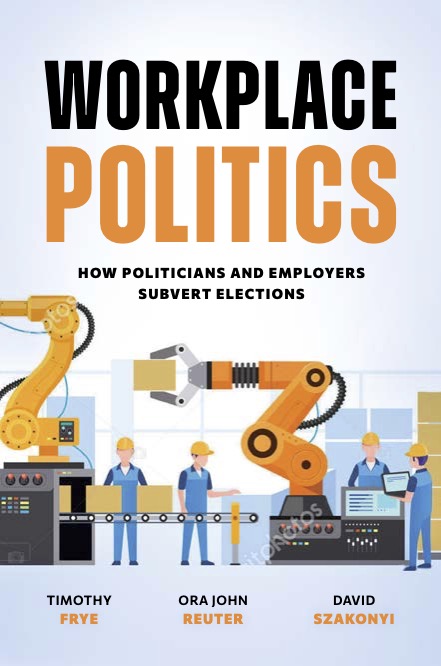
Workplace Politics: How Politicians and Employers Subvert Elections, Oxford University Press, 2025 (with Timothy Frye and Ora John Reuter)
In many countries politicians rely on employers to influence the voting behavior of their employees, but this type of voter mobilization has received very little attention. Workplace Politics draws on unique surveys of firm managers and employees in eight countries, as well as a wealth of fine-grained observational data and qualitative interviews from Russia, to demonstrate that workplace mobilization is common, often coercive, and unpopular with many voters. It argues that when firm managers depend on the state, cannot easily move their assets, or can easily replace workers, politicians can induce employers to get their workers to the polls. In these settings, politicians and employers can use workplace mobilization to diminish voter autonomy, undermine electoral integrity, and skew electoral outcomes in favor of entrenched political groups. But because workplace mobilization is unpopular in the broader electorate, politicians use this strategy less frequently in information-rich settings, where voters are likely to learn about it. This book helps explain why countries whose economies are dominated by state interventions in markets, immobile capital, and slack labor markets may be especially prone to clientelism and autocratic rule and contributes to core debates in comparative politics and political economy.
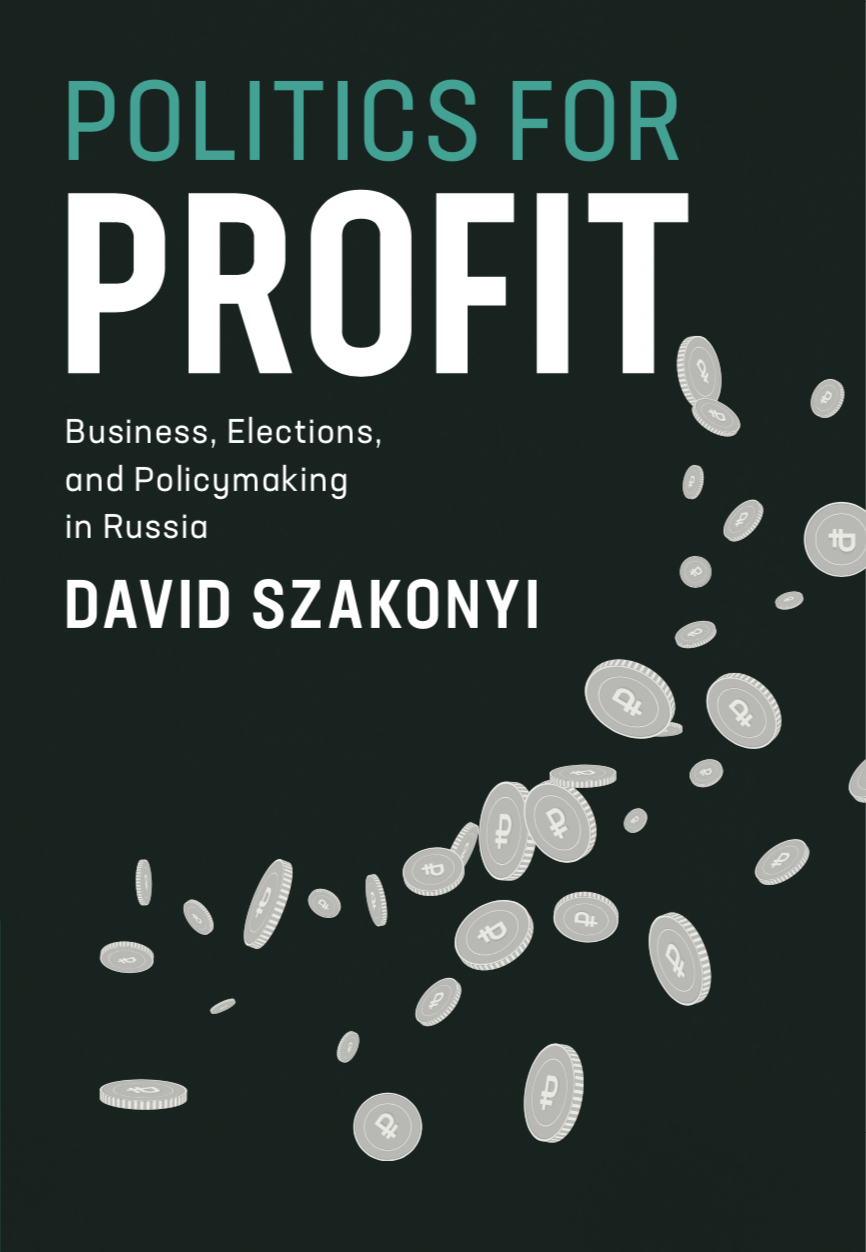
Politics for Profit: Business, Elections, and Policymaking in Russia, Cambridge University Press (Cambridge Studies in Comparative Politics), 2020.
Businesspeople run for and win elected office around the world, with roughly one-third of members of parliament and numerous heads of states coming directly from the private sector. Yet we know little about why these politicians choose to leave the private sector and what they actually do while in government. In Politics for Profit, I bring to bear sweeping quantitative and qualitative evidence from Putin-era Russia to shed light on why businesspeople contest elections and what the consequences are for their firms and for society when they win. The book develops an original theory of businessperson candidacy as a type of corporate political activity undertaken in response to both economic competition and weak political parties. My evidence then shows that businesspeople help their firms reap huge gains in revenue and profitability while prioritizing investments in public infrastructure over human capital. The book finally evaluates policies for combatting political corruption.
Reviewed in Perspectives on Politics, Foreign Affairs, Europe-Asia Studies, Slavic Review, Eurasian Geography and Economics, and Governance.

Under Siege: Inter-Ethnic Relations in Abkhazia. Columbia University Press, 2010 (with Tom Trier and Hedvig Lohm)
Located in the northeastern corner of the Black Sea, Abkhazia was once part of Georgia but broke away from the country after the fall of the Soviet Republic. For fifteen years the region functioned as a de facto independent, though internationally unrecognized, state, until August of 2008, when the short war over South Ossetia (another breakaway territory) ended in Russia's recognition of Abkhazian and South Ossetian sovereignty. Consequently, Abkhazia has become a crucial component of Russia's struggle to redefine its global influence and a major player in its geopolitical battle with the West. Under Siege clarifies Abkhazia's ethno-political dynamics, which have played a major role in the country's state-building efforts and have come to shape the conditions under which the country's many ethnic communities live. Abkhazians, Armenians, Georgians, and Russians all call Abkhazia home, and this volume explores the effect of the government's de facto status on these groups' ideas of nationhood and continuing tensions between Georgia, Abkhazia, and Russia. This book also launches a rare investigation into the conflict brewing among human rights, minority protections, and Abkhazia's state building project.
Reviewed in Slavic Review, Europe-Asia Studies, Bulletin of the School of Oriental and African Studies, and Nationalities Papers.
published papers
money and politics
- [Indecent Disclosures: Anti-Corruption Reforms and Political Selection.](./assets/papers/Szakonyi AJPS 2022.pdf) American Journal of Political Science, 67(3), 503-519. 2023.
Does the passage of anticorruption reforms affect the types of people that want to serve in government? This article evaluates the effects of a common tool to fight corruption—financial disclosures—using data on 25,642 elections in Putin-era Russia. I argue that financial disclosures function like a personal audit, generating information for journalists and prosecutors to investigate illicit gains earned inside and outside of government. Exploiting staggered elections, I find that requiring financial disclosures leads to roughly 25% fewer incumbents seeking reelection and 10% fewer candidates with suspicious financial histories. Greater media freedom and law enforcement capacity further increase the risk of corruption and tax evasion being uncovered, resulting in even fewer candidacies from those criminally exposed. Increasing transparency changes the incentives for serving in elected office, even in settings where other political motives may be at play. - [Private Sector Policymaking: Business Background and Politicians’ Behavior in Office.](./assets/papers/Szakonyi JOP 2021.pdf) Journal of Politics, 83(1), 260-276. 2021.
Candidates often tout their private sector experience when running for public office. But do businessperson politicians actually govern differently? This paper argues that given their preferences and managerial expertise, businesspeople in office adopt policies favorable to the business community and improve government efficiency. To test these claims, I collect data on over 33,000 Russian mayors and legislators and investigate policy outcomes using detailed municipal budgets and over a million procurement contracts. Using a regression discontinuity design, I find that businessperson politicians increase expenditures on roads and transport, while leaving health and education spending untouched. Prioritizing economic over social infrastructure brings immediate benefits to firms, while holding back long-term accumulation of human capital. Businesspeople also do not reduce budget deficits, but rather adopt less competitive methods for selecting contractors, particularly in corruption-ripe construction. In all, businessperson politicians do more to make government run for business, rather than like a business. - [Princelings in the Private Sector: The Value of Nepotism.](./assets/papers/Frye, Reuter, and Szakonyi World Politics 2019.pdf) Quarterly Journal of Political Science, 14(4), 349-381. 2019.
What is the value of a family tie? Nepotism is a common feature of democratic and non-democratic systems, but our understanding of how and why family members of government officials receive preferential treatment is limited. Using administrative data on the universe of Moscow citizens to identify family links, I adopt a difference-in-differences design to estimate the labor market returns of having a relative enter the Russian government from 1999 to 2004. Employment rates and annual wages increase for individuals related to federal bureaucrats. Surprisingly, these relatives just as often find work in the private sector, over which the government has no formal control. To explain this, I demonstrate that companies strategically hire officials’ family members in order to receive state contracts and preferential regulatory treatment. Governments may be willing to overlook this type of favoritism in the allocation of jobs, since even if they do not benefit directly, nepotism creates a class of individuals invested in the current power structure. - [Businesspeople in Elected Office: Identifying Private Benefits from Firm-Level Returns.](./assets/papers/Szakonyi APSR 2018.pdf) American Political Science Review, 112(2), 322-338. 2018.
Do businesspeople who win elected office use their positions to help their firms? Business leaders become politicians around the world, yet we know little about whether their commitment to public service trumps their own private interests. Using an original dataset of 2,703 firms in Russia, I employ a regression discontinuity design to identify the causal effect of firm directors winning seats in subnational legislatures from 2004 to 2013. First, having a connection to a winning politician increases a firm’s revenue by 60% and profitability by 15% over a term in office. I then test between different mechanisms, finding that connected firms improve their performance by gaining access to bureaucrats and not by signaling legitimacy to financiers. The value of winning a seat increases in more politically competitive regions but falls markedly when more businesspeople win office in a convocation. Politically connected firms extract fewer benefits when faced with greater competition from other rent-seekers. autocracy - [Opposition Rule Under Autocracy: Evidence from Russia.](./assets/papers/Szakonyi 2025 - Opposition rule under autocracy.pdf) American Journal of Political Science, 1-19. 2025.
How does the opposition govern under autocracy? Most authoritarian regimes tolerate some degree of internal opposition, allowing it to contest and even take power. Yet we know little about how such power-sharing dynamics affect governance. In this paper, I exploit a unique instance where the opposition won control of political institutions in a prominent electoral autocracy: the 2017 Moscow municipal elections. Using a difference-in-differences design, I find that opposition control of municipal councils reduced the financial returns from office for ruling party deputies. This decrease in earnings comes from opposition-held councils removing rent-seeking opportunities by organizing more competitive procurement, reducing unnecessary budget expenditures, and curbing over-the-top compensation. Using a survey experiment, I then show that voters prefer opposition candidates with municipal governing experience over ruling party ones without it. Even in repressive environments, challenging autocratic rule may be well served by joining rather than boycotting institutions. - Corruption and Co-Optation in Autocracy: Evidence from Russia. American Political Science Review, 119(1), 402-419. 2025.
Do corrupt officials govern differently in elected office? This article develops a theoretical framework and analyzes new data from financial disclosures to estimate the governing costs of corruption. First, I uncover substantial hidden wealth held by roughly one quarter of the legislators in the Russian Duma; these “kompromat deputies” are vulnerable to damaging information being used against them by the regime. Analyzing their behavior in office, I find that these deputies are less active and more absent members of parliament. When called to vote, kompromat deputies from the opposition also more eagerly support the regime’s political agenda. Finally, kompromat deputies are less likely to win reelection, suggesting that they have shorter time horizons as well as that parties have incentives to rotate them out. Autocrats permit and then monitor corruption in order to co-opt potential challengers, who in turn trade loyalty to the regime in exchange for opportunities to self-enrich. - [Candidate Filtering: The Strategic Use of Electoral Manipulations in Russia.](./assets/papers/Szakonyi BJPS 2022.pdf) British Journal of Political Science, 52(2), 649-670. 2022.
Incumbents have many tools to tip elections in their favor, yet little is known about how they choose between strategies. By comparing various tactics, this article argues that electoral malpractice centered on manipulating institutions offers the greatest effectiveness while shielding incumbents from public anger and criminal prosecution. To demonstrate this, the study focuses on a widespread institutional tactic: preventing candidates from accessing the ballot. First, in survey experiments, Russian voters respond less negatively to institutional manipulations, such as rejecting candidates, than to blatant fraud, such as ballot box stuffing. Next, using evidence from 25,935 Russian mayoral races, the article shows that lower societal and implementation costs enable incumbents to strategically reject candidacies from credible challengers and then reduce their electoral vulnerability. In all, the technology behind specific manipulations helps determine when and how incumbents violate electoral integrity. - [Electoral Manipulation and Regime Support: Survey Evidence from Russia.](./assets/papers/Reuter and Szakonyi World Politics 2022.pdf) World Politics, 73(2), 275-314. 2021. (with Ora John Reuter)
Does electoral fraud stabilize authoritarian rule or undermine it? The answer to this question rests in part on how voters evaluate regime candidates who engage in fraud. Using a survey experiment conducted after the 2016 elections in Russia, the authors find that voters withdraw their support from ruling party candidates who commit electoral fraud. This effect is especially large among strong supporters of the regime. Core regime supporters are more likely to have ex ante beliefs that elections are free and fair. Revealing that fraud has occurred significantly reduces their propensity to support the regime. The authors’ findings illustrate that fraud is costly for autocrats not just because it may ignite protest, but also because it can undermine the regime’s core base of electoral support. Because many of its strongest supporters expect free and fair elections, the regime has strong incentives to conceal or otherwise limit its use of electoral fraud. - [Elite Defection under Autocracy: Evidence from Russia.](./assets/papers/Reuter and Szakonyi APSR 2019.pdf) American Political Science Review, 113(2), 552-568. 2019. (with Ora John Reuter)
Elite cohesion is a fundamental pillar of authoritarian stability. High-level defections can signal weakness, embolden the opposition, and sometimes, lead to regime collapse. Using a dataset of 4,291 ruling party candidates in Russia, this paper develops and tests hypotheses about the integrity of elite coalitions under autocracy. Our theory predicts that ruling elites defect when there is greater uncertainty about the regime’s willingness to provide spoils. Regimes that share power with the opposition, limit access to spoils, and lack formal institutions see more defections. Co-opting the opposition assuages outside threats but leaves regime insiders disgruntled and prone to defection. Those with personal followings and business connections are the most likely to defect, since they can pursue their political goals independently of the regime. Taken together, our results highlight important tradeoffs among authoritarian survival strategies. Many of the steps autocrats take to repel challenges simultaneously heighten the risk of defections. - [Online Social Media and Political Awareness in Competitive Authoritarian Regimes.](./assets/papers/Reuter and Szakonyi BJPS 2015.pdf) British Journal of Political Science, 45(1), 29-51. 2015. (with Ora John Reuter)
Do online social media undermine authoritarianism? The conditions under which online social networks can increase public awareness of electoral fraud in non-democracies are examined in this article and it is argued that a given online social network will only increase political awareness if it is first politicized by elites. Survey data from the 2011 Russian parliamentary elections show that usage of Twitter and Facebook, which were politicized by opposition elites, significantly increased respondents’ perceptions of electoral fraud, while usage of Russia’s domestic social networking platforms, VKontakte and Odnoklassniki, which were not politicized by opposition activists, had no effect on perceptions of fraud. This study elucidates the causes of post-election protest by uncovering a mechanism through which knowledge of electoral fraud spreads. bureaucracy - Individuals and Organizations as Sources of State Effectiveness, and Consequences for Policy Design. American Economic Review, 113(8), 2121-67. 2023. (with Michael Best and Jonas Hjort)
Bureaucrats implement policy. How important are they for a state’s productivity? And do the tradeoffs between policies depend on their effectiveness? Using data on 16 million public purchases in Russia, we show that 39 percent of the variation in prices paid for narrowly defined items is due to the individual bureaucrats and organizations who manage procurement. Low-price buyers also display higher spending quality. Theory suggests that such differences in effectiveness can be pivotal for policy design. To illustrate, we show that a common one—bid preferences for domestic suppliers—substantially improves procurement performance, but only when implemented by ineffective bureaucrats. - [Who Benefits From Economic Reform? Firms and Distributive Politics.](./assets/papers/Szakonyi and Urpelainen JOP 2014.pdf) Journal of Politics, 76(3), 841-858. 2014. (with Johannes Urpelainen)
While the distributional consequences of economic reform have captivated political scientists, few studies have investigated the ability of different firms to reap gains from policy change. Reforms indeed create winners and losers, but there is scant evidence on specifically which firms benefit and which firms lose out. We propose that the benefits from liberalizing reform accrue mostly to firms that are not vulnerable to extortion by the state and that have past experience with lobbying through a business association. This theory goes against the common intuition that liberalization reduces the importance of the state in the distribution of gains from economic activity. To test the theory, we examine how India’s national electricity reform in 2003 changed the quality of power supply for 1,094 manufacturing firms between 2002 and 2005. We find that liberalization produced highly skewed benefits and identify the politically salient characteristics that drive firm-level distributional inequality. - [Veto Players and the Value of Political Control: A Theory with Evidence From Energy Privatization.](./assets/papers/Szakonyi and Urpelainen CPS 2014.pdf) Comparative Political Studies, 47(10), 1384-1415. 2014. (with Johannes Urpelainen)
We examine how veto players and the government’s valuation of political control of economic activity affect the likelihood of privatization. When the government ascribes a high value to political control, veto players impede privatization because they would have to be compensated for their losses. When the value of political control is low, the government prefers to privatize enterprises that become difficult to control with multiple veto players. We test the theory against data on energy privatizations in developing countries, 1988-2008. Oil prices offer a quantitative measure of the government’s valuation of controlling the energy sector. When oil prices are high, the government has a keen interest in controlling the energy sector. Accordingly, additional veto players reduce (increase) the likelihood of privatization in times of high (low) oil prices. Beyond illuminating the politics of privatization, the results inform debates on the role of veto players in government policy. clientelism - [Vote Brokers, Clientelist Appeals, and Voter Turnout: Evidence from Russia and Venezuela.](./assets/papers/Frye, Reuter, and Szakonyi World Politics 2019.pdf) World Politics, 71(4), 710-746. 2019. (with Timothy Frye and Ora John Reuter)
Modern clientelist exchange is typically carried out by intermediaries—party activists, employers, local strongmen, traditional leaders, and the like. Politicians use such brokers to mobilize voters, yet little about their relative effectiveness is known. The authors argue that broker effectiveness depends on their leverage over clients and their ability to monitor voters. They apply their theoretical framework to compare two of the most common brokers worldwide, party activists and employers, arguing the latter enjoy numerous advantages along both dimensions. Using survey-based framing experiments in Venezuela and Russia, the authors find voters respond more strongly to turnout appeals from employers than from party activists. To demonstrate mechanisms, the article shows that vulnerability to job loss and embeddedness in workplace social networks make voters more responsive to clientelist mobilization by their bosses. The results shed light on the conditions most conducive to effective clientelism and highlight broker type as important for understanding why clientelism is prevalent in some countries but not others. - [Hitting Them with Carrots: Voter Intimidation and Vote Buying In Russia.](./assets/papers/Frye, Reuter, and Szakonyi BJPS 2018.pdf) British Journal of Political Science, 49(3), 857-861. 2019. (with Timothy Frye and Ora John Reuter)
Scholars have identified many ways that politicians use carrots, such as vote buying, to mobilize voters, but have paid far less attention to how they use sticks, such as voter intimidation. This article develops a simple argument which suggests that voter intimidation should be especially likely where vote buying is expensive and employers have greater leverage over employees. Using survey experiments and crowdsourced electoral violation reports from the 2011–12 election cycle in Russia, the study finds evidence consistent with these claims. Moreover, it finds that where employers have less leverage over employees, active forms of monitoring may supplement intimidation in order to encourage compliance. These results suggest that employers can be reliable vote brokers; that voter intimidation can persist in a middleincome country; and that, under some conditions, intimidation may be employed without the need for active monitoring. - [Political Machines at Work: Voter Mobilization and Electoral Subversion in the Workplace.](./assets/papers/Frye, Reuter, and Szakonyi World Politics 2014.pdf) World Politics, 66(2), 195-228. 2014. (with Timothy Frye and Ora John Reuter)
The authors explore how modern autocrats win elections by inducing employers to mobilize their employees to vote for the regime and thereby subvert the electoral process. Using two original surveys of employers and workers conducted around the 2011 parliamentary elections in Russia, they find that just under one-quarter of employers engaged in some form of political mobilization. They then develop a simple framework for identifying which firms engage in voter mobilization and which workers are targeted for mobilization. Firms that are vulnerable to state pressure—financially dependent firms and those in sectors characterized by asset immobility—are among the most common sites of workplace-based electoral subversion. The authors also find that workers who are especially dependent on their employer are more likely to be targeted for mobilization. By identifying the conditions under which workplace mobilization occurs in authoritarian regimes, the authors contribute to the long-standing debate about the economic bases of democratization. In addition, they explore an understudied means of subverting elections in contemporary autocracies: the use of economic coercion to mobilize voters. Moreover, their research finds that clientelist exchange can thrive in industrial settings and in the absence of deeply embedded political parties.
teaching
I have taught the following classes at George Washington University and other institutions.
- Money and Influence in Politics Around the World
- Russian Politics
- Russian Underground Economy
- Russian Financial System and Cryptocurrency
- Corruption and Kleptocracy
- Advanced Theories of Comparative Politics
- Craft of Political Inquiry