Bladder cancer course, four genetic high-risk variants, and histopathological findings (original) (raw)
Authors
- Thura Kadhum Leibniz Research Centre for Working Environment and Human Factors at TU Dortmund (IfADo), Dortmund, Germany; Specialist Clinic for Psychosomatic Rehabilitation, Mittelrhein-Klinik, Boppard - Bad Salzig, Germany https://orcid.org/0000-0002-5756-1162
- Silvia Selinski Leibniz Research Centre for Working Environment and Human Factors at TU Dortmund (IfADo), Dortmund, Germany https://orcid.org/0000-0002-8876-5774
- Meinolf Blaszkewicz Leibniz Research Centre for Working Environment and Human Factors at TU Dortmund (IfADo), Dortmund, Germany
- Jörg Reinders Leibniz Research Centre for Working Environment and Human Factors at TU Dortmund (IfADo), Dortmund, Germany https://orcid.org/0000-0003-1025-7849
- Emanuel Roth Department of Urology, Evangelic Hospital, Paul-Gerhardt Foundation, Lutherstadt Wittenberg, Germany https://orcid.org/0009-0002-3721-9009
- Frank Volkert Department of Urology, Evangelic Hospital, Paul-Gerhardt Foundation, Lutherstadt Wittenberg, Germany https://orcid.org/0009-0003-3379-4433
- Daniel Ovsiannikov St.-Josefs-Hospital Dortmund-Hoerde, Dortmund, Germany https://orcid.org/0000-0001-9015-3497
- Oliver Moormann St.-Josefs-Hospital Dortmund-Hoerde, Dortmund, Germany https://orcid.org/0000-0001-7342-4865
- Holger Gerullis Rheinland Klinikum Lukaskrankenhaus Neuss, Neuss, Germany https://orcid.org/0000-0003-4160-8074
- Dimitri Barski Rheinland Klinikum Lukaskrankenhaus Neuss, Neuss, Germany https://orcid.org/0000-0001-8611-8250
- Thomas Otto Rheinland Klinikum Lukaskrankenhaus Neuss, Neuss, Germany; Tel: +49 (0)2131 888-2401, E-Mail: thomas.otto@rheinlandklinikum.de https://orcid.org/0000-0002-1925-0822
- Svetlana Höhne Leibniz Research Centre for Working Environment and Human Factors at TU Dortmund (IfADo), Dortmund, Germany https://orcid.org/0009-0005-2612-492X
- Jan G. Hengstler Leibniz Research Centre for Working Environment and Human Factors at TU Dortmund (IfADo), Dortmund, Germany https://orcid.org/0000-0002-1427-5246
- Klaus Golka Leibniz Research Centre for Working Environment and Human Factors at TU Dortmund (IfADo), Dortmund, Germany https://orcid.org/0000-0003-0954-3805
DOI:
https://doi.org/10.17179/excli2023-5862
Keywords:
muscle invasive bladder cancer (MIBC), non-muscle invasive bladder cancer (NMIBC), PSCA gene rs2294008 and rs2978974, FGFR3-TACC3 gene region rs798766, CBX6-APOBEC3A gene region rs1014971
Abstract
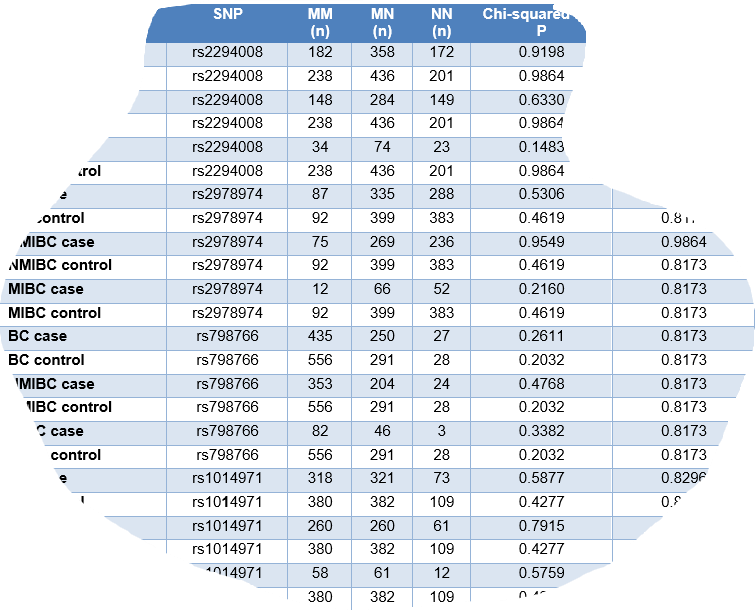
Urinary bladder cancer, a smoking and occupation related disease, was subject of several genome-wide association studies (GWAS). However, studies on the course of the disease based on GWAS findings differentiating between muscle invasive bladder cancer (MIBC) and non-muscle invasive bladder cancer (NMIBC) are rare. Thus we investigated 4 single nucleotide polymorphisms (SNPs) detected in GWAS, related to the genes coding for TACC3 (transforming, acidic coiled-coil containing protein 3), for FGFR3 (fibroblast growth factor receptor 3), for PSCA (prostate stem cell antigen) and the genes coding for CBX6 (chromobox homolog 6) and APOBEC3A (apolipoprotein B mRNA editing enzyme, catalytic polypeptide-like 3A). This study is based on 712 bladder cancer patients and 875 controls from 3 different case control studies in Germany. The 4 SNPs of interest (PSCA rs2294008 and rs2978974, FGFR3-TACC3 rs798766, and CBX6-APOBEC3A rs1014971) were determined by real-time polymerase chain reaction. The distribution of the 4 SNPs does not vary significantly between cases and controls in the entire study group and in the 3 local subgroups, including two former highly industrialized areas and a region without such history. Also, no significant differences in the bladder cancer subgroups of MIBC and NMIBC were observed. The 4 investigated SNPs do not noticeably contribute differently to the bladder cancer risk for the bladder cancer subgroups of MIBC and NMIBC.
How to Cite
Kadhum, T., Selinski, S., Blaszkewicz, M., Reinders, J., Roth, E., Volkert, F., … Golka, K. (2023). Bladder cancer course, four genetic high-risk variants, and histopathological findings. EXCLI Journal, 22, 867–879. https://doi.org/10.17179/excli2023-5862
License
Copyright (c) 2023 Thura Kadhum, Silvia Selinski, Meinolf Blaszkewicz, Jörg Reinders, Emanuel Roth, Frank Volkert, Daniel Ovsiannikov, Oliver Moormann, Holger Gerullis, Dimitri Barski, Thomas Otto, Svetlana Höhne, Jan G. Hengstler, Klaus Golka

This work is licensed under a Creative Commons Attribution 4.0 International License.
Authors who publish in this journal agree to the following terms:
- The authors keep the copyright and grant the journal the right of first publication under the terms of the Creative Commons Attribution license, CC BY 4.0. This licencse permits unrestricted use, distribution and reproduction in any medium, provided that the original work is properly cited.
- The use of general descriptive names, trade names, trademarks, and so forth in this publication, even if not specifically identified, does not imply that these names are not protected by the relevant laws and regulations.
- Because the advice and information in this journal are believed to be true and accurate at the time of publication, neither the authors, the editors, nor the publisher accept any legal responsibility for any errors or omissions presented in the publication. The publisher makes no guarantee, express or implied, with respect to the material contained herein.
- The authors can enter into additional contracts for the non-exclusive distribution of the journal's published version by citing the initial publication in this journal (e.g. publishing in an institutional repository or in a book).