A facile method to generate cerebral organoids from human pluripotent stem cells (original) (raw)
Authors
- Susan Simorgh Department of Developmental Biology, School of Basic Sciences and Advanced Technologies in Biology, University of Science and Culture, Tehran, Iran; Department of Stem Cells and Developmental Biology, Cell Science Research Center, Royan Institute for Stem Cell Biology and Technology, ACECR, Tehran, Iran; Stem Cell Institute, Department of Development and Regeneration, KU Leuven, Leuven 3000, Belgium https://orcid.org/0000-0002-9347-4728
- Seyed Ahmad Mousavi Department of Stem Cells and Developmental Biology, Cell Science Research Center, Royan Institute for Stem Cell Biology and Technology, ACECR, Tehran, Iran https://orcid.org/0000-0003-3845-3286
- San Kit To Department of Development and Regeneration, Lab for Epigenetic Reprogramming, Leuven Stem Cell Institute, Leuven Single-Cell Omics Institute and Leuven Cancer Institute, KU Leuven-University of Leuven, Leuven 3000, Belgium https://orcid.org/0000-0002-3057-2902
- Vincent Pasque Department of Development and Regeneration, Lab for Epigenetic Reprogramming, Leuven Stem Cell Institute, Leuven Single-Cell Omics Institute and Leuven Cancer Institute, KU Leuven-University of Leuven, Leuven 3000, Belgium https://orcid.org/0000-0002-5129-0146
- Keimpe Wierda VIB-KU Leuven Center for Brain & Disease Research, Leuven 3000, Belgium; Electrophysiology Unit, Leuven 3000, Belgium https://orcid.org/0000-0002-8784-9490
- Tim Vervliet Laboratory of Molecular and Cellular Signaling, Department of Cellular and Molecular Medicine, KU Leuven, Leuven 3000, Belgium https://orcid.org/0000-0002-4030-5875
- Meghdad Yeganeh Department of Stem Cells and Developmental Biology, Cell Science Research Center, Royan Institute for Stem Cell Biology and Technology, ACECR, Tehran, Iran https://orcid.org/0009-0005-4738-7761
- Paria Pooyan Department of Stem Cells and Developmental Biology, Cell Science Research Center, Royan Institute for Stem Cell Biology and Technology, ACECR, Tehran, Iran https://orcid.org/0000-0002-1945-1480
- Yoke Chin Chai Stem Cell Institute, Department of Development and Regeneration, KU Leuven, Leuven 3000, Belgium; E-mail: yokechin.chai@kuleuven.be https://orcid.org/0000-0001-9913-257X
- Catherine Verfaillie Stem Cell Institute, Department of Development and Regeneration, KU Leuven, Leuven 3000, Belgium; E-mail: catherine.verfaillie@kuleuven.be https://orcid.org/0000-0001-7564-4079
- Hossein Baharvand Department of Stem Cells and Developmental Biology, Cell Science Research Center, Royan Institute for Stem Cell Biology and Technology, ACECR, Tehran, Iran; E-mail: h.baharvand@royan-rc.ac.ir https://orcid.org/0000-0001-6528-3687
DOI:
https://doi.org/10.17179/excli2023-6299
Keywords:
cerebral organoids, human pluripotent stem cell, hanging drop, neural induction protocol, single nuclei RNA-sequencing analysis
Abstract
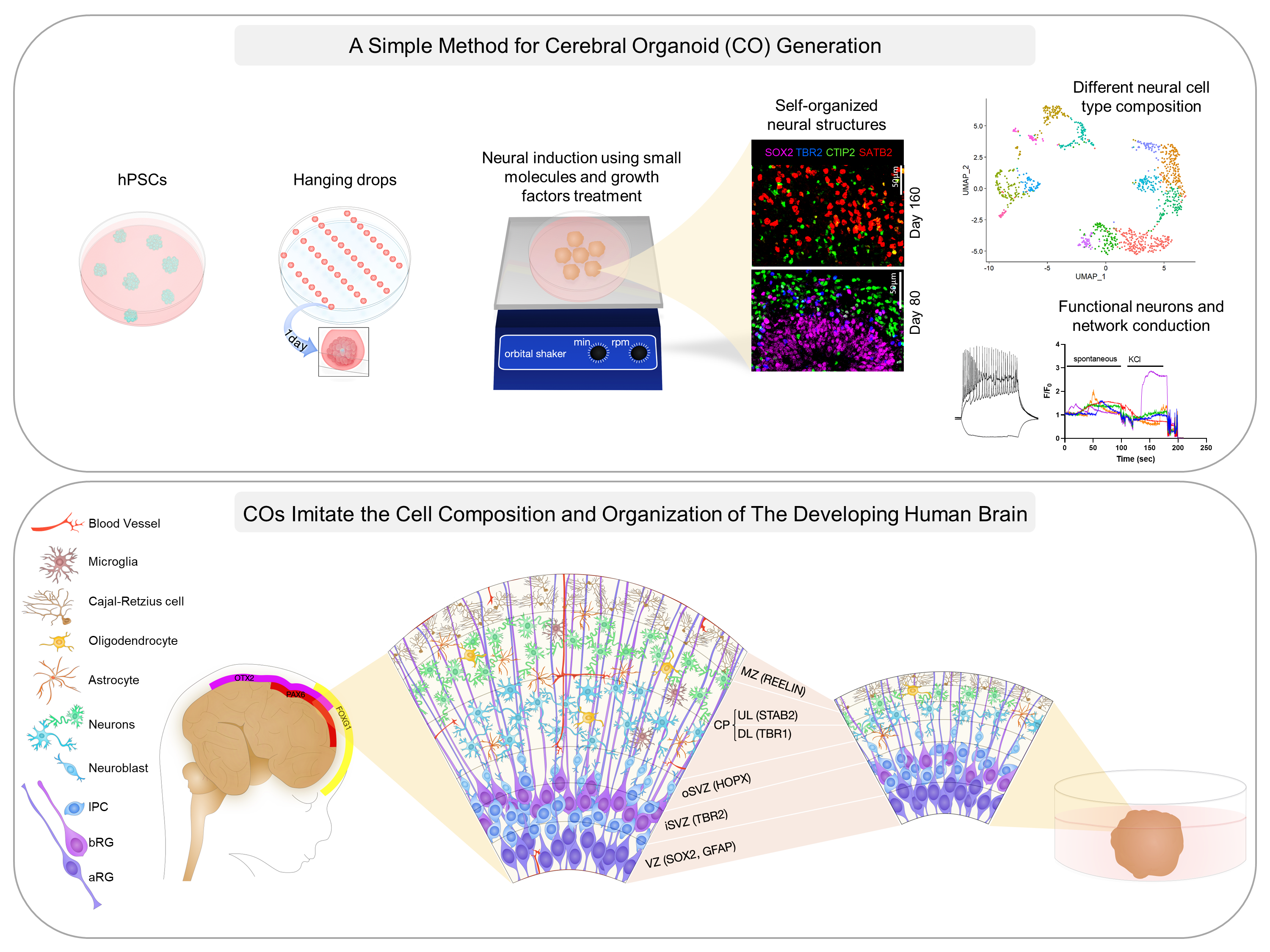
Human cerebral organoids (COs) are self-organizing three-dimensional (3D) neural structures that provide a human-specific platform to study the cellular and molecular processes that underlie different neurological events. The first step of CO generation from human pluripotent stem cells (hPSCs) is neural induction, which is an in vitro simulation of neural ectoderm development. Several signaling pathways cooperate during neural ectoderm development and in vitro differentiation of hPSCs toward neural cell lineages is also affected by them. In this study, we considered some of the known sources of these variable signaling cues arising from cell culture media components and sought to modulate their effects by applying a comprehensive combination of small molecules and growth factors for CO generation. Histological analysis demonstrated that these COs recapitulate the neural progenitor zone and early cortical layer organization, containing different types of neuronal and glial cells which was in accordance with single-nucleus transcriptome profiling results. Moreover, patch clamp and intracellular Ca2+ dynamic studies demonstrated that the COs behave as a functional neural network. Thus, this method serves as a facile protocol for generating hPSC-derived COs that faithfully mimic the features of their in vivo counterparts in the developing human brain.
How to Cite
Simorgh, S., Mousavi, S. A., To, S. K., Pasque, V., Wierda, K., Vervliet, T., … Baharvand, H. (2023). A facile method to generate cerebral organoids from human pluripotent stem cells. EXCLI Journal, 22, 1055–1076. https://doi.org/10.17179/excli2023-6299
License
Copyright (c) 2023 Susan Simorgh, Seyed Ahmad Mousavi, San Kit To, Vincent Pasque, Keimpe Wierda, Tim Vervliet, Meghdad Yeganeh, Paria Pooyan, Yoke Chin Chai, Catherine Verfaillie, Hossein Baharvand

This work is licensed under a Creative Commons Attribution 4.0 International License.
Authors who publish in this journal agree to the following terms:
- The authors keep the copyright and grant the journal the right of first publication under the terms of the Creative Commons Attribution license, CC BY 4.0. This licencse permits unrestricted use, distribution and reproduction in any medium, provided that the original work is properly cited.
- The use of general descriptive names, trade names, trademarks, and so forth in this publication, even if not specifically identified, does not imply that these names are not protected by the relevant laws and regulations.
- Because the advice and information in this journal are believed to be true and accurate at the time of publication, neither the authors, the editors, nor the publisher accept any legal responsibility for any errors or omissions presented in the publication. The publisher makes no guarantee, express or implied, with respect to the material contained herein.
- The authors can enter into additional contracts for the non-exclusive distribution of the journal's published version by citing the initial publication in this journal (e.g. publishing in an institutional repository or in a book).