Bank Reconciliation Statement (BRS) (original) (raw)
Last Updated : 20 Apr, 2026
A Bank Reconciliation Statement (BRS) is a statement prepared on a particular date to match the balance shown in the bank column of the Cash Book with the balance shown in the Pass Book (bank statement). It lists all the reasons for differences between the two balances and helps in finding the correct bank balance. In business, many daily transactions involve receiving and paying money, and most businesses prefer to use bank accounts instead of dealing in cash. Differences may arise because of cheques not yet cleared, bank charges, direct deposits, or errors. To identify and adjust these differences, a BRS is prepared. Businesses generally use Fixed Deposit, Savings, or Current Accounts, and a Current Account is most suitable for business as it allows more transactions and higher limits.
Pass Book
A Pass Book is provided by the bank when a new account is opened to have a record of all the transactions related to the bank. The Pass Book is maintained by the bank. On the other hand, to have a check on all the transactions related to the bank, the businessman maintains a Cash Book.
Reasons of difference
- **Cheques Issued but Not Presented – Cheques issued by the business may not be presented to the bank for payment immediately.
- **Cheques Deposited but Not Cleared – Cheques deposited into the bank may take time to clear.
- **Bank Charges – Charges deducted by the bank may not be recorded in the Cash Book immediately.
- **Interest Credited by Bank – Interest added by the bank may not be recorded in the Cash Book.
- **Direct Deposits by Customers – Customers may deposit money directly into the bank account without informing the business.
- **Standing Instructions – Payments made by the bank as per instructions (e.g., insurance, rent) may not be recorded in the Cash Book.
- **Dishonour of Cheques – Cheques returned unpaid by the bank may not be recorded immediately.
- **Errors – Mistakes in recording transactions in either book can cause differences.
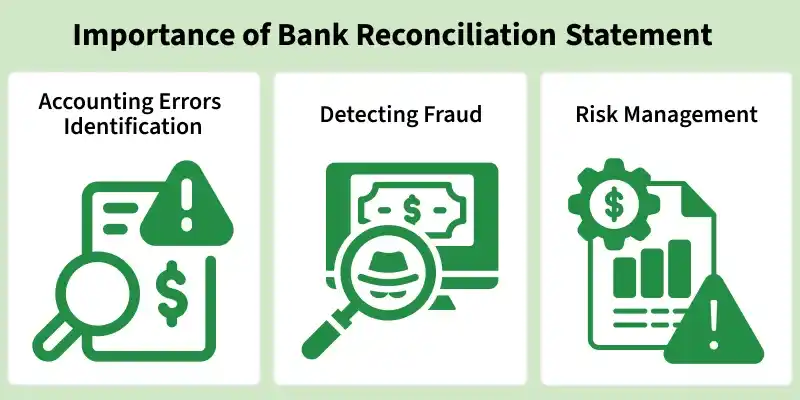
Need for Reconciliation:
**1. Detection of Errors: Reconciliation of Cash Book and Pass Book helps in detecting any error. An error can be either made by the bank in the Pass Book or by the businessman in the Cash Book. When both the books are compared, then an error if any, can be easily found.
**2. Detection of Cause of Error: Bank Reconciliation Statement not only helps in detecting the errors but also helps in detecting the cause of that error. When both the books are compared, then the cause can easily be found due to which wrong entry the balances are not tallying.
**3. Correction in Cash Book: With the help of Bank Reconciliation Statement, corrections can be made in the Cash Book by comparing it with the Pass Book. Cash Book can only be corrected when the error and its cause is identified.
**4. Knowledge of Bank Balance: Sometimes Cash Book shows less balance, but in reality, bank account has not been debited yet. When the actual bank balance is known to the business, it helps the business in making future transactions in a better way.
**5. Control over Misappropriation: Misappropriation of funds by the personnel of the bank as well as the employees of the company can be avoided if reconciliation is done at regular intervals. Reconciliation helps in determining the actual position of the balance company as any misappropriated figure can be detected easily.
Methods of Preparing BRS
Bank Reconciliation Statement can be prepared in two ways:
- Starting with balance as per Cash Book
- Starting with balance as per Pass Book
Adjustments are made by adding or subtracting the items causing differences to arrive at the correct balance.
Format of BRS
**1. When Starting with Balance as per Cash Book
**Bank Reconciliation Statement
As on ___________
| Particulars | Amount (₹) | Amount (₹) |
|---|---|---|
| Balance as per Pass Book | XXXX | |
| Add: Cheques deposited but not cleared | XXXX | |
| Add: Bank charges not recorded | XXXX | |
| XXXX | ||
| Less: Cheques issued but not presented | XXXX | |
| Less: Interest credited by bank | XXXX | |
| XXXX | ||
| Balance as per Cash Book | XXXX |
- When Starting with Balance as per Pass Book
**Bank Reconciliation Statement
As on ___________
| Particulars | Amount (₹) | Amount (₹) |
|---|---|---|
| Balance as per Pass Book | XXXX | |
| Add: Cheques deposited but not cleared | XXXX | |
| Add: Bank charges not recorded | XXXX | |
| XXXX | ||
| Less: Cheques issued but not presented | XXXX | |
| Less: Interest credited by bank | XXXX | |
| XXXX | ||
| Balance as per Cash Book | XXXX |
**Illustration with numerical:
1. On 31st March 2025, the balance as per Cash Book is ₹25,000 (Dr.).
- Cheques issued but not presented – ₹5,000
- Cheques deposited but not cleared – ₹3,000
- Bank charges debited by bank – ₹500
- Interest credited by bank – ₹1,000
Solution
**Bank Reconciliation Statement
As on 31st March 2025
| Particulars | Amount (₹) | Amount (₹) |
|---|---|---|
| Balance as per Cash Book | 25,000 | |
| Add: Cheques issued but not presented | 5,000 | |
| Add: Interest credited by bank | 1,000 | |
| 31,000 | ||
| Less: Cheques deposited but not cleared | 3,000 | |
| Less: Bank charges | 500 | |
| 3,500 | ||
| Balance as per Pass Book | 27,500 |
2. On 31st December 2025, the balance as per Pass Book is ₹40,000 (Cr.).
- Cheques issued but not presented – ₹6,000
- Cheques deposited but not cleared – ₹4,000
- Bank charges – ₹1,000
- Direct deposit by customer – ₹3,000
Solution
**Bank Reconciliation Statement
As on 31st December 2025
| Particulars | Amount (₹) | Amount (₹) |
|---|---|---|
| Balance as per Pass Book | 40,000 | |
| Add: Cheques deposited but not cleared | 4,000 | |
| Add: Bank charges | 1,000 | |
| 45,000 | ||
| Less: Cheques issued but not presented | 6,000 | |
| Less: Direct deposit by customer | 3,000 | |
| 9,000 | ||
| Balance as per Cash Book | 36,000 |