Comparative Balance Sheet: Objectives, Importance, Format & Example (original) (raw)
Last Updated : 17 Jun, 2026
A Comparative Balance Sheet is a statement that facilitates the comparative study of the components of a company's balance sheet over a period of two or more years by presenting data in both absolute and percentage forms. It is an important tool for analysing the financial position and progress of a business, as it compares the assets, liabilities, and shareholders' equity of different accounting periods. Since the future growth and performance of an organization can often be assessed from its past results, a comparative study of financial statements becomes essential. This statement is a form of horizontal analysis that not only presents the figures of various years side by side but also highlights the increase or decrease in each item in terms of amount and percentage. By examining these changes, users can evaluate trends, measure financial stability, and form an informed opinion about the overall progress and future prospects of the enterprise.
Comparative Balance Sheet
A Comparative Balance Sheet is a technique of analysing a company's financial position by comparing its Assets, Liabilities, and Equity over two or more accounting periods. It is a form of horizontal analysis in which each item of the balance sheet is examined to identify changes and trends over time. The statement presents figures of different years side by side, enabling the analysis of increases or decreases in various items. Comparative Balance Sheet analysis helps in studying the trend of the same items, groups of items, and computed figures across balance sheets prepared on different dates. By highlighting these changes, it assists in evaluating the financial progress, stability, and overall performance of the enterprise and helps in forming an informed opinion about its future prospects.**-Foulka
**Objectives of Comparative Balance Sheet
- To compare the financial position of a company over two or more accounting periods.
- To identify changes in assets, liabilities, and shareholders' equity.
- To measure increases or decreases in balance sheet items in absolute and percentage terms.
- To analyse financial trends and patterns over time.
- To evaluate the growth and progress of the business.
- To assess the liquidity and solvency of the enterprise.
- To assist management in planning and decision-making.
- To provide useful information to investors, creditors, and other stakeholders.
- To facilitate forecasting of future financial performance and growth.
Importance of Comparative Balance Sheet
**1. Shows Financial Position Changes: A comparative balance sheet displays the changes in assets, liabilities, and capital from one period to another. It helps understand how the financial position of the business has changed over time.
**2. Facilitates Performance Analysis: By comparing financial data from different years, management and stakeholders can evaluate whether the company's financial performance is improving or declining.
**3. Assists in Decision-Making: The information provided by a comparative balance sheet helps managers, investors, and creditors make better financial and business decisions for the future.
**4. Measures Growth: It indicates the growth or reduction in the company's resources and obligations. An increase in assets and equity may reflect business expansion and progress.
**5. Evaluates Liquidity and Solvency: Comparing current assets and liabilities helps assess the company's ability to meet short-term debts, while changes in long-term liabilities indicate its long-term financial stability.
**6. Helps Detect Strengths and Weaknesses: Significant increases or decreases in specific balance sheet items can reveal strong areas of performance or potential financial problems that need attention.
**7. Useful for Investors and Creditors: Investors use comparative balance sheets to evaluate profitability and growth potential, while creditors use them to judge the company's ability to repay debts.
**8. Provides a Basis for Ratio Analysis: The comparative data serves as a foundation for calculating financial ratios, making it easier to analyze trends and compare performance across periods.
Preparation of Comparative Balance Sheet
**1. First Column – Particulars: This column contains the various items or components of the Balance Sheet, such as assets, liabilities, and shareholders' equity.
**2. Second Column – Note Number: The note number corresponding to each balance sheet item is recorded in this column. It helps users refer to detailed information provided in the notes to accounts.
**3. Third Column – Previous Year Amount: This column shows the value of each balance sheet item for the previous accounting year and serves as the base for comparison.
**4. Fourth Column – Current Year Amount: The amount of each balance sheet item for the current accounting year is recorded in this column.
**5. Fifth Column – Absolute Change: This column shows the increase or decrease in each item by subtracting the previous year's amount from the current year's amount.
**Formula: Absolute Change = Current Year Amount − Previous Year Amount
6. Sixth Column – Percentage Change: This column expresses the absolute change as a percentage of the previous year's amount. It helps in understanding the magnitude of change more clearly.
Formula: Percentage~Change=\frac{Absolute~Change}{Amount~of~Previous~Year}\times{100}
Format of Comparative Balance Sheet
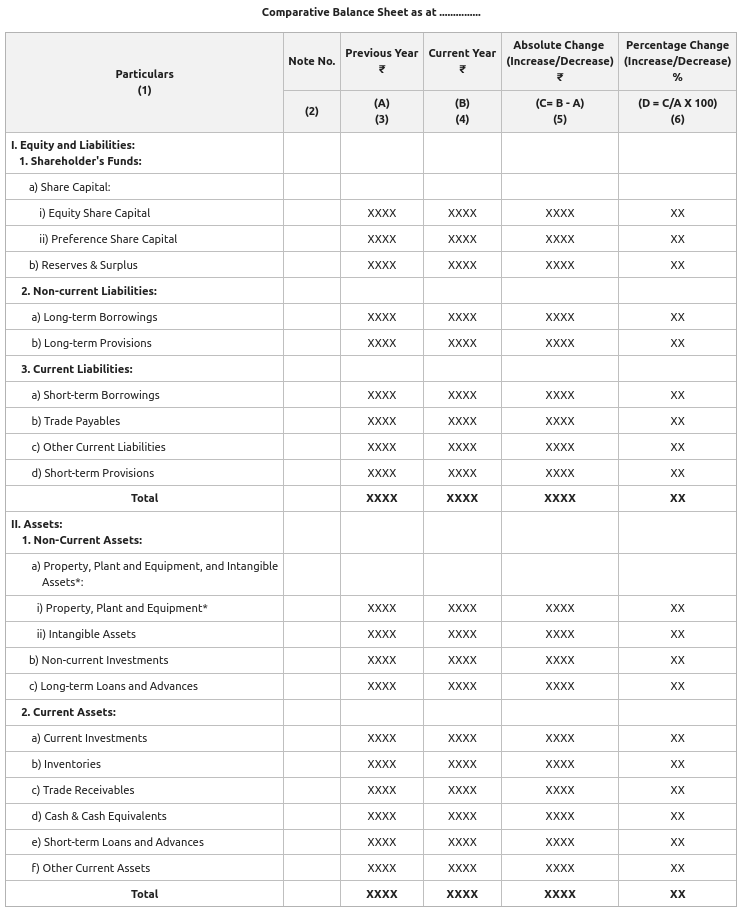
***Schedule III of the Companies Act 2013, is amended. And according to this, "Property, Plant and Equipment, and Intangible Assets" is used in place of Fixed Assets, and "Property, Plant and Equipment" is used in place of Tangible Assets.
**Notes:
**1. If the current year's value of a company has decreased, then show the Absolute Change and Percentage Change in brackets to reflect the negative item.
**2. Accounting treatment or entries related to items like Money received against Share Warrants, Application Money Pending Allotment, Deferred Tax Assets, etc., will not be asked in the examination.
Example of Comparative Balance Sheet
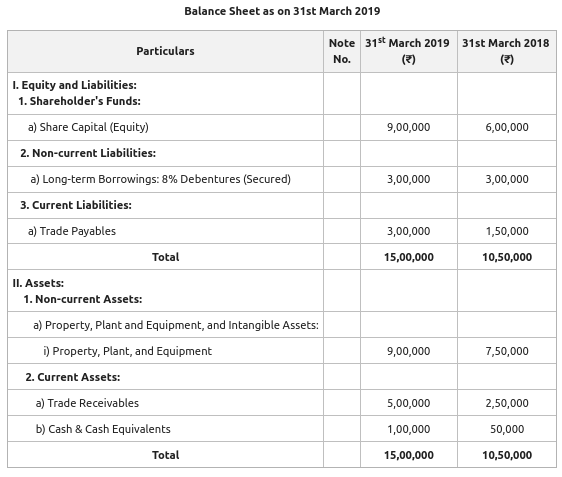
Prepare a Comparative Balance Sheet of Vanshika Ltd., from the following Balance Sheet as on 31st March 2019:
**Solution:
