Difference between Bookkeeping and Accounting (original) (raw)
Last Updated : 2 May, 2026
Bookkeeping and Accounting together refer to the process of recording, classifying, summarizing, and analysing financial transactions of a business to find out its profit or loss and financial position. Although they are related, they are not the same. Bookkeeping records daily financial transactions, while accounting uses these records to prepare financial statements and make decisions. Both work together to ensure the smooth running of a business.
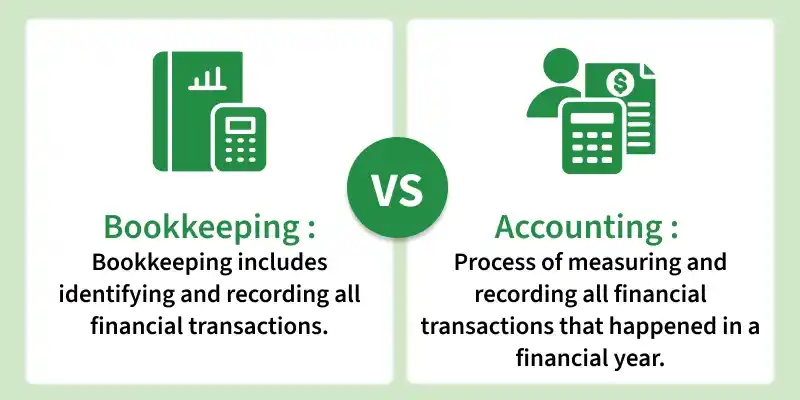
Bookkeeping
**Bookkeeping can be defined as the proper and systematic maintenance of the books of accounts. It is the science and art of identifying and recording accounting transactions in a systematic way . It is concerned with the proper maintenance of the books, i.e., Journal, Ledger, Cash Book, and other subsidiary books. bookkeeping does not involve analysing or interpreting the results of a business; it focuses only on accurate recording.
Bookkeeping consists of the following steps:
- Identifying a financial transaction
- Recording or posting debit or credit
- Producing invoices
- Preparing financial statement
- Maintaining and balancing subsidiaries and other accounts
Accounting
**Accounting is the process of measuring and recording, summarizing, analysing all the financial transactions of business during the financial year. It helps in getting a clear picture of the financial position of the business by showing value of assets and liabilities .
Accounting is guided by many different rules, principles and standards, which are needed to be followed to obtain the required information for the decision-making process.
Accounting consists of some basic terms:
- **Summarizing the data: All the financial transactions are recorded and summarized at one place.
- **Analysing the data: The summarized data must need to be analyse to know financial performance.
- **Interpreting the data: The analysed data is interpreted to understand about the business’s financial position.
- **Communicating the information: The results and insights are shared with investors, management, and other stakeholders to help them make informed decisions.
Difference between Bookkeeping and Accounting
| **Basis | **Bookkeeping | **Accounting |
|---|---|---|
| **Definition | Identifying and recording all financial transactions | Measuring, summarizing, analysing, and interpreting financial transactions |
| **Objective | To record all transactions | To record, analyse, and interpret transactions |
| **Scope | Limited scope | Wider scope compared to bookkeeping |
| **Decision Making | Does not help in decision making | Helps in decision making |
| **Analysis | Only records information; no analysis | Analyses data to gain business insights |
| **Skill Required | Knowledge of recording transactions accurately | Knowledge of accounting rules, principles, and standards |
| **Financial Position | Does not show financial position | Shows profit, assets, and liabilities |
| **Complexity | Simple process | More complex process |
| **Level of Work | Clerical, low-level work | Involves all management levels |
| **Supervision | Does not supervise accountant | Accountant supervises bookkeeper |