Difference between Capital Receipts and Revenue Receipts in Accountancy (original) (raw)
Last Updated : 27 Apr, 2026
It is important to understand the difference between Capital Receipts and Revenue Receipts. Capital Receipts either raise a liability or decrease an asset and are shown either on the _Liability side of the Balance Sheet or the _receipt amount is deduced in the Asset side. However, Revenue Receipts neither raise a liability nor decrease an asset and are shown on the _credit side of the Trading and Profit & Loss Account.
Capital Receipts
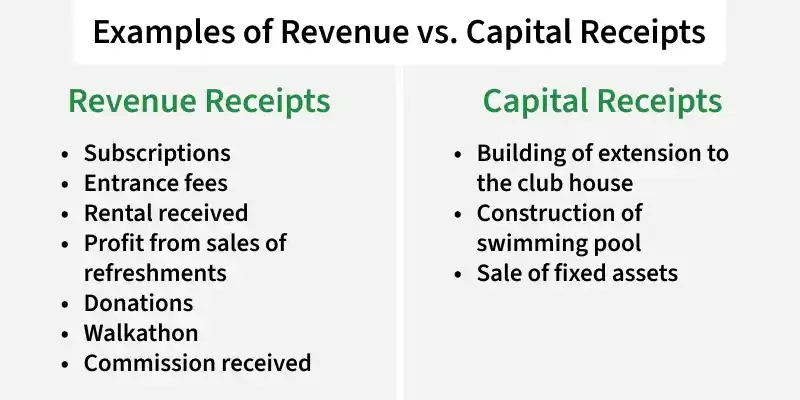
One that either raises a liability or decreases an asset. For instance, the amount received in the way of additional capital, the amount generated with loans, or the amount generated from the sale of fixed assets.
- A bank loan is a capital receipt because it raises a liability. Similarly, receipts from the sale of machinery are also capital receipts because they decrease an asset.
- Capital Receipts either raise liabilities or decrease assets. It implies that capital receipts have no effect on the company's profit or loss and are recorded on the balance sheet.
Revenue Receipts
One that neither raises a liability nor decreases an asset. For instance, the amount obtained from the sale of goods and services.
- Revenue Receipts refer to the regular receipts of the business but are generated primarily from the sale of products and services. Rent, discounts, interest, and commissions are all examples of revenue receipts.
- Revenue Receipts generate income for the business. As a result, they are recorded in the credit side of the Profit and Loss Account.
Difference between Capital Receipts and Revenue Receipts:
| Basis | Capital Receipts | Revenue Receipts |
|---|---|---|
| **Meaning | It refers to a receipt that either raises a liability or decreases an asset. | It is a receipt that neither raises nor decreases a liability or asset. |
| **Nature | Capital receipts are usually non-recurring. They are not acquired in the normal course of events. | Revenue receipts are usually recurring. They are acquired in the normal course of events. |
| **Presentation | It is presented or recorded in the Balance Sheet. | It is presented or recorded in the Trading or Profit And Loss account. |
| **Example | Amount received by means of capital, amount borrowed, or amount generated from the sale of fixed assets is an example of capital receipt. | Amount generated from the sale of goods and services, rent received, commission received, etc. is an example of revenue receipt. |