Oversubscription of Shares: Prorata Allotment with Calls in Arrear (original) (raw)
Last Updated : 11 Jun, 2026
A share is a unit of capital or an equal portion into which the share capital of a company is divided, and ownership of a share is evidenced by a share certificate. In simple terms, shares represent the divisions of a company’s share capital. For example, if a company has a capital of ₹10,00,000 divided into 10,000 units of ₹100 each, then each unit of ₹100 is called a share. To identify each share separately, they are given distinct numbers. Shares are movable property and can be transferred in accordance with the provisions laid down in the Articles of Association of the company. According to the Companies Act, 2013, a “share” means a share in the share capital of a company and includes stock except where a distinction between stock and shares is expressly or impliedly made.
Over-subscription of Shares:
Sometimes, a company may receive applications for a greater number of shares than what it has actually issued to the public. This condition is called oversubscription. It usually happens in the case of reputable and well-managed companies. Even then, the company is not allowed to allot shares beyond the number offered for subscription. When such a situation arises, the company can follow different methods to handle the excess demand, and one of these methods is pro-rata allotment
Pro-rata Allotment:
When a company receives applications for shares in excess of the number of shares offered, it may allot shares proportionately to all applicants. This method is called pro-rata allotment. Under this system, each applicant is allotted shares in the same ratio as the number of shares applied for, ensuring a fair distribution of available shares among all investors.
The pro-rata ratio is used by a company to determine two things:
- The Number of Shares allotted to an applicant if the Number of Shares applied by him is given.
- The Number of Shares applied by an applicant if the Number of Shares allotted to him is given.
Steps to Calculate the Amount due but not received from Defaulting shareholder to whom shares were allotted or Pro-rata Basis:
**Step 1: Calculate the Total Number of Shares applied for (if not already given in the question) with the help of the following formula:
\frac{Total~No.~of~Shares~applied~under~pro-rata~category}{Total~No.~of~Share~allotted~under~pro-rata~category}\times{No.~of~Shares~allotted~to~Defaulter}
**Or
Calculate the Number of Shares allotted (in not already given in the question) with the help of the following formula:
\frac{Total~No.~of~Shares~allotted~under~pro-rata~category}{Total~No.~of~Shares~applied~under~pro-rata~category}\times{No.~of~Shares~applied~by~Defaulter}
**Step 2: Calculate the Total Application Money received on shares applied by Defaulter with the help of the following formula:
**Total Application Money received on shares applied by Defaulter = No. of Shares applied by the Defaulter x Application money per share
**Step 3: Calculate the Total Application money due on the shares allotted to defaulter with the help of the following formula:
**Total Application money due on the shares allotted to defaulter = No. of Shares allotted to defaulter x Application money per share
**Step 4: Calculate the Excess Application Money with the help of the following formula:
**Excess Application Money = Amount as per Step 2 - Amount as per Step 3
**Step 5: Calculate the Allotment or Call Money due but not received with the help of the following formula:
**Allotment or Call Money due but not received = No. of Shares allotted to defaulter x Allotment Money/Call Money per share
**Step 6: Calculate the Allotment or Call Money due but not received with the help of the following formula:
**Allotment or Call Money due but not received = Amount as per Step 5 - Amount as per Step 4
**Steps to Calculate the Amount received on Allotment Stage:
**Step 1: Calculate the Total Allotment Money due with the help of the following formula:
**Total Allotment Money Due = Total No. of Shares Allotted x Allotment Money per Share
**Step 2: Deduct Allotment Money already received on the Application stage.
**Step 3: Deduct Allotment money not received from Defaulting Shareholders.
**Step 4: Add Calls in Advance (if any) received on Allotment Stage.
**Step 5: Calculate the Amount Received on the Allotment Stage with the help of the following formula:
**Amount Received on Allotment Stage = Amount as per (Step 1 - Step 2 - Step 3 + Step 4)
**Illustration 1:
Ashutosh Ltd. issued a prospectus inviting applications for 40,000 shares of ₹10 each at a premium of ₹5 per share payable as:
₹3 on Application
₹4 on Allotment
₹6 on First Call (including premium)
₹2 on Second & Final Call
Applications were received for 70,000 shares. Applicants of 60,000 shares were allotted 40,000 shares on a pro-rata basis and money received on 10,000 shares was returned. It was decided to utilise excess application money towards the amount due on allotment. Kamal to whom 600 shares were allotted failed to pay the allotment money. Calculate the amount due but not received on allotment from Kamal and Calculate Allotment Money received later on.
**Solution:
**i) Total No. of Shares applied by Kamal:
Total~No.~of~Shares~Applied=\frac{Total~No.~of~Shares~applied~under~pro-rata~category}{Total~No.~of~Share~allotted~under~pro-rata~category}\times{No.~of~Shares~allotted~to~Defaulter}
=\frac{60,000}{40,000}\times{600}
= **900 Shares
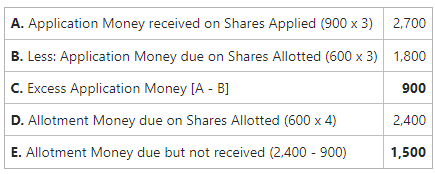
**ii) Amount due but not received on allotment from Kamal:
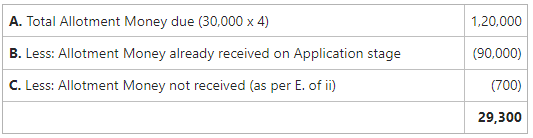
**iii) Allotment Money received later on:

**Illustration 2:
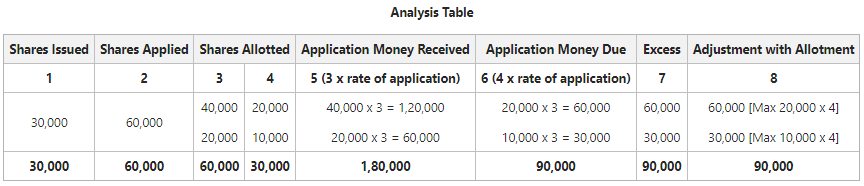
Manjul Ltd. issued 30,000 shares @ ₹10 each payable as ₹3 on Application, ₹4 on Allotment, ₹1.5 on First Call, and ₹1.5 on Second & Final Call. Applications were received for 60,000 shares and the allotment was made as follows:
a) Applicants of 40,000 shares were allotted 20,000 shares.
b) Applicants of 20,000 shares were allotted 10,000 shares.
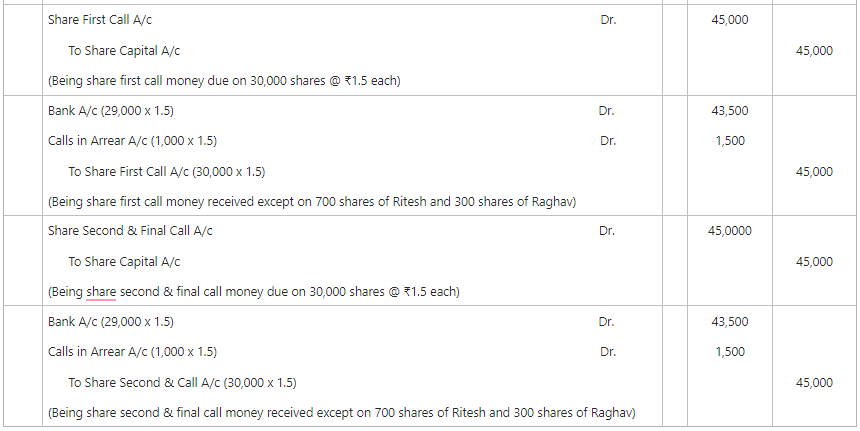
Ritesh to whom 700 shares were allotted from category b), failed to pay the allotment money and Raghav to whom 300 shares were allotted from category a), failed to pay both calls. Pass the necessary Journal Entries.
**Solution:

**Working Notes:
**i) Total No. of Shares applied by Kamal:
Total~No.~of~Shares~Applied=\frac{Total~No.~of~Shares~applied~under~pro-rata~category}{Total~No.~of~Share~allotted~under~pro-rata~category}\times{No.~of~Shares~allotted~to~Defaulter}
=\frac{60,000}{30,000}\times{700}
= **1400 Shares
**ii) Amount due but not received on allotment from Kamal:

**iii) Allotment Money received later on: