Partnership Deed and Provisions of the Indian Partnership Act 1932 (original) (raw)
Last Updated : 27 Apr, 2026
Partnership is one of the most common forms of business organization in India. It is suitable for small and medium businesses where two or more persons agree to carry on a business and share profits. The law governing partnerships in India is the Indian Partnership Act, 1932. This Act defines the rights, duties, and of partners and regulates the functioning of partnership firms. A key document in forming a partnership is the Partnership Deed, which records the terms and conditions agreed upon by partners.
Meaning of Partnership Deed:
A written agreement among partners that states the terms and conditions of the partnership business. It is a legal agreement for running the business together. A partnership may be formed through a written or oral agreement, but when the terms are written in a document, it is called a Partnership Deed or Articles of Partnership.
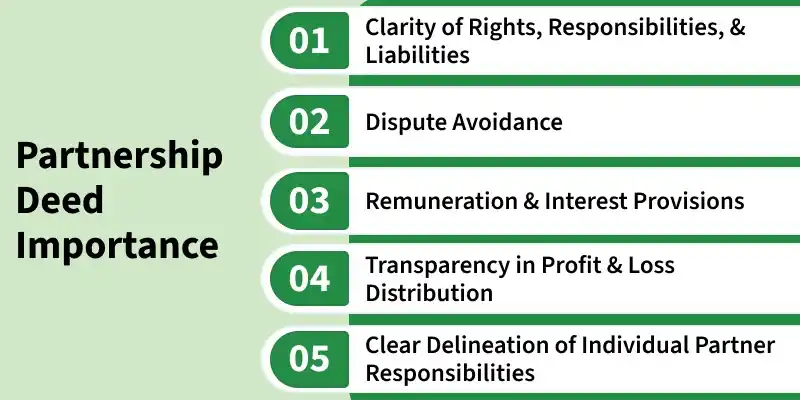
The deed is signed by all partners and usually stamped according to the Indian Stamp Act 1889, which makes it a legal document. It helps settle disputes and serves as evidence in a court of law.
The Partnership Deed generally includes the following details:
**1. Description of Partners: Names, descriptions and addresses of the partners.
**2. Description of Firm: Names and addresses of the firm.
**3. Principal Place of Business: Address of the principal place of business or profession.
**4. Nature of Business: Nature of business or profession the firm proposes to carry on.
**5. Commencement of Partnership: Date of commencement of partnership.
**6. Capital Contribution: The amount of capital to be contributed by each partner and also whether the capital accounts shall be fixed or fluctuating.
**7. Interest on Capita**l: Whether interest is to be allowed on capital or not should be written in the deed. If it is allowed, then the rate of interest should be mentioned.
**8. Interest on Drawings: The interest to be charged on drawings should be written in the deed, along with the rate of interest to be charged.
**9. Profit Sharing Ratio: Ratio to share profits or losses agreed by the partners.
**10. Interest on Loan: If a partner has an advanced loan besides his capital, will interest be allowed to him? If yes, then the rate should be mentioned.
**11. Amount of Salary, Commission: If a partner is to be paid salary, commission, etc., it should be written in the deed.
**12. Death of Partner: Whether the firm continues or dissolves after a partner dies should be mentioned.
**13. Settlement of Accounts: The manner in which accounts of partners shall be settled in case of retirement, death, or dissolution of the firm.
**14. Rights and Duties of Partners: The authority and duties of each partner should be mentioned.
**15. Duration of Partnership: The period for which partnership is established.
**16. Bank Account: Modes of operations of bank accounts by partners, i.e., jointly or individually.
Provisions of The Indian Partnership Act,1932 (in the absence of Partnership Deed):
A partnership firm is governed by the Indian Partnership Act, 1932. Its provisions help resolve situations that are not mentioned in the partnership deed or when no deed exists. If the partnership deed contains rules different from the Act, the deed will prevail. However, if the deed is silent on any matter, the provisions of the Act apply.
Example: If the partnership deed does not mention interest on a loan given by a partner, then 6% interest per year must be paid to that partner, even if the firm suffers a loss.
In the absence of a partnership deed or if it is silent to any clause, the following provisions of the Indian Partnership Act,1932 will apply:
**1. Sharing Profit & Losses: If the ratio or percentage is not mentioned in the partnership deed related to sharing of profits or losses amongst the partners, then the provisions say that it has to be shared equally by the partners.
**2. Interest on Capital: If the percentage of interest to be allowed on capital is silent, then the provisions suggest not allowing any interest on capital to partners.
**3. Interest on Drawings: If the percentage of interest to be charged by the partners for the amount withdrawn by them is silent, then the provisions say not to charge any interest on drawings from the partners.
**4. Interest on Loan by Partner: If the partnership deed is silent on the terms related to interest paid to the partner advancing the loan, then according to the provisions of the partnership act, the interest on loans is allowed @ 6% p.a., and such interest is payable even if there is a loss.
**5. Salary/Commission to a Partner: The provisions of the partnership act states that remuneration is not allowed to any partner if the partnership deed is silent for it.