Redirect to Different Pages After Login With Spring Security (original) (raw)
Last Updated : 29 May, 2026
Spring Security allows developers to control authentication and authorization in Spring Boot applications. In many applications, different users need different dashboards after login. It provides role-based redirection using a custom authentication success handler. After successful login, users can be redirected to different pages based on their roles and authorities.
- Redirect users to different pages after successful login.
- Handle role-based access using ROLE_ADMIN and ROLE_USER.
- Improve user experience with personalized dashboards.
Implementation to Redirect to Different Pages After Login
Below are the implementation steps to redirect to different pages after login with spring.
Step 1: Create Spring Boot Project
Create a Spring Boot project using Spring Initializr with the following dependencies:
- Spring Web
- Spring Security
- Thymeleaf
- Lombok
- Spring DevTools
- Spring Data JPA
- MySQL Driver Java `
4.0.0 org.springframework.boot spring-boot-starter-parent 3.2.5 org.example spring-security-redirect-pages 0.0.1-SNAPSHOT spring-security-redirect-pages spring-security-redirect-pages <java.version>17</java.version> org.springframework.boot spring-boot-starter-data-jpa org.springframework.boot spring-boot-starter-security org.springframework.boot spring-boot-starter-thymeleaf org.springframework.boot spring-boot-starter-web org.thymeleaf.extras thymeleaf-extras-springsecurity6
    <dependency>
        <groupId>org.springframework.boot</groupId>
        <artifactId>spring-boot-devtools</artifactId>
        <scope>runtime</scope>
        <optional>true</optional>
    </dependency>
    <dependency>
        <groupId>com.mysql</groupId>
        <artifactId>mysql-connector-j</artifactId>
        <scope>runtime</scope>
    </dependency>
    <dependency>
        <groupId>org.projectlombok</groupId>
        <artifactId>lombok</artifactId>
        <optional>true</optional>
    </dependency>
    <dependency>
        <groupId>org.springframework.boot</groupId>
        <artifactId>spring-boot-starter-test</artifactId>
        <scope>test</scope>
    </dependency>
    <dependency>
        <groupId>org.springframework.security</groupId>
        <artifactId>spring-security-test</artifactId>
        <scope>test</scope>
    </dependency>
</dependencies>

<build>
    <plugins>
        <plugin>
            <groupId>org.springframework.boot</groupId>
            <artifactId>spring-boot-maven-plugin</artifactId>
            <configuration>
                <excludes>
                    <exclude>
                        <groupId>org.projectlombok</groupId>
                        <artifactId>lombok</artifactId>
                    </exclude>
                </excludes>
            </configuration>
        </plugin>
    </plugins>
</build>
`
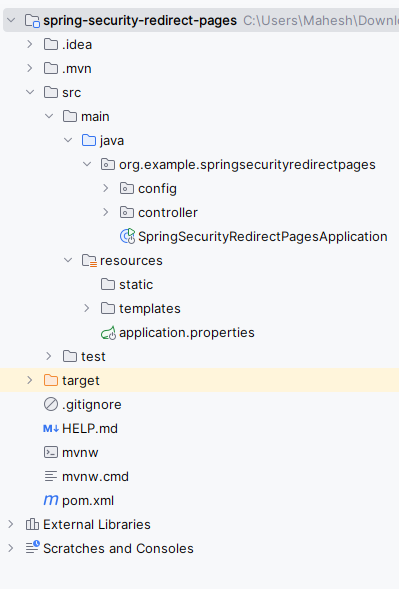
After the project creation done, the folder structure will be like the below image:
Step 2: Configure application.properties
Add database and user credentials configuration inside application.properties.
spring.application.name=spring-security-redirect-pages
# Database Configuration
spring.datasource.url=jdbc:mysql://localhost:3306/example
spring.datasource.username=root
spring.datasource.password=
spring.jpa.hibernate.ddl-auto=update
spring.jpa.show-sql=true# User Credentials
spring.security.user.name=user
spring.security.user.password=password
spring.security.user.roles=USER# Admin Credentials
spring.security.admin.name=admin
spring.security.admin.password=password
spring.security.admin.roles=ADMIN
Step 3: Configure Spring Security
Create SecurityConfig.java inside the config package.
- SecurityFilterChain secures application URLs.
- /admin/** is accessible only to ADMIN users. Java `
package org.example.springsecurityredirectpages.config;
import org.springframework.context.annotation.Bean; import org.springframework.context.annotation.Configuration; import org.springframework.security.config.annotation.web.builders.HttpSecurity; import org.springframework.security.web.SecurityFilterChain; import org.springframework.security.web.authentication.AuthenticationSuccessHandler;
@Configuration public class SecurityConfig {
@Bean
public SecurityFilterChain securityFilterChain(HttpSecurity http) throws Exception {

    http
            .authorizeHttpRequests(auth -> auth
                    .requestMatchers("/admin/**").hasRole("ADMIN")
                    .requestMatchers("/user/**").hasRole("USER")
                    .anyRequest().authenticated()
            )
            .formLogin(form -> form
                    .loginPage("/login")
                    .successHandler(customSuccessHandler())
                    .permitAll()
            )
            .logout(logout -> logout.permitAll());

    return http.build();
}

@Bean
public AuthenticationSuccessHandler customSuccessHandler() {
    return new CustomAuthenticationSuccessHandler();
}
}
`
Step 4: Create Custom Authentication Success Handler
Create CustomAuthenticationSuccessHandler.java inside the config package.
- Checks authenticated user roles.
- Redirects ADMIN users to /admin/home. Java `
package org.example.springsecurityredirectpages.config;
import jakarta.servlet.ServletException; import jakarta.servlet.http.HttpServletRequest; import jakarta.servlet.http.HttpServletResponse; import org.springframework.security.core.Authentication; import org.springframework.security.web.authentication.AuthenticationSuccessHandler;
import java.io.IOException;
public class CustomAuthenticationSuccessHandler implements AuthenticationSuccessHandler { @Override public void onAuthenticationSuccess(HttpServletRequest request, HttpServletResponse response, Authentication authentication) throws IOException, ServletException { String redirectURL = request.getContextPath();
    if (authentication.getAuthorities().stream().anyMatch(a -> a.getAuthority().equals("ROLE_ADMIN"))) {
        redirectURL = "/admin/home";
    } else if (authentication.getAuthorities().stream().anyMatch(a -> a.getAuthority().equals("ROLE_USER"))) {
        redirectURL = "/user/home";
    }

    response.sendRedirect(redirectURL);
}
}
`
Step 5: Create Admin Controller
Create AdminController.java.
- Handles requests for the admin dashboard.
- Returns adminHome.html page. Java `
package org.example.springsecurityredirectpages.controller;
import org.springframework.stereotype.Controller; import org.springframework.web.bind.annotation.GetMapping;
@Controller public class AdminController {
@GetMapping("/admin/home")
public String adminHome() {
    return "adminHome";
}
}
`
Step 6: Create User Controller
Create UserController.java.
- Handles user dashboard requests.
- Returns login page for authentication. Java `
package org.example.springsecurityredirectpages.controller;
import org.springframework.stereotype.Controller; import org.springframework.web.bind.annotation.GetMapping;
@Controller public class UserController {
@GetMapping("/user/home")
public String userHome() {
    return "userHome";
}

@GetMapping("/login")
public String login() {
    return "login";
}
}
`
Step 7: Main Application Class
Open the main class and write the below code. (No change are required)
Java `
package org.example.springsecurityredirectpages;
import org.springframework.boot.SpringApplication; import org.springframework.boot.autoconfigure.SpringBootApplication;
@SpringBootApplication public class SpringSecurityRedirectPagesApplication {
public static void main(String[] args) {
    SpringApplication.run(SpringSecurityRedirectPagesApplication.class, args);
}
}
`
Step 8: Create Login Page
Create login.html inside templates.
HTML `
Login`
Step 9: Create User Home Page
Displayed after successful USER login.
HTML `
User HomeWelcome User!
`
Step 10: Create Admin Home Page
Displayed after successful ADMIN login.
HTML `
Admin HomeWelcome Admin!
`
Step 12: Run the Application
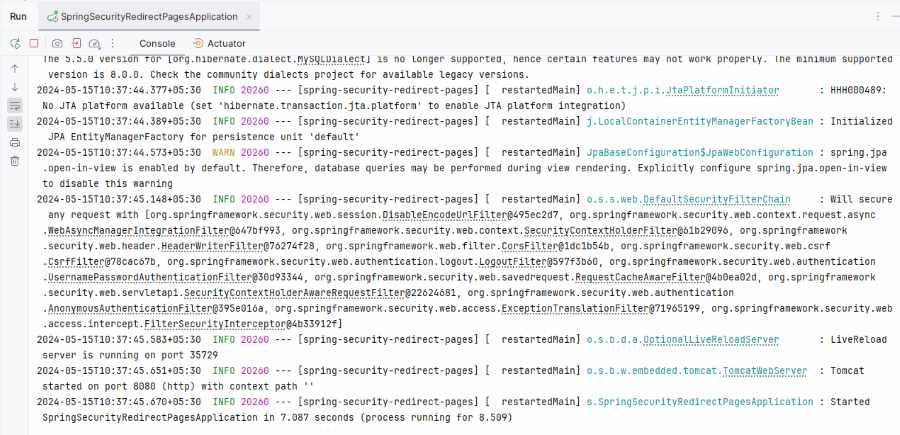
Run the Spring Boot application. After completing the project, it will start at port 8080.
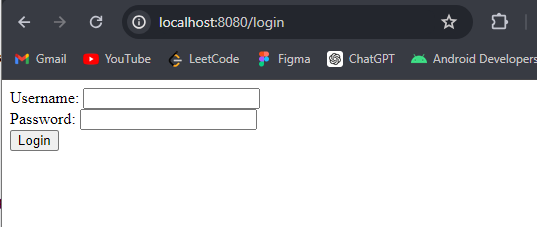
Login page:
**API:
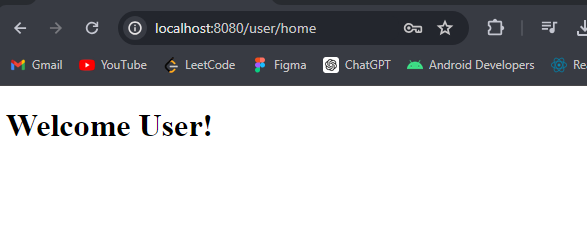
If we enter the user credential the it redirects to the user home page.
- username: user
- password: password
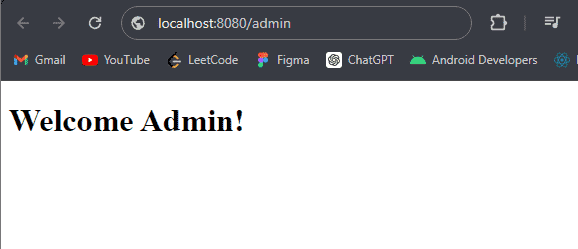
If we enter the admin credential the it redirects to the user home page.
- username: admin
- password: password
**Output:
**AdminHome page:
**UserHome page:
After hitting the URL, the below page will redirect.