Spring Dependency Injection with Example (original) (raw)
Last Updated : 30 Apr, 2026
Spring Dependency Injection (DI) is a fundamental concept in the Spring Framework that allows objects to receive their dependencies from an external source rather than creating them internally.
- Eliminates the need for classes to create their own dependencies
- Makes code more reusable and modular
- Supports constructor, setter, and field injection
- Works with XML configuration, annotations, or Java-based configuration
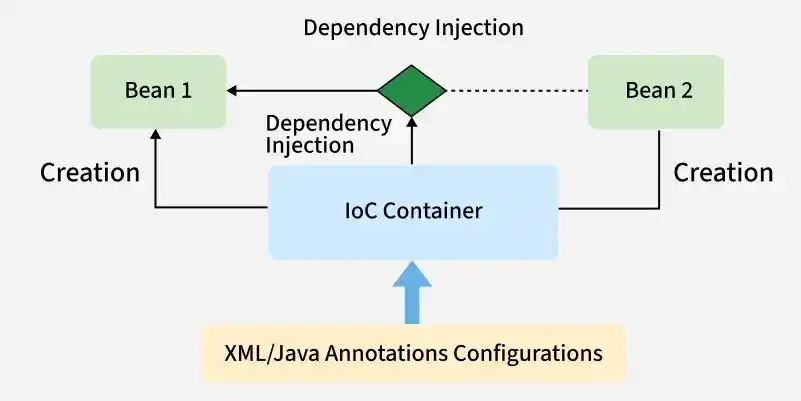
In above Diagram:
- The IoC (Inversion of Control) Container is responsible for creating and managing objects (called Beans).
- Bean 1 and Bean 2 are created by the container instead of being manually instantiated.
- If Bean 1 depends on Bean 2, the container automatically injects Bean 2 into Bean 1 (this is Dependency Injection).
- The configuration for this process is defined using XML or Java Annotations.
**Why Dependency Injection is Needed
Dependency Injection is necessary because directly creating dependencies inside classes can lead to several problems:
**1. Tight Coupling
- Classes that create their own dependencies are tightly coupled to specific implementations.
- Changes in one class may break dependent classes.
**2. Reduced Testability
- Directly created dependencies make unit testing difficult.
- DI allows injecting mock objects for testing individual components.
**3. Poor Maintainability
- Updating or replacing a dependency requires changes in multiple classes.
- DI centralizes dependency management in the Spring container, simplifying maintenance.
**4. Lack of Flexibility and Reusability
- Classes cannot easily switch to alternative implementations of a dependency.
- DI allows using interfaces or multiple implementations without modifying the dependent class.
**5. Centralized Object Management
- Spring IoC container handles object creation, configuration, and lifecycle, reducing boilerplate code and ensuring consistency across the application.
**Types of Spring Dependency Injection
There are two primary types of Spring Dependency Injection:
**1. Setter Dependency Injection (SDI):
Setter DI involves injecting dependencies via setter methods. To configure SDI, the @Autowiredannotation is used along with setter methods and the property is set through the <property> tag in the bean configuration file.
Java `
package com.geeksforgeeks.org;
import com.geeksforgeeks.org.IGeek; import org.springframework.beans.factory.annotation.Autowired;
public class GFG {
// The object of the interface IGeek
private IGeek geek;

// Setter method for property geek with @Autowired annotation
@Autowired
public void setGeek(IGeek geek) {
    this.geek = geek;
}
}
`
**Bean Configuration:
XML `
<bean id="GFG" class="com.geeksforgeeks.org.GFG">
    <property name="geek"  ref ="CsvGFG" />
</bean>
`
This injects the CsvGFG bean into the GFG object using the setter method (setGeek).
**2. Constructor Dependency Injection (CDI):
Constructor DI involves injecting dependencies through constructors. To configure CDI, the <constructor-arg> tag is used in the bean configuration file.
Java `
package com.geeksforgeeks.org;
import com.geeksforgeeks.org.IGeek;
public class GFG {
// The object of the interface IGeek
private IGeek geek;

// Constructor to set the CDI
public GFG(IGeek geek) {
    this.geek = geek;
}
}
`
**Bean Configuration:
XML `
<bean id="GFG" class="com.geeksforgeeks.org.GFG">
    <constructor-arg>
        <bean class="com.geeksforgeeks.org.impl.CsvGFG" />
    </constructor-arg>
</bean>
`
This injects the CsvGFG bean into the GFG object via the constructor.
Setter Dependency Injection (SDI) vs. Constructor Dependency Injection (CDI)
| Setter DI | Constructor DI |
|---|---|
| Creates mutable objects. Dependencies can be modified after creation. | Creates immutable objects. Dependencies can't be modified after creation. |
| Dependencies can be injected later. | All dependencies must be provided at creation. |
| Requires addition of @Autowired annotation. | @Autowired annotation is not needed. |
| It results in circular dependencies or partial dependencies. | It too can have circular dependencies, it just fails faster and more explicitly. |
| Requires framework or manual setter calls for dependency injection in tests. | Easier unit testing - can create objects directly with mock dependencies. |
**Steps to Create a Spring DI Project
**Prerequisites
- Java JDK installed (8 or above)
- Eclipse IDE or IntelliJ IDEA
- Maven (optional, for dependency management)
- Spring Framework libraries (or use Maven/Gradle)

Step 1: Create a Java Project
- **IntelliJ: New Project -> Java -> Add SDK -> Finish
Step 2: Add Spring Dependencies
Add Spring context dependency in pom.xml:
XML `
org.springframework spring-context 5.3.30`
**Note: The classes ApplicationContext and ClassPathXmlApplicationContext used in MainApp.java belong to the spring-context module. If this dependency is missing, you will get errors like:
"package org.springframework.context does not exist"
Make sure to add the spring-context dependency and reload your Maven project.
Step 3: Create Interfaces and Classes
Create interface and classes to define engine behavior and vehicle dependency.
**1. Create an interface (IEngine.java)
Java `
public interface IEngine { void start(); }
`
**2. Create implementation class (ToyotaEngine.java)
Java `
public class ToyotaEngine implements IEngine { public void start() { System.out.println("Toyota Engine started"); } }
`
**3. Create dependent class (Vehicle.java)
Java `
public class Vehicle { private IEngine engine;
// Constructor for Constructor DI
public Vehicle(IEngine engine) { this.engine = engine; }

// Setter for Setter DI
public void setEngine(IEngine engine) { this.engine = engine; }

public void drive() {
    engine.start();
    System.out.println("Vehicle is moving");
}
}
`
Step 4: Configure Spring Beans
Configure Spring beans in XML to enable Dependency Injection for objects.
XML `
<!-- Engine bean -->
<bean id="engine" class="ToyotaEngine"/>

<!-- Vehicle using Constructor DI -->
<bean id="vehicleConstructor" class="Vehicle">
    <constructor-arg ref="engine"/>
</bean>

<!-- Vehicle using Setter DI -->
<bean id="vehicleSetter" class="Vehicle">
    <property name="engine" ref="engine"/>
</bean>
`
Step 5: Write Main Class to Test DI
Load Spring container and retrieve beans to test Dependency Injection.
Java `
import org.springframework.context.ApplicationContext; import org.springframework.context.support.ClassPathXmlApplicationContext;
public class MainApp { public static void main(String[] args) { // Requires spring-context dependency ApplicationContext context = new ClassPathXmlApplicationContext("applicationContext.xml");
    Vehicle vehicle1 = (Vehicle) context.getBean("vehicleConstructor");
    vehicle1.drive();

    Vehicle vehicle2 = (Vehicle) context.getBean("vehicleSetter");
    vehicle2.drive();
}
}
`
Step 6: Run the Project
- Save all files.
- Run MainApp.java as a Java Application.
**Output:
Toyota Engine started
Vehicle is moving
Toyota Engine started
Vehicle is moving