Difference between @Injectable and @Inject Decorators (original) (raw)
Last Updated : 01 Apr, 2024
In Angular, decorators play an important role in defining and managing dependencies within the application. Two commonly used decorators are @Injectable and @Inject. While they both relate to dependency injection, they serve different purposes and are applied to different elements within an Angular application.
Table of Content
- What are @Injectable Decorators ?
- What are @Inject Decorators ?
- Difference between @Injectable and @Inject decorators
- Conclusion
What are @Injectable Decorators ?
@Injectable is a decorator in Angular used to mark a class as an injectable that allows it to be provided and injected as a dependency within other Angular components, services, or modules.
**Syntax:
@Injectable({
providedIn: 'root',
})
export class ServiceClass {
constructor() {}
}
**Features of @Injectable decorators
- **Singleton Pattern: Creates a single instance of a service to be shared across the application.
- **Reusability: Services are designed to encapsulate certain capabilities, making integration and reuse simple.
- **Lazy Loading: Optimizes performance by loading services only when needed, reducing initial load times.
Steps to Create Angular Project
**Step 1: Create a new Angular Project using the following command
ng new gfg-decorators
**Step 2: Create a new service
ng generate service gfg
**Folder Structure:
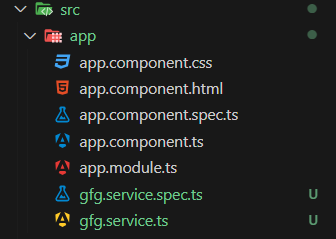
**Dependencies:
"dependencies": {
"@angular/animations": "^17.3.0",
"@angular/common": "^17.3.0",
"@angular/compiler": "^17.3.0",
"@angular/core": "^17.3.0",
"@angular/forms": "^17.3.0",
"@angular/platform-browser": "^17.3.0",
"@angular/platform-browser-dynamic": "^17.3.0",
"@angular/router": "^17.3.0",
"rxjs": "7.8.0",0.14.3"
"tslib": "^2.3.0",
"zone.js": "
}
**Example:
JavaScript ``
// gfg.service.ts
import { Injectable } from '@angular/core';
@Injectable({ providedIn: 'root' })
export class GfgService {
constructor() { }

greetUser(user: string): string {
    return `Hello ${user} from GfgService`;
}
}
``
We created a method greetUser(user: string), which accepts the username as a parameter and will return a greeting message with the username.
**Output:
The '@Injectable' decorator makes no apparent changes to itself. Instead, it acts as a label in Angular, which means that a particular class can be assigned to other parts of the code. As a result, you won't get any output if you only use '@Injectable'. It's more like telling Angular "Hey, this class is there to be used elsewhere!"
What are @Inject Decorators ?
@Inject is a decorator used to specify the token (dependency) to be injected into a class constructor or a provider definition. It specifies dependencies explicitly for Angular's DI system when automatic resolution is not possible, helping to resolve dependencies based on the specified token.
**Features of @Inject decorators
- **Decoupling: Enables dependencies and components to be coupled less tightly.
- **Parameter Injection: Injecting dependencies into constructors or methods without relying on TypeScript's type inference.
- **Clearer Intent: Enhances readability by indicating which dependencies are being injected into a component or service.
**Syntax:
export class MyComponent {
constructor(@Inject(ServiceClass) private myService: ServiceClass) {}
}
**Now Create a new component:-
ng generate component gfgcomponent
**Folder Structure:
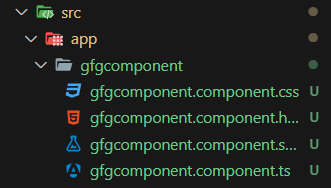
A new component will be created in app folder
**Example:
HTML `
{{greetingMessage}}
JavaScript
// gfgcomponent.component.ts
import { Component, Inject } from '@angular/core'; import { GfgService } from '../gfg.service';
@Component({ selector: 'app-gfgcomponent', templateUrl: './gfgcomponent.component.html', styleUrls: ['./gfgcomponent.component.css'] }) export class GfgcomponentComponent { constructor(@Inject(GfgService) private gfgService: GfgService) { }
greetingMessage = "";

ngOnInit() {
    this.greetingMessage = this.gfgService.greetUser("GFGUser")
}
}
`
- The GfgService is injected into the component using the @Inject decorator in the constructor.
- Next, we can use greetUser() method from GfgService, and we save the resultant greeting message in the greetingMessage variable.
- You can now access and see this welcome message in the HTML template of the component.
Output:
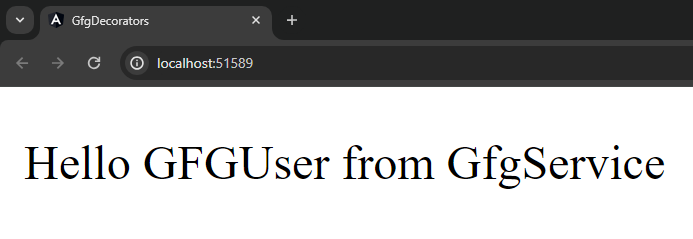
Output on browser
Difference between @Injectable and @Inject decorators
| Feature | @Injectable Decorator | @Inject Decorator |
|---|---|---|
| Purpose | Marks a class as eligible for dependency injection. | Specifies a dependency token for manual injection. |
| Usage | Applied to service classes or providers. | Applied to constructor parameters to specify injection dependencies. |
| Dependency Scope | Defines the metadata needed for DI resolution. | Specifies the exact dependency to be injected. |
| Dependency Type | Marks a class as a candidate for DI resolution. | Directs DI to inject a specific dependency instance. |
| Example | @Injectable({ providedIn: 'root' }) | constructor(@Inject(MyDependency) private dependency: MyDependency) |
Conclusion
In summary, @Injectable is used to mark a class as injectable, that allows it to be managed by Angular's dependency injection system, while @Inject is used to specify the token (dependency) to be injected into a class constructor or a provider definition. Understanding the difference between these decorators is important for effectively managing dependencies and implementing dependency injection in Angular applications.