Calendars (original) (raw)
Last Updated : 3 Dec, 2025
A calendar is a system used to organize time into days, weeks, and months throughout the year. It typically includes important dates, such as holidays or special events. There are various types of calendars, depending on cultural or religious practices, but many follow the same basic structure.
This includes evaluating leap years, decoding the days of the week, finding the day when another day is given or not given, and matching calendars for a particular month. Understanding these concepts can help make planning and keeping track of important dates much easier.
In Calendar, questions are mainly based on finding the day of the week if we are given a date. For example, we may be asked to find the day of 2 February 1981.
Calendar Formulas and Concepts
1. Odd Days
To determine the day of the week for a specific date, we use the concept of “odd days”. Odd days refer to the extra or remaining days in a given period.
For example, if a month has 30 days, there are two odd days because two days exceed four complete weeks. It is important to understand this concept when working with calendars and scheduling events on specific dates.
Finding days from dates is based on calculating the number of odd days by odd days, we mean several days more than a complete number of weeks.
For example,
- Number of days in a non-leap year = 365; 365 mod 7 = 1. So, the number of odd days in a non-leap year = 1
- Number of days in a leap year = 366 => Number of odd days in a leap year = 366 mod 7 = 2
- Number of odd days in 100 years (76 non-leap years + 24 leap years) = [(76 x 1) + (24 x 2)] mod 7 = (76 + 48) mod 7 = 124 mod 7 = 5 days
- Number of odd days in 200 years = (2 x Number of odd days in 100 years) mod 7 = 10 mod 7 = 3
- Number of odd days in 300 years = (3 x 5) mod 7 = 1
- Number of odd days in 400 years = (4 x 5 + 1) mod 7 = 21 mod 7 = 0. Note that here, we have added 1 day extra because the 400th year would itself be a leap year.
| **Month | January | February (ordinary/leap) | March | April | May | June | July | August | September | October | November | December |
|---|---|---|---|---|---|---|---|---|---|---|---|---|
| **Number of odd days | 3 | (0/1) | 3 | 2 | 3 | 2 | 3 | 3 | 2 | 3 | 2 | 3 |
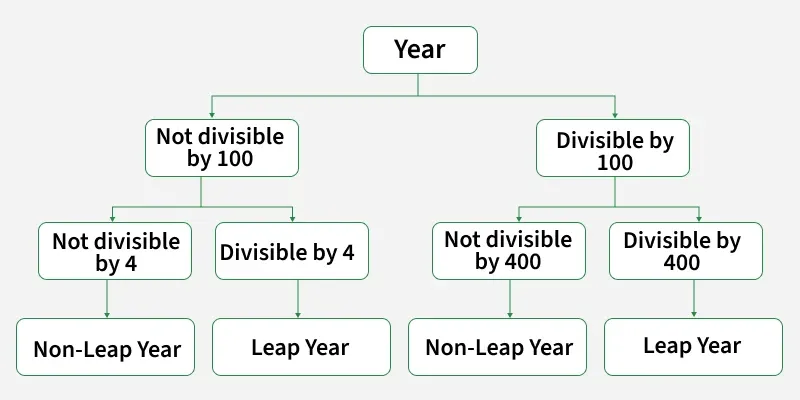
2. Leap Year
To check if a non – centennial year is a leap year, we divide it by 4. If the remainder is 0, the year is a leap year.
For example, 2016 mod 4 = 0. Thus, we can safely deduce that 2016 is a leap year.
To check if a centennial year is a leap year, we divide it by 400. If the remainder is 0, the year is a leap year.
For example, 1700 mod 400 = 100. So, it was not a leap year. But 1600 mod 400 = 0. Thus, we can safely deduce that 1600 was a leap year.
| **No. of days: | 0 | 1 | 2 | 3 | 4 | 5 | 6 |
|---|---|---|---|---|---|---|---|
| **Day: | Sun. | Mon. | Tues. | Wed. | Thurs. | Fri. | Sat. |
Calendars - Questions and Answers
**Question 1: Today is Wednesday. After 45 days, it will be:
**Solution:
To find the day of the week after 45 days from a Wednesday, follow these steps:
- **Determine the number of weeks and extra days:
45 ÷ 7 = 6 weeks and a remainder of 3.- **Count 3 days from Wednesday:
- Wednesday + 3 days = Saturday.
Therefore, after 45 days, it will be **Saturday.
**Question 2 : If 12th July 2010 is a Monday, what was the day of the week on 12th July 2009?
**Solution:
To find the day of the week on July 12, 2009, given that July 12, 2010, is a Monday, follow these steps:
- **Determine if 2009 is a leap year:
- Since 2009 is not a leap year, it has 365 days.
- **Calculate the day of the week one year earlier:
- Going back one year (from July 12, 2010, to July 12, 2009), we lose 1 day.
If July 12, 2010 = Monday, then:
- July 12, 2009 = Monday - 1 day = **Sunday.
Therefore, July 12, 2009, was a **Sunday.
**Question 3 : If March 1st, 2024 is a Saturday, what day of the week will be September 1st, 2024?
**Solution:
To solve this problem, we need to count the number of days between March 1st, 2024, and September 1st, 2024, and then find out what day of the week September 1st, 2024 falls on.
A total number of days =
31 + 30 + 31 + 30 + 31 + 31 = 184Now, we can find out what day of the week September 1st, 2024 falls on by adding 184 days to Saturday, which is the day of the week on March 1st, 2024.
184 divided by 7 leaves a remainder of 2, which means that 184 days after Saturday is the second day after Saturday, which is Monday.
Therefore, September 1st, 2024 is on a Monday.
**Question 4 : What was the day on 14 April 2000?
**Solution :
_1600 will have 0 odd days. 300 years will have 1 odd day. Now, in the next 99 years, we would be having 75 non-leap years and 24 leap years.
_=> Number of odd days = (75 x 1) + (24 x 2) = 75 + 48 = 123 mod 7 = 4 odd days
_Total odd days till now = 1 + 4 = 5
_Number of odd days in January = 31 mod 7 = 3
_Number of odd days in February (2000 is a leap year) = 29 mod 7 = 1
_Number of odd days in March = 31 mod 7 = 3
_Number of odd days till 14 April 2000 in the month of April= 14 mod 7 = 0
_So, the total number of odd days = 5 + 3 + 1 + 3 = 12 mod 7 = 5
_Thus, 14 April 2000 was Friday (odd days = 5 => Friday)
**Question 5 : What was the day on 16 August 1947?
**Solution:
_1600 will have 0 odd days. 300 years will have 1 odd day. Now, in the next 46 years, we would be having 35 non-leap years and 11 leap years.
_=> Number of odd days = (35 x 1) + (11 x 2) = 35 + 22 = 57 mod 7 = 1 odd days
_Total odd days till now = 1 + 1 = 2
_Number of odd days in January = 31 mod 7 = 3
_Number of odd days in February (1947 is a non – leap year) = 28 mod 7 = 0
_Number of odd days in March = 31 mod 7 = 3
_Number of odd days in April = 30 mod 7 = 2
_Number of odd days in May = 31 mod 7 = 3
_Number of odd days in June = 30 mod 7 = 2
_Number of odd days in July = 31 mod 7 = 3
_Number of odd days till 16 August 1947 = 16 mod 7 = 2
_So, the total number of odd days = 2 + 3 + 0 + 3 + 2 + 3 + 2 + 3 + 2 = 20 mod 7 = 6
_Thus, 16 August 1947 was Saturday (odd days = 6 => Saturday)
Also Check:
➣ Calendars Solved Question- Refer Here!
➣ Test your knowledege- Quiz!