Conjunction Verbal Ability Aptitude Question and Answer (original) (raw)
Last Updated : 30 May, 2025
A **conjunction is a word that joins two or more words, phrases, or clauses. Conjunctions help in making sentences more concise and meaningful.
Example:
I wanted to go for a walk, **but it started to rain.
Here, **but is the conjunction linking the two independent clauses and indicating a contrast.
**Practice Quiz:
Types of Conjunctions
Conjunctions are mainly used to join actions, ideas, and thoughts. They are categorised into three main types:
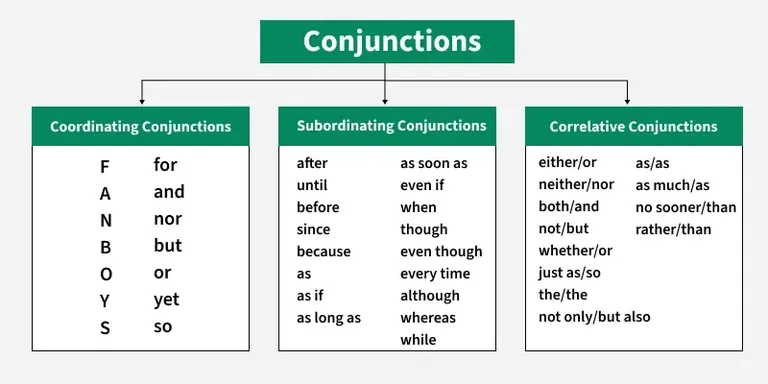
Types of Conjunctions
**1. Coordinating Conjunctions
Coordinating conjunctions join words, phrases, or clauses of **equal grammatical rank.
Examples: **or, and, **nor, **but**,** or, **yet**,** **so
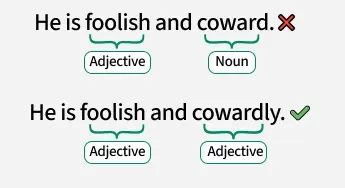
Example of Coordinating conjunctions
Example 1: He is rich(adj) but miserly(adj).
**Example 2: She works honestly(**adverb) **and sincerely (**adverb).
**2. Subordinating Conjunctions
A subordinating conjunction joins a dependent clause to an independent clause, indicating a specific relationship such as cause, effect, contrast, condition, time, and more.
Examples: **after, because, if, that, until, before, since, till, unless, as, though, although, whereas.
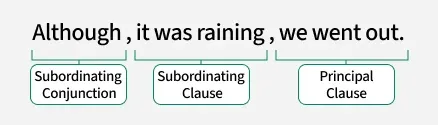
Example of subordinating conjunction
**Example 1: She stayed home **because she was feeling sick.
**Example 2: If it rains, we will cancel the picnic.
| Type | Words / Phrases | Examples |
|---|---|---|
| TIME | before, till, since, after | 1. She has lived here **since 2010.2. Wait **before you leave. |
| CAUSE | because, since, as | 1. **Because it was cold, we stayed inside.2. **Since he was late, we started without him. |
| PURPOSE | so that, lest | 1. I spoke loudly **so that everyone could hear.2. Run fast **lest you should miss the bus. |
| RESULT | so, therefore | 1. It rained a lot, **so the game was canceled.2. He was ill; **therefore, he missed school. |
| CONDITION | if, unless | 1. **If you study, you will pass.2. You cannot enter **unless you have a ticket. |
| COMPARISON | than, rather than, whether, as much as, whereas | 1. She runs faster **than I do.2. I love chocolate **as much as ice cream. |
| CONCESSION | although, though, even though | 1. **Although it was late, she kept working.2. Even **though he was tired, he finished the race. |
**3. Correlative Conjunctions
Correlative conjunctions come in linked pairs to join grammatically balanced elements. A key rule is parallelism: if you use one part of the pair to introduce a noun, the other must also introduce a noun.
As ... as Either ... or
So ... as Neither ... nor
So ... that Hardly ... when
Too ... to No sooner ... than
Such ... as Scarcely ... when
Such ... that Whether ... or
Though/Although ... yet Lest ... should
Between ... and From ... to
Both ... and Not only ... but also
Else ... but Other ... than
Doubt ... if (In positive sentence) Doubt ... that (In negative and interrogative sentence)
**Example:
- She is **not only punctual **but also diligent.
- She likes **neither coffee **nor tea.
Here are some common wrong or **incorrect correlative conjunction pairs people often use mistakenly:
- If ... than (✖) → If ... ,(✔)
- When ... than (✖) → When ... ,(✔)
- As/Since/Because ... therefore/ that's way/ so/ since (✖) → As/Since/Because ... ,(✔)
Strategies for Tackling Conjunction Questions
**Understand the Relationship: What kind of relationship is being shown?
Map conjunctions to these relationships:
- Addition → and, both…and
- Contrast → but, although, yet
- Cause → because, since
- Condition → if, unless
- Choice → or, either…or
**Check Clause Independence:
- Use a coordinating conjunction (often with a comma) when joining two full sentences.
- Use a subordinating conjunction if one clause is dependent (no comma if the dependent clause follows).
**Ensure Parallelism with Correlatives:
- Balance the grammatical forms on both sides of the correlative pair (e.g., two verbs, two nouns).
**Watch for Punctuation Cues:
- Commas before but, so, yet, and when connecting independent clauses.
- No comma when subordinating conjunctions follow the main clause.
Solved Question on Conjunction
**Question 1: She wanted to go for a walk,_____ it was raining heavily.
- and
- but
- so
- because
**Correct Option: (2) but
**Explantion: The sentence presents two contrasting ideas:
- Positive Intent: _She wanted to go for a walk
- Negative Condition/Obstacle: _It was raining heavily
Conjunction **“but” to indicate a **contrast between what someone wants and what the situation is.
**Question 2: You can have tea ___ coffee, not both.
- or
- but
- so
- because
**Correct Option: (1) or
**Explantion: The sentence is giving a **choice between two options – tea or coffee. The correct conjunction for choices is ****"or"**.
**Question 3: She failed the test ___she had not studied.
- and
- although
- because
- but
**Correct Option: (3) because
**Explantion: The sentence explains a **reason for failing – not studying. ****"Because"** is the correct conjunction to show cause or reason.
**Question 4: He worked hard ___ he could pass the exam.
- although
- so that
- or
- because
**Correct Option: (2) so that
**Explantion: The sentence expresses **purpose or intention. He worked hard **with the goal of passing. ****"So that"** correctly shows purpose.
**Question 5: ___ he was late, he still caught the train.
- although
- so that
- or
- because
**Correct Option: (1) although
**Explantion: This sentence has a **contrast: being late, yet catching the train. ****"Although"** introduces a surprising or unexpected contrast.
**Question 6: Neither the manager ____ the employees were aware of the policy change, ____ the confusion persisted for days.
- nor, so
- or, and
- nor, and
- and, so
**Correct Option: (1) nor, so
**Explantion:
"Neither...nor" is a correlative conjunction pair used to connect two negative alternatives of equal importance
"So" is a coordinating conjunction showing the result of their unawareness
**Question 7: He acted ____ he had not heard the instructions, ____ he was actually paying close attention.
- as if, though
- as though, but
- as if, but
- as though, and
**Correct Option: (3) as if, but
**Explantion:
"As if" is a subordinating conjunction expressing something untrue or hypothetical
"But" is a coordinating conjunction showing contrast between his actions and reality
**Question 8: You will not succeed in your efforts ____ you plan carefully ____ implement your ideas with dedication.
- if, and
- unless, or
- unless, and
- if, or
**Correct Option: (3) unless, and
**Explantion:
"Unless" is a subordinating conjunction introducing a negative condition (if not)
"And" is a coordinating conjunction joining two requirements of equal importance
**Question 9: She speaks French fluently, ____ she has never visited France, ____ she learned the language from her grandmother.
- yet, because
- and, so
- but, since
- although, as
**Correct Option: (3) but, since
**Explantion:
"But" is a coordinating conjunction showing contrast between fluency and never visiting France
"Since" is a subordinating conjunction giving the reason for her fluency
**Question 10: No sooner had she entered the room ___ the lights went out.
- than
- when
- then
- but
**Correct Option: (1) than
**Explantion:
“**No sooner... than” is a fixed correlative structure used to show two closely linked events.
Practice Question on Conjunction
**Question 1: I don’t know ___ she will come today.
- if
- and
- so
- because
**Question 2: We stayed inside ___ it was raining.
- or
- but
- so
- because
**Question 3: He is not only smart ___ also kind.
- but
- so
- because
- but also
**Question 4: played well ___ they lost the match.
- although
- so
- because
- and
**Question 5: You can have tea ___ coffee, not both.
- or
- but
- so
- because
**Question 6: He behaves ___ he were the owner of the company.
- like
- as
- if
- as if
**Question 7: Hardly had they reached the airport ___ the flight was cancelled.
- when
- then
- than
- while
**Question 8: He refused to confess the truth ___ all the evidence pointing against him.
- even though
- because
- since
- as
**Question 9: Not only did she win the competition, ____ she also broke the previous record, ____ the judges were impressed.
- but, so
- and, but
- but also, and
- but also, so
**Question 10: She will eat ____ pasta ____ pizza for dinner.
- either, or
- both, and
- neither, nor
- not only, but also
**Answer Key:
- if
- because
- but also
- although
- or
- as if
- when
- even though
- but also, so
- either, or