Puzzle | Pay an employee using a gold rod of 7 units ? (original) (raw)
Last Updated : 27 Apr, 2026
An employee works for an employer for 7 days. The employer has a gold rod of 7 units length. How does the employer pay the employee, so that the employee’s total gold increases by 1 unit each day? The employer can make at most 2 cuts in the rod.
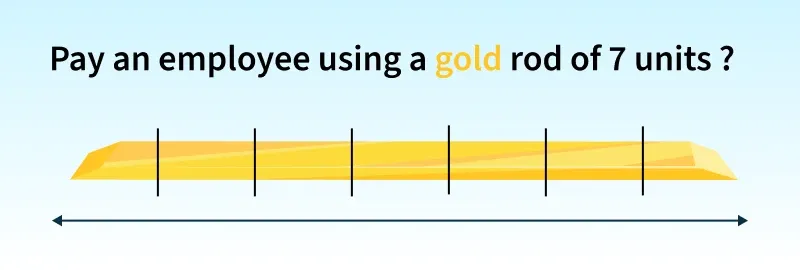
(**Hint- after the end of the day, employees can't spend any part of the rod)
Check if you were right - full answer with solution below.
**Solution:
The employer can pay the employee for seven days by making two cuts, resulting in three rods of lengths 1, 2, and 4 units.
| Day | Action Taken by Employer | Rods with Employee | Total Gold |
|---|---|---|---|
| 1 | Gives 1 unit rod | 1 | 1 |
| 2 | Takes 1, gives 2 | 2 | 2 |
| 3 | Gives 1 | 1 + 2 | 3 |
| 4 | Takes 1 & 2, gives 4 | 4 | 4 |
| 5 | Gives 1 | 4 + 1 | 5 |
| 6 | Takes 1, gives 2 | 4 + 2 | 6 |
| 7 | Gives 1 | 4 + 2 + 1 | 7 |
**How does this work?
We use powers of 2, the same idea as decimal to binary conversion. These allow us to express any number from 1 to 7 via binary:
Notice that 7 = 2³ - 1. This means, with three pieces (after two cuts), we can represent any number from 1 to 7 by combining the lengths 1, 2, and 4 ,which are powers of 2:
- 2⁰ = 1
- 2¹ = 2
- 2² = 4
This is just like binary numbers, where we can express any number using combinations of powers of 2. With 3 such pieces, we can form all sums from 1 to 7:
- 1
- 2
- 1 + 2 = 3
- 4
- 4 + 1 = 5
- 4 + 2 = 6
- 4 + 2 + 1 = 7
So each day, the employee gets a total of rods that sum up to the day's number by giving, taking back, or combining the existing pieces. This clever method ensures daily payment without needing more than 2 cuts.