Decision Theory in AI (original) (raw)
Last Updated : 4 Apr, 2026
Decision theory is about making the best choice when the outcome is uncertain. In AI, it helps systems evaluate different possibilities and select the option that leads to the most beneficial result overall.
For example, AI system used in online shopping to recommend products. It can choose to:
- Recommend a popular product
- Recommend a personalized product
Each option leads to different outcomes, like clicks or purchases. The system compares these and selects the overall better choice using decision theory.
Types of Decision Theory
Decision theory can be understood in two main ways based on how decisions are approached:
1. Normative Decision Theory
Focuses on how decisions should be made in an ideal situation.
- Assumes decisions are logical and based on complete information
- Aims to choose the best possible outcome
2. **Descriptive Decision Theory
Focuses on how decisions are actually made in real life.
- Considers human behaviour and limitations
- Includes real-world influences and imperfect decision-making
Key Components
- **Agent and Actions: The agent is the decision-maker and it has different actions to choose from
- **States of the World: These are possible situations that can affect the outcome, and are not fully known
- **Outcomes: Each action leads to a result, which can be good, bad, or neutral
- **Probability: Shows how often each outcome or situation occurs
- **Utility Function: Measures how valuable or useful an outcome is
- **Decision Rule: Method used to choose the best action based on outcomes
Working
AI systems use different learning methods to make decisions based on data and experience. It mainly applies decision theory in the following ways:
**1. Supervised Learning
- The system is trained on labeled data (input + correct output)
- It learns patterns and uses them to make predictions on new data
- Decisions are made by selecting the output that best matches learned patterns
- Example: An email system classifies messages as spam or not spam based on past labeled data.
2. **Reinforcement Learning
- The system learns by interacting with its environment
- It receives rewards for correct actions and penalties for wrong ones
- It improves over time by choosing actions that give better results
- Example:A game-playing AI learns which moves lead to higher scores through trial and error.
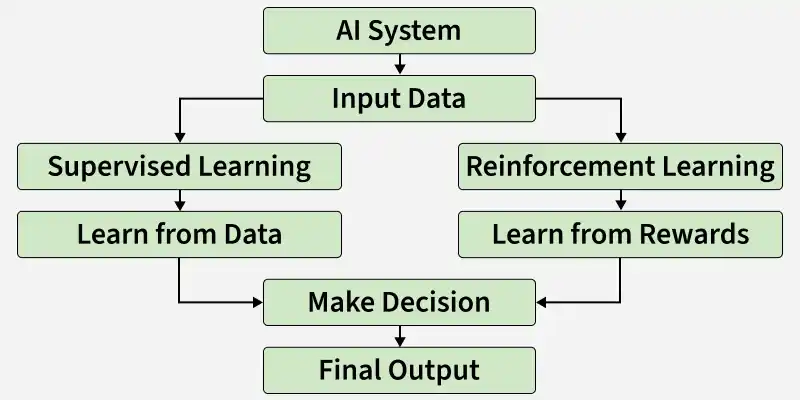
Working of Decision Theory
Use Cases
- Autonomous vehicles make real-time driving decisions to ensure safety and smooth navigation.
- Healthcare systems analyze patient data to recommend effective treatments.
- Fraud detection systems evaluate transactions to prevent financial losses.
- Multi-agent systems predict actions to maintain stable and optimal decision-making.
**Advantages
- Helps in making better decisions under uncertainty
- Considers multiple possible outcomes before choosing
- Improves the accuracy and reliability of AI systems
- Can be applied across different fields like healthcare, finance, and robotics
**Disadvantages
- Requires accurate data and probabilities to work well
- Can become complex for large real-world problems
- Utility (value of outcomes) can be difficult to define clearly
- May not fully capture human emotions or intuition