Fuzzy Logic | Introduction (original) (raw)
Last Updated : 29 May, 2026
Fuzzy Logic helps work with situations where the information is unclear or partly true. Instead of only 0 or 1 like traditional logic, it allows values between 0 and 1 to represent partial truth. This makes it useful in real-world decision-making where data is not exact.
- Handles uncertainty and vague information effectively.
- Supports flexible and human-like reasoning in systems.
- Useful in control systems, medical diagnosis, AI and image processing.
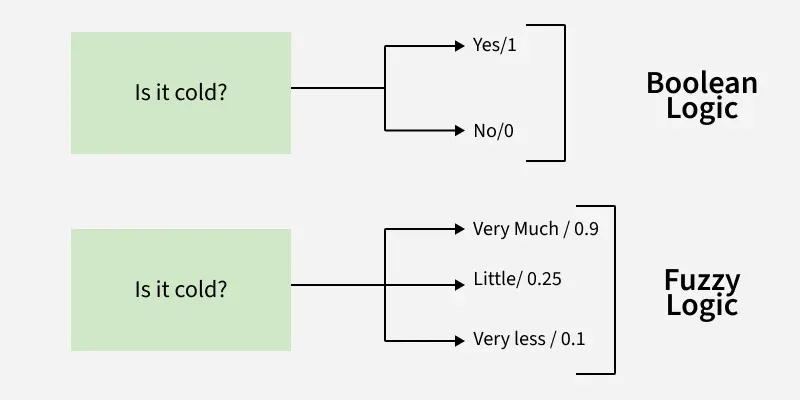
Fuzzy Logic
Key Components
**1. Membership Functions
A membership function defines how strongly an input value belongs to a fuzzy set by assigning a degree of membership between 0 and 1. The input space is also called the universe of discourse.
- 0 indicates the value does not belong to the set
- 1 indicates full membership in the set
- Values between 0 and 1 represent partial membership
These functions play a key role in fuzzification by converting precise real-world data into fuzzy values that can be processed by the system.
Common Types of Membership Functions:
- **Singleton: Represents a single crisp value with membership at one specific point.
- **Gaussian: Uses a smooth bell-shaped curve for gradual changes in membership values.
- **Trapezoidal or Triangular: Uses straight-line shapes to define gradual increase and decrease in membership across a range.
By selecting an appropriate membership function, fuzzy logic systems can represent uncertainty more effectively and behave in a more human-like manner.
2. **Fuzzy Control
Fuzzy control is a method of designing systems that make decisions similar to human reasoning. It uses approximate rather than exact values to produce practical results in uncertain or incomplete data conditions where traditional control methods may fail.
- Applies fuzzy rules to convert imprecise inputs into suitable actions.
- Ensures smooth system behavior through gradual output changes.
Example: In an air conditioning system, fuzzy control can adjust the cooling not just as “on” or “off” but based on degrees like “slightly cool” or “very cool,” creating smoother and more comfortable temperature control.
By capturing the flexibility of human decision-making, it helps systems operate effectively in complex, unpredictable environments.
Architecture
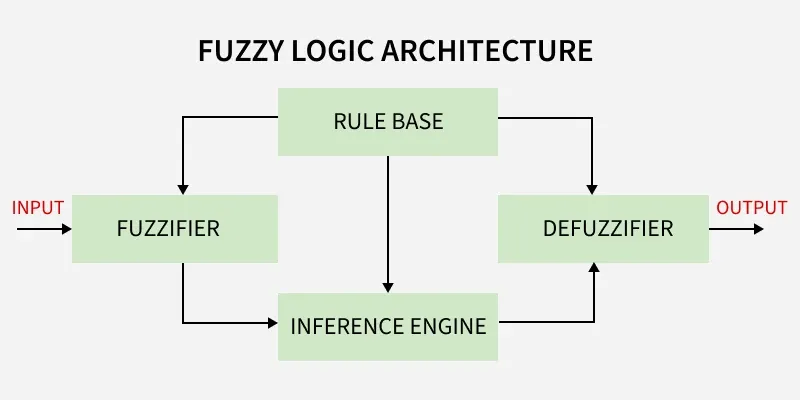
Architecture of Fuzzy Logic
Fuzzy Logic systems are made up of four main components that work together to process imprecise or uncertain data:
- **Fuzzification: It is the process of converting precise input values(such as temperature or pressure readings) into fuzzy sets. This step is important because real-world inputs like those from sensors aren’t perfect or exact.
- **Rule Base: A collection of “if-then” rules created by experts to guide the system’s decisions. These rules use linguistic terms like “high,” “low,” and “warm” to define conditions and actions.
- **Inference Engine: It evaluates the fuzzified input data and applies the relevant rules from the rule base. It identifies which rules are most appropriate and combines their results to generate a control action.
- **Defuzzification: It converts fuzzy outputs produced by the inference engine into a precise, crisp value so the system can take a clear final decision.
Implementation
Let's consider a temperature-based fan control system where fuzzy logic determines the appropriate fan speed according to the temperature value.
**Input: Temperature = 32°C
**Goal: Adjust fan speed (Low / Medium / High)
Step 1: Fuzzification
In this step, the temperature value of 32°C is converted into fuzzy values to determine how strongly it belongs to the “Warm” and “Hot” categories.
Define sets:
- Warm = triangular (20, 30, 40)
- Hot = triangular (30, 40, 50)
Warm membership: \mu_{warm}(32)=\frac{40-32}{40-30}=0.8
Hot membership: \mu_{hot}(32)=\frac{32-30}{40-30}=0.2
This means the temperature is 80% Warm and 20% Hot.
**Step 2: Rule Base
Based on the fuzzy temperature values, the system applies predefined rules to decide the fan speed.
- IF temperature is warm → fan = medium
- IF temperature is hot → fan = high
**Step 3: Inference
The system evaluates the rules according to the membership values obtained in the previous step.
- Medium fan output = 0.8
- High fan output = 0.2
This indicates that medium fan speed has a stronger influence on the final decision.
**Step 4: Defuzzification
The fuzzy outputs are converted into a single numerical fan speed value.
Assume:
- Medium = 50
- High = 80
Using the centroid method:
Output = \frac{0.8 \cdot 50 + 0.2 \cdot 80}{0.8 + 0.2}
= \frac{40 + 16}{1.0} =56
**Final Output: Fan speed = 56%
This output shows how fuzzy logic combines multiple partial conditions to generate smooth and realistic control decisions.
Boolean Logic vs Fuzzy Logic
| Concept | Boolean Logic | Fuzzy Logic |
|---|---|---|
| Values | 0 or 1 | Any value between 0 and 1 |
| Truth | Absolute | Partial |
| Useful For | Exact systems | Real-world uncertain systems |
| Example | Hot or Not Hot | Slightly Hot, Warm, Very Hot |
**Applications
- **Aerospace: Fuzzy logic is used in spacecraft and satellite altitude control systems.
- **Automotive: It's applied in speed control and traffic management systems.
- **Industrial: It is used for processes like pH control, drying and distillation in the chemical industry.
- **Artificial Intelligence: In areas like natural language processing and decision-making support systems.
- **Control Systems: It is integral to many modern control systems including expert systems and robotics.
**Advantages
- Handles imprecise or noisy data effectively even when inputs are not completely accurate.
- Easy to design and implement compared to many complex algorithms.
- Solves complex problems efficiently by mimicking human reasoning and decision-making.
- Requires low memory and computational resources due to simple algorithms.
**Disadvantages
- May produce ambiguous solutions since different approaches can solve the same problem differently.
- Difficult to verify and prove correctness due to uncertainty in decision-making.
- Can compromise accuracy when handling highly precise or sensitive data.
For more related article, refer to Fuzzy Logic | Set 2 (Classical and Fuzzy Sets)