Generalized Method of Moments (GMM) in StatsModels (original) (raw)
Last Updated : 30 Jun, 2025
Generalized Method of Moments (GMM) is a flexible estimation technique that uses moment conditions relationships expected to hold in the data to estimate model parameters. In StatsModels, GMM is implemented as a class that you subclass to define your own moment conditions. The process is especially useful for both linear and non-linear models, and works with or without instrumental variables.
**How GMM Works in StatsModels
- **Moment Conditions: The moment conditions are defined that relate the data and parameters. These are mathematical expressions expected to be zero when evaluated at the true parameter values.
- **Subclassing: In StatsModels, you implement GMM by subclassing the GMM class and defining the momcond method, which returns your moment conditions.
- **Estimation: StatsModels estimates parameters by minimizing the (weighted) sum of squared sample moments, iteratively updating the weighting matrix for efficiency.
**Step-by-Step Implementation
**Step 1: Import Libraries and Prepare Data
Let's create a simple linear model:
y = \beta_0 + \beta_1 x + \epsilon
We will estimate β_0 and β_1 using GMM.
- Import numpy as np: Load NumPy for array and math operations.
- from statsmodels.sandbox.regression.gmm import GMM: Import GMM class for estimation.
- **np.random.seed(42): Set random seed for reproducibility.
- **n = 100: Set sample size.
- **x = np.random.normal(size=n): Generate 100 random x values.
- \beta_0 = 1.0; \beta_1 = 2.0: Set true intercept and slope.
- **epsilon = np.random.normal(scale=1.0, size=n): Generate random noise.
- y = \beta_0 + \beta_1 x + \epsilon: Create y using the linear model.
- **instruments = np.column_stack((np.ones(n), x)): Stack constant and x as instrument matrix. Python `
import numpy as np from statsmodels.sandbox.regression.gmm import GMM
Simulate data
np.random.seed(42) n = 100 x = np.random.normal(size=n) beta_0 = 1.0 beta_1 = 2.0 epsilon = np.random.normal(scale=1.0, size=n) y = beta_0 + beta_1 * x + epsilon
Instruments (here, just use x and a constant as instruments)
instruments = np.column_stack((np.ones(n), x))
`
Step 2: Define the GMM Model by Subclassing
The LinearGMM class defines how the moment conditions are constructed: residuals multiplied by instruments.
Python `
class LinearGMM(GMM): def momcond(self, params): # params: [beta_0, beta_1] y_hat = params[0] + params[1] * self.exog[:, 1] error = self.endog - y_hat # Moment conditions: error * instruments return error[:, None] * self.instrument
`
**Explanation:
- params are the parameters to estimate.
- error is the residual.
- Moment conditions are the product of residuals and instruments.
**Step 3: Initialize and Fit the GMM Model
The model is initialized with the data and fit using the fit() method. start_params gives initial guesses for the parameters. maxiter controls the number of iterations for updating the weighting matrix.
Python `
Prepare exog with constant and x
exog = np.column_stack((np.ones(n), x))
Initialize model
model = LinearGMM(y, exog, instruments)
Fit model (one-step)
results = model.fit(start_params=[0, 0], maxiter=2)
`
**Output:
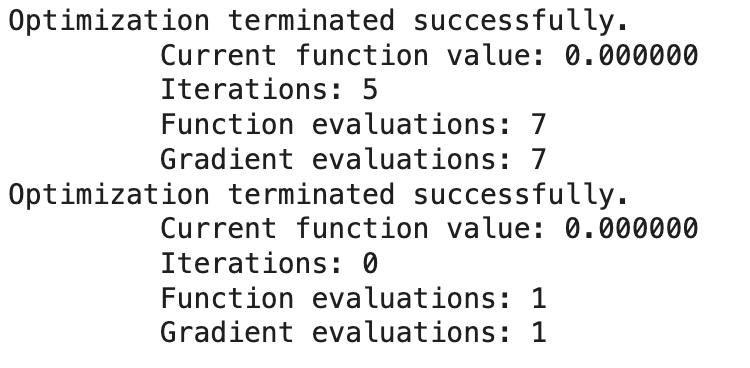
Fitting the GMM
**Step 4: View Output
results.paramsgives the estimated coefficients (β_0 and β_1).results.bseprovides their standard errors.- **Output Interpretation: The estimated parameters should be close to the true values used to generate the data (here, 1.0 and 2.0). Python `
print("Estimated parameters:", results.params) print("Standard errors:", results.bse)
`
**Output:

Output
**Download the complete source code from here : Generalised Method of Moments