Multi Agent System in AI (original) (raw)
Last Updated : 2 May, 2026
Multi-Agent System (MAS) is a computational system where multiple agents, interact with each other and with their environment to achieve their individual or collective goals. Unlike single-agent systems where only one agent makes decisions, in MAS agents works by cooperation, competition or coordination with each other. It is widely used in complex models, distributed and dynamic problems that are too difficult for a single agent to solve alone.
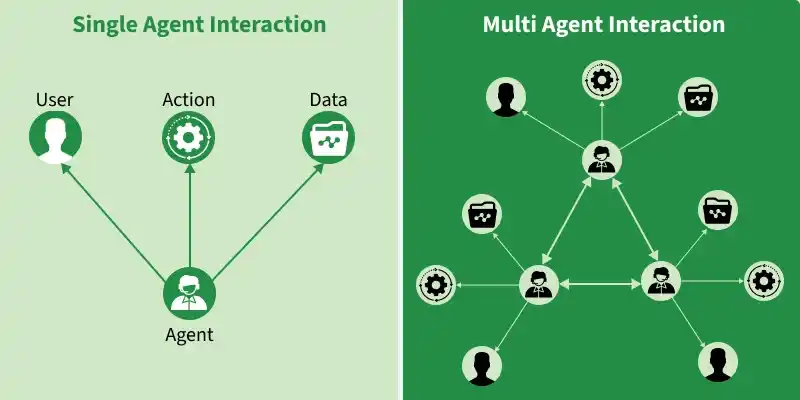
The main components of Multi-Agent system are:
- **Agents: These are the individual parts of the system. Each agent has its own abilities, knowledge and goals. Agents can range from simple bots to advanced robots that can learn and adapt.
- **Environment: This is the space where agents operate. It can be a physical place like a factory or a virtual one like a digital platform. The environment shapes how agents act and interact.
- **Interactions: Agents interact with each other and the environment through various methods such as talking to each other, working together or competing. These interactions are crucial for the system to work and improve.
- **Communication: Agents often need to communicate to share information, negotiate or coordinate their actions. Effective communication helps agents work together or compete more effectively.
Architectures of Multi-Agent Systems
MAS can be designed using different architectures which define how agents are structured and how they make decisions:
**1. Reactive Architecture
- Agents respond directly to stimuli from the environment without deep reasoning.
- **Example: Obstacle-avoiding robots.
**2. Deliberative (Cognitive) Architecture
- Agents maintain internal models, perform planning, reasoning and goal selection before acting.
- **Example: Intelligent personal assistants.
**3. Hybrid Architecture
- Combines reactive and deliberative approaches. Here agents can quickly react when necessary but also plan long-term.
- **Example: Autonomous vehicles.
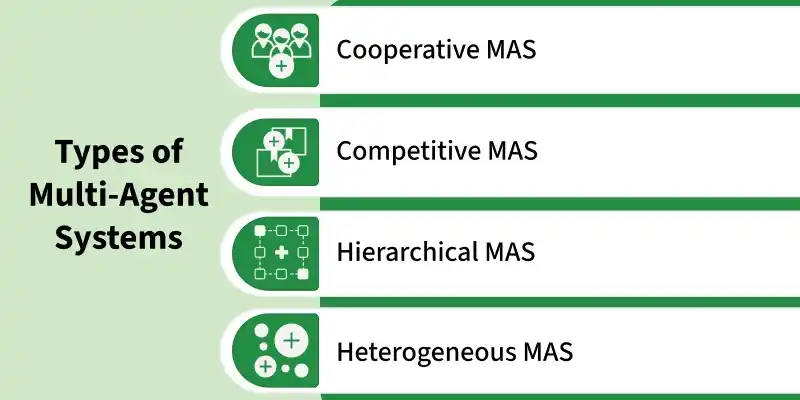
Types of Multi-Agent Systems
Let's see the types of Multi-Agent Systems:
**1. Cooperative MAS
- Agents in these systems work together to achieve a common goal.
- They share information and resources to do things that would be hard for a single agent.
- **Example: Multiple drones conducting a search-and-rescue mission.
**2. Competitive MAS
- Agents have conflicting goals and compete for limited resources.
- **Example: In competitive gaming, players (agents) compete to win.
**3. Hierarchical MAS
- These systems have a structured organization with agents at different levels.
- Higher-level agents manage and coordinate lower-level ones.
- **Example: Mission control systems in space exploration.
**4. Heterogeneous MAS
- In these systems, agents have different skills or roles which can make the system more flexible and adaptable.
- **Example: Mixed robot teams (flying drones + ground robots).
Structures of Multi-Agent Systems (MAS)
The structural organization of a Multi-Agent System defines how agents are arranged, how they cooperate or coordinate and how control or decision-making flows within the system. This structure greatly influences the system’s efficiency, responsiveness and scalability. The main MAS structures include:
**1. Flat Structure
In a flat MAS, all agents operate independently with equal status and none have authority over others. Agents communicate and interact as peers, collaborating or competing without any hierarchy. This structure promotes decentralization and flexibility, allowing agents to quickly adapt to changes.
- **Advantages: Simple to implement, robust since no single agent controls the system, avoids bottlenecks.
- **Typical Use: Peer-to-peer networks, swarm robotics, decentralized sensor networks.
**2. Hierarchical Structure
Agents are organized into multiple layers or levels, forming a clear chain of command. Higher-level agents act as supervisors or coordinators, managing and delegating tasks to lower-level agents which focus on execution. This structure helps enforce order, coordination and goal alignment.
- **Advantages: Efficient task delegation, easier management of complex systems, clear responsibility separation.
- **Typical Use: Industrial control systems organizational management in enterprises, military command systems.
**3. Holonic Structure
The holonic approach groups agents into holons (units) that are both autonomous agents themselves and parts of a higher-level agent. Each holon can act independently while also cooperating as part of a larger system. This structure supports modularity and scalability, as holons can be nested or reorganized dynamically.
- **Advantages: Flexible task allocation, supports complex systems with multiple levels of abstraction, resilient to failures.
- **Typical Use: Manufacturing systems, robot teams with sub-teams, complex adaptive systems.
**4. Organizational or Network Structure
Agents are organized into networks or coalitions based on task requirements or shared goals. Agents form clusters, teams or coalitions where they share resources and coordinate to complete specific tasks. Unlike strict hierarchies, authority may be distributed based on roles or situational needs.
- **Advantages: Dynamic team formations, efficient resource sharing, adaptable to varying task demands.
- **Typical Use: Collaborative problem solving, distributed sensor networks, multi-robot coordination in logistics.
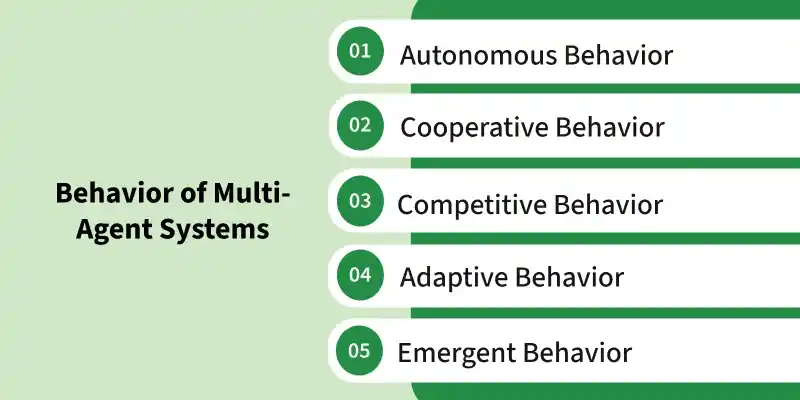
Behavior of Multi-Agent Systems
**1. Autonomous Behavior
- Agents act independently and make decisions based on their own knowledge and goals.
- No external control is needed for their actions.
**2. Cooperative Behavior
- Agents work together to achieve shared goals.
- They share information, divide tasks and coordinate efforts.
**3. Competitive Behavior
- Agents have conflicting goals and compete for limited resources.
- Decision-making involves strategy and anticipation of others actions.
**4. Adaptive Behavior
- Agents learn from experience and environmental feedback.
- They improve performance by updating strategies over time.
**5. Emergent Behavior
- Complex system-wide patterns emerge from simple local agent interactions.
- No central control like a swarm intelligence of ant colonies or bird flocking.
Applications
- **Robotics and Automation: Multiple robots cooperating in warehouses, rescue missions or exploration.
- **Smart Cities and Traffic Control: Intelligent traffic lights and vehicles coordinating to reduce congestion.
- **Economics and Trading: Autonomous trading agents in stock markets.
- **Healthcare: Coordinating hospitals, clinics and patients for resource optimization.
- **Gaming and Entertainment: Smarter NPCs and dynamic game environments.
- **Cybersecurity: Intrusion detection systems using distributed agents to monitor networks.
Advantages
- **Decentralization: No single point of failure hence becoming robust and resilient.
- **Scalability: New agents can be added without major redesign.
- **Flexibility: Handles dynamic and uncertain environments.
- **Efficiency: Workload can be distributed among multiple agents.
- **Emergent Intelligence: Complex behavior emerges from simple interaction rules.
Challenges
- **Coordination Complexity: Aligning actions of multiple agents is complex.
- **Communication Overhead: Inefficient communication may slow down the system.
- **Conflict Resolution: Agents with competing goals may reduce efficiency.
- **Scalability Issues: As the number of agents increases, managing them gets harder.
- **Security and Trust: Systems must defend against malicious or unreliable agents.