Named Entity Recognition with Hugging Face (original) (raw)
Last Updated : 14 Apr, 2026
Named Entity Recognition (NER) is an NLP task that identifies and classifies entities in text, such as people, organizations and locations. It helps systems automatically understand important information within sentences, even when language and context vary.
For example, in the sentence: Barack Obama was born in Hawaii and served as President of the United States.
NER identifies:
- **Barack Obama: Person
- **Hawaii: Location
- **United States: Location
Implementation of Named Entity Recognition
Run the following command in your command prompt to install required libraries
pip install transformers torch
1. Without Pipeline
Let's see the implementation of Named Entity Recognition using a BERT model without using the Hugging face transformer's pipeline API
Step 1: Import Required Classes
- **BertTokenizer: Converts text into tokens the model can understand
- **BertForTokenClassification: BERT model adapted for tasks like NER
- **torch: Handles tensor operations and model execution Python `
from transformers import BertTokenizer, BertForTokenClassification import torch
`
Step 2: Load Model and Tokenizer
- The tokenizer converts text into tokens
- The model predicts entity labels for each token Python `
model_name = "dslim/bert-base-NER"
tokenizer = BertTokenizer.from_pretrained(model_name) model = BertForTokenClassification.from_pretrained(model_name)
`
**Output:

Loading pretrained model
Step 3: Tokenize Input
This converts the sentence into tensors that the model can process, preparing it for entity prediction.
Python `
text = "Sundar Pichai is the CEO of Google and lives in California."
inputs = tokenizer( text, return_tensors="pt", truncation=True, padding=True )
`
Step 4: Run Model Inference
We use torch.no_grad() to disable gradient calculations because we are only performing inference, not training. This makes prediction faster and more memory efficient.
Python `
with torch.no_grad(): outputs = model(**inputs)
`
Step 5: Extract Predictions
- **logits: Raw scores output by the model for each token and each possible entity label
- **argmax: Selects the label with the highest score (most probable entity class) for each token Python `
logits = outputs.logits predictions = torch.argmax(logits, dim=2)
`
Step 6: Map Token IDs to Labels
- **convert_ids_to_tokens: Converts numeric token IDs back into readable tokens
- **id2label: Maps predicted label IDs to actual entity names (e.g., PER, ORG, LOC)
- The loop prints each token along with its predicted entity label Python `
tokens = tokenizer.convert_ids_to_tokens(inputs["input_ids"][0]) labels = [model.config.id2label[p.item()] for p in predictions[0]]
for token, label in zip(tokens, labels): print(token, "→", label)
`
**Output:
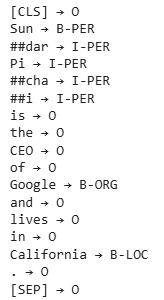
Output
2. With Pipeline
**Step 1: Import Required Libraries
Import the pipeline from Transformers, as it provides a high level interface that automatically manages tokenization, model loading, inference and output formatting in a single streamlined workflow.
Python `
from transformers import pipeline
`
**Step 2: Initialize NER Model
- **ner: Specifies token classification task
- **dslim/bert-base-NER: Pretrained BERT model for NER
- **aggregation_strategy="simple": Merges split tokens Python `
ner = pipeline( "ner", model="dslim/bert-base-NER", aggregation_strategy="simple"
)
`
**Output:

Pretrained model
**Step 3: Run NER
The pipeline processes the sentence, identifies named entities and returns them with their categories like Person, Organization, Location, etc. The loop simply prints each detected entity along with its label. The output shows the entities detected by the NER model:
- **GeeksforGeeks: ORG (Organization)
- **India: LOC (Location) Python `
text = "GeeksforGeeks was founded in India and is widely used by programming students."
entities = ner(text)
for entity in entities: print(f"{entity['word']} → {entity['entity_group']}")
`
**Output:
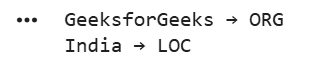
Output
We can see our model is working fine.
You can download the full code from here