RetrievalAugmented Prompting (original) (raw)
Retrieval-Augmented Prompting
Last Updated : 15 Apr, 2026
Retrieval Augmented Prompting (RAP) improves AI by enabling it to access external information along with its trained knowledge, resulting in more accurate, relevant and up to date responses.
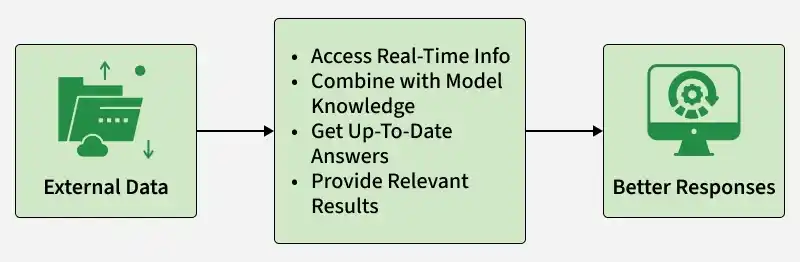
Retrieval Augmented Prompting
Its key aspects include:
- Retrieves external or dynamically available data to enhance responses.
- Improves accuracy by combining model knowledge with retrieved information.
- Supports tasks requiring up to date or domain specific data.
- Produces more relevant and context aware outputs.
Working of Retrieval Augmented Prompting
Retrieval Augmented Prompting works by combining external data retrieval with the model’s internal reasoning to generate more accurate and up to date responses.
**1. Querying External Information
AI is prompted to retrieve information from external databases, websites or knowledge graphs. This allows model to collect relevant, up to date data.
**Example: If AI is asked "_What are the latest advancements in quantum computing?" it can search for recent articles or research papers which ensures the response is up to date and informed by the latest findings.
**2. Combining Retrieved Data with Internal Reasoning
The AI combines retrieved external data with its internal knowledge to generate more accurate and context aware responses.
**Example: If the question focuses on new medical treatment, AI can see latest research from clinical trials and combine it with its existing knowledge of medical practices to provide a accurate, up to date answer.
Example of Retrieval Augmented Prompting
**Prompt: "What is the latest research on artificial intelligence applications in healthcare?"
**Without RAP (Internal Knowledge Only):
The model gives a general answer based only on its trained knowledge, such as AI being used in diagnosis, personalized medicine and drug discovery, but without recent updates.
**With RAP (Retrieving External Information):
- **Retrieves Latest Info: The model fetches recent research or articles from external sources.
- **Enhanced Response: Provides updated insights like early cancer detection using advanced imaging.
- **Adds New Information: Includes recent developments such as predicting patient deterioration using real time data.
Applications
- Supports healthcare by using latest medical research for better diagnostics and treatment insights.
- Enhances legal research by retrieving current laws and case data for accurate analysis.
- Improves customer support by accessing manuals, FAQs and user data in real time.
- Strengthens education by providing detailed explanations using updated learning resources.
Advantages
- Provides access to real time information, ensuring responses stay current and relevant.
- Expands knowledge by using external sources beyond the model’s training data.
- Improves accuracy by enhancing reasoning with additional context.
- Increases flexibility, allowing the model to adapt to new and complex tasks.
Challenges
- Relies on external data quality, so inaccurate or misleading sources can affect results.
- Increases computational load due to data retrieval and processing, which may slow performance or raise costs.
- Depends on availability of external sources and lack of relevant data can reduce effectiveness.