Semantic Kernel (original) (raw)
Last Updated : 22 Aug, 2025
Semantic Kernel (SK) is an open-source, lightweight SDK developed by Microsoft that acts as a powerful orchestration layer to build, deploy and manage intelligent AI applications and agents by integrating large language models (LLMs) with external code, memory, planning and plugins. It supports multiple programming languages, including C#, Python and Java, making it a versatile choice for enterprise-grade AI development.
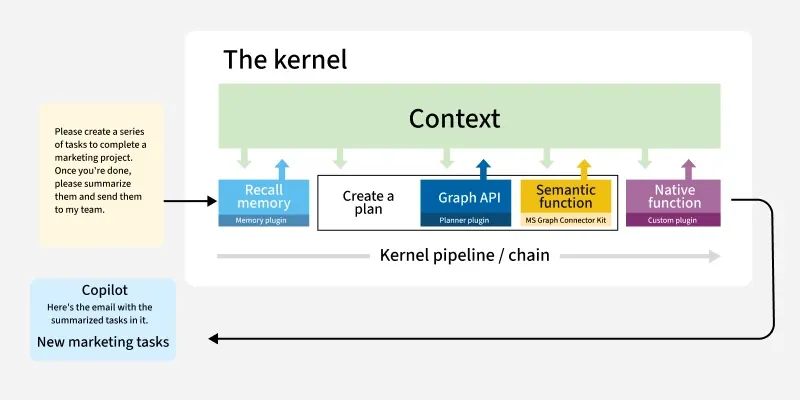
Semantic Kernel
Core Concepts and Architecture
1. The Kernel: The Central Orchestrator
TheSemantic Kernel lies in the Kernel the orchestrating container that manages all AI services, plugins and workflows within an application. It acts as a dependency injection container enabling seamless integration between LLM services, memory modules, plugins (or skills) and business logic.
When you invoke a task through the kernel:
- It selects the most suitable AI service (LLM) for the prompt.
- Constructs the prompt using templates and parameters.
- Sends the prompt to the AI service.
- Parses and returns the response.
- Throughout, it supports middleware hooks for logging, monitoring and responsible AI practices.
This centralized management simplifies complex AI app development by consolidating configuration and runtime control into one unified interface.
2. Plugins (Skills) and Functions: Modular AI Capabilities
In Semantic Kernel, **plugins are collections of functions packaged together to expose external APIs and capabilities to AI applications. These plugins enable AI models to interact with external systems, access data, trigger workflows or automate tasks that go beyond the model’s built-in capabilities. This concept is similar to plugins in ChatGPT or Copilot extensions in Microsoft 365, where external tools and services can be integrated with AI.
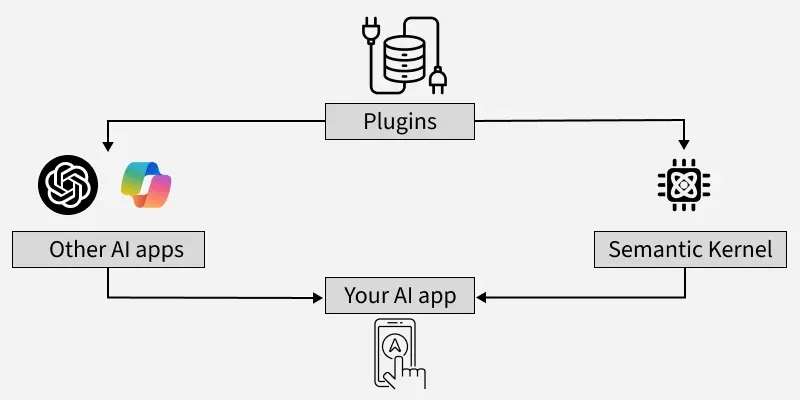
Plugins in Semantic Kernel
**Function calling is the mechanism that allows plugins to work. When an AI model recognizes the need for a specific function, it can request it by name. Semantic Kernel then routes this request to the corresponding function within the appropriate plugin. The results are returned to the language model to form part of the final response.
**Key aspects of plugins in Semantic Kernel:
- **Abstraction: Plugins group related functions, which may include native code implementations, prompts or both.
- **Capability extension: Plugins allow AI systems to access data, automate tasks and integrate with enterprise systems—features not available natively within the language model.
- **Reusability and orchestration: Functions in plugins can be invoked individually or orchestrated into sequences (plans) to complete complex tasks.
- **Integration options: Plugins can be created using native code, imported via OpenAPI specifications or developed with MCP Server for broader interoperability.
- **Enterprise compatibility: Standard software engineering practices, such as dependency injection, are supported, allowing for seamless integration with existing back-end services.
**Plugin usage in Semantic Kernel typically involves:
- Defining one or more functions within a plugin.
- Registering the plugin within the kernel.
- Enabling the language model, through prompts or plans, to invoke plugin functions via function calling.
Overall, plugins provide a flexible and structured way for AI-powered applications to connect with real-world systems, vastly expanding the scope of what they can achieve.
3. Memory: Context and Knowledge Retention
Memory is integral to SK for managing conversational context, agent state and knowledge across interactions.
Types of memory include:
- **Key-Value Memory: Stores simple contextual variables for reference.
- **Semantic Memory: Embedding-based stores that support similarity search over knowledgebases, documents or past conversations.
- **Persistence Stores: Memory can be local (in-memory or file-based) or cloud-backed for long-term retention.
This makes it possible to create AI agents that remember prior interactions or recall relevant external knowledge dynamically during dialogue or workflow execution.
4. Planning and Orchestration: Automating Complex Workflows
Semantic Kernel supports sophisticated planning through components that can automatically or manually generate plans sequences of function calls to solve complex high-level tasks.
- **Static Planning: Manually defined ordered steps.
- **LLM-driven Planning: LLMs dynamically decide which functions to invoke to fulfill goals.
- Support for multi-agent workflows where several agents collaborate, each specializing in subsets of tasks.
This flexibility allows developers to build AI systems that chain together APIs, semantic functions, native code and other services without hardcoding every step.
5. Multi-Agent Framework
SK enables creation and coordination of multiple AI agents that autonomously or cooperatively perform tasks.
Agents have:
- Distinct capabilities based on plugins (skills).
- Ability to communicate and share data.
- Human-in-the-loop interaction support.
- Task orchestration logic directing handoffs and collaboration among agents.
Applications include distributed AI workflows, automation pipelines, research assistants and more.
Practical Workflow Example
A typical usage flow in Semantic Kernel (Python) involves:
- **Create the kernel and add services : Register one or more LLMs (OpenAI, Azure OpenAI or others) to the kernel.
- **Define and add plugins : Add semantic functions (prompt templates) or native code plugins.
- **Configure memory : Optionally plug in semantic or key-value memory to maintain state.
- **Invoke plugins/functions : Call semantic or native functions via the kernel, optionally chaining or planning calls.
- **Implement multi-turn workflows : Leverage memory and planning modules to build conversational agents or multi-step processes.
Advanced Features and Use Cases
- **Observability: SK supports logging, telemetry and middleware hooks at various pipeline stages for monitoring and responsible AI.
- **Interoperability: Use OpenAPI specs for plugins to enable easy integration and API exposure.
- **Extensibility: Swap or add LLM providers without changing business logic.
- **Enterprise Ready: Security, versioning and stable APIs support production-grade deployments.
- **Multi-Modal and Multi-Agent Applications: SK is well suited for orchestrating agents that use vision, text, audio and execute complex domain workflows.